
Korean Circ J.
2015 Nov;45(6):516-521. 10.4070/kcj.2015.45.6.516.
T-Helper Cytokine Profiles in Patients with Kawasaki Disease
- Affiliations
-
- 1Department of Pediatrics, Kyungbook National University School of Medicine, Daegu, Korea.
- 2Department of Pediatrics, Yeungnam University College of Medicine, Daegu, Korea. yhlee3535@ynu.ac.kr
- 3Department of Microbiology, Yeungnam University College of Medicine, Daegu, Korea.
- KMID: 2223791
- DOI: http://doi.org/10.4070/kcj.2015.45.6.516
Abstract
- BACKGROUND AND OBJECTIVES
Kawasaki disease is an acute systemic vasculitis of which pathogenesis suspected is caused by immune dysregulation. The goal of this study is to evaluate the activation pattern of T helper cell type 1 (Th1) and T helper cell type 2 (Th2) in patients with Kawasaki disease.
SUBJECTS AND METHODS
Prospective study of 60 patients (male 36, female 24) with diagnosis of Kawasaki disease were enrolled. One hundred and eighty blood samples from these patients were collected according to the different clinical stages {before initial intravenous immunoglobulin (IVIG), 5 days after initial IVIG, 2 months after initial IVIG}. The plasma level of Th1 cytokines; interferon-gamma (IFN-gamma) & interleukin (IL)-2 and Th2 cytokines; IL-4 & IL-10 were measured by enzyme-liked immunosorbent assay.
RESULTS
In all patients, the plasma level of Th1 cytokines (IFN-gamma, IL-2) and Th2 cytokines (IL-4 and IL-10) were markedly elevated during the acute stage of Kawasaki disease. Since then, the plasma level of all these cytokines decreased significantly along with the process of clinical stages. Regardless of the existence of coronary artery lesion or no response to initial IVIG treatment, there were no significant differences between them.
CONCLUSION
These data suggest that both Th1 and Th2 cells may be activated simultaneously during the acute stage of Kawasaki disease. Further studies are therefore required to establish the difference of activation pattern of T helper cells between Kawasaki disease and other inflammatory diseases.
MeSH Terms
-
Coronary Vessels
Cytokines
Diagnosis
Female
Humans
Immunoglobulins
Immunoglobulins, Intravenous
Interferon-gamma
Interleukin-10
Interleukin-4
Interleukins
Mucocutaneous Lymph Node Syndrome*
Plasma
Prospective Studies
Systemic Vasculitis
T-Lymphocytes, Helper-Inducer
Th1-Th2 Balance
Th2 Cells
Cytokines
Immunoglobulins
Immunoglobulins, Intravenous
Interferon-gamma
Interleukin-10
Interleukin-4
Interleukins
Figure
-
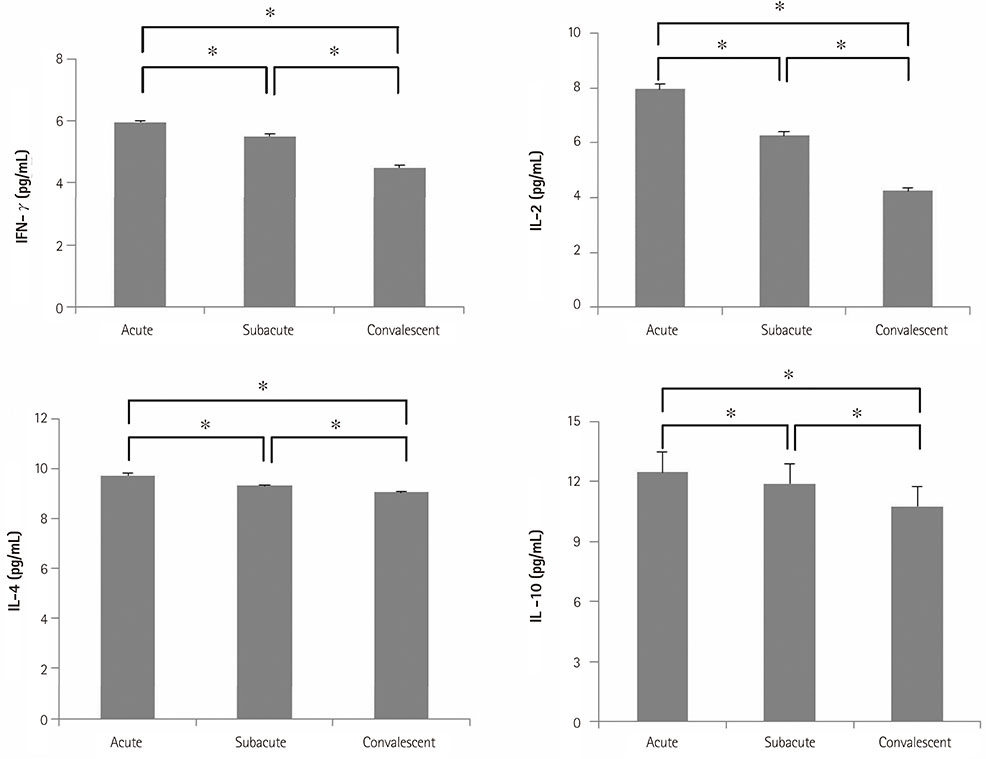
Fig. 1 The changes of plasma cytokines (IFN-γ, IL-2, IL-4, IL-10) level according to clinical stages in patients with Kawasaki disease. *p<0.001. IFN: interferon, IL: interleukin.
Reference
-
1. Kawasaki T. Acute febrile mucocutaneous syndrome with lymphoid involvement with specific desquamation of the fingers and toes in children. Arerugi. 1967; 16:178–222.2. Takahashi K, Oharaseki T, Yokouchi Y. Update on etio and immunopathogenesis of Kawasaki disease. Curr Opin Rheumatol. 2014; 26:31–36.3. Leung DY. Immunologic aspects of Kawasaki syndrome. J Rheumatol Suppl. 1990; 24:15–18.4. de Inocencio J, Hirsch R. The role of T cells in Kawasaki disease. Crit Rev Immunol. 1995; 15:349–357.5. Jason J, Gregg L, Han A, et al. Immunoregulatory changes in Kawasaki disease. Clin Immunol Immunopathol. 1997; 84:296–306.6. Brogan PA, Shah V, Clarke LA, Dillon MJ, Klein N. T cell activation profiles in Kawasaki disease. Clin Exp Immunol. 2008; 151:267–274.7. Matsubara T, Katayama K, Matsuoka T, Fujiwara M, Koga M, Furukawa S. Decreased interferon-gamma(IFN-gamma)-producing T cells in patients with acute Kawasaki disease. Clin Exp Immunol. 1999; 116:554–557.8. Liew WK, Lim CW, Tan TH, et al. The effect of Kawasaki disease on childhood allergies - a sibling control study. Pediatr Allergy Immunol. 2011; 22:488–493.9. Matsuoka S, Tatara K, Nakagawa R, Mori K, Kuroda Y. Tendency toward atopy in Kawasaki disease. Eur J Pediatr. 1997; 156:30–32.10. Kimura J, Takada H, Nomura A, et al. Th1 and Th2 cytokine production is suppressed at the level of transcription regulation in Kawasaki disease. Clin Exp Immunol. 2004; 137:444–449.11. Kuo HC, Wang CL, Liang CD, et al. Association of lower eosinophil-related T helper 2 (Th2) cytokines with coronary artery lesions in Kawasaki disease. Pediatr Allergy Immunol. 2009; 20:266–272.12. Newburger JW, Takahashi M, Gerber MA, et al. Diagnosis, treatment, and long-term management of Kawasaki disease: a statement for health professionals from the Committee on Rheumatic Fever, Endocarditis and Kawasaki Disease, Council on Cardiovascular Disease in the Young, American Heart Association. Circulation. 2004; 110:2747–2771.13. Japan Kawasaki Disease Research Committee. Report of subcommittee on standardization of diagnostic criteria and reporting of coronary artery lesions in Kawasaki disease. Tokyo: Ministry of Health and Welfare;1984.14. Jia S, Li C, Wang G, Yang J, Zu Y. The T helper type 17/regulatory T cell imbalance in patients with acute Kawasaki disease. Clin Exp Immunol. 2010; 162:131–137.15. Wang Y, Wang W, Gong F, et al. Evaluation of intravenous immunoglobulin resistance and coronary artery lesions in relation to Th1/Th2 cytokine profiles in patients with Kawasaki disease. Arthritis Rheum. 2013; 65:805–814.16. Strachan DP. Hay fever, hygiene, and household size. BMJ. 1989; 299:1259–1260.17. Okada H, Kuhn C, Feillet H, Bach JF. The 'hygiene hypothesis' for autoimmune and allergic disease: an update. Clin Exp Immunol. 2010; 160:1–9.18. Del Prete G. The concept of type-1 and type-2 helper T cells and their cytokines in humans. Int Rev Immunol. 1998; 16:427–455.19. Mosmann TR, Cherwinski H, Bond MW, Giedlin MA, Coffman RL. Two types of murine helper T cell clone. I. Definition according to profiles of lymphokine activities and secreted proteins. J Immunol. 1986; 136:2348–2357.20. Bertotto A, Spinozzi F, Vagliasindi C, Radicioni M, De Rosa O, Vaccaro R. Tuberculin skin test reactivity in Kawasaki disease. Pediatr Res. 1997; 41(4 Pt 1):560–562.21. Sinha R, Balakumar T. BCG reactivation: a useful diagnostic tool even for incomplete Kawasaki disease. Arch Dis Child. 2005; 90:891.22. Shirakawa T, Enomoto T, Shimazu S, Hopkin JM. The inverse association between tuberculin responses and atopic disorder. Science. 1997; 275:77–79.23. Brosius CL, Newburger JW, Burns JC, Hojnowski-Diaz P, Zierler S, Leung DY. Increased prevalence of atopic dermatitis in Kawasaki disease. Pediatr Infect Dis J. 1988; 7:863–866.24. Kuo HC, Chang WC, Yang KD, et al. Kawasaki disease and subsequent risk of allergic disease: a population-based matched cohort study. BMC Pediatr. 2013; 13:38.


