
Korean J Lab Med.
2006 Jun;26(3):223-226. 10.3343/kjlm.2006.26.3.223.
A Case of Acute Lymphoblastic Leukemia with ider(9)(q10)t(9;22)(q34;q11.2)
- Affiliations
-
- 1Department of Laboratory Medicine, Ewha Womans University, College of Medicine, Seoul, Korea. JungWonH@ewha.ac.kr
- KMID: 2238891
- DOI: http://doi.org/10.3343/kjlm.2006.26.3.223
Abstract
- ider(9)(q10)t(9;22)(q34;q11.2) is an isochromosome for the long arm of a derivative chromosome 9 generated by a t(9;22), resulting from the deletion of the short arm of chromosome 9. It is known to be rarely observed in acute lymphoblastic leukemia (ALL) or lymphoblastic crisis transformed from chronic myelogenous leukemia. We herein describe a 26-year-old female patient with precursor B-cell ALL, cytogenetically characterized by ider(9)(q10)t(9;22). Fluorescence in situ hybridization analysis showed two ABL-BCR fusion signals on the derivative chromosome 9 and one BCR-ABL fusion signal on the derivative chromosome 22. Although a t(9;22) and a deletion of the short arm of chromosome 9 are known to be associated with a poor prognostic factor in acute lymphoblastic leukemia, a larger study is needed to determine the prognosis of ider(9)(q10)t(9;22) cases.
Keyword
MeSH Terms
Figure
-
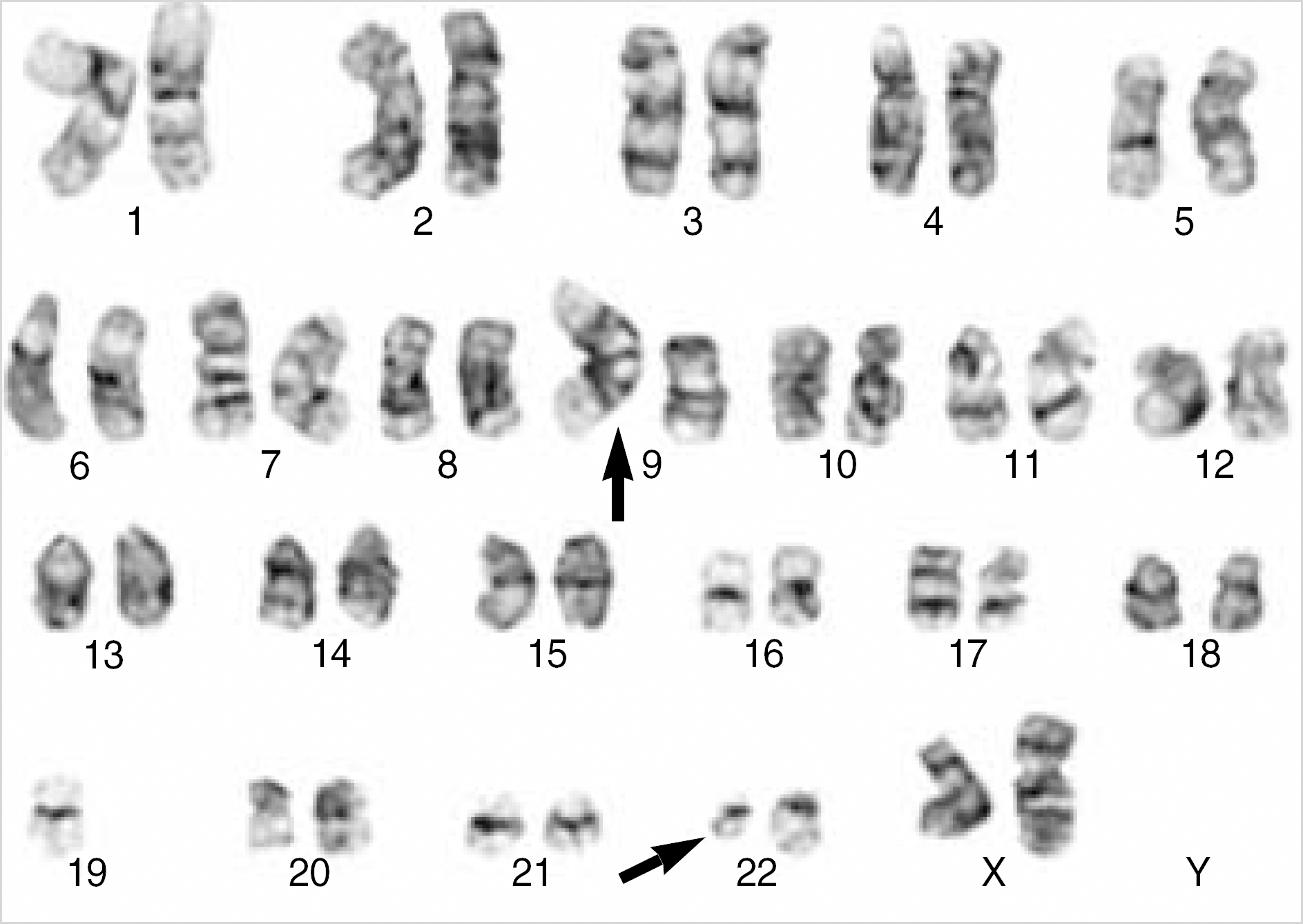
Fig. 1. G-banded karyotype, demonstrating ider(9)(q10)t(9;22) (q34;q11.2) and der(22)t(9;22) (arrows).
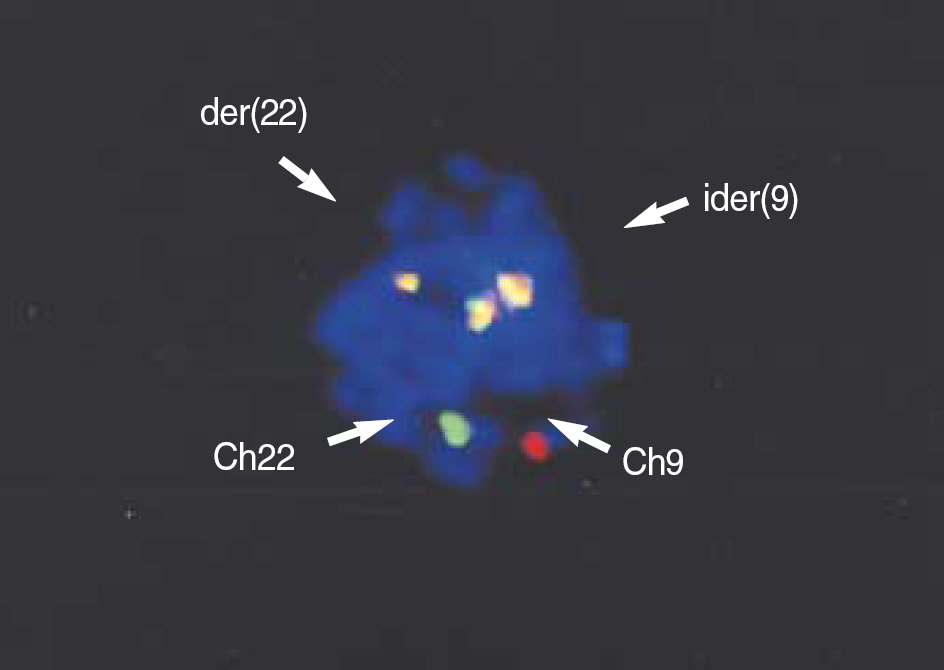
Fig. 2. FISH with BCR/ABL probe. One red and one green signals are present on the normal chromosome 9 and 22, respectively. One yellow fusion signal is present on der(22)t(9;22). Two yellow fusion signals are present on ider(9)(q10)t(9;22).
Cited by 1 articles
-
A Case of Adult B Lymphoblastic Leukemia with ider(9)(q10)t(9;22)(q34;q11.2) and der(19)t(1;19)(q23;p13.3)
Soon Il Jung, Hee Soon Cho, Chae Hoon Lee, Bo-Chan Jung
Korean J Lab Med. 2010;30(6):585-590. doi: 10.3343/kjlm.2010.30.6.585.
Reference
-
References
1. Kurzrock R, Kantarjian HM, Druker BJ, Talpaz M. Philadelphia chromosome-positive leukemias: from basic mechanisms to molecular therapeutics. Ann Intern Med. 2003; 138:819–30.
Article2. Dierlamm J, Michaux L, Kroger N, Wlodarska I, Martiat P, Zeller W, et al. ider(9)(q10)t(9;22)(q34;q11) is a recurrent chromosomal abnormality in acute lymphoblastic leukemia and lymphatic blastic phase of chronic myelogenous leukemia. Cancer Genet Cytogenet. 1996; 89:109–13.
Article3. Diez-Martin JL, Dewald GW, Pierre RV. Possible cytogenetic distinction between lymphoid and myeloid blast crisis in chronic granulocytic leukemia. Am J Hematol. 1988; 27:194–203.
Article4. Chan LC, Kwong YL, Liu HW, Chan TK, Todd D, Ching LM. Cytogenetic analysis of hematologic malignancies in Hong Kong. A study of 98 cases. Cancer Genet Cytogenet. 1992; 62:154–9.5. Sessarego M, Defferrari R, Fugazza G, Comelli A, Salvidio E, Ajmar F. Involvement of the short arm of the derivative chromosome 9 in Philadelphia-positive acute lymphoblastic leukemia. Cancer Genet Cytogenet. 1991; 52:43–9.
Article6. Heerema NA, Palmer CG, Weetman R, Bertolone S. Cytogenetic analysis in relapsed childhood acute lymphoblastic leukemia. Leukemia. 1992; 6:185–92.7. Choi GJ, Jeon DS, Chun HJ, Kim JR, Song HS, Lee JW. ider(9)(q10) (q34;q11.2) as secondary karyotypic aberration of chronic myeloid leukemia. Korean J Clin Pathol. 1999; 19:266–70.8. Rieder H, Ludwig WD, Gassmann W, Maurer J, Janssen JW, Gokbuget N, et al. Prognostic significance of additional chromosome abnormalities in adult patients with Philadelphia chromosome positive acute lymphoblastic leukaemia. Br J Haematol. 1996; 95:678–91.
Article9. Shaffer LG, Tommerup N, editors. An Internationa System for Human Cytogenetic Nomenclature. Basel: S. Karger;2005.10. Heerema NA, Harbott J, Galimberti S, Camitta BM, Gaynon PS, Janka-Schaub G, et al. Secondary cytogenetic aberrations in childhood Philadelphia chromosome positive acute lymphoblastic leukemia are nonrandom and may be associated with outcome. Leukemia. 2004; 18:693–702.
Article11. Wetzler M, Dodge RK, Mrozek K, Stewart CC, Carroll AJ, Tantravahi R, et al. Additional cytogenetic abnormalities in adults with Philadelphia chromosome-positive acute lymphoblastic leukaemia: a study of the Cancer and Leukaemia Group B. Br J Haematol. 2004; 124:275–88.12. Bacher U, Haferlach T, Hiddemann W, Schnittger S, Kern W, Schoch C. Additional clonal abnormalities in Philadelphia-positive ALL and CML demonstrate a different cytogenetic pattern at diagnosis and follow different pathways at progression. Cancer Genet Cytoget. 2005; 157:53–61.
Article13. Faderl S, Estrov Z, Kantarjian HM, Thomas D, Cortes J, Manshouri T, et al. The incidence of chromosome 9p21 abnormalities and deletions of tumor suppressor genes p15(INK4b)/p16(INK4a)/p14(ARF) in patients with acute lymphoblastic leukemia. Cytokines Cell Mol Ther. 1999; 5:159–63.14. Leblanc T, Derre J, Flexor M, Le Coniat M, Leroux D, Rimokh R, et al. FISH analysis of translocations involving the short arm of chromosome 9 in lymphoid malignancies. Genes Chromosomes Cancer. 1997; 19:273–7.
Article15. Gadzicki D, von Neuhoff N, Steinemann D, Just M, Busche G, Kreipe H, et al. BCR-ABL gene amplification and overexpression in a patient with chronic myeloid leukemia treated with imatinib. Cancer Genet Cytogenet. 2005; 159:164–7.
Article16. Gargallo PM, Cuello MT, Aranguren PN, Larripa IB. Amplification of the BCR/ABL fusion gene clustered on a masked Philadelphia chromosome in a patient with myeloblastic crisis of chronic myelocytic leukemia. Cancer Genet Cytogenet. 2003; 143:140–4.
Article17. Bernasconi P, Calatroni S, Giardini I, Inzoli A, Castagnola C, Cavigliano PM, et al. ABL1 amplification in T-cell acute lymphoblastic leukemia. Cancer Genet Cytogenet. 2005; 162:146–50.
Article18. Kim HJ, Woo HY, Koo HH, Tak EY, Kim SH. ABL oncogene amplification with p16(INK4a) gene deletion in precursor T-cell acute lymphoblastic leukemia/lymphoma: report of the first case. Am J Hematol. 2004; 76:360–3.
- Full Text Links
-
- Actions
-
Cited
- CITED
-
- Close
- Share
-
- Similar articles
-
- ider (9) (q10)t (9;22) (q34;q11.2) as Secondary Karyotypic Aberration of Chronic Myelogeous Leukemia
- A Case of Chronic Myelogenous Leukemia with ider(22)(q10)t(9;22)(q34;q11.2) as Clonal Evolution
- A Case of Adult B Lymphoblastic Leukemia with ider(9)(q10)t(9;22)(q34;q11.2) and der(19)t(1;19)(q23;p13.3)
- A Case of B-cell Precursor Acute Lymphoblastic Leukemia with the t(14;22)(q32;q11) Presenting Hyperleukocytosis
- A Rare Case of Microgranular Acute Promyelocytic Leukemia Associated with ider(17)(q10)t(15;17) in an Old-age Patient


