A retrospective analysis of 20-year data of the surgical management of ulcerative colitis patients in Taiwan: a study of Taiwan Society of Inflammatory Bowel Disease
- Affiliations
-
- 1Division of Colon and Rectal Surgery, Department of Surgery, Taipei Veterans General Hospital and Department of Surgery, National Yang-Ming University, Taipei, Taiwan. jklin@vghtpe.gov.tw
- 2Department of Internal Medicine, National Taiwan University Hospital, Taipei, Taiwan.
- 3Division of Colon and Rectal Surgery, Department of Surgery, National Taiwan University Hospital, Taipei, Taiwan.
- 4Division of Colorectal Surgery, Chang Gung Memorial Hospital at Linkou, Taoyuan, Taiwan.
- 5Division of Colon and Rectal Surgery, Department of Surgery, Mackay Memorial Hospital, Taipei, Taiwan.
- 6Department of Internal Medicine, Mackay Memorial Hospital, Taipei, Taiwan.
- 7Division of Gastroenterology, Department of Internal Medicine, Tri-Service General Hospital, National Defense Medical Center, Taipei, Taiwan.
- 8Division of Colorectal Surgery, Department of Surgery, Taichung Veterans General Hospital, Taichung, Taiwan.
- KMID: 2354967
- DOI: http://doi.org/10.5217/ir.2016.14.3.248
Abstract
- BACKGROUND/AIMS
With the recent progress in medical treatment, surgery still plays a necessary and important role in treating ulcerative colitis (UC) patients. In this study, we analyzed the surgical results and outcomes of UC in Taiwan in the recent 20 years, via a multi-center study through the collaboration of Taiwan Society of IBD.
METHODS
A retrospective analysis of surgery data of UC patients from January 1, 1995, through December 31, 2014, in 6 Taiwan major medical centers was conducted. The patients' demographic data, indications for surgery, and outcome details were recorded and analyzed.
RESULTS
The data of 87 UC patients who received surgical treatment were recorded. The median post-operative follow-up duration was 51.1 months and ranged from 0.4 to 300 months. The mean age at UC diagnosis was 45.3±16.0 years and that at operation was 48.5±15.2 years. The 3 leading indications for surgical intervention were uncontrolled bleeding (16.1%), perforation (13.8%), and intractability (12.6%). In total, 27.6% of surgeries were performed in an emergency setting. Total or subtotal colectomy with rectal preservation (41.4%) was the most common operation. There were 6 mortalities, all due to sepsis. Emergency operation and low pre-operative albumin level were significantly associated with poor survival (P=0.013 and 0.034, respectively).
CONCLUSIONS
In the past 20 years, there was no significant change in the indications for surgery in UC patients. Emergency surgeries and low pre-operative albumin level were associated with poor survival. Therefore, an optimal timing of elective surgery for people with poorly controlled UC is paramount.
Keyword
MeSH Terms
Figure
-
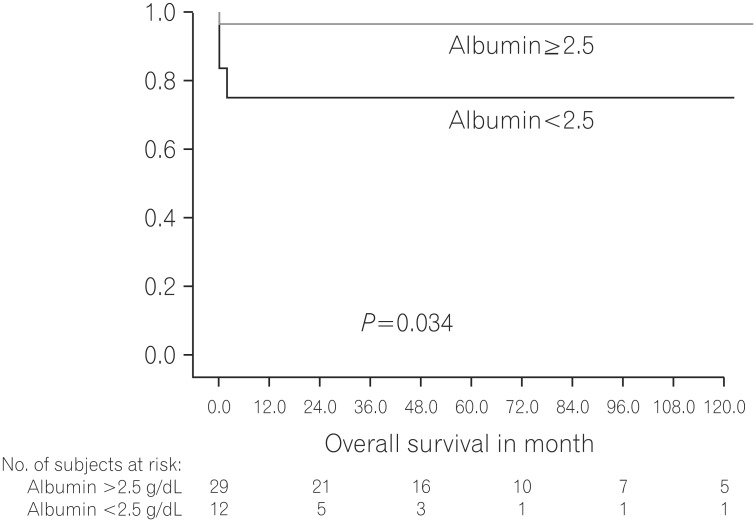
Fig. 1 The patient overall survival depends on albumin level. Patients with a pre-operative albumin level ≥2.5 g/dL had a significant better survival rate than patients with an albumin level <2.5 g/dL.
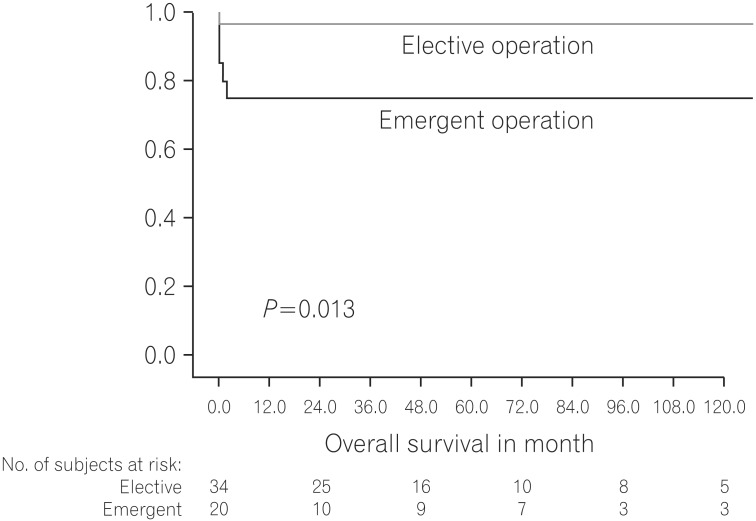
Fig. 2 The patient overall survival depends on elective or emergency surgery. Patients who underwent elective surgery had a significantly better survival rate than patients who underwent emergency surgery.
Cited by 1 articles
-
Management of ulcerative colitis in Taiwan: consensus guideline of the Taiwan Society of Inflammatory Bowel Disease updated in 2023
Hsu-Heng Yen, Jia-Feng Wu, Horng-Yuan Wang, Ting-An Chang, Chung-Hsin Chang, Chen-Wang Chang, Te-Hsin Chao, Jen-Wei Chou, Yenn-Hwei Chou, Chiao-Hsiung Chuang, Wen-Hung Hsu, Tzu-Chi Hsu, Tien-Yu Huang, Tsung-I Hung, Puo-Hsien Le, Chun-Che Lin, Chun-Chi Lin, Ching-Pin Lin, Jen-Kou Lin, Wei-Chen Lin, Yen-Hsuan Ni, Ming-Jium Shieh, I-Lun Shih, Chia-Tung Shun, Tzung-Jiun Tsai, Cheng-Yi Wang, Meng-Tzu Weng, Jau-Min Wong, Deng-Chyang Wu, Shu-Chen Wei
Intest Res. 2024;22(3):213-249. doi: 10.5217/ir.2023.00050.
Reference
-
1. Wilks S. Morbid appearances in the intestines of Miss Banks. Med Times Gazette. 1859; 2:264–265.2. Loftus EV Jr. Clinical epidemiology of inflammatory bowel disease: Incidence, prevalence, and environmental influences. Gastroenterology. 2004; 126:1504–1517. PMID: 15168363.
Article3. Kornbluth A, Sachar DB. Practice Parameters Committee of the American College of Gastroenterology. Ulcerative colitis practice guidelines in adults: American College Of Gastroenterology, Practice Parameters Committee. Am J Gastroenterol. 2010; 105:501–523. PMID: 20068560.
Article4. Sandborn WJ, Hanauer SB. Systematic review: the pharmacokinetic profiles of oral mesalazine formulations and mesalazine pro-drugs used in the management of ulcerative colitis. Aliment Pharmacol Ther. 2003; 17:29–42. PMID: 12492730.
Article5. Desreumaux P, Ghosh S. Review article: mode of action and delivery of 5-aminosalicylic acid - new evidence. Aliment Pharmacol Ther. 2006; 24(Suppl 1):2–9. PMID: 16939423.
Article6. Ho GT, Chiam P, Drummond H, Loane J, Arnott ID, Satsangi J. The efficacy of corticosteroid therapy in inflammatory bowel disease: analysis of a 5-year UK inception cohort. Aliment Pharmacol Ther. 2006; 24:319–330. PMID: 16842459.
Article7. Dignass A, Lindsay JO, Sturm A, et al. Second European evidence-based consensus on the diagnosis and management of ulcerative colitis part 2: current management. J Crohns Colitis. 2012; 6:991–1030. PMID: 23040451.
Article8. Cohen RD, Stein R, Hanauer SB. Intravenous cyclosporin in ulcerative colitis: a five-year experience. Am J Gastroenterol. 1999; 94:1587–1592. PMID: 10364029.
Article9. Rutgeerts P, Sandborn WJ, Feagan BG, et al. Infliximab for induction and maintenance therapy for ulcerative colitis. N Engl J Med. 2005; 353:2462–2476. PMID: 16339095.
Article10. Bach SP, Mortensen NJ. Ileal pouch surgery for ulcerative colitis. World J Gastroenterol. 2007; 13:3288–3300. PMID: 17659667.
Article11. Bernstein CN, Ng SC, Lakatos PL, et al. A review of mortality and surgery in ulcerative colitis: milestones of the seriousness of the disease. Inflamm Bowel Dis. 2013; 19:2001–2010. PMID: 23624887.12. Jiang L, Xia B, Li J, et al. Retrospective survey of 452 patients with inflammatory bowel disease in Wuhan city, central China. Inflamm Bowel Dis. 2006; 12:212–217. PMID: 16534423.
Article13. Hiwatashi N, Yao T, Watanabe H, et al. Long-term follow-up study of ulcerative colitis in Japan. J Gastroenterol. 1995; 30(Suppl 8):13–16. PMID: 8563875.14. Park SH, Kim YM, Yang SK, et al. Clinical features and natural history of ulcerative colitis in Korea. Inflamm Bowel Dis. 2007; 13:278–283. PMID: 17206722.
Article15. Wang Y, Ouyang Q. APDW 2004 Chinese IBD working group. Ulcerative colitis in China: retrospective analysis of 3100 hospitalized patients. J Gastroenterol Hepatol. 2007; 22:1450–1455. PMID: 17716349.
Article16. Lee HS, Park SH, Yang SK, et al. Long-term prognosis of ulcerative colitis and its temporal change between 1977 and 2013: a hospital-based cohort study from Korea. J Crohns Colitis. 2015; 9:147–155. PMID: 25518059.
Article17. Lee HS, Yang SK, Soh JS, et al. Short- and long-term outcomes of acute severe ulcerative colitis in Korea: the 1999-2005 cohort. Inflamm Bowel Dis. 2015; 21:1825–1831. PMID: 25985248.
Article18. Pal S, Sahni P, Pande GK, Acharya SK, Chattopadhyay TK. Outcome following emergency surgery for refractory severe ulcerative colitis in a tertiary care centre in India. BMC Gastroenterol. 2005; 5:39. PMID: 16316474.
Article20. Meagher AP, Farouk R, Dozois RR, Kelly KA, Pemberton JH. J ileal pouch-anal anastomosis for chronic ulcerative colitis: complications and long-term outcome in 1310 patients. Br J Surg. 1998; 85:800–803. PMID: 9667712.
Article21. Michelassi F, Lee J, Rubin M, et al. Long-term functional results after ileal pouch anal restorative proctocolectomy for ulcerative colitis: a prospective observational study. Ann Surg. 2003; 238:433–441. PMID: 14501509.22. Carter FM, McLeod RS, Cohen Z. Subtotal colectomy for ulcerative colitis: complications related to the rectal remnant. Dis Colon Rectum. 1991; 34:1005–1009. PMID: 1935463.23. Hyman NH, Cataldo P, Osler T. Urgent subtotal colectomy for severe inflammatory bowel disease. Dis Colon Rectum. 2005; 48:70–73. PMID: 15690660.
Article24. Ikeuchi H, Uchino M, Matsuoka H, et al. Surgery for ulcerative colitis in 1,000 patients. Int J Colorectal Dis. 2010; 25:959–965. PMID: 20217422.
Article25. Tøttrup A, Erichsen R, Sværke C, Laurberg S, Srensen HT. Thirty-day mortality after elective and emergency total colectomy in Danish patients with inflammatory bowel disease: a population-based nationwide cohort study. BMJ Open. 2012; 2:e000823. 10.1136/bmjopen-2012-000823.
Article26. Kaplan GG, McCarthy EP, Ayanian JZ, Korzenik J, Hodin R, Sands BE. Impact of hospital volume on postoperative morbidity and mortality following a colectomy for ulcerative colitis. Gastroenterology. 2008; 134:680–687. PMID: 18242604.
Article27. Ooi CJ, Fock KM, Makharia GK, et al. The Asia-Pacific consensus on ulcerative colitis. J Gastroenterol Hepatol. 2010; 25:453–468. PMID: 20370724.
Article28. Silverberg MS, Satsangi J, Ahmad T, et al. Toward an integrated clinical, molecular and serological classification of inflammatory bowel disease: report of a Working Party of the 2005 Montreal World Congress of Gastroenterology. Can J Gastroenterol. 2005; 19(Suppl A):5A–36A.
Article29. Jones JH, Chapman M. Definition of megacolon in colitis. Gut. 1969; 10:562–564. PMID: 5806937.
Article30. Truelove SC, Witts LJ. Cortisone in ulcerative colitis; final report on a therapeutic trial. Br Med J. 1955; 2:1041–1048. PMID: 13260656.31. Dignass A, Eliakim R, Magro F, et al. Second European evidence-based consensus on the diagnosis and management of ulcerative colitis part 1: definitions and diagnosis. J Crohns Colitis. 2012; 6:965–990. PMID: 23040452.
Article32. Ross H, Steele SR, Varma M, et al. Practice parameters for the surgical treatment of ulcerative colitis. Dis Colon Rectum. 2014; 57:5–22. PMID: 24316941.
Article33. Mowat C, Cole A, Windsor A, et al. Guidelines for the management of inflammatory bowel disease in adults. Gut. 2011; 60:571–607. PMID: 21464096.
Article34. Roberts SE, Williams JG, Yeates D, Goldacre MJ. Mortality in patients with and without colectomy admitted to hospital for ulcerative colitis and Crohn's disease: record linkage studies. BMJ. 2007; 335:1033. 10.1136/bmj.39345.714039.55. PMID: 17977817.
Article35. Nicholls RJ, Clark DN, Kelso L, et al. Nationwide linkage analysis in Scotland implicates age as the critical overall determinant of mortality in ulcerative colitis. Aliment Pharmacol Ther. 2010; 31:1310–1321. PMID: 20236256.
Article36. de Silva S, Ma C, Proulx MC, et al. Postoperative complications and mortality following colectomy for ulcerative colitis. Clin Gastroenterol Hepatol. 2011; 9:972–980. PMID: 21806954.
Article37. Nguyen GC, Laveist TA, Gearhart S, Bayless TM, Brant SR. Racial and geographic variations in colectomy rates among hospitalized ulcerative colitis patients. Clin Gastroenterol Hepatol. 2006; 4:1507–1513. PMID: 17162242.
Article38. Deepak P, Hanson GJ, Fletcher JG, et al. Incremental diagnostic yield of chromoendoscopy and outcomes in inflammatory bowel disease patients with a history of colorectal dysplasia on white-light endoscopy. Gastrointest Endosc. 2016; 83:1005–1012. PMID: 26408903.
Article39. Parks AG, Nicholls RJ. Proctocolectomy without ileostomy for ulcerative colitis. Br Med J. 1978; 2:85–88. PMID: 667572.
Article40. Utsunomiya J, Iwama T, Imajo M, et al. Total colectomy, mucosal proctectomy, and ileoanal anastomosis. Dis Colon Rectum. 1980; 23:459–466. PMID: 6777128.
Article41. Alves A, Panis Y, Bouhnik Y, Maylin V, Lavergne-Slove A, Valleur P. Subtotal colectomy for severe acute colitis: a 20-year experience of a tertiary care center with an aggressive and early surgical policy. J Am Coll Surg. 2003; 197:379–385. PMID: 12946792.
Article42. Fazio VW, Kiran RP, Remzi FH, et al. Ileal pouch anal anastomosis: analysis of outcome and quality of life in 3707 patients. Ann Surg. 2013; 257:679–685. PMID: 23299522.43. Dayton MT, Larsen KR, Christiansen DD. Similar functional results and complications after ileal pouch-anal anastomosis in patients with indeterminate vs ulcerative colitis. Arch Surg. 2002; 137:690–694. PMID: 12049540.
Article44. Leowardi C, Hinz U, Tariverdian M, et al. Long-term outcome 10 years or more after restorative proctocolectomy and ileal pouch-anal anastomosis in patients with ulcerative colitis. Langenbecks Arch Surg. 2010; 395:49–56. PMID: 19280217.
Article45. Filippi J, Allen PB, Hébuterne X, Peyrin-Biroulet L. Does anti-TNF therapy reduce the requirement for surgery in ulcerative colitis? A systematic review. Curr Drug Targets. 2011; 12:1440–1447. PMID: 21466486.
Article46. Aratari A, Papi C, Clemente V, et al. Colectomy rate in acute severe ulcerative colitis in the infliximab era. Dig Liver Dis. 2008; 40:821–826. PMID: 18472316.
Article47. Moore SE, McGrail KM, Peterson S, et al. Infliximab in ulcerative colitis: the impact of preoperative treatment on rates of colectomy and prescribing practices in the province of British Columbia, Canada. Dis Colon Rectum. 2014; 57:83–90. PMID: 24316950.
- Full Text Links
-
- Actions
-
Cited
- CITED
-
- Close
- Share
-
- Similar articles
-
- Chemoprevention of Colitis-Associated Dysplasia or Cancer in Inflammatory Bowel Disease
- Epidemiological trend in inflammatory bowel disease in Taiwan from 2001 to 2015: a nationwide populationbased study
- Therapeutic Drug Monitoring of Biologics for Patients with Inflammatory Bowel Diseases: How, When, and for Whom?
- Balloon-Assisted Enteroscopy and Capsule Endoscopy in Suspected Small Bowel Crohn's Disease
- Association of young age and male sex with primary sclerosing cholangitis in Taiwanese patients with inflammatory bowel disease