
Yonsei Med J.
2015 Nov;56(6):1497-1502. 10.3349/ymj.2015.56.6.1497.
The Prognostic Impact of Heat Shock Proteins Expression in Patients with Esophageal Cancer: A Meta-Analysis
- Affiliations
-
- 1Department of Medical Oncology, Huai'an First People's Hospital, Nanjing Medical University, Huai'an, Jiangsu, Korea.
- 2Department of Laboratory Medicine, Yancheng First People's Hospital, Yancheng, Jiangsu, Korea.
- 3Department of Surgical Oncology, Nanjing First Hospital, Nanjing Medical University, Nanjing, Jiangsu, P.R. China. cxf551101@sina.com
- KMID: 2345875
- DOI: http://doi.org/10.3349/ymj.2015.56.6.1497
Abstract
- PURPOSE
Heat shock proteins (HSPs) are highly conserved molecular chaperones. There are various studies that assess the prognostic value of HSPs in patients with esophageal cancer, but the conclusion remains controversial. This is the first meta-analysis study aiming to summarize the evidence on the suitability of HSPs to predict patients' survival.
MATERIALS AND METHODS
Searching PubMed, Web of science and Medline until May 31, 2014, data were compared for overall survival in patients with down-regulated HSPs level with those with up-regulated level. We conducted a meta-analysis of 9 studies (801 patients) that correlated HSPs levels with overall survival. Data were synthesized with hazard ratios (HRs).
RESULTS
The estimated risk of death was 2.93-fold greater in HSP27 negative patients than HSP27 positive patients [95% confidence interval (CI), 1.12-7.62]. When limited to esophageal squamous cell carcinoma (ESCC), the risk of death in HSP27 negative patients seemed more significant (HR, 3.90; 95% CI, 2.35-6.49). Decreased expression of HSP70 was also associated with worse survival in esophageal cancer (HR, 2.83; 95% CI, 1.90-4.23) and, when limited to ESCC, HR was 3.21 (95% CI, 1.94-5.30). Data collected, however, were not sufficient to determine the prognostic value of HSP90 in patients with ESCC nor esophageal adenocarcinomas (EADC).
CONCLUSION
In this meta-analysis, reduced HSP27 and HSP70 expressions were associated with poor survival in patients with esophageal cancer, especially esophageal squamous cell carcinoma.
Keyword
MeSH Terms
-
Adenocarcinoma/*diagnosis/*metabolism/mortality
Carcinoma, Squamous Cell/diagnosis/*metabolism/therapy
Esophageal Neoplasms/*diagnosis/*metabolism/mortality/therapy
Gene Expression Regulation, Neoplastic
HSP27 Heat-Shock Proteins
HSP70 Heat-Shock Proteins
HSP90 Heat-Shock Proteins
Heat-Shock Proteins/*metabolism
Humans
Male
Neoplasm Proteins
Prognosis
Survival
Treatment Outcome
HSP27 Heat-Shock Proteins
HSP70 Heat-Shock Proteins
HSP90 Heat-Shock Proteins
Heat-Shock Proteins
Neoplasm Proteins
Figure
-
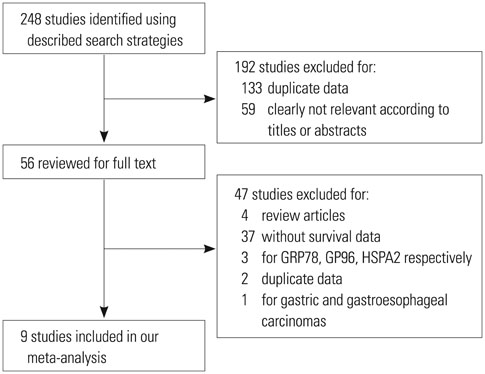
Fig. 1 Search strategy flowchart.

Fig. 2 Meta-analysis (forest plot) of the 5 eligible studies assessing HSP27 in esophageal cancer. SE, standard error; CI, confidence interval; HSP, heat shock protein.
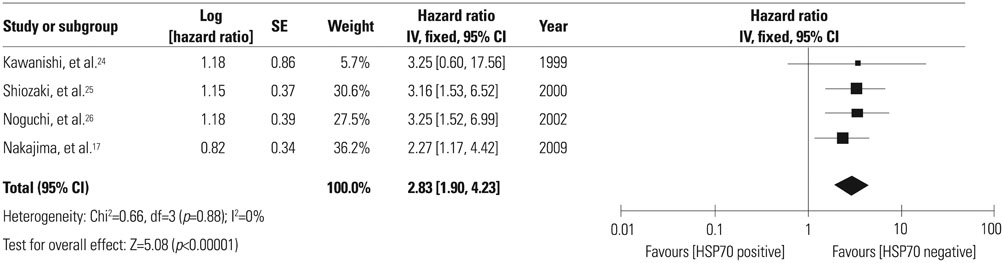
Fig. 3 Meta-analysis (forest plot) of the 6 eligible studies assessing HSP70 in esophageal cancer. SE, standard error; CI, confidence interval; HSP, heat shock protein.

Fig. 4 Meta-analysis (forest plot) of the 3 eligible studies assessing HSP90 in esophageal cancer. SE, standard error; CI, confidence interval; HSP, heat shock protein.
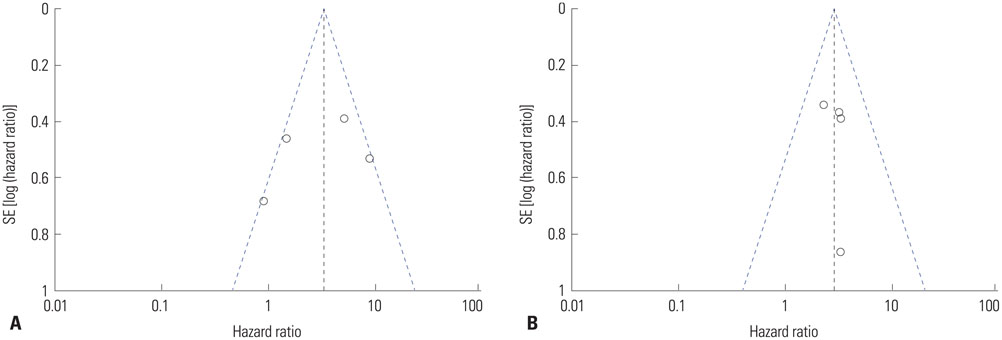
Fig. 5 Begg's funnel plot for publication bias. (A) Funnel plot of HSP27. (B) Funnel plot of HSP70. SE, standard error.
Reference
-
1. Jemal A, Bray F, Center MM, Ferlay J, Ward E, Forman D. Global cancer statistics. CA Cancer J Clin. 2011; 61:69–90.
Article2. Mohamed A, El-Rayes B, Khuri FR, Saba NF. Targeted therapies in metastatic esophageal cancer: advances over the past decade. Crit Rev Oncol Hematol. 2014; 91:186–196.
Article3. Quiros RM, Bui CL. Multidisciplinary approach to esophageal and gastric cancer. Surg Clin North Am. 2009; 89:79–96. viii
Article4. Chen M, Cai E, Huang J, Yu P, Li K. Prognostic value of vascular endothelial growth factor expression in patients with esophageal cancer: a systematic review and meta-analysis. Cancer Epidemiol Biomarkers Prev. 2012; 21:1126–1134.
Article5. Ferlay J, Shin HR, Bray F, Forman D, Mathers C, Parkin DM. Estimates of worldwide burden of cancer in 2008: GLOBOCAN 2008. Int J Cancer. 2010; 127:2893–2917.
Article6. Xu YW, Peng YH, Chen B, Wu ZY, Wu JY, Shen JH, et al. Autoantibodies as potential biomarkers for the early detection of esophageal squamous cell carcinoma. Am J Gastroenterol. 2014; 109:36–45.
Article7. Kaneko K, Kumekawa Y, Makino R, Nozawa H, Hirayama Y, Kogo M, et al. EGFR gene alterations as a prognostic biomarker in advanced esophageal squamous cell carcinoma. Front Biosci (Landmark Ed). 2010; 15:65–72.
Article8. Delektorskaya VV, Chemeris GY, Zavalishina LE, Ryazantseva AA, Grigorchuk AY, Kononets PV, et al. Squamous cell carcinoma of the esophagus: evaluation of the status of epidermal growth factor receptors (EGFR and HER-2) by immunohistochemistry and in situ hybridization. Bull Exp Biol Med. 2010; 149:615–620.
Article9. Langer R, Ott K, Specht K, Becker K, Lordick F, Burian M, et al. Protein expression profiling in esophageal adenocarcinoma patients indicates association of heat-shock protein 27 expression and chemotherapy response. Clin Cancer Res. 2008; 14:8279–8287.
Article10. Berg D, Wolff C, Langer R, Schuster T, Feith M, Slotta-Huspenina J, et al. Discovery of new molecular subtypes in oesophageal adenocarcinoma. PLoS One. 2011; 6:e23985.
Article11. Morimoto RI. Cells in stress: transcriptional activation of heat shock genes. Science. 1993; 259:1409–1410.
Article12. Argon Y, Simen BB. GRP94, an ER chaperone with protein and peptide binding properties. Semin Cell Dev Biol. 1999; 10:495–505.
Article13. Langer T, Lu C, Echols H, Flanagan J, Hayer MK, Hartl FU. Successive action of DnaK, DnaJ and GroEL along the pathway of chaperone-mediated protein folding. Nature. 1992; 356:683–689.
Article14. Hoe KL, Won M, Chung KS, Jang YJ, Lee SB, Kim DU, et al. Isolation of a new member of DnaJ-like heat shock protein 40 (Hsp40) from human liver. Biochim Biophys Acta. 1998; 1383:4–8.
Article15. Liu Y, Zhou J, Zhang C, Fu W, Xiao X, Ruan S, et al. HLJ1 is a novel biomarker for colorectal carcinoma progression and overall patient survival. Int J Clin Exp Pathol. 2014; 7:969–977.16. Ciocca DR, Calderwood SK. Heat shock proteins in cancer: diagnostic, prognostic, predictive, and treatment implications. Cell Stress Chaperones. 2005; 10:86–103.
Article17. Nakajima M, Kato H, Miyazaki T, Fukuchi M, Masuda N, Fukai Y, et al. Tumor immune systems in esophageal cancer with special reference to heat-shock protein 70 and humoral immunity. Anticancer Res. 2009; 29:1595–1606.18. Lebret T, Watson RW, Molinié V, O'Neill A, Gabriel C, Fitzpatrick JM, et al. Heat shock proteins HSP27, HSP60, HSP70, and HSP90: expression in bladder carcinoma. Cancer. 2003; 98:970–977.19. Parmar MK, Torri V, Stewart L. Extracting summary statistics to perform meta-analyses of the published literature for survival endpoints. Stat Med. 1998; 17:2815–2834.
Article20. Tierney JF, Stewart LA, Ghersi D, Burdett S, Sydes MR. Practical methods for incorporating summary time-to-event data into meta-analysis. Trials. 2007; 8:16.
Article21. DerSimonian R, Laird N. Meta-analysis in clinical trials. Control Clin Trials. 1986; 7:177–188.
Article22. Egger M, Davey Smith G, Schneider M, Minder C. Bias in meta-analysis detected by a simple, graphical test. BMJ. 1997; 315:629–634.
Article23. Nakajima M, Kuwano H, Miyazaki T, Masuda N, Kato H. Significant correlation between expression of heat shock proteins 27, 70 and lymphocyte infiltration in esophageal squamous cell carcinoma. Cancer Lett. 2002; 178:99–106.
Article24. Kawanishi K, Shiozaki H, Doki Y, Sakita I, Inoue M, Yano M, et al. Prognostic significance of heat shock proteins 27 and 70 in patients with squamous cell carcinoma of the esophagus. Cancer. 1999; 85:1649–1657.
Article25. Shiozaki H, Doki Y, Kawanishi K, Shamma A, Yano M, Inoue M, et al. Clinical application of malignancy potential grading as a prognostic factor of human esophageal cancers. Surgery. 2000; 127:552–561.
Article26. Noguchi T, Takeno S, Shibata T, Uchida Y, Yokoyama S, Müller W. Expression of heat shock protein 70 in grossly resected esophageal squamous cell carcinoma. Ann Thorac Surg. 2002; 74:222–226.
Article27. Faried A, Sohda M, Nakajima M, Miyazaki T, Kato H, Kuwano H. Expression of heat-shock protein Hsp60 correlated with the apoptotic index and patient prognosis in human oesophageal squamous cell carcinoma. Eur J Cancer. 2004; 40:2804–2811.
Article28. Wu X, Wanders A, Wardega P, Tinge B, Gedda L, Bergstrom S, et al. Hsp90α is expressed and represents a therapeutic target in human oesophageal cancer using the inhibitor 17-allylamino-17-demethoxygeldanamycin. Br J Cancer. 2009; 100:334–343.
Article29. Huang T, Chen S, Han H, Li H, Huang Z, Zhang J, et al. Expression of Hsp90α and cyclin B1 were related to prognosis of esophageal squamous cell carcinoma and keratin pearl formation. Int J Clin Exp Pathol. 2014; 7:1544–1552.30. Bartkova J, Horejsí Z, Koed K, Krämer A, Tort F, Zieger K, et al. DNA damage response as a candidate anti-cancer barrier in early human tumorigenesis. Nature. 2005; 434:864–870.
Article31. Jolly C, Morimoto RI. Role of the heat shock response and molecular chaperones in oncogenesis and cell death. J Natl Cancer Inst. 2000; 92:1564–1572.
Article32. Lee AS. GRP78 induction in cancer: therapeutic and prognostic implications. Cancer Res. 2007; 67:3496–3499.
Article33. Khalil AA, Kabapy NF, Deraz SF, Smith C. Heat shock proteins in oncology: diagnostic biomarkers or therapeutic targets? Biochim Biophys Acta. 2011; 1816:89–104.
Article
- Full Text Links
-
- Actions
-
Cited
- CITED
-
- Close
- Share
-
- Similar articles
-
- Expression of Heat Shock Protein 70 m-RNA in Rat Bladder Overdistended by Diuresis
- Environmental factors regulating the expression of Porphyromonas gingivalis heat shock protein
- Expression of Heat Shock Protein 27 and Apoptosis in Renal Cell Carcinomas
- Heat Shock Protein Induction By An Infrared Warm Compression Device
- Prognostic Significance of Heat Shock Protein 70 Expression in Early Gastric Carcinoma


