Clin Exp Otorhinolaryngol.
2008 Jun;1(2):110-112. 10.3342/ceo.2008.1.2.110.
Syndrome of Inappropriate Antidiuretic Hormone (SIADH) Secretion Caused by Squamous Cell Carcinoma of the Nasopharynx: Case Report
- Affiliations
-
- 1Department of Anesthesiology and Perioperative Medicine, University of Louisville Health Care Center, Louisville, Kentucky, USA. newmachine@hanmail.net
- KMID: 1486063
- DOI: http://doi.org/10.3342/ceo.2008.1.2.110
Abstract
- The Paraneoplastic syndromes include the disorders that accompany benign or malignant tumors but are not directly related to mass effects or invasion by the primary tumor or its metastases. Neoplastic cells can produce a variety of peptides that exert biologic actions at local and distant sites and can elicit responses that cause a variety of hormonal, hematologic, dermatologic and neurologic symptoms. Almost every type of malignancy has the potential to produce hormones or cytokines or to induce immunologic responses. Lung cancers, both non-small cell and small cell, are capable of producing a variety of paraneoplastic syndromes. The majority of such syndromes are caused by small cell carcinomas, including many endocrinopathies. Syndrome of inappropriate antidiuretic hormone (SIADH) has been commonly associated with small cell carcinoma and is often seen in these patients. However, SIADH associated with squamous cell carcinoma has rarely been reported on, and the mechanism for this rare association is still unknown. We present here a case of a 77-yr-old man who developed SIADH caused by squamous cell carcinoma of the nasopharynx.
MeSH Terms
Figure
-
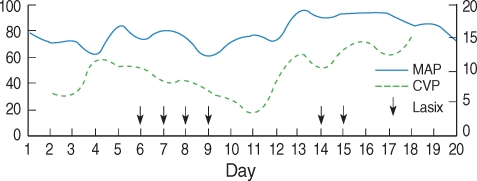
Fig. 1 Mean arterial pressure and central vein pressure.
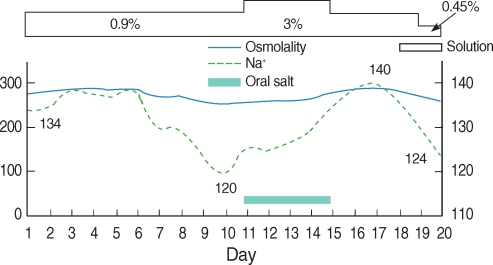
Fig. 2 Serum Na+ and serum osmolality.
Reference
-
1. Bartter FC, Schwartz WB. The syndrome of inappropriate secretion of antidiuretic hormone. Am J Med. 1967; 5. 42(5):790–806. PMID: 5337379.
Article2. Zohar Y, Talmi YP, Finkelstein Y, Nobel M, Gafter U. Syndrome of inappropriate antidiuretic hormone secretion in cancer of the head and neck. Ann Otol Rhinol Laryngol. 1991; 4. 100(4 Pt 1):341–344. PMID: 2018296.
Article3. Schwartz WB, Bennett W, Curelop S, Bartter FC. A syndrome of renal sodium loss and hyponatremia probably resulting from inappropriate secretion of antidiuretic hormone. Am J Med. 1957; 10. 23(4):529–542. PMID: 13469824.
Article4. Bleich HL, Boro ES. Antidiuretic hormone. N Engl J Med. 1976; 9. 16. 295(12):659–665. PMID: 184385.
Article5. Amatruda TT Jr, Mulrow PJ, Gallagher JC, Sawyer WH. Carcinoma of the lung with inappropriate antidiuresis demonstration of antidiuretic-hormone-like activity in tumor extract. N Engl J Med. 1963; 9. 12. 269:544–549. PMID: 14043255.6. Sausville E, Carney D, Battey J. The human vasopressin gene is linked to the oxytocin gene and is selectively expressed in a cultured lung cancer cell line. J Biol Chem. 1985; 8. 25. 260(18):10236–10241. PMID: 2991279.
Article7. Moses AM, Miller M, Streeten DH. Pathophysiologic and pharmacologic alterations in the release and action of ADH. Metabolism. 1976; 6. 25(6):697–721. PMID: 818477.
Article8. Kavanagh BD, Halperin EC, Rosenbaum LC, Shannon EM, Nilaver G. Syndrome of inappropriate secretion of antidiuretic hormone in a patient with carcinoma of the nasopharynx. Cancer. 1992; 3. 15. 69(6):1315–1319. PMID: 1540868.
Article9. Krmar RT, Ferraris JR, Ruiz SE, Dibar E, Morandi AA, Ramirez JA. Syndrome of inappropriate secretion of antidiuretic hormone in nasopharynx carcinoma. Pediatr Nephrol. 1997; 8. 11(4):502–503. PMID: 9260257.
Article10. Jacobson L. Hypothalamic-pituitary-adrenocortical axis regulation. Endocrinol Metab Clin North Am. 2005; 6. 34(2):271–292. PMID: 15850842.
Article11. Lee JH, Cha MJ, Choi SH, Hwang SJ, Kim DG, Jahng JW. Neuropeptide Y immunoreactivity and corticotropin-releasing hormone mRNA level are increased in the hypothalamus of mouse bearing a human oral squamous cell carcinoma. Neuropeptides. 2004; 12. 38(6):345–350. PMID: 15567470.
Article
- Full Text Links
-
- Actions
-
Cited
- CITED
-
- Close
- Share
-
- Similar articles
-
- Small cell neuroendocrine carcinoma of the uterine cervix presenting with syndrome of inappropriate antidiuretic hormone secretion
- Case of Syndrome of Inappropriate Antidiuretic Hormone Secretion in a Patient with Esophageal Cancer
- The syndrome of inappropriate antidiuretic hormone secretion with olfactory neuroblastoma: A case report
- A Case Report of Syndrome of Inappropriate Antidiuretic Hormone Induced by Pregabalin
- A case of syndrome of inappropriate secretion of antidiuretic hormone associated with paroxetine