
Infect Chemother.
2018 Jun;50(2):153-159. 10.3947/ic.2018.50.2.153.
Cytomegalovirus Colitis during Dasatinib Treatment for Patients with Hematologic Malignancy: Case Series and Literature Review

- Affiliations
-
- 1Division of Infectious Diseases, Department of Internal Medicine, College of Medicine, The Catholic University of Korea, Seoul, Korea. symonlee@catholic.ac.kr
- 2Vaccine Bio Research Institute, College of Medicine, The Catholic University of Korea, Seoul, Korea.
- 3Catholic Hematology Hospital, College of Medicine, The Catholic University of Korea, Seoul, Korea.
- KMID: 2415038
- DOI: http://doi.org/10.3947/ic.2018.50.2.153
Abstract
- Dasatinib, a tyrosine kinase inhibitor, is widely used for patients with chronic myeloid leukemia and Philadelphia chromosome-positive acute lymphoblastic leukemia. Although the drug has a potent immunosuppressive effect, infectious complications during dasatinib treatment have been reported rarely. We describe five patients who developed cytomegalovirus (CMV) colitis during dasatinib treatment, in whom the colitis was initially confused with other causes. The patients, three with chronic myeloid leukemia, and two with acute lymphoblastic leukemia, were diagnosed with CMV colitis based on endoscopic and histologic findings. The patients who examined blood CMV polymerase chain reaction were all positive. The patients received antiviral therapy in the form of either ganciclovir or valganciclovir, and the overall treatment outcome was fair. These cases suggest that physicians should consider the possibility of CMV reactivation when treating diarrhea and/or hematochezia in patients on dasatinib.
Keyword
MeSH Terms
-
Colitis*
Cytomegalovirus*
Dasatinib*
Diarrhea
Ganciclovir
Gastrointestinal Hemorrhage
Hematologic Neoplasms*
Humans
Leukemia, Myelogenous, Chronic, BCR-ABL Positive
Polymerase Chain Reaction
Precursor Cell Lymphoblastic Leukemia-Lymphoma
Protein-Tyrosine Kinases
Treatment Outcome
Dasatinib
Ganciclovir
Protein-Tyrosine Kinases
Figure
-
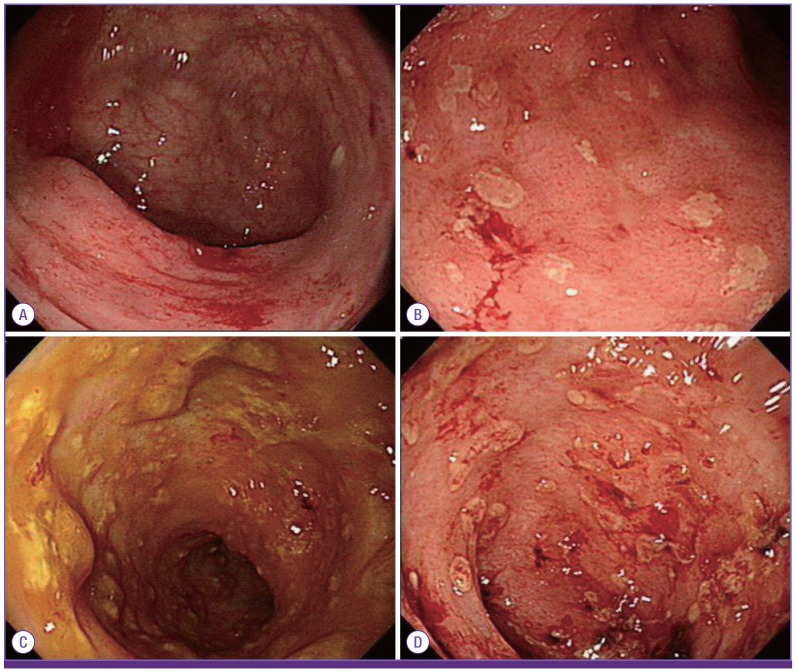
Figure 1 Colonoscopic finding of cytomegalovirus colitis (A) patient 1, edematous mucosa, friability, loss of vascularity. (B) patient 2, multiple erythema and shallow ulceration. (C) patient 4, edematous mucosa and shallow erosion. (D) patient 5, mild erythema, ulceration with blood clot
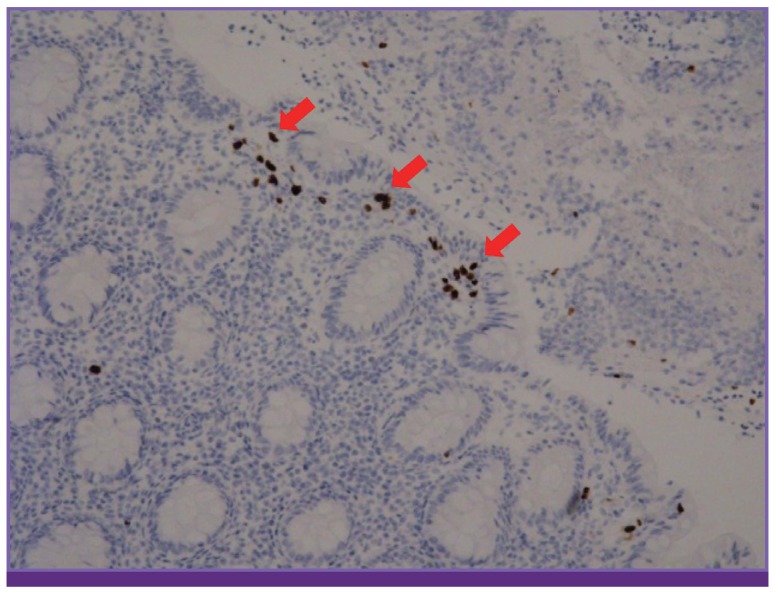
Figure 2 Pathologic finding of cytomegalovirus colitis: positive immunohistochemistry for cytomegalovirus (red arrow) (×100)
Reference
-
1. Schade AE, Schieven GL, Townsend R, Jankowska AM, Susulic V, Zhang R, Szpurka H, Maciejewski JP. Dasatinib, a small-molecule protein tyrosine kinase inhibitor, inhibits T-cell activation and proliferation. Blood. 2008; 111:1366–1377. PMID: 17962511.
Article2. Baccarani M, Cortes J, Pane F, Niederwieser D, Saglio G, Apperley J, Cervantes F, Deininger M, Gratwohl A, Guilhot F, Hochhaus A, Horowitz M, Hughes T, Kantarjian H, Larson R, Radich J, Simonsson B, Silver RT, Goldman J, Hehlmann R. European LeukemiaNet. Chronic myeloid leukemia: an update of concepts and management recommendations of European LeukemiaNet. J Clin Oncol. 2009; 27:6041–6051. PMID: 19884523.3. Ottmann O, Dombret H, Martinelli G, Simonsson B, Guilhot F, Larson RA, Rege-Cambrin G, Radich J, Hochhaus A, Apanovitch AM, Gollerkeri A, Coutre S. Dasatinib induces rapid hematologic and cytogenetic responses in adult patients with Philadelphia chromosome positive acute lymphoblastic leukemia with resistance or intolerance to imatinib: interim results of a phase 2 study. Blood. 2007; 110:2309–2315. PMID: 17496201.4. de la Hoz RE, Stephens G, Sherlock C. Diagnosis and treatment approaches of CMV infections in adult patients. J Clin Virol. 2002; 25(Suppl 2):S1–12.
Article5. Kmira Z, Nesrine BS, Houneida Z, Wafa BF, Aida S, Yosra BY, Monia Z, Sriha B, Abderrahim K. Severe hemorrhagic colitis in a patient with chronic myeloid leukemia in the blastic phase after dasatinib use. World J Gastrointest Pathophysiol. 2013; 4:59–62. PMID: 23946889.
Article6. Torres HA, Chemaly RF. Viral infection or reactivation in patients during treatment with dasatinib: a call for screening? Leuk Lymphoma. 2007; 48:2308–2309. PMID: 18067004.
Article7. Kreutzman A, Ladell K, Koechel C, Gostick E, Ekblom M, Stenke L, Melo T, Einsele H, Porkka K, Price DA, Mustjoki S, Seggewiss R. Expansion of highly differentiated CD8+ T-cells or NK-cells in patients treated with dasatinib is associated with cytomegalovirus reactivation. Leukemia. 2011; 25:1587–1597. PMID: 21647156.
Article8. Yassin MA, Nashwan AJ, Soliman AT, Yousif A, Moustafa A, AlBattah A, Mohamed SF, Mudawi DS, Elkourashy S, Asaari DR, Gutierrez HL, Almusharaf M, Hussein RM, Moustafa AH, Derhoubi HE, Boukhris S, Kohla S, AlDewik N. Cytomegalovirus-induced Hemorrhagic colitis in a patient with chronic myeloid leukemia (chronic phase) on dasatinib as an upfront therapy. Clin Med Insights Case Rep. 2015; 8:77–81. PMID: 26379451.
Article9. Sunami Y, Sato E, Ichikawa K, Yasuda H, Komatsu N. Hemorrhagic colitis caused by dasatinib following cytomegalovirus enterocolitis in a patient with chronic myelogenous leukemia in the second chronic phase. Rinsho Ketsueki. 2011; 52:282–286. PMID: 21646774.10. Mera JR, Whimbey E, Elting L, Preti A, Luna MA, Bruner JM, Williams T Jr, Bodey GP, Goodrich JM. Cytomegalovirus pneumonia in adult nontransplantation patients with cancer: review of 20 cases occurring from 1964 through 1990. Clin Infect Dis. 1996; 22:1046–1050. PMID: 8783708.
Article11. Kim SH, Lee HJ, Kim SM, Jung JH, Shin S, Kim YH, Sung H, Lee SO, Choi SH, Kim YS, Woo JH, Han DJ. Diagnostic usefulness of cytomegalovirus (CMV)-specific T cell immunity in predicting CMV infection after kidney transplantation: a pilot proof-of-concept study. Infect Chemother. 2015; 47:105–110. PMID: 26157588.
Article12. Lemonovich TL, Watkins RR. Update on cytomegalovirus infections of the gastrointestinal system in solid organ transplant recipients. Curr Infect Dis Rep. 2012; 14:33–40. PMID: 22125047.
Article13. Ko JH, Peck KR, Lee WJ, Lee JY, Cho SY, Ha YE, Kang CI, Chung DR, Kim YH, Lee NY, Kim KM, Song JH. Clinical presentation and risk factors for cytomegalovirus colitis in immunocompetent adult patients. Clin Infect Dis. 2015; 60:e20–e26. PMID: 25452594.
Article14. Tanaka H, Nakashima S, Usuda M. Rapid and sustained increase of large granular lymphocytes and rare cytomegalovirus reactivation during dasatinib treatment in chronic myelogenous leukemia patients. Int J Hematol. 2012; 96:308–319. PMID: 22767140.
Article15. Chang H, Tang TC, Hung YS, Lin TL, Kuo MC, Wang PN. Cytomegalovirus infection in non-transplant patients with hematologic neoplasms: a case series. Chang Gung Med J. 2011; 34:65–74. PMID: 21392476.
- Full Text Links
-
- Actions
-
Cited
- CITED
-
- Close
- Share
-
- Similar articles
-
- Proven Cytomegalovirus Colitis Associated with Dasatinib Administration in Two Pediatric Allogeneic Hematopoietic Stem Cell Transplantation Recipients
- A Case of Cytomegalvirus Colitis Developed during the Treatment of Ulcerative Colitis
- Dasatinib induces severe hemorrhagic colitis in a patient with accelerated phase of chronic myelogenous leukemia
- A Case of Cytomegalovirus and Pseudomembranous Colitis in an Immunocompetent Adult
- When is an Assay of Cytomegalovirus Antigenemia Useful in Detecting Cytomegalovirus Colitis?


