
J Korean Neuropsychiatr Assoc.
2013 Sep;52(5):279-291.
Understanding of "Attunement Disorder" from Phenomenological-Anthropological Perspective : Inquiry into the Use of the Term "Attunement" in Psychiatric Literature
- Affiliations
-
- 1Department of Psychiatry, Eulji University School of Medicine, Daejeon, Korea.
- 2Department of Neuropsychiatry, Chungbuk National University College of Medicine, Cheongju, Korea.
- 3Department of Neuropsychiatry, Dongguk University School of Medicine, Goyang, Korea. kys@snu.ac.kr
- 4Institute of Clinical Psychopharmacology, Dongguk University International Hospital, Goyang, Korea.
Abstract
- The Korean Neuropsychiatric Association has decided that the existing nomenclature "Schizophrenia" should be replaced with "Attunement disorder" in order to mitigate prejudices from the general public. In this process, "attunement" was meant to express the harmonious relationship and organic integration among the various substructures of global mental functioning. However, the term "attunement" and related concepts had occupied an important position in discourses surrounding the fundamental concept of schizophrenia. In this regard, the historical vicissitudes of the term "attunement" in the context of schizophrenia research was discussed. The term "attunement" is an English translation of Heideggerian expressions "Befindlichkeit" and "Stimmung". It is used by Heidegger to convey the emotional experience of Dasein's inextricable entanglement with the surrounding interpersonal world. Heidegger's philosophical works formed the theoretical foundation for the so-called Phenomenological-anthropological psychiatry. Psychiatrists influenced by this approach argue that patients with schizophrenia suffer from a sense of alienation and bewilderment resulting from loss of normal attunement. In addition, they stress that the loss of attunement brings about distorted self-experience, which leads to strange and uncanny life experiences exiled from intersubjectivity based society. From the phenomenological perspective, mind or consciousness is not a solipsistic Cartesian reason confined to the brain, but an intentional existence embedded in the interpersonal and intersubjective worlds. In the developmental period, intentional relationship between the consciousness and the world has been acquired from repeated shared experiences with other people via intersubjectivity. The intersubjective experiences also contribute to maintenance of solid attunement even after reaching mature adulthood. Whatever the reason, losing the tacit understanding of the world will cause disintegration of the foundation of intersubjectivity and confusion with regard to the certainties of self and the world. This state was described as "Attunement disorder". Recent emphasis on neurobiological understanding of schizophrenia has impeded the proper appreciation of Phenomenological-anthropological understanding of schizophrenia, one of the valuable heritages of psychiatry. Meanwhile, the concept of phenomenological understanding or embedded cognition has recently gained renewed attention among neuroscientists studying neurobiological correlates of consciousness. Standing on the pivotal point witnessing the conceptual change from "Schizophrenia" to "Attunement disorder", reappraisal of the past heritage from modern perspectives would be a valuable endeavor for advancement of psychiatry.
Keyword
MeSH Terms
Figure
-
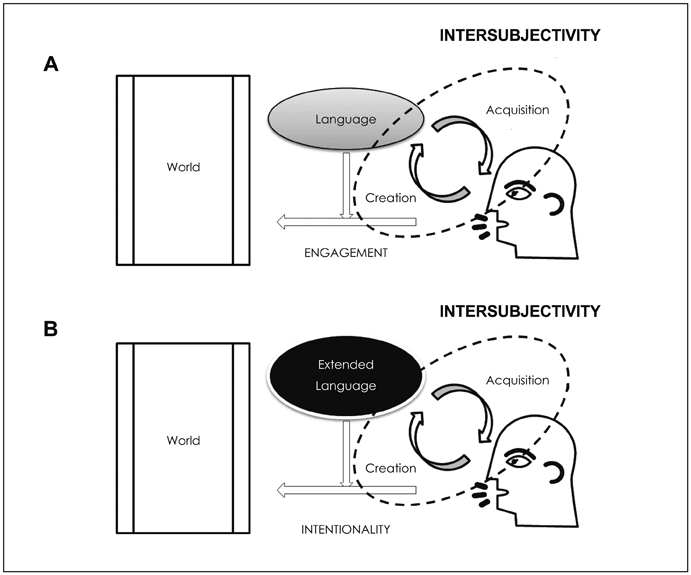
Fig. 1 Relationship between a subject and the world via (A) language and (B) extended language. Extended language denotes socially agreed-upon gestures, customs, conventions, laws etc. Subjects participate in the acquisition, creation and use of language and extended language based on intersubjectivity.
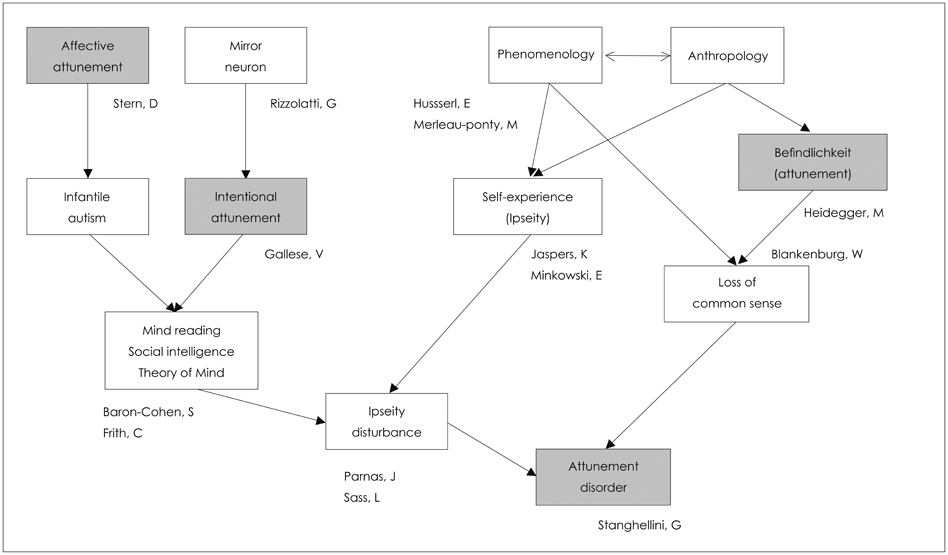
Fig. 2 A simplified overview of the development process of the concept "Attunement" in psychiatric literature. Boxes in gray color depict the concepts directly related to "Attunement" and those in white depict the concepts indirectly related to "Attunement".
Reference
-
1. Park JH, Choi YM, Kim B, Lee DW, Gim MS. Use of the terms "schizophrenia" and "schizophrenic" in the South Korean news media: a content analysis of newspapers and news programs in the last 10 years. Psychiatry Investig. 2012; 9:17–24.
Article2. Wiggins O, Schwartz M. Schizphrenia: a phenomenological-anthropological approach. In : Chung MC, Graham G, editors. Reconceiving Schizophrenia. Oxford University Press;2007.3. Parnas J, Sass LA. Self, solipsism, and schizophrenic delusions. Philos Psychiatry Psychol. 2001; 8:101–120.
Article4. Parnas J, Handest P. Phenomenology of anomalous self-experience in early schizophrenia. Compr Psychiatry. 2003; 44:121–134.
Article5. Sass LA, Parnas J. Schizophrenia, consciousness, and the self. Schizophr Bull. 2003; 29:427–444.
Article6. Svenaeus F. The hermeneutics of medicine and the phenomenology of health: steps towards a philosophy of medical practice. Springer;2001.7. Mulhall S. Attunement and Disorientation: the moods of philosophy in Heidegger and Sartre. In : Kenaan H, Ferber I, editors. Philosophy's Moods: The Affective Grounds of Thinking. Springer;2011. p. 123–139.8. Gallagher S, Zahavi D. The Phenomenological Mind: An Introduction to Philosophy of Mind and Cognitive Science. London/New York: Routledge;2008.9. Hartmann E, Milofsky E, Vaillant G, Oldfield M, Falke R, Ducey C. Vulnerability to schizophrenia. Prediction of adult schizophrenia using childhood information. Arch Gen Psychiatry. 1984; 41:1050–1056.10. Paek MJ, Kang UG. Phenomenological psychopathology. J Korean Neuropsychiatr Assoc. 2011; 50:97–115.11. Sass LA, Parnas J. Explaining schizophrenia: the relevance of phenomenology. In : Chung MC, Fulford KWM, Graham G, editors. Reconceiving schizophrenia. Oxford: Oxford University Press;2007.12. Nelson B, Sass LA, Thompson A, Yung AR, Francey SM, Amminger GP, et al. Does disturbance of self underlie social cognition deficits in schizophrenia and other psychotic disorders? Early Interv Psychiatry. 2009; 3:83–93.
Article13. Inwood M. Heidegger: A Very Short Introduction. Oxford: Oxford University Press;2000.14. Zahavi D. Subjectivity and Selfhood: Investigating the First-Person Perspective. Cambridge, MA: The MIT Press;2005.15. Nelkin N. Subjectivity. In : Guttenplan S, editor. A Companion to the Philosophy of Mind. Oxford: Blackwell Publishers;1994.16. Frie R. Subjectivity and intersubjectivity in modern philosophy and psychoanalysis: a study of Sartre, Binswanger, Lacan, and Habermas. Boston: Rowman & Littlefield;1997.17. Rochat P, Passos-Ferreira C. From Imitation to Reciprocation and Mutual Recognition. In : Pineda J, editor. Mirror Neuron Systems. Springer;2009.18. Russell M. Husserl: a guide for the perplexed. New York: Continuum International Publishing Group;2006.19. Cerbone DR. Understanding Phenomenology. Acumen Publishing Limited;2006.20. Stanghellini G. Disembodied spirits and deanimated bodies: the psychopathology of common sense. Oxford: Oxford University Press;2004.21. Premack D, Woodruff G. Does the chimpanzee have a theory of mind? Behav Brain Sci. 1978; 1:515–526.
Article22. Heal J. Simulation, theory, and content. In : Carruthers P, Smith PK, editors. Theories of theories of mind. Cambridge: Cambridge University Press;1996.23. Lee KH. Three Theories on the Principles of Folk Psychological Understanding of Others : A reconstruction of Theory theory, Simulation theory and Embodiment theory. Philos. 2004; 80:315–340.24. Gopnik A. How we know our minds: the illusion of first-person knowledge of intentionality. Behav Brain Sci. 1993; 16:1–14.
Article25. Varela FJ, Thompson E, Rosch E. The embodied mind: cognitive science and human experience. Cambridge, MA: The MIT Press;1993.26. Gallagher S. The Practice of Mind. The practice of mind. Theory, simulation or primary interaction? J Conscious Stud. 2001; 8:83–108.27. Rowlands M. The New Science of the Mind: From Extended Mind to Embodied Phenomenology. Cambridge, MA: The MIT Press;2010.28. Rochat P. The emergence of self-awareness as co-awareness in early child development. In : Zahavi D, Grunbaum T, Parnas J, editors. The Structure and Development of Self-Consciousness: Interdisciplinary perspectives. Amsterdam: John Benjamins Publishing Co.;2004.29. Meltzoff AN, Moore MK. Infants' Understanding of People and Things: From Body Imitation to Folk Psychology. In : Bermúdez J, Marcel AJ, Eilan N, editors. The body and the Self. Cambridge, MA: MIT Press;1995.30. Dennett DC. The Intentional Stance. Cambridge, MA: MIT Press;1987.31. Howson A. The body in society: an introduction. Cambridge, MA: Wiley-Blackwell;2004.32. Zahavi D. The embodied self-awareness of the infant: a challenge to the theory-theory of mind?. In : Zahavi D, Grünbaum T, Parnas J, editors. The structure and development of self-consciousness: interdisciplinary perspectives. Amsterdam: John Benjamins Publishing Co.;2004.33. Trevarthen C. Communication and cooperation in early infancy: a description of primary intersubjectivity. In : Bullowa M, editor. Before speech: the beginning of interpersonal communication. London: Cambridge University Press;1979.34. Gopnik A, Meltzoff AN. Words, thoughts, and theories. Cambridge, MA: The MIT Press;1998.35. Stern DN. The interpersonal world of the infant: a view from psychoanalysis and developmental psychology. Karnac Books;1998.36. Turella L, Pierno AC, Tubaldi F, Castiello U. Mirror neurons in humans: consisting or confounding evidence? Brain Lang. 2009; 108:10–21.
Article37. Gallese V. Intentional attunement: a neurophysiological perspective on social cognition and its disruption in autism. Brain Res. 2006; 1079:15–24.
Article38. Agnew ZK, Bhakoo KK, Puri BK. The human mirror system: a motor resonance theory of mind-reading. Brain Res Rev. 2007; 54:286–293.
Article39. Emery NJ. The eyes have it: the neuroethology, function and evolution of social gaze. Neurosci Biobehav Rev. 2000; 24:581–604.
Article40. Trevarthen C, Hubley P. Secondary Intersubjectivity: Confidence, confiding and acts of meaning in the first year. In : Lock A, editor. Action, gesture, and symbol: the emergence of language. London: Academic Press;1978.41. Baars B, Gage N. Cognition, Brain and Consciousness. Academic Press;2010.42. Meltzoff A, Brooks R. "Like Me" as a Building Block for Understanding Other Minds: Bodily Acts, Attention, and Intention. In : Malle BF, Moses LJ, editors. Intentions and intentionality: foundations of social cognition. Cambridge, MA: The MIT Press;2003.43. Vygotsky LS. Mind in Society. The Development of Higher Psychological Processes. Cambridge, MA: Harvard University Press;1978.44. Wittgenstein L. Philosophical Investigation translated by G.E.M. Anscombe. Oxford: Basil Blackwell;1958.45. Raffard S, D'Argembeau A, Lardi C, Bayard S, Boulenger JP, Van der Linden M. Narrative identity in schizophrenia. Conscious Cogn. 2010; 19:328–340.
Article46. Lysaker PH, Dimaggio G, Buck KD, Carcione A, Nicolò G. Metacognition within narratives of schizophrenia: associations with multiple domains of neurocognition. Schizophr Res. 2007; 93:278–287.
Article47. Gonzalez-Torres MA, Inchausti L, Aristegui M, Ibañez B, Diez L, Fernandez-Rivas A, et al. Depersonalization in patients with schizophrenia spectrum disorders, first-degree relatives and normal controls. Psychopathology. 2010; 43:141–149.
Article48. Kean C. Silencing the self: schizophrenia as a self-disturbance. Schizophr Bull. 2009; 35:1034–1036.
Article49. Parnas J, Møller P, Kircher T, Thalbitzer J, Jansson L, Handest P, et al. EASE: Examination of Anomalous Self-Experience. Psychopathology. 2005; 38:236–258.
Article50. Nelson B, Fornito A, Harrison BJ, Yücel M, Sass LA, Yung AR, et al. A disturbed sense of self in the psychosis prodrome: linking phenomenology and neurobiology. Neurosci Biobehav Rev. 2009; 33:807–817.
Article51. Stanghellini G. Embodiment and schizophrenia. World Psychiatry. 2009; 8:56–59.
Article52. Parnas J, Bovet P. Autism in schizophrenia revisited. Compr Psychiatry. 1991; 32:7–21.
Article53. Mishara AL. On Wolfgang Blankenburg, Common Sense, and Schizophrenia. Philos Psychiatry Psychol. 2001; 8:317–322.
Article54. Cobb-Stevens R. James and Husserl: the foundations of meaning. Springer;1974.55. Mohanty J. Edmund Husserl's theory of meaning. Springer;1976.56. Brüne M. "Theory of mind" in schizophrenia: a review of the literature. Schizophr Bull. 2005; 31:21–42.
Article
- Full Text Links
-
- Actions
-
Cited
- CITED
-
- Close
- Share
-
- Similar articles
-
- Comparison of Stigma according to the Term Used for Schizophrenia : Split-Mind Disorder vs. Attunement Disorder
- Attunement Disorder : A Disorder of Brain Connectivity
- Effects of Renaming Schizophrenia in Korea: from “Split-Mind Disorder†to “Attunement Disorderâ€
- A phenomenological perspective and discovery of meaning in mid-aged women's experience of mastectomy
- Phenomenological Psychopathology


