
Korean J Hematol.
2009 Sep;44(3):193-197. 10.5045/kjh.2009.44.3.193.
A Case Report of Rituximab Therapy for Recurrent Thrombotic Thrombocytopenia Purpura
- Affiliations
-
- 1Department of Internal Medicine, University of Ulsan College of Medicine, Asan Medical Center, Seoul, Korea. jhlee3@amc.seoul.kr
- KMID: 2252142
- DOI: http://doi.org/10.5045/kjh.2009.44.3.193
Abstract
- Thrombotic thrombocytopenic purpura (TTP) is a rare medical condition characterized by thrombocytopenia, microangiopathic hemolytic anemia, neurologic manifestations, and infrequently, renal involvement. In many cases, TTP is associated with deficiency of the von Willebrand factor-cleaving protease, ADAMTS13, and treatment with plasma exchange is effective in the majority of patients. We report a patient with acute TTP in whom remission was not achieved by initial treatment consisting of plasma exchange and corticosteroids. In view of the severe autoantibody-mediated ADAMTS-13 deficiency, treatment was initiated with rituximab, a chimeric monoclonal antibody directed against the CD 20 antigen present on B lymphocytes. The patient received 4 weekly infusions of rituximab (375 mg/m2). Four weeks after the last infusion of rituximab, a complete clinical and laboratory remission was documented. We conclude that rituximab should be considered in patients with TTP with acquired ADAMTS-13 deficiency, who fail to respond to standard treatment with plasma exchange and corticosteroids. Rituximab may result in a lowered requirement for plasmapheresis and avoid the complications of salvage immunosuppressive therapy.
MeSH Terms
-
Adrenal Cortex Hormones
Anemia, Hemolytic
Antibodies, Monoclonal, Murine-Derived
B-Lymphocytes
Humans
Neurologic Manifestations
Plasma Exchange
Plasmapheresis
Purpura
Purpura, Thrombotic Thrombocytopenic
Thrombocytopenia
Thymine Nucleotides
Rituximab
Adrenal Cortex Hormones
Antibodies, Monoclonal, Murine-Derived
Thymine Nucleotides
Figure
-
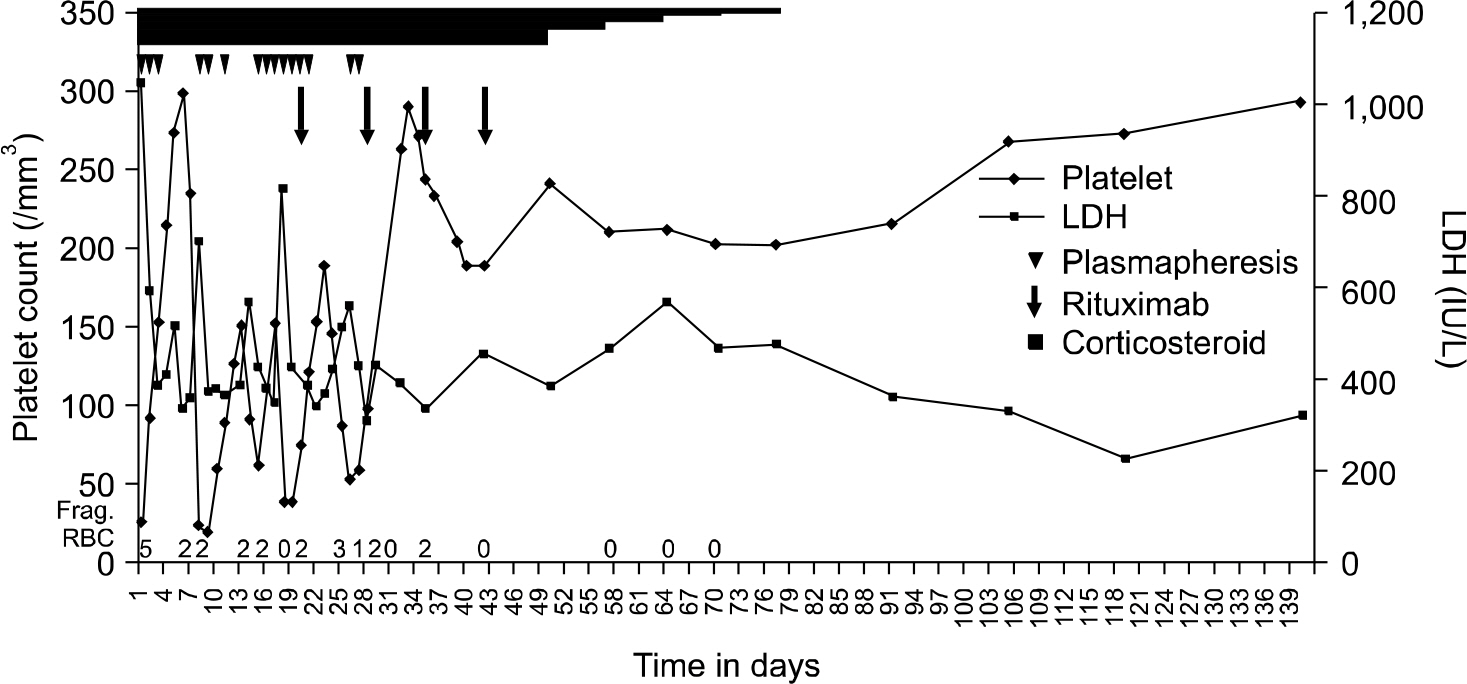
Fig. 1. Clinical course before and after initiation of rituximab in a patient with recurrent thrombotic thrombocytopenic purpura.
Reference
-
References
1. Moschcowitz E. An acute febrile pleiochromic anemia with hyaline thrombosis of the terminal arterioles and capillaries: an undescribed disease. 1925. Mt Sinai J Med. 2003; 70:352–5.2. Cuttner J. Thrombotic thrombocytopenic purpura: a ten-year experience. Blood. 1980; 56:302–6.
Article3. Moake JL, Rudy CK, Troll JH, et al. Unusually large plasma factor VIII: von Willebrand factor multimers in chronic relapsing thrombotic thrombocytopenic purpura. N Engl J Med. 1982; 307:1432–5.
Article4. Furlan M, Robles R, Galbusera M, et al. von Willebrand factor-cleaving protease in thrombotic thrombocytopenic purpura and the hemolytic-uremic syndrome. N Engl J Med. 1998; 339:1578–84.
Article5. Sadler JE. Von Willebrand factor, ADAMTS13, and thrombotic thrombocytopenic purpura. Blood. 2008; 112:11–8.
Article6. Scheiflinger F, Knobl P, Trattner B, et al. Nonneutr-alizing IgM and IgG antibodies to von Willebrand factor-cleaving protease (ADAMTS-13) in a patient with thrombotic thrombocytopenic purpura. Blood. 2003; 102:3241–3.
Article7. Yomtovian R, Niklinski W, Silver B, Sarode R, Tsai HM. Rituximab for chronic recurring thrombotic thrombocytopenic purpura: a case report and review of the literature. Br J Haematol. 2004; 124:787–95.
Article8. Bresin E, Gastoldi S, Daina E, et al. Rituximab as preemptive treatment in patients with thrombotic thrombocytopenic purpura and evidence of anti-ADAMTS13 autoantibodies. Thromb Haemost. 2009; 101:233–8.
Article9. Chemnitz J, Draube A, Scheid C, et al. Successful treatment of severe thrombotic thrombocytopenic purpura with the monoclonal antibody rituximab. Am J Hematol. 2002; 71:105–8.
Article10. Galbusera M, Bresin E, Noris M, et al. Rituximab prevents recurrence of thrombotic thrombocytopenic purpura: a case report. Blood. 2005; 106:925–8.
Article11. Ahmad A, Aggarwal A, Sharma D, et al. Rituximab for treatment of refractory/relapsing thrombotic thrombocytopenic purpura (TTP). Am J Hematol. 2004; 77:171–6.
Article12. Gutterman LA, Kloster B, Tsai HM. Rituximab therapy for refractory thrombotic thrombocytopenic purpura. Blood Cells Mol Dis. 2002; 28:385–91.
Article13. Zheng XL, Kaufman RM, Goodnough LT, Sadler JE. Effect of plasma exchange on plasma ADAMTS13 metalloprotease activity, inhibitor level, and clinical outcome in patients with idiopathic and non-idiopathic thrombotic thrombocytopenic purpura. Blood. 2004; 103:4043–9.
Article14. Vesely SK, George JN, Lammle B, et al. ADAMTS13 activity in thrombotic thrombocytopenic purpura-hemolytic uremic syndrome: relation to presenting features and clinical outcomes in a prospective cohort of 142 patients. Blood. 2003; 102:60–8.
Article15. Millward PM, Bandarenko N, Chang PP, et al. Cardiogenic shock complicates successful treatment of refractory thrombotic thrombocytopenia purpura with rituximab. Transfusion. 2005; 45:1481–6.
Article
- Full Text Links
-
- Actions
-
Cited
- CITED
-
- Close
- Share
-
- Similar articles
-
- Rituximab Treatment in a Case of Dermatomyositis Accompanied by Thrombotic Thrombocytopenic Purpura
- Successful Treatment with Low-dose Rituximab in a Patient with Plasma Exchange-refractory Idiopathic Thrombotic Thrombocytopenic Purpura
- Successful Treatment of Thrombotic Thrombocytopenic Purpura with Recurrent Transient Ischemic Attacks in Old Age
- A Postoperative Thrombotic Thrombocytopenic Purpura in a Cardiac Surgery Patient: A Case Report
- Recurrent Cerebral Infarctions and Multi-Vessel Thrombosis in a Male Patient with Refractory Idiopathic Thrombocytopenic Purpura: a Case Report


