
Vestibular Rehabilitation Therapy: Review of Indications, Mechanisms, and Key Exercises
- Affiliations
-
- 1Do Neurology Clinic, Daegu, Korea. byung_in@hotmail.com
- 2Department of Neurology, School of Medicine, Kyungpook National University, Deagu, Korea.
- 3Department of Neurology, School of Medicine, Seoul National University, Seoul, Korea.
- KMID: 2179003
- DOI: http://doi.org/10.3988/jcn.2011.7.4.184
Abstract
- Vestibular rehabilitation therapy (VRT) is an exercise-based treatment program designed to promote vestibular adaptation and substitution. The goals of VRT are 1) to enhance gaze stability, 2) to enhance postural stability, 3) to improve vertigo, and 4) to improve activities of daily living. VRT facilitates vestibular recovery mechanisms: vestibular adaptation, substitution by the other eye-movement systems, substitution by vision, somatosensory cues, other postural strategies, and habituation. The key exercises for VRT are head-eye movements with various body postures and activities, and maintaining balance with a reduced support base with various orientations of the head and trunk, while performing various upper-extremity tasks, repeating the movements provoking vertigo, and exposing patients gradually to various sensory and motor environments. VRT is indicated for any stable but poorly compensated vestibular lesion, regardless of the patient's age, the cause, and symptom duration and intensity. Vestibular suppressants, visual and somatosensory deprivation, immobilization, old age, concurrent central lesions, and long recovery from symptoms, but there is no difference in the final outcome. As long as exercises are performed several times every day, even brief periods of exercise are sufficient to facilitate vestibular recovery. Here the authors review the mechanisms and the key exercises for each of the VRT goals.
Keyword
MeSH Terms
Figure
-
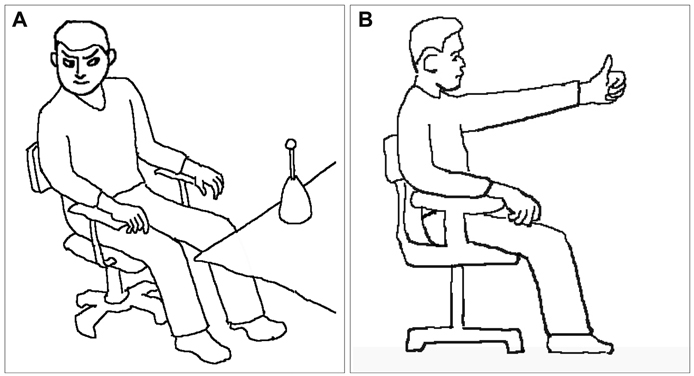
Fig. 1 Exercises for enhancing gaze stability. A: Head turns. B: Head-trunk turns.
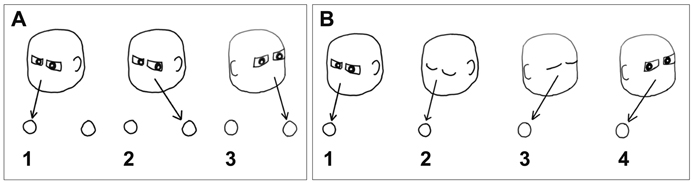
Fig. 2 Exercises for enhancing eye movements. A: Exercise for saccade and vestibulo-ocular reflex: 1, look directly at a target, ensuring that your head is aligned with the target; 2, look at the other target; and 3, turn your head to the other target. B: Exercise for imagery pursuit: 1, look directly at a target, ensuring that your head is aligned with the target; 2, close your eyes; 3, slowly turn your head away from the target while imagining that you are still looking directly at the target; and 4, open your eyes and check to see whether you have been able to keep your eyes on the target; if not, adjust your gaze on the target.
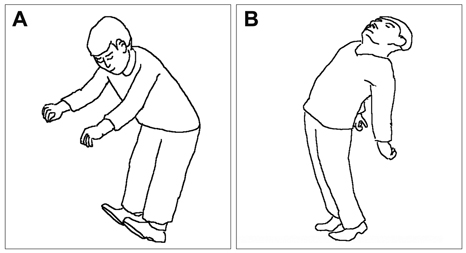
Fig. 3 Swaying back and forth. A: Bend forward and move the center of your body backward with your toes up. B: Bend backward and move the center of your body forward with your heels up. Repeat several times.

Fig. 4 Exercises for improving vertigo. A: Stand with one arm elevated over the head, with the eyes looking at the elevated hand. B: Bend over and lower the arm diagonally with the eyes continuously looking at the hand until the hand arrives at the opposite foot. Repeat with the other arm.
Reference
-
1. Shepard NT, Telian SA, Smith-Wheelock M. Habituation and balance retraining therapy. A retrospective review. Neurol Clin. 1990. 8:459–475.2. Shepard NT, Telian SA. Programmatic vestibular rehabilitation. Otolaryngol Head Neck Surg. 1995. 112:173–182.3. Cawthorne T. Vestibular injuries. Proc R Soc Med. 1946. 39:270–273.
Article4. Cooksey FS. Rehabilitation in vestibular injuries. Proc R Soc Med. 1946. 39:273–278.
Article5. Hall CD, Heusel-Gillig L, Tusa RJ, Herdman SJ. Efficacy of gaze stability exercises in older adults with dizziness. J Neurol Phys Ther. 2010. 34:64–69.
Article6. Shepard N, Asher A. Herdman SJ, editor. Treatment of patients with nonvestibular dizziness and disequilibrium. Vestibular Rehabilitation. 2000. 2nd ed. Philadelphia: F.A. Davis Co.;534–544.7. Seok JI, Lee HM, Yoo JH, Lee DK. Residual dizziness after successful repositioning treatment in patients with benign paroxysmal positional vertigo. J Clin Neurol. 2008. 4:107–110.
Article8. Blatt PJ, Georgakakis GA, Herdman SJ, Clendaniel RA, Tusa RJ. The effect of the canalith repositioning maneuver on resolving postural instability in patients with benign paroxysmal positional vertigo. Am J Otol. 2000. 21:356–363.
Article9. Shepard NT, Telian SA, Smith-Wheelock M, Raj A. Vestibular and balance rehabilitation therapy. Ann Otol Rhinol Laryngol. 1993. 102:198–205.
Article10. Hain TC. Vestibular rehabilitation therapy (VRT). cited 2010 Oct 3. Available from: http://www.dizziness-and-balance.com/treatment/rehab.html.11. Zee DS. Herdman SJ, editor. Vestibular adaptation. Vestibular Rehabilitation. 2007. 3rd ed. Philadelphia: F.A. Davis Co.;77–90.12. Halmagyi GM, Weber KP, Curthoys IS. Vestibular function after acute vestibular neuritis. Restor Neurol Neurosci. 2010. 28:37–46.
Article13. Kim HA, Hong JH, Lee H, Yi HA, Lee SR, Lee SY, et al. Otolith dysfunction in vestibular neuritis: recovery pattern and a predictor of symptom recovery. Neurology. 2008. 70:449–453.
Article14. Brandt T, Huppert T, Hüfner K, Zingler VC, Dieterich M, Strupp M. Long-term course and relapses of vestibular and balance disorders. Restor Neurol Neurosci. 2010. 28:69–82.
Article15. Herdman SJ, Whitney SL. Herdman SJ, editor. Intervention for the patient with vestibular hypofunction. Vestibular Rehabilitation. 2007. 3rd ed. Philadelphia: F.A. Davis Co.;309–337.16. Herdman SJ, Clendaniel RA, Mattox DE, Holliday MJ, Niparko JK. Vestibular adaptation exercises and recovery: acute stage after acoustic neuroma resection. Otolaryngol Head Neck Surg. 1995. 113:77–87.
Article17. Krebs DE, Gill-Body KM, Riley PO, Parker SW. Double-blind, placebo-controlled trial of rehabilitation for bilateral vestibular hypofunction: preliminary report. Otolaryngol Head Neck Surg. 1993. 109:735–741.
Article18. Herdman SJ. Role of vestibular adaptation in vestibular rehabilitation. Otolaryngol Head Neck Surg. 1998. 119:49–54.
Article19. Curthoys IS, Halmagyi M. Herdman SJ, editor. Vestibular compensation: clinical changes in vestibular function with time after unilateral vestibular loss. Vestibular Rehabilitation. 2007. 3rd ed. Philadelphia: F.A. Davis Co.;172–194.20. Herdman SJ. Advances in the treatment of vestibular disorders. Phys Ther. 1997. 77:602–618.
Article21. Gauthier GM, Robinson DA. Adaptation of the human vestibuloocular reflex to magnifying lenses. Brain Res. 1975. 92:331–335.
Article22. Schubert MC, Zee DS. Saccade and vestibular ocular motor adaptation. Restor Neurol Neurosci. 2010. 28:9–18.
Article23. Lisberger SG, Miles FA, Optican LM. Frequency-selective adaptation: evidence for channels in the vestibulo-ocular reflex? J Neurosci. 1983. 3:1234–1244.
Article24. Schubert MC, Della Santina CC, Shelhamer M. Incremental angular vestibulo-ocular reflex adaptation to active head rotation. Exp Brain Res. 2008. 191:435–446.
Article25. Tiliket C, Shelhamer M, Tan HS, Zee DS. Adaptation of the vestibulo-ocular reflex with the head in different orientations and positions relative to the axis of body rotation. J Vestib Res. 1993. 3:181–195.
Article26. Herdman SJ, Hall CD, Schubert MC, Das VE, Tusa RJ. Recovery of dynamic visual acuity in bilateral vestibular hypofunction. Arch Otolaryngol Head Neck Surg. 2007. 133:383–389.
Article27. Fetter M, Zee DS, Proctor LR. Effect of lack of vision and of occipital lobectomy upon recovery from unilateral labyrinthectomy in rhesus monkey. J Neurophysiol. 1988. 59:394–407.
Article28. Shelhamer M, Tiliket C, Roberts D, Kramer PD, Zee DS. Short-term vestibulo-ocular reflex adaptation in humans. II. Error signals. Exp Brain Res. 1994. 100:328–336.29. Pfaltz CR. Vestibular compensation Physiological and clinical aspects. Acta Otolaryngol. 1983. 95:402–406.30. Barnes GR. Visual-vestibular interaction in the control of head and eye movement: the role of visual feedback and predictive mechanisms. Prog Neurobiol. 1993. 41:435–472.
Article31. Kasai T, Zee DS. Eye-head coordination in labyrinthine-defective human beings. Brain Res. 1978. 144:123–141.
Article32. Tian J, Crane BT, Demer JL. Vestibular catch-up saccades in labyrinthine deficiency. Exp Brain Res. 2000. 131:448–457.
Article33. Bockisch CJ, Straumann D, Hess K, Haslwanter T. Enhanced smooth pursuit eye movements in patients with bilateral vestibular deficits. Neuroreport. 2004. 15:2617–2620.
Article34. Leigh RJ, Huebner WP, Gordon JL. Supplementation of the human vestibulo-ocular reflex by visual fixation and smooth pursuit. J Vestib Res. 1994. 4:347–353.
Article35. Herdman SJ, Schubert MC, Tusa RJ. Role of central preprogramming in dynamic visual acuity with vestibular loss. Arch Otolaryngol Head Neck Surg. 2001. 127:1205–1210.
Article36. Black RA, Halmagyi GM, Curthoys IS, Thurtell MJ, Brizuela AE. Unilateral vestibular deafferentation produces no long-term effects on human active eye-head coordination. Exp Brain Res. 1998. 122:362–366.37. Bronstein AM, Hood JD. The cervico-ocular reflex in normal subjects and patients with absent vestibular function. Brain Res. 1986. 373:399–408.
Article38. Schubert MC, Das V, Tusa RJ, Herdman SJ. Cervico-ocular reflex in normal subjects and patients with unilateral vestibular hypofunction. Otol Neurotol. 2004. 25:65–71.
Article39. Shumway-Cook A, Horak FB, Yardley L, Bronstein AM. Bronstein AM, Brandt T, Woollacott M, editors. Rehabilitation of balance disorders in the patient with vestibular pathology. Clinical Disorders of Balance Posture and Gait. 1996. London: Arnold;211–235.40. Horak FB. Postural compensation for vestibular loss and implications for rehabilitation. Restor Neurol Neurosci. 2010. 28:57–68.
Article41. Shumway-Cook A, Horak FB. Luxon LM, Davies RA, editors. Physical exercise regimes-practical aspects. Handbook of Vestibular Rehabilitation. 1997. London: Whurr Publishers;101–115.42. Shumway-Cook A, Horak FB. Assessing the influence of sensory interaction of balance. Suggestion from the field. Phys Ther. 1986. 66:1548–1550.43. Pavlou M, Shumway-Cook A, Horak FB, Yardley Yardley, Bronstein AM. Bronstein AM, Brandt T, Woollacott MH, Nutt JG, editors. Rehabilitation of balance disorders in the patient with vestibular pathology. Clinical Disorders of Balance, Posture and Gait. 2004. 2nd ed. London: Arnold;317–343.44. Bles W, Vianney de Jong JM, de Wit G. Compensation for labyrinthine defects examined by use of a tilting room. Acta Otolaryngol. 1983. 95:576–579.
Article45. Whitney SL, Herdman SJ. Herdman SJ, editor. Physical therapy assessment of vestibular hypofunction. Vestibular Rehabilitation. 2007. 3rd ed. Philadelphia: F.A. Davis Co.;333–372.46. Horak FB, Nashner LM, Diener HC. Postural strategies associated with somatosensory and vestibular loss. Exp Brain Res. 1990. 82:167–177.
Article47. Horak FB. Herdman SJ, editor. Role of the vestibular system in postural control. Vestibular Rehabilitation. 2007. 3rd ed. Philadelphia: F.A. Davis Co.;32–53.48. Shupert CL, Horak FB, Black FO. Hip sway associated with vestibulopathy. J Vestib Res. 1994. 4:231–244.49. Brandt T, Strupp M, Benson J. You are better off running than walking with acute vestibulopathy. Lancet. 1999. 354:746.
Article50. Herdman SJ, Blatt P, Schubert MC, Tusa RJ. Falls in patients with vestibular deficits. Am J Otol. 2000. 21:847–851.51. Smith PF, Curthoys IS. Mechanisms of recovery following unilateral labyrinthectomy: a review. Brain Res Brain Res Rev. 1989. 14:155–180.
Article52. Herdman SJ, Clendaniel RA. Herdman SJ, editor. Assessment and interventions for the patient with complete vestibular loss. Vestibular Rehabilitation. 2007. 3rd ed. Philadelphia: F.A. Davis Co.;338–359.53. Jones TA, Nelson RC. Recovery of vestibular function following hair cell destruction by streptomycin. Hear Res. 1992. 62:181–186.
Article54. Dieterich M, Brandt T. Imaging cortical activity after vestibular lesions. Restor Neurol Neurosci. 2010. 28:47–56.
Article55. Norré ME, De Weerdt W. Treatment of vertigo based on habituation. 1. Physio-pathological basis. J Laryngol Otol. 1980. 94:689–696.56. Norré ME, Beckers A. Vestibular habituation training for positional vertigo in elderly patients. Arch Gerontol Geriatr. 1989. 8:117–122.
Article57. Brandt T, Daroff RB. Physical therapy for benign paroxysmal positional vertigo. Arch Otolaryngol. 1980. 106:484–485.
Article58. Das VE, Leigh RJ, Thomas CW, Averbuch-Heller L, Zivotofsky AZ, Discenna AO, et al. Modulation of high-frequency vestibuloocular reflex during visual tracking in humans. J Neurophysiol. 1995. 74:624–632.
Article59. Lundin-Olsson L, Nyberg L, Gustafson Y. "Stops walking when talking" as a predictor of falls in elderly people. Lancet. 1997. 349:617.
Article60. Keim RJ, Cook M, Martini D. Balance rehabilitation therapy. Laryngoscope. 1992. 102:1302–1307.
Article61. Furman JM, Balaban CD, Pollack IF. Vestibular compensation in a patient with a cerebellar infarction. Neurology. 1997. 48:916–920.
Article62. Telian SA, Shepard NT, Smith-Wheelock M, Kemink JL. Habituation therapy for chronic vestibular dysfunction: preliminary results. Otolaryngol Head Neck Surg. 1990. 103:89–95.
Article63. Norré ME, Beckers A. Benign paroxysmal positional vertigo in the elderly. Treatment by habituation exercises. J Am Geriatr Soc. 1988. 36:425–429.
Article64. Brandt T, Dieterich M. Bronstein AM, Brandt T, Woollacott MH, Nutt JG, editors. Postural imbalance in peripheral and central vestibular disorders. Clinical Disorders of Balance, Posture and Gait. 2004. 2nd ed. London: Arnold;146–162.
- Full Text Links
-
- Actions
-
Cited
- CITED
-
- Close
- Share
-
- Similar articles
-
- Customized Vestibular Exercise
- Current diagnosis and treatment of vestibular neuritis: a narrative review
- Vestibular Rehabilitation for Patients with Unilateral Peripheral Vestibular Deficit
- Vestibular Rehabilitation for Patient with Bilateral Peripheral Vestibular Deficit
- Vestibular Rehabilitation in Central Dizziness


