
Pancreatic Panniculitis Associated with Acinar Cell Carcinoma of the Pancreas: A Case Report
- Affiliations
-
- 1Department of Hepatobiliopancreatic Surgery, West China Hospital, Sichuan University, Chengdu, China. xbliu@medmail.com.cn
- KMID: 2156669
- DOI: http://doi.org/10.5021/ad.2011.23.2.225
Abstract
- Pancreatic panniculitis is a rare type of disorder associated with pancreatic diseases. We describe here a case of 54-year-old man who was admitted to the Department of Dermatology with the diagnosis of erythema nodosum. The patient presented with a 9-month history of painful erythematous nodules on the extremities, joint pain and swelling, and weight loss. A highly elevated level of pancreatic lipase was found on the laboratory examinations. The biopsy specimens from the skin lesions showed subcutaneous fat necrosis. Abdominal computed tomography (CT) revealed a large mass with central necrosis in the body and tail of the pancreas. Distal pancreatectomy, splenectomy and partial transverse colectomy were successfully performed on day 17 of the hospitalization. The histopathologic findings supported the diagnosis of acinar cell carcinoma of the pancreas (ACCP). Postoperatively, the level of serum lipase returned to normal, and the skin lesions and joint manifestations gradually regressed. However, the swelling did not significantly resolve in the left knee. In view of the non-specific clinical presentation of this disease, clinicians should be alert and have a high index of suspicion for pancreatic panniculitis.
Keyword
MeSH Terms
Figure
-
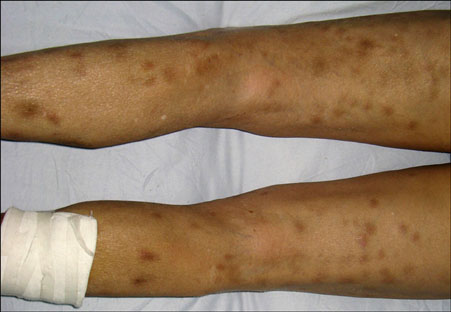
Fig. 1 Erythematous and violaceous nodules on the extremities.
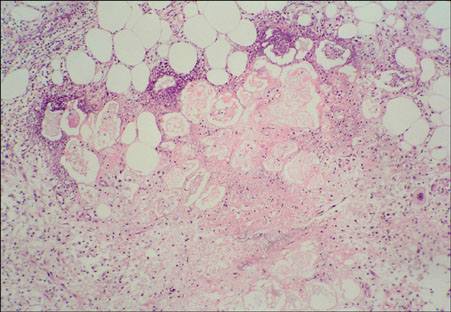
Fig. 2 The skin biopsy showing pancreatic panniculitis with colliquative necrosis of adipocytes, ghost-like cells, an inflammatory infiltration and lipid-laden, foamy histiocytes (H&E, ×200).

Fig. 3 Computed tomography scan showed a large mass with central necrosis in the body and tail of the pancreas.
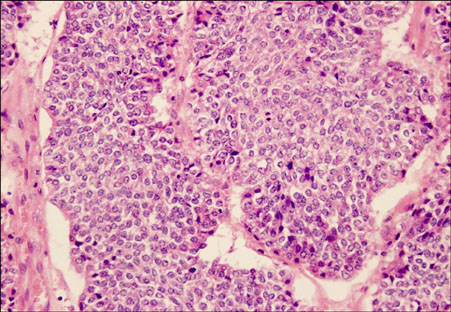
Fig. 4 The histological section of the pancreatic acinar cell carcinoma shows the acinar structure and a solid pattern with uniform nuclei (H&E, ×400).
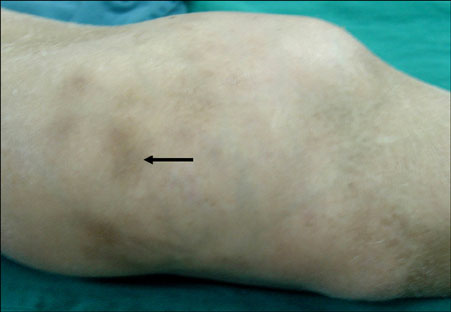
Fig. 5 On the follow up at two months, the skin lesions regressed with subcutaneous pigmentation on the swollen left knee (arrows).
Cited by 1 articles
-
Pancreatic Panniculitis in Patients with Chronic Pancreatitis: Case Report and Review of Literature
Eui Joong Kim, Min Su Chu, Ki Chang Sohn, Dong Ho Cho, Ga Hye Na, Haak Cheoul Kim, Eun Young Cho
Korean J Gastroenterol. 2017;69(1):83-86. doi: 10.4166/kjg.2017.69.1.83.
Reference
-
1. Chiari H. Über die Sogenannte Fettnekrose. Prager Med Wochenschr. 1883. 8:285–286.2. Dahl PR, Su WP, Cullimore KC, Dicken CH. Pancreatic panniculitis. J Am Acad Dermatol. 1995. 33:413–417.
Article3. Narváez J, Bianchi MM, Santo P, de la Fuente D, Ríos-Rodriguez V, Bolao F, et al. Pancreatitis, panniculitis, and polyarthritis. Semin Arthritis Rheum. 2010. 39:417–423.
Article4. Berkovic D, Hallermann C. Carcinoma of the pancreas with neuroendocrine differentiation and nodular panniculitis. Onkologie. 2003. 26:473–476.
Article5. Beltraminelli HS, Buechner SA, Häusermann P. Pancreatic panniculitis in a patient with an acinar cell cystadenocarcinoma of the pancreas. Dermatology. 2004. 208:265–267.
Article6. Suwattee P, Cham PM, Pope E, Ho N. Pancreatic panniculitis in a 4-year-old child with nephrotic syndrome. Pediatr Dermatol. 2007. 24:659–660.
Article7. Mourad FH, Hannoush HM, Bahlawan M, Uthman I, Uthman S. Panniculitis and arthritis as the presenting manifestation of chronic pancreatitis. J Clin Gastroenterol. 2001. 32:259–261.
Article8. Haber RM, Assaad DM. Panniculitis associated with a pancreas divisum. J Am Acad Dermatol. 1986. 14:331–334.
Article9. López A, García Estañ J, Marras C, Castaño M, Rojas MJ, Garre C, et al. Pancreatitis associated with pleural-mediastinal pseudocyst, panniculitis and polyarthritis. Clin Rheumatol. 1998. 17:335–339.
Article10. Antoine M, Khitrik-Palchuk M, Saif MW. Long-term survival in a patient with acinar cell carcinoma of pancreas. A case report and review of literature. JOP. 2007. 8:783–789.11. Jovanović M, Golušin Z, Petrović A, Vučković N, Brkić S, Sotirović-Seničar S, et al. Lobular panniculitis: a manifestation of pancreatic tumor with fatal outcome. Arch Oncol. 2005. 13:153–155.
Article12. Chi ZC, Ma SZ. Rheumatologic manifestations of hepatic diseases. Hepatobiliary Pancreat Dis Int. 2003. 2:32–37.13. García-Romero D, Vanaclocha F. Pancreatic panniculitis. Dermatol Clin. 2008. 26:465–470.
Article14. Requena L. Normal subcutaneous fat, necrosis of adipocytes and classification of the panniculitides. Semin Cutan Med Surg. 2007. 26:66–70.
Article15. Ball NJ, Adams SP, Marx LH, Enta T. Possible origin of pancreatic fat necrosis as a septal panniculitis. J Am Acad Dermatol. 1996. 34:362–364.
Article16. Zellman GL. Pancreatic panniculitis. J Am Acad Dermatol. 1996. 35:282–283.
Article17. Lewis CT 3rd, Tschen JA, Klima M. Subcutaneous fat necrosis associated with pancreatic islet cell carcinoma. Am J Dermatopathol. 1991. 13:52–56.
Article18. Preiss JC, Faiss S, Loddenkemper C, Zeitz M, Duchmann R. Pancreatic panniculitis in an 88-year-old man with neuroendocrine carcinoma. Digestion. 2002. 66:193–196.
Article19. Durden FM, Variyam E, Chren MM. Fat necrosis with features of erythema nodosum in a patient with metastatic pancreatic carcinoma. Int J Dermatol. 1996. 35:39–41.
Article
- Full Text Links
-
- Actions
-
Cited
- CITED
-
- Close
- Share
-
- Similar articles
-
- Polyarthritis and Pancreatic Panniculitis in a Patient with Pancreatic Acinar Cell Carcinoma
- A Case of Acinar Cell Carcinoma of the Pancreas
- Acinar Cell Carcinoma of the Pancreas: A case report
- Mixed acinar-endocrine carcinoma of the pancreas: a case report
- A case of acinar cell carcinoma of the pancreas


