
J Gynecol Oncol.
2014 Oct;25(4):272-278. 10.3802/jgo.2014.25.4.272.
Defining the concept of locally advanced squamous cell carcinoma of the vulva: a new perspective based on standardization of criteria and current evidence
- Affiliations
-
- 1Department of Gynecologic Oncology, Oncology Hospital of Buenos Aires Marie Curie, Buenos Aires, Argentina. alearagona2@gmail.com
- 2Unit of Gynecologic Oncology, Donacion Francisco Santojanni Hospital, Buenos Aires, Argentina.
- 3Unit of Gynecologic Oncology, Parmenio Pinero Hospital, Buenos Aires, Argentina.
- KMID: 2130113
- DOI: http://doi.org/10.3802/jgo.2014.25.4.272
Abstract
- The phrase "locally advanced carcinoma of the vulva" has often been mentioned in the literature, though not accurately defined, or even leading to the interpretation overlapping. Grounded on cervical cancer experience, we are able to state that designing a tailored primary strategy based on clinically measurable adverse prognostic factors represents the cornerstone of therapy. This fact urged us to rethink about the real usefulness of the concept of locally advanced squamous cell carcinoma of the vulva. We will refer to this concept as a clinical entity emerging from a rigorous workup which is a valuable guiding tool in the context of a thorough debate about the best primary treatment approach to be used. Furthermore, bulky tumors of the vulva have been associated with a worse prognosis on several occasions. Some authors have questioned the fact that tumor size has not been considered in the staging system. Finally, a standardized definition will help us compare the results obtained, which is extremely necessary given the worldwide low prevalence of this disease.
Keyword
MeSH Terms
Figure
-
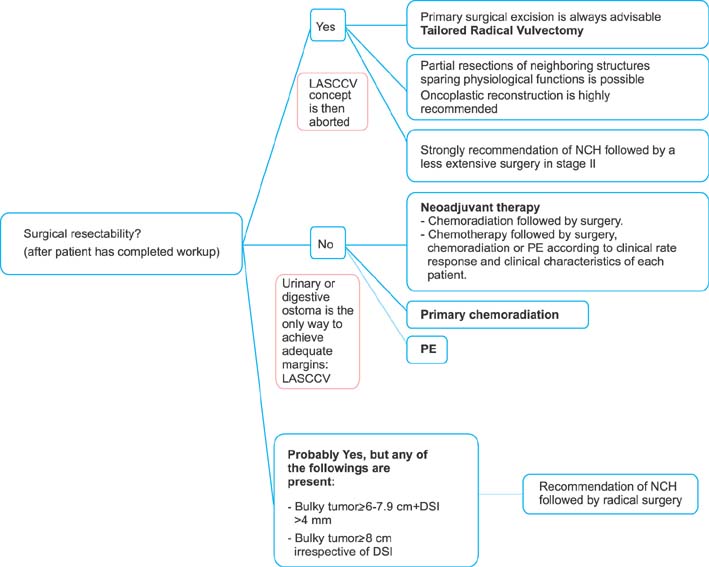
Fig. 1 Authors recommendations for the management of probably locally advanced squamous cell carcinoma of the vulva (LASCCV): primary treatment of local disease. DSI, depth of stromal invasion; NCH, neoadjuvant chemotherapy; PE, pelvic exenteration.
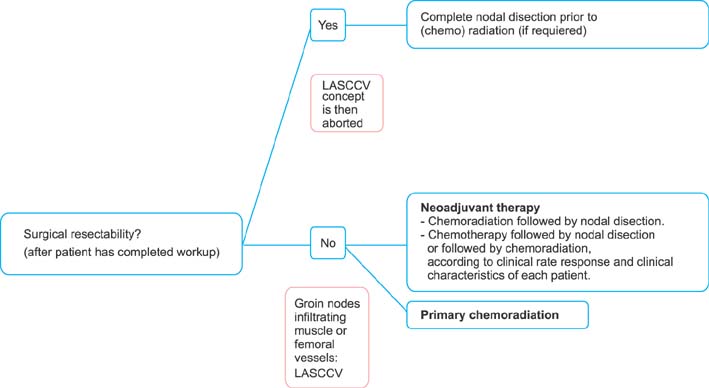
Fig. 2 Authors recommendations for the management of probably locally advanced squamous cell carcinoma of the vulva (LASCCV): primary treatment of regional disease.
Reference
-
1. Daily LJ, Kaplan AL, Kaufman RH. Exenteration for advanced carcinoma of the vulva. Obstet Gynecol. 1970; 36:845–849.2. Howlader N, Noone AM, Krapcho M, Neyman N, Aminou R, Waldron W, et al. SEER cancer statistics review, 1975-2008. Bethesda, MD: National Cancer Institute;2012.3. Pecorelli S. Revised FIGO staging for carcinoma of the vulva, cervix, and endometrium. Int J Gynaecol Obstet. 2009; 105:103–104.4. Tabbaa ZM, Gonzalez J, Sznurkowski JJ, Weaver AL, Mariani A, Cliby WA. Impact of the new FIGO 2009 staging classification for vulvar cancer on prognosis and stage distribution. Gynecol Oncol. 2012; 127:147–152.5. de Mooij Y, Burger MP, Schilthuis MS, Buist M, van der Velden J. Partial urethral resection in the surgical treatment of vulvar cancer does not have a significant impact on urinary continence: a confirmation of an authority-based opinion. Int J Gynecol Cancer. 2007; 17:294–297.6. Barton DP, Hoffman MS, Roberts WS, Fiorica JV, Finan MA, Gleeson N, et al. Use of local flaps in the preservation of fecal continence following resection of perianal neoplasias. Int J Gynecol Cancer. 1993; 3:318–323.7. Aragona AM, Cuneo N, Soderini AH, Alcoba E, Greco A, Reyes C, et al. Tailoring the treatment of locally advanced squamous cell carcinoma of the vulva: neoadjuvant chemotherapy followed by radical surgery: results from a multicenter study. Int J Gynecol Cancer. 2012; 22:1258–1263.8. Montana GS, Thomas GM, Moore DH, Saxer A, Mangan CE, Lentz SS, et al. Preoperative chemo-radiation for carcinoma of the vulva with N2/N3 nodes: a gynecologic oncology group study. Int J Radiat Oncol Biol Phys. 2000; 48:1007–1013.9. Shylasree TS, Bryant A, Howells RE. Chemoradiation for advanced primary vulval cancer. Cochrane Database Syst Rev. 2011; (4):CD003752.10. Classification and staging of malignant tumours in the female pelvis. Acta Obstet Gynecol Scand. 1971; 50:1–7.11. Franklin EW 3rd. Clinical staging of carcinoma of the vulva. Obstet Gynecol. 1972; 40:277–286.12. Morley GW. Cancer of the vulva: a review. Cancer. 1981; 48:2 Suppl. 597–601.13. Homesley HD, Bundy BN, Sedlis A, Yordan E, Berek JS, Jahshan A, et al. Prognostic factors for groin node metastasis in squamous cell carcinoma of the vulva (a Gynecologic Oncology Group study). Gynecol Oncol. 1993; 49:279–283.14. Podratz KC, Symmonds RE, Taylor WF, Williams TJ. Carcinoma of the vulva: analysis of treatment and survival. Obstet Gynecol. 1983; 61:63–74.15. Friedrich EG Jr, diPaola GR. Postoperative staging of vulvar carcinoma: a retrospective study. Int J Gynaecol Obstet. 1977; 15:270–274.16. Announcements: FIGO stages 1998 revision. Gynecol Oncol. 1989; 35:125–127.17. Krupp PJ, Lee FY, Bohm JW, Batson HW, Diem JE, Lemire JE. Prognostic parameters and clinical staging criteria in the epidermoid carcinoma of the vulva. Obstet Gynecol. 1975; 46:84–88.18. Podratz KC, Symmonds RE, Taylor WF. Carcinoma of the vulva: analysis of treatment failures. Am J Obstet Gynecol. 1982; 143:340–351.19. Andreasson B, Nyboe J. Value of prognostic parameters in squamous cell carcinoma of the vulva. Gynecol Oncol. 1985; 22:341–351.20. Rutledge FN, Mitchell MF, Munsell MF, Atkinson EN, Bass S, McGuffee V, et al. Prognostic indicators for invasive carcinoma of the vulva. Gynecol Oncol. 1991; 42:239–244.21. Homesley HD, Bundy BN, Sedlis A, Yordan E, Berek JS, Jahshan A, et al. Assessment of current International Federation of Gynecology and Obstetrics staging of vulvar carcinoma relative to prognostic factors for survival (a Gynecologic Oncology Group study). Am J Obstet Gynecol. 1991; 164:997–1003.22. Paladini D, Cross P, Lopes A, Monaghan JM. Prognostic significance of lymph node variables in squamous cell carcinoma of the vulva. Cancer. 1994; 74:2491–2496.23. Kirschner CV, Yordan EL, De Geest K, Wilbanks GD. Smoking, obesity, and survival in squamous cell carcinoma of the vulva. Gynecol Oncol. 1995; 56:79–84.24. Smyczek-Gargya B, Volz B, Geppert M, Dietl J. A multivariate analysis of clinical and morphological prognostic factors in squamous cell carcinoma of the vulva. Gynecol Obstet Invest. 1997; 43:261–267.25. Aragona AM, Cuneo NA, Soderini AH, Alcoba EB. An analysis of reported independent prognostic factors for survival in squamous cell carcinoma of the vulva: is tumor size significance being underrated? Gynecol Oncol. 2014; 132:643–648.26. Kosary CL. FIGO stage, histology, histologic grade, age and race as prognostic factors in determining survival for cancers of the female gynecological system: an analysis of 1973-87 SEER cases of cancers of the endometrium, cervix, ovary, vulva, and vagina. Semin Surg Oncol. 1994; 10:31–46.27. Hacker NF. Revised FIGO staging for carcinoma of the vulva. Int J Gynaecol Obstet. 2009; 105:105–106.28. Rouzier R, Preti M, Sideri M, Paniel BJ, Jones RW. A suggested modification to FIGO stage III vulvar cancer. Gynecol Oncol. 2008; 110:83–86.29. Sznurkowski JJ. Letter to the Editor referring to the manuscript entitled: "New FIGO staging system of vulvar cancer indeed provides a better reflection of prognosis" recently reported by van der Steen S. et al., (Gynecol Oncol 2010;119:520-5. Epub 2010 Sep 28). Gynecol Oncol. 2011; 121:424–425.30. Moore DH, Ali S, Koh WJ, Michael H, Barnes MN, McCourt CK, et al. A phase II trial of radiation therapy and weekly cisplatin chemotherapy for the treatment of locally-advanced squamous cell carcinoma of the vulva: a gynecologic oncology group study. Gynecol Oncol. 2012; 124:529–533.31. Piver MS, Chung WS. Prognostic significance of cervical lesion size and pelvic node metastases in cervical carcinoma. Obstet Gynecol. 1975; 46:507–510.32. Delgado G, Bundy B, Zaino R, Sevin BU, Creasman WT, Major F. Prospective surgical-pathological study of disease-free interval in patients with stage IB squamous cell carcinoma of the cervix: a Gynecologic Oncology Group study. Gynecol Oncol. 1990; 38:352–357.33. Landoni F, Maneo A, Colombo A, Placa F, Milani R, Perego P, et al. Randomised study of radical surgery versus radiotherapy for stage Ib-IIa cervical cancer. Lancet. 1997; 350:535–540.34. Perez CA, Grigsby PW, Chao KS, Mutch DG, Lockett MA. Tumor size, irradiation dose, and long-term outcome of carcinoma of uterine cervix. Int J Radiat Oncol Biol Phys. 1998; 41:307–317.35. Horn LC, Fischer U, Raptis G, Bilek K, Hentschel B. Tumor size is of prognostic value in surgically treated FIGO stage II cervical cancer. Gynecol Oncol. 2007; 107:310–315.36. International Federation of Gynecology and Obstetrics. Modifications in the staging for stage I vulvar and stage I cervical cancer: report of the FIGO Committee on Gynecologic Oncology. Int J Gynaecol Obstet. 1995; 50:215–216.37. FIGO Committee on Gynecologic Oncology. Guidelines for Gynaecologic cancers staging classifications and clinical practice pages. 3rd ed. FIGO Committee on Gynecologic Oncology;2006. p. 37–62.38. Chemoradiotherapy for Cervical Cancer Meta-Analysis Collaboration. Reducing uncertainties about the effects of chemoradiotherapy for cervical cancer: a systematic review and meta-analysis of individual patient data from 18 randomized trials. J Clin Oncol. 2008; 26:5802–5812.39. Jemal A, Bray F, Center MM, Ferlay J, Ward E, Forman D. Global cancer statistics. CA Cancer J Clin. 2011; 61:69–90.40. Beller U, Quinn MA, Benedet JL, Creasman WT, Ngan HY, Maisonneuve P, et al. Carcinoma of the vulva. FIGO 26th Annual Report on the Results of Treatment in Gynecological Cancer. Int J Gynaecol Obstet. 2006; 95:Suppl 1. S7–S27.41. Magrina JF, Stanhope CR, Weaver AL. Pelvic exenterations: supralevator, infralevator, and with vulvectomy. Gynecol Oncol. 1997; 64:130–135.42. Chiantera V, Rossi M, De Iaco P, Koehler C, Marnitz S, Fagotti A, et al. Morbidity after pelvic exenteration for gynecological malignancies: a retrospective multicentric study of 230 patients. Int J Gynecol Cancer. 2014; 24:156–164.43. Chan JK, Sugiyama V, Pham H, Gu M, Rutgers J, Osann K, et al. Margin distance and other clinico-pathologic prognostic factors in vulvar carcinoma: a multivariate analysis. Gynecol Oncol. 2007; 104:636–641.44. Chan JK, Sugiyama V, Tajalli TR, Pham H, Gu M, Rutgers J, et al. Conservative clitoral preservation surgery in the treatment of vulvar squamous cell carcinoma. Gynecol Oncol. 2004; 95:152–156.
- Full Text Links
-
- Actions
-
Cited
- CITED
-
- Close
- Share
-
- Similar articles
-
- The Current Evidence on Neoadjuvant Therapy for Locally Advanced Esophageal Squamous Cell Carcinoma
- A Case of Squamous Cell Carcinoma following Erosive Lichen Planus of the Vulva
- A Case of Vulvar Carcinoma: Squamous Cell Carcinoma with Sarcomatoid Features
- Adenoid Squamous Cell Carcinoma of the Vulva: Report of a case
- Role of paclitaxel and cisplatin as the neoadjuvant treatment for locally advanced squamous cell carcinoma of the vulva


