
J Gastric Cancer.
2017 Jun;17(2):162-172. 10.5230/jgc.2017.17.e20.
Clinicopathological Features and Survival of Patients with Gastric Cancer with a Family History: a Large Analysis of 2,736 Patients with Gastric Cancer

- Affiliations
-
- 1Division of Gastroenterological Surgery, Department of Surgery, Chonnam National University School of Medicine, Gwangju, Korea. zuchum@naver.com
- KMID: 2383739
- DOI: http://doi.org/10.5230/jgc.2017.17.e20
Abstract
- PURPOSE
Previous studies indicated conflicting results regarding the prognosis of gastric cancer with a family history (FHX). This study aimed to determine the clinicopathological features and survival of patients with gastric cancer with a FHX.
MATERIALS AND METHODS
We reviewed 2,736 patients with gastric cancer who underwent surgery between 2003 and 2009. The prognostic value of a FHX was determined in the multivariate model after adjusting for variables in the Asian and internationally validated prognostic models.
RESULTS
Of the patients, 413 (15.1%) had a FHX of gastric cancer. The patients with a FHX were younger (58.1 vs. 60.4 years; P<0.001) than the patients without a FHX. There were no significant differences in the histopathological characteristics between the 2 groups. A FHX was associated with a better overall survival (OS) rate only in the stage I group (5-year survival rate, 95% vs. 92%; P=0.006). However, the disease-specific survival (DSS) rate was not significantly different between the 2 groups in all stages. The multivariate model adjusted for the variables in the Asian and internationally validated prognostic models revealed that FHX has no significant prognostic value for OS and DSS.
CONCLUSIONS
The clinicopathological features and survival of the patients with gastric cancer with a FHX did not significantly differ from those of the patients without a FHX.
Figure
-

Fig. 1 (A) Survival of the patients with and without a FHX. (B) Survival of familial gastric cancer and gastric cancer without a FHX. (C) Survival according to the degree of FHX. FHX = family history.
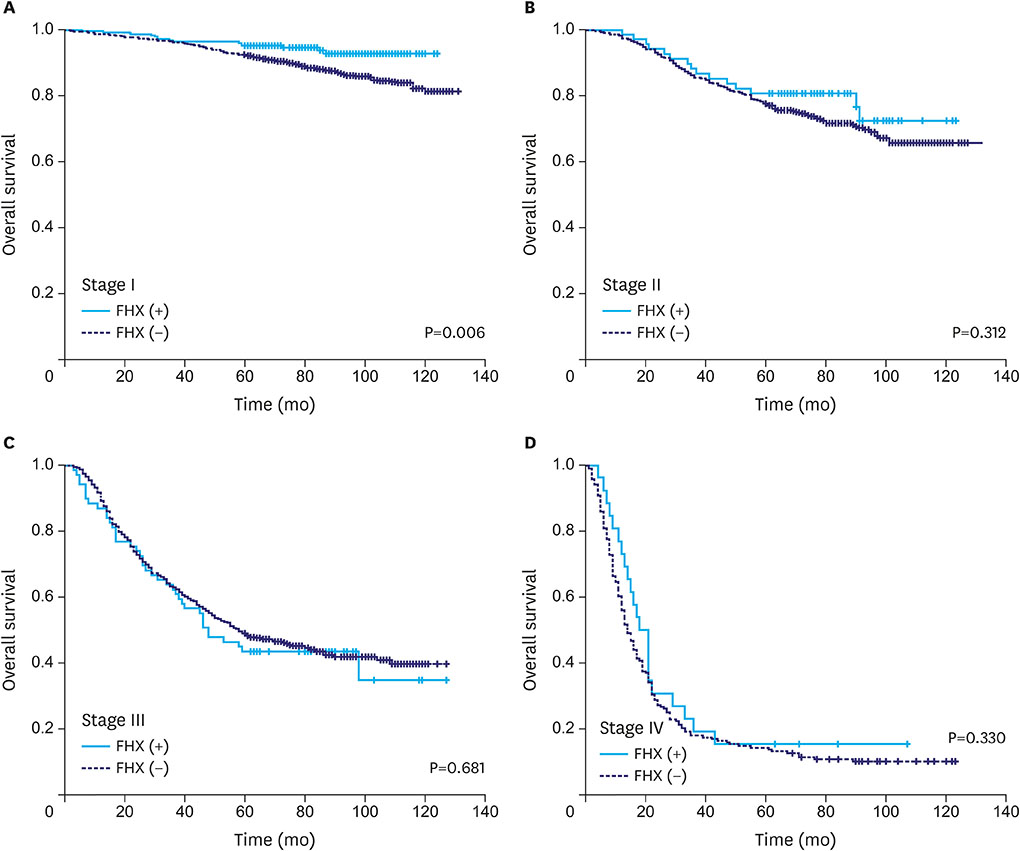
Fig. 2 OS of the patients with and without a FHX of gastric cancer in different tumor stages. A difference in the OS is only found in the stage I group. OS = overall survival; FHX = family history.
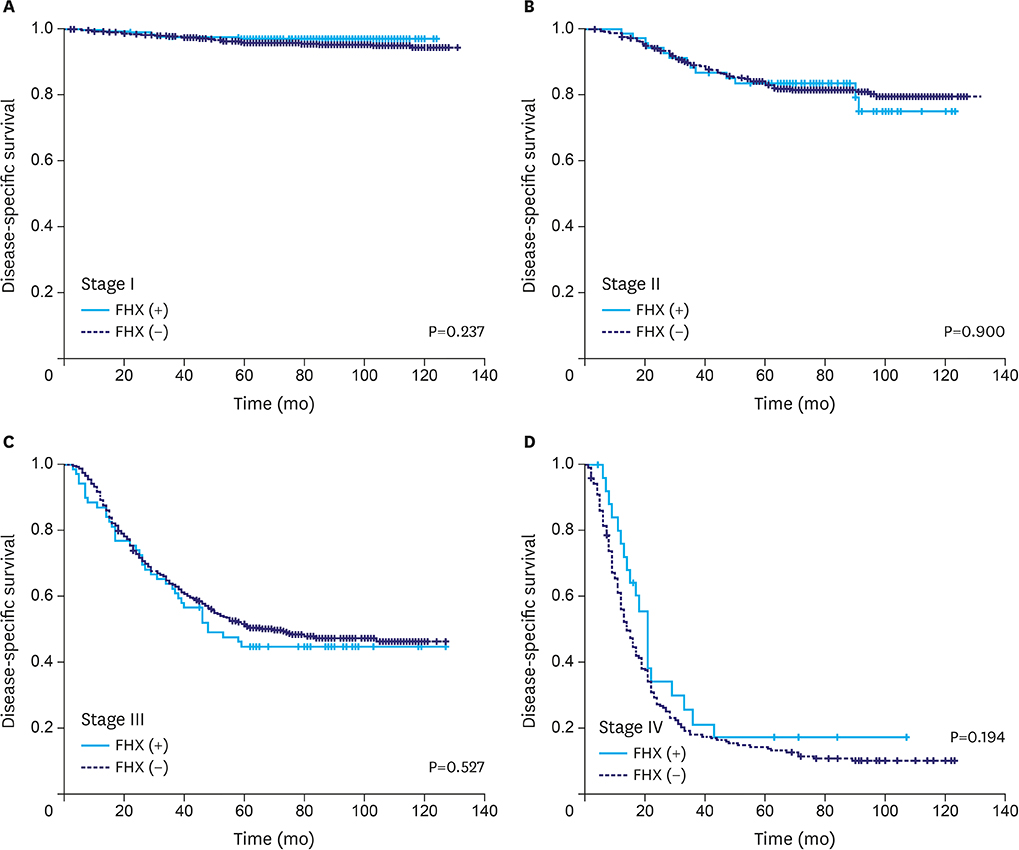
Fig. 3 DSS of the patients with and without a FHX of gastric cancer in different tumor stages. The DSS rates are not significantly different between the groups at any disease stage. DSS = disease-specific survival; FHX = family history.
Reference
-
1. Parkin DM, Ferlay J, Curado MP, Bray F, Edwards B, Shin HR, et al. Fifty years of cancer incidence: CI5 I–IX. Int J Cancer. 2010; 127:2918–2927.2. Huang JQ, Sridhar S, Chen Y, Hunt RH. Meta-analysis of the relationship between Helicobacter pylori seropositivity and gastric cancer. Gastroenterology. 1998; 114:1169–1179.3. Tsugane S, Sasazuki S. Diet and the risk of gastric cancer: review of epidemiological evidence. Gastric Cancer. 2007; 10:75–83.4. Setia N, Clark JW, Duda DG, Hong TS, Kwak EL, Mullen JT, et al. Familial gastric cancers. Oncologist. 2015; 20:1365–1377.5. Crew KD, Neugut AI. Epidemiology of gastric cancer. World J Gastroenterol. 2006; 12:354–362.6. Yatsuya H, Toyoshima H, Mizoue T, Kondo T, Tamakoshi K, Hori Y, et al. Family history and the risk of stomach cancer death in Japan: differences by age and gender. Int J Cancer. 2002; 97:688–694.7. Yaghoobi M, Bijarchi R, Narod SA. Family history and the risk of gastric cancer. Br J Cancer. 2010; 102:237–242.8. Shin CM, Kim N, Lee HS, Lee DH, Kim JS, Jung HC, et al. Intrafamilial aggregation of gastric cancer: a comprehensive approach including environmental factors, Helicobacter pylori virulence, and genetic susceptibility. Eur J Gastroenterol Hepatol. 2011; 23:411–417.9. Ebert MP, Malfertheiner P. Pathogenesis of sporadic and familial gastric cancer--implications for clinical management and cancer prevention. Aliment Pharmacol Ther. 2002; 16:1059–1066.10. Palli D, Russo A, Saieva C, Salvini S, Amorosi A, Decarli A. Dietary and familial determinants of 10-year survival among patients with gastric carcinoma. Cancer. 2000; 89:1205–1213.11. Gao Y, Hu N, Han X, Giffen C, Ding T, Goldstein A, et al. Family history of cancer and risk for esophageal and gastric cancer in Shanxi, China. BMC Cancer. 2009; 9:269–279.12. Lee WJ, Hong RL, Lai IR, Chen CN, Lee PH, Huang MT. Clinicopathologic characteristics and prognoses of gastric cancer in patients with a positive familial history of cancer. J Clin Gastroenterol. 2003; 36:30–33.13. Han MA, Oh MG, Choi IJ, Park SR, Ryu KW, Nam BH, et al. Association of family history with cancer recurrence and survival in patients with gastric cancer. J Clin Oncol. 2012; 30:701–708.14. Sobin LH, Gospodarowicz MK, Wittekind C. TNM Classification of Malignant Tumours. New York (NY): John Wiley & Sons;2011.15. Japanese Gastric Cancer Association. Japanese gastric cancer treatment guidelines 2010 (ver. 3). Gastric Cancer. 2011; 14:113–123.16. Woo Y, Son T, Song K, Okumura N, Hu Y, Cho GS, et al. A novel prediction model of prognosis after gastrectomy for gastric carcinoma: development and validation using Asian databases. Ann Surg. 2016; 264:114–120.17. Kattan MW, Karpeh MS, Mazumdar M, Brennan MF. Postoperative nomogram for disease-specific survival after an R0 resection for gastric carcinoma. J Clin Oncol. 2003; 21:3647–3650.18. Fang WL, Chang SC, Lan YT, Huang KH, Lo SS, Li AF, et al. Molecular and survival differences between familial and sporadic gastric cancers. Biomed Res Int. 2013; 2013:396272.19. Hemminki K, Sundquist J, Ji J. Is family history associated with improved survival in patients with gastric cancer? J Clin Oncol. 2012; 30:3150–3151.20. Kanemitsu K, Kawasaki K, Nakamura M, Li D, Yasuda T, Kuroda D, et al. MSI is frequently recognized among gastric cancer patients with a family history of cancer. Hepatogastroenterology. 2007; 54:2410–2414.21. Pedrazzani C, Corso G, Velho S, Leite M, Pascale V, Bettarini F, et al. Evidence of tumor microsatellite instability in gastric cancer with familial aggregation. Fam Cancer. 2009; 8:215–220.22. El-Omar EM, Rabkin CS, Gammon MD, Vaughan TL, Risch HA, Schoenberg JB, et al. Increased risk of noncardia gastric cancer associated with proinflammatory cytokine gene polymorphisms. Gastroenterology. 2003; 124:1193–1201.23. Brenner H, Bode G, Boeing H. Helicobacter pylori infection among offspring of patients with stomach cancer. Gastroenterology. 2000; 118:31–35.24. Ebert MP, Yu J, Miehlke S, Fei G, Lendeckel U, Ridwelski K, et al. Expression of transforming growth factor beta-1 in gastric cancer and in the gastric mucosa of first-degree relatives of patients with gastric cancer. Br J Cancer. 2000; 82:1795–1800.25. Kluijt I, Sijmons RH, Hoogerbrugge N, Plukker JT, de Jong D, van Krieken JH, et al. Familial gastric cancer: guidelines for diagnosis, treatment and periodic surveillance. Fam Cancer. 2012; 11:363–369.26. Shinmura K, Kohno T, Takahashi M, Sasaki A, Ochiai A, Guilford P, et al. Familial gastric cancer: clinicopathological characteristics, RER phenotype and germline p53 and E-cadherin mutations. Carcinogenesis. 1999; 20:1127–1131.27. Kim SJ, Cho SJ, Heo SC, Yang HK, Kim WH, Park JG, et al. The incidence of hereditary gastric cancer in Korean. J Korean Cancer Assoc. 2000; 32:1–6.28. Kerber RA, Slattery ML. Comparison of self-reported and database-linked family history of cancer data in a case-control study. Am J Epidemiol. 1997; 146:244–248.
- Full Text Links
-
- Actions
-
Cited
- CITED
-
- Close
- Share
-
- Similar articles
-
- Characteristics of Gastric Cancer Patients with Family History
- Clinicopathological Features of Borrmann Type IV Gastric Carcinomas
- Clinicopathological Features and Prognosis of Gastric Cancer in Young Patients
- The Metformin Use and Gastric Cancer Risk
- Operative Treatment of Patients Over 75 Years Old with Gastric Cancer


