J Korean Med Assoc.
2013 Jun;56(6):478-484.
Evidence-based stress management: focusing on nonpharmacological procedure which reduce stress and promote health
- Affiliations
-
- 1Department of Family Medicien, Seoul National University Hospital, Seoul, Korea. msp20476@hanmail.net
Abstract
- In modern society, stress is one of the most significant problems affecting physical as well as mental health. Stress, which is defined as a situation in which the homeostasis of the physiological system of one's mind and body is threatened, is composed of two concepts: stressors and stress reactions. A stressor is the stimulus that is perceived as a threat and arouses a stress reaction, such as a disaster or serious life event. Stress reactions are physical and mental symptoms, for example, chest tightness, dizziness, abdominal pain, dyspepsia, headache, and agitation, which are mediated by the sympathetic nervous system and stress hormones such as cortisol. These reactions, along with stress-related unhealthy behaviors, result in serious chronic diseases, including cancers and cardiovascular disease. Stress coping methods are classified into two components: cognitive behavioral interventions for stressors and mind-body interventions to reduce the stress response. Various interventions have been identified: progressive muscle relaxation, autogenic training, relaxation response, biofeedback, the emotional freedom technique, guided imagery, diaphragmatic breathing, transcendental meditation, and mindfulness-based stress reduction. Meditation and progressive muscular relaxation are well-known and widely used procedures to reduce the stress response and to improve quality of life. Further studies to establish an evidence-based standardized program that can be easily applied at the individual level are needed.
Keyword
MeSH Terms
-
Abdominal Pain
Autogenic Training
Biofeedback, Psychology
Cardiovascular Diseases
Chronic Disease
Dihydroergotamine
Disasters
Dizziness
Dyspepsia
Freedom
Headache
Homeostasis
Hydrocortisone
Imagery (Psychotherapy)
Meditation
Mental Health
Muscle Relaxation
Quality of Life
Relaxation
Respiration
Stress, Psychological
Sympathetic Nervous System
Thorax
Dihydroergotamine
Hydrocortisone
Figure
-
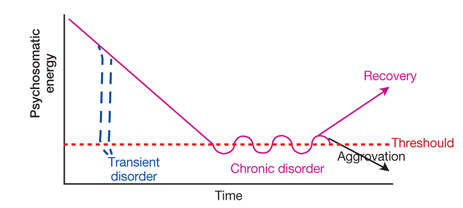
Figure 1 Psychosomatic energy and threshold for symptom presentation. From Department of Family Medicine, Seoul National University College of Medicine. Functional disease and stress management. Seoul: Korea Medicine; 2005, with permission department of Family Medicine, Seoul National University College of Medicine [6].
Reference
-
1. Selye H. The stress of life. New York: McGraw-Hill;1956.2. Cannon WB. The wisdom of the body. New York: Norton;1932.3. McEwen BS, Stellar E. Stress and the individual: mechanisms leading to disease. Arch Intern Med. 1993; 153:2093–2101.
Article4. Fisher S, Reason JT. Handbook of life stress, cognition, and health. Chichester: Wiley;1988.5. Sardinha A, Freire RC, Zin WA, Nardi AE. Respiratory manifestations of panic disorder: causes, consequences and therapeutic implications. J Bras Pneumol. 2009; 35:698–708.
Article6. Department of Family Medicine, Seoul National University College of Medicine. Functional disease and stress management. Seoul: Korea Medicine;2005.7. Glass DC, McKnight JD. Perceived control, depressive symptomatology, and professional burnout: a review of the evidence. Psycol Health. 1996; 11:23–48.
Article8. Kang YS. Stress management and mind-body medicine: focusing on relaxation and meditation. J Korean Med Assoc. 2011; 54:284–293.
Article9. Holmes TH, Rahe RH. The social readjustment rating scale. J Psychosom Res. 1967; 11:213–218.
Article10. Greenberg JS. Comprehensive stress management. 9th ed. Boston: McGraw-Hill;2006.11. Okun MA, Wanheung Yeung E, Brown S. Volunteering by older adults and risk of mortality: a meta-analysis. Psychol Aging. 2013; 02. 18. [Epub].
Article12. Dishman RK, Sui X, Church TS, Hand GA, Trivedi MH, Blair SN. Decline in cardiorespiratory fitness and odds of incident depression. Am J Prev Med. 2012; 43:361–368.
Article13. De la Fuente-Fernandez R, Ruth TJ, Sossi V, Schulzer M, Calne DB, Stoessl AJ. Expectation and dopamine release: mechanism of the placebo effect in Parkinson's disease. Science. 2001; 293:1164–1166.
Article14. Varvogli L, Darviri C. Stress management techniques: evidence-based procedures that reduce stress and promote health. Health Sci J. 2011; 5:74–82.15. Holmes DS, Roth DL. Effects of aerobic exercise training and relaxation training on cardiovascular activity during psychological stress. J Psychosom Res. 1988; 32:469–474.
Article16. Leckey J. The therapeutic effectiveness of creative activities on mental well-being: a systematic review of the literature. J Psychiatr Ment Health Nurs. 2011; 18:501–509.
Article17. Bungay H, Clift S. Arts on prescription: a review of practice in the U.K. Perspect Public Health. 2010; 130:277–281.
Article18. De Berry S. An evaluation of progressive muscle relaxation on stress related symptoms in a geriatric population. Int J Aging Hum Dev. 1981-1982; 14:255–269.
Article19. Rainforth MV, Schneider RH, Nidich SI, Gaylord-King C, Salerno JW, Anderson JW. Stress reduction programs in patients with elevated blood pressure: a systematic review and meta-analysis. Curr Hypertens Rep. 2007; 9:520–528.
Article20. Lolak S, Connors GL, Sheridan MJ, Wise TN. Effects of progressive muscle relaxation training on anxiety and depression in patients enrolled in an outpatient pulmonary rehabilitation program. Psychother Psychosom. 2008; 77:119–125.
Article21. Marchand WR. Mindfulness-based stress reduction, mindfulness-based cognitive therapy, and Zen meditation for depression, anxiety, pain, and psychological distress. J Psychiatr Pract. 2012; 18:233–252.
Article22. University of Massachusetts Medical School. [Internet]. Worcester: University of Massachusetts Medical School;cited 2011 Jan 11. Available from: http://www.umassmed.edu/cfm/index.aspx.23. Stetter F, Kupper S. Autogenic training: a meta-analysis of clinical outcome studies. Appl Psychophysiol Biofeedback. 2002; 27:45–98.24. Butler AC, Chapman JE, Forman EM, Beck AT. The empirical status of cognitive-behavioral therapy: a review of meta-analyses. Clin Psychol Rev. 2006; 26:17–31.
Article25. Knapp P, Beck AT. Cognitive therapy: foundations, conceptual models, applications and research. Rev Bras Psiquiatr. 2008; 30:Suppl 2. s54–s64.
- Full Text Links
-
- Actions
-
Cited
- CITED
-
- Close
- Share
-
- Similar articles
-
- Psychological Stress Management in Primary Care
- Relationship between Infertility Stress and Quality of Life of Infertile Women: Based on the Moderating and Mediating Effects of Sexual Satisfaction
- The School Related Stress and the Need of Mental Health Education among High School Students
- The Effects of a Stress Management Program on Job Stress in a Hotel Culinary Staff
- Factors Affecting the Depressive Mood Experience in Local Residents: Focusing on Gangseo-gu, Seoul