
Korean J Urol.
2013 Oct;54(10):651-659.
Management of Complications After Tension-Free Midurethral Slings
- Affiliations
-
- 1Department of Urology, Istanbul University Cerrahpasa Medical School, Istanbul, Turkey.
- 2Department of Urology, Marmara University School of Medicine, Istanbul, Turkey. tufan@marmara.edu.tr
Abstract
- Since their introduction in 1996, tension-free midurethral slings (MUS) have been proven to have long-term efficacy and safety. They are considered the gold standard treatment of female stress urinary incontinence, especially in cases that are associated with urethral hypermobility. However, they are not free of complications and, although rare, some of these complications can be challenging for both patients and physicians. Some complications occur intraoperatively, whereas others appear in the early or late postoperative period. There is less controversy in the diagnosis and treatment of complications such as vaginal extrusion or urinary system erosion, whereas de novo voiding problems are at best not completely understood. Voiding dysfunction after MUS placement may vary in a wide range from urinary frequency or urgency to retention and is usually attributed to the obstructive or irritative effect of the sling. However, present urodynamic criteria for the diagnosis of female infravesical obstruction are not satisfactory, and the best management policy for de novo voiding dysfunction remains controversial. In the majority of cases, the diagnosis of obstruction leading to a urethral release surgery depends on a combination of several clinical findings. The timing of urethral release surgery varies depending on the preferences of the surgeon, and the outcome of this surgery is not always predictable. The purpose of this review was to assess the diagnosis and management of the immediate, short-term, and long-term complications of MUS in light of the current literature in an attempt to determine the best management policy.
MeSH Terms
Figure
-
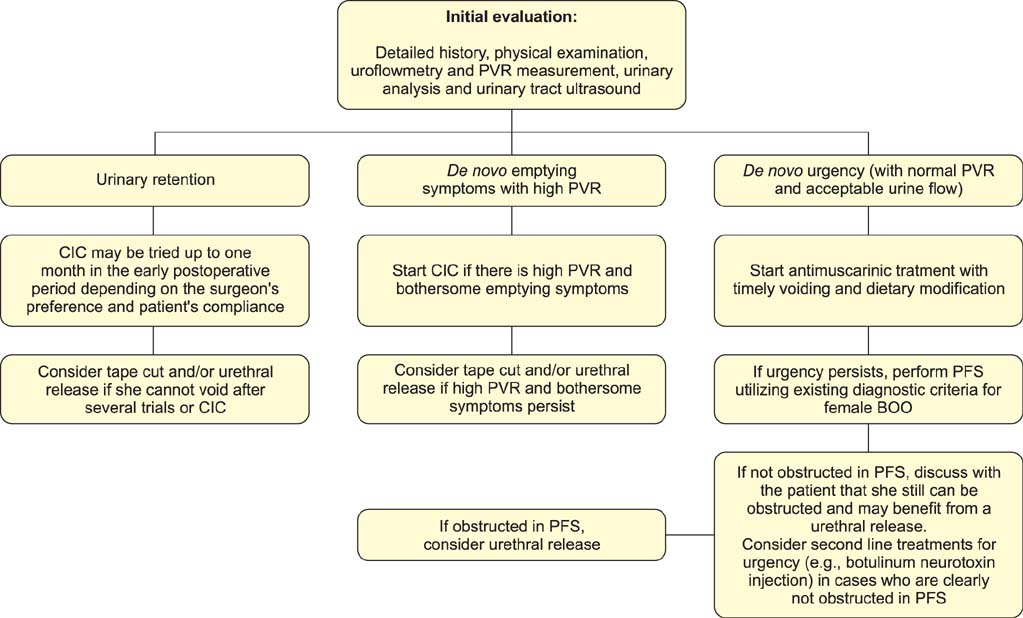
FIG. 1 An algorithm for the management of de novo voiding dysfunction after midurethral sling. PVR, postvoiding residual; CIC, clean intermittent catheterization; PFS, pressure-flow studies; BOO, bladder outlet obstruction.
Reference
-
1. DeLancey JO. Structural support of the urethra as it relates to stress urinary incontinence: the hammock hypothesis. Am J Obstet Gynecol. 1994; 170:1713–1720.2. Petros PE, Ulmsten UI. An integral theory of female urinary incontinence: experimental and clinical considerations. Acta Obstet Gynecol Scand Suppl. 1990; 153:7–31.3. Ulmsten U, Henriksson L, Johnson P, Varhos G. An ambulatory surgical procedure under local anesthesia for treatment of female urinary incontinence. Int Urogynecol J Pelvic Floor Dysfunct. 1996; 7:81–85.4. Delorme E. Transobturator urethral suspension: mini-invasive procedure in the treatment of stress urinary incontinence in women. Prog Urol. 2001; 11:1306–1313.5. Dmochowski RR, Blaivas JM, Gormley EA, Juma S, Karram MM, Lightner DJ, et al. Update of AUA guideline on the surgical management of female stress urinary incontinence. J Urol. 2010; 183:1906–1914.6. FDA Public Health Notification: Serious Complications Associated with Transvaginal Placement of Surgical Mesh in Repair of Pelvic Organ Prolapse and Stress Urinary Incontinence. October 20, 2008 [Internet]. Silver Spring: U.S. Food and Drug Administration;c2013. updated Mar 21 2013. cited Jul 1 2013. Available from: http://www.fda.gov/MedicalDevices/Safety/AlertsandNotices/PublicHealthNotifications/ucm061976.htm.7. FDA Safety Communication: UPDATE on Serious Complications Associated with Transvaginal Placement of Surgical Mesh for Pelvic Organ Prolapse. July 13, 2013 [Internet]. Silver Spring: U.S. Food and Drug Administration;c2013. updated Mar 21 2013. cited Jul 1 2013. Available from: http://www.fda.gov/MedicalDevices/Safety/AlertsandNotices/ucm262435.htm.8. Smith AR, Dmochowski R, Hilton P. Surgery for urinary incontinence. In : Abrams P, Cardozo L, Khoury S, Wein A, editors. Incontinence. 4th ed. Plymouth: Health Publication Ltd;2009. p. 1191–1272.9. Brubaker L, Norton PA, Albo ME, Chai TC, Dandreo KJ, Lloyd KL, et al. Adverse events over two years after retropubic or transobturator midurethral sling surgery: findings from the Trial of Midurethral Slings (TOMUS) study. Am J Obstet Gynecol. 2011; 205:498.10. Flock F, Reich A, Muche R, Kreienberg R, Reister F. Hemorrhagic complications associated with tension-free vaginal tape procedure. Obstet Gynecol. 2004; 104(5 Pt 1):989–994.11. Dmochowski R, Scarpero H, Starkman J. Tension-free vaginal tape procedures. In : Wein AJ, Kavoussi LR, Novick AC, Partin AW, Peters CA, editors. Campbell-Walsh urology. 9th ed. Philadelphia: Saunders;2007. p. 2251–2272.12. Sivanesan K, Abdel-Fattah M, Ghani R. External iliac artery injury during insertion of tension-free vaginal tape: a case report and literature review. Int Urogynecol J Pelvic Floor Dysfunct. 2007; 18:1105–1108.13. Meschia M, Busacca M, Pifarotti P, De Marinis S. Bowel perforation during insertion of tension-free vaginal tape (TVT). Int Urogynecol J Pelvic Floor Dysfunct. 2002; 13:263–265.14. Moore RD, Gamble K, Miklos JR. Tension-free vaginal tape sling for recurrent stress incontinence after transobturator tape sling failure. Int Urogynecol J Pelvic Floor Dysfunct. 2007; 18:309–313.15. Cetinel B, Demirkesen O. Risk factors influencing the complication rates of tension-free vaginal tape-type procedures. Curr Opin Obstet Gynecol. 2005; 17:530–534.16. Kuuva N, Nilsson CG. A nationwide analysis of complications associated with the tension-free vaginal tape (TVT) procedure. Acta Obstet Gynecol Scand. 2002; 81:72–77.17. Long CY, Hsu CS, Wu MP, Liu CM, Wang TN, Tsai EM. Comparison of tension-free vaginal tape and transobturator tape procedure for the treatment of stress urinary incontinence. Curr Opin Obstet Gynecol. 2009; 21:342–347.18. Andonian S, Chen T, St-Denis B, Corcos J. Randomized clinical trial comparing suprapubic arch sling (SPARC) and tension-free vaginal tape (TVT): one-year results. Eur Urol. 2005; 47:537–541.19. Cetinel B, Demirkesen O, Onal B, Akkus E, Alan C, Can G. Are there any factors predicting the cure and complication rates of tension-free vaginal tape? Int Urogynecol J Pelvic Floor Dysfunct. 2004; 15:188–193.20. Crosby EC, Vilasagar S, Duecy EE, Flynn MK. Expectant management of cystotomy at the time of midurethral sling placement: a retrospective case series. Int Urogynecol J. 2013; 24:1543–1546.21. Fenderson JL, Washington BB, Hampton BS, Myers D. Unrecognized bladder perforation leading to severe progressive cellulitis and candidal infection. Female Pelvic Med Reconstr Surg. 2012; 18:130–131.22. Minaglia S, Ozel B, Klutke C, Ballard C, Klutke J. Bladder injury during transobturator sling. Urology. 2004; 64:376–377.23. Shepherd JP, Rapkin RB, Zyczynski HM. Urethral injury with transobturator midurethral sling. Female Pelvic Med Reconstr Surg. 2012; 18:132–133.24. Costa P, Grise P, Droupy S, Monneins F, Assenmacher C, Ballanger P, et al. Surgical treatment of female stress urinary incontinence with a trans-obturator-tape (T.O.T.) Uratape: short term results of a prospective multicentric study. Eur Urol. 2004; 46:102–106.25. Roumeguere T, Quackels T, Bollens R, de Groote A, Zlotta A, Bossche MV, et al. Trans-obturator vaginal tape (TOT) for female stress incontinence: one year follow-up in 120 patients. Eur Urol. 2005; 48:805–809.26. Johnson DW, ElHajj M, OBrien-Best EL, Miller HJ, Fine PM. Necrotizing fasciitis after tension-free vaginal tape (TVT) placement. Int Urogynecol J Pelvic Floor Dysfunct. 2003; 14:291–293.27. Connolly TP. Necrotizing surgical site infection after tension-free vaginal tape. Obstet Gynecol. 2004; 104:1275–1276.28. Tsivian A, Kessler O, Mogutin B, Rosenthal J, Korczak D, Levin S, et al. Tape related complications of the tension-free vaginal tape procedure. J Urol. 2004; 171(2 Pt 1):762–764.29. Kobashi KC, Govier FE. Management of vaginal erosion of polypropylene mesh slings. J Urol. 2003; 169:2242–2243.30. Wai CY, Atnip SD, Williams KN, Schaffer JI. Urethral erosion of tension-free vaginal tape presenting as recurrent stress urinary incontinence. Int Urogynecol J Pelvic Floor Dysfunct. 2004; 15:353–355.31. Latthe PM, Foon R, Toozs-Hobson P. Transobturator and retropubic tape procedures in stress urinary incontinence: a systematic review and meta-analysis of effectiveness and complications. BJOG. 2007; 114:522–531.32. Domingo S, Alama P, Ruiz N, Perales A, Pellicer A. Diagnosis, management and prognosis of vaginal erosion after transobturator suburethral tape procedure using a nonwoven thermally bonded polypropylene mesh. J Urol. 2005; 173:1627–1630.33. Nitti VW, Carlson KV, Blaivas JG, Dmochowski RR. Early results of pubovaginal sling lysis by midline sling incision. Urology. 2002; 59:47–51.34. Carr LK, Webster GD. Voiding dysfunction following incontinence surgery: diagnosis and treatment with retropubic or vaginal urethrolysis. J Urol. 1997; 157:821–823.35. Petrou SP, Brown JA, Blaivas JG. Suprameatal transvaginal urethrolysis. J Urol. 1999; 161:1268–1271.36. Patel BN, Kobashi KC, Staskin D. Iatrogenic obstruction after sling surgery. Nat Rev Urol. 2012; 06. 05. [Epub]. http://dx.doi.org/10.1038/nrurol.2012.110.37. Elliott CS, Comiter CV. Evaluation and management of urinary retention and voiding dysfunction after sling surgery for female stress urinary incontinence. Curr Bladder Dysfunct Rep. 2012; 7:268–274.38. Rosenblum N, Nitti VW. Post-urethral suspension obstruction. Curr Opin Urol. 2001; 11:411–416.39. Kleeman S, Goldwasser S, Vassallo B, Karram M. Predicting postoperative voiding efficiency after operation for incontinence and prolapse. Am J Obstet Gynecol. 2002; 187:49–52.40. Miller EA, Amundsen CL, Toh KL, Flynn BJ, Webster GD. Preoperative urodynamic evaluation may predict voiding dysfunction in women undergoing pubovaginal sling. J Urol. 2003; 169:2234–2237.41. Hong B, Park S, Kim HS, Choo MS. Factors predictive of urinary retention after a tension-free vaginal tape procedure for female stress urinary incontinence. J Urol. 2003; 170:852–856.42. Foster RT Sr, Borawski KM, South MM, Weidner AC, Webster GD, Amundsen CL. A randomized, controlled trial evaluating 2 techniques of postoperative bladder testing after transvaginal surgery. Am J Obstet Gynecol. 2007; 197:627.e1–627.e4.43. Kim JW, Moon du G, Shin JH, Bae JH, Lee JG, Oh MM. Predictors of Voiding Dysfunction after Mid-urethral Sling Surgery for Stress Urinary Incontinence. Int Neurourol J. 2012; 16:30–36.44. Wheeler TL 2nd, Richter HE, Greer WJ, Bowling CB, Redden DT, Varner RE. Predictors of success with postoperative voiding trials after a mid urethral sling procedure. J Urol. 2008; 179:600–604.45. Deng DY, Rutman M, Raz S, Rodriguez LV. Presentation and management of major complications of midurethral slings: are complications under-reported? Neurourol Urodyn. 2007; 26:46–52.46. Mahajan ST, Kenton K, Bova DA, Brubaker L. Transobturator tape erosion associated with leg pain. Int Urogynecol J Pelvic Floor Dysfunct. 2006; 17:66–68.47. Daneshgari F, Kong W, Swartz M. Complications of mid urethral slings: important outcomes for future clinical trials. J Urol. 2008; 180:1890–1897.48. Barber MD, Gustilo-Ashby AM, Chen CC, Kaplan P, Paraiso MF, Walters MD. Perioperative complications and adverse events of the MONARC transobturator tape, compared with the tension-free vaginal tape. Am J Obstet Gynecol. 2006; 195:1820–1825.49. Abdel-Fattah M, Ramsay I, Pringle S. Lower urinary tract injuries after transobturator tape insertion by different routes: a large retrospective study. BJOG. 2006; 113:1377–1381.50. Griffiths D, Hofner K, van Mastrigt R, Rollema HJ, Spangberg A, Gleason D. Standardization of terminology of lower urinary tract function: pressure-flow studies of voiding, urethral resistance, and urethral obstruction: International Continence Society Subcommittee on Standardization of Terminology of Pressure-Flow Studies. Neurourol Urodyn. 1997; 16:1–18.51. Akikwala TV, Fleischman N, Nitti VW. Comparison of diagnostic criteria for female bladder outlet obstruction. J Urol. 2006; 176:2093–2097.52. Nager CW, Brubaker L, Litman HJ, Zyczynski HM, Varner RE, Amundsen C, et al. A randomized trial of urodynamic testing before stress-incontinence surgery. N Engl J Med. 2012; 366:1987–1997.53. Chassagne S, Bernier PA, Haab F, Roehrborn CG, Reisch JS, Zimmern PE. Proposed cutoff values to define bladder outlet obstruction in women. Urology. 1998; 51:408–411.54. Lemack GE, Zimmern PE. Pressure flow analysis may aid in identifying women with outflow obstruction. J Urol. 2000; 163:1823–1828.55. Defreitas GA, Zimmern PE, Lemack GE, Shariat SF. Refining diagnosis of anatomic female bladder outlet obstruction: comparison of pressure-flow study parameters in clinically obstructed women with those of normal controls. Urology. 2004; 64:675–679.56. Nitti VW, Tu LM, Gitlin J. Diagnosing bladder outlet obstruction in women. J Urol. 1999; 161:1535–1540.57. Blaivas JG, Groutz A. Bladder outlet obstruction nomogram for women with lower urinary tract symptomatology. Neurourol Urodyn. 2000; 19:553–564.58. Serati M, Ghezzi F, Cattoni E, Braga A, Siesto G, Torella M, et al. Tension-free vaginal tape for the treatment of urodynamic stress incontinence: efficacy and adverse effects at 10-year follow-up. Eur Urol. 2012; 61:939–946.59. Long CY, Lo TS, Liu CM, Hsu SC, Chang Y, Tsai EM. Lateral excision of tension-free vaginal tape for the treatment of iatrogenic urethral obstruction. Obstet Gynecol. 2004; 104:1270–1274.60. Ogah J, Cody DJ, Rogerson L. Minimally invasive synthetic suburethral sling operations for stress urinary incontinence in women: a short version Cochrane review. Neurourol Urodyn. 2011; 30:284–291.61. Houwing MM, Schulz JA, Flood CG, Baydock S, Rosychuk RJ. A retrospective review of tension-free vaginal tape/transobturator tape procedures done concomitantly with prolapse repair. J Obstet Gynaecol Can. 2013; 35:340–347.62. Petri E, Ashok K. Comparison of late complications of retropubic and transobturator slings in stress urinary incontinence. Int Urogynecol J. 2012; 23:321–325.
- Full Text Links
-
- Actions
-
Cited
- CITED
-
- Close
- Share
-
- Similar articles
-
- Urethral Erosion and Perineal Cellulitis after Midurethral Sling Procedure
- Pelvic artery embolization in the management of pelvic arterial bleeding following midurethral sling surgery for stress urinary incontinence
- Current Overview of Surgical Options for Female Stress Urinary Incontinence
- Twenty-Five Years of the Midurethral Sling: Lessons Learned
- Efficacy and Safety of Tension-Free Vaginal Tape-Secur Mini-Sling Versus Standard Midurethral Slings for Female Stress Urinary Incontinence: A Systematic Review and Meta-Analysis


