
Estimating free-living human energy expenditure: Practical aspects of the doubly labeled water method and its applications
- Affiliations
-
- 1Department of Physical Education, Konkuk University, 120 Neungdong-ro, Gwangjin-gu, Seoul 143-701, Korea. jonghoonp@konkuk.ac.jp
- 2Department of Nutritional Education, National Institute of Health and Nutrition, Tokyo 162-8636, Japan.
- 3Department of Food and Nutrition, Gangneung-Wonju National University, Gangneung 210-702, Korea.
- 4Department of Home Economics Education, Pai-Chai University, Daejeon 302-735, Korea.
- 5Department of Food and Nutrition, Keimyung University, Daegu 704-701, Korea.
Abstract
- The accuracy and noninvasive nature of the doubly labeled water (DLW) method makes it ideal for the study of human energy metabolism in free-living conditions. However, the DLW method is not always practical in many developing and Asian countries because of the high costs of isotopes and equipment for isotope analysis as well as the expertise required for analysis. This review provides information about the theoretical background and practical aspects of the DLW method, including optimal dose, basic protocols of two- and multiple-point approaches, experimental procedures, and isotopic analysis. We also introduce applications of DLW data, such as determining the equations of estimated energy requirement and validation studies of energy intake.
MeSH Terms
Figure
-

Fig. 1 Decline of 2H and 18O levels in total body water during a doubly labeled water experiment. TEE, total energy expenditure; FQ, food quotient.
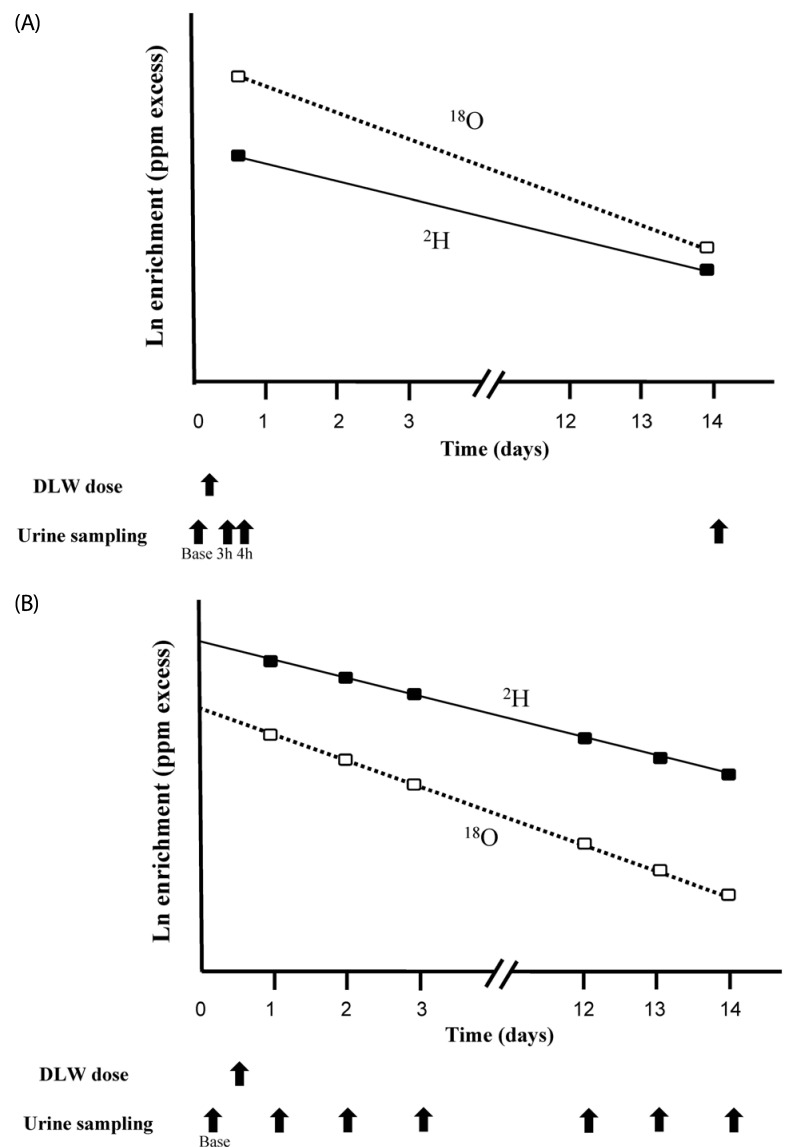
Fig. 2 The time points of urine sampling and log-linear plot of isotope elimination in a two-point (A) and multiple-point (B) doubly labeled water (DLW) protocol. (A) On day 0, the 2H218O (DLW) dose was given orally to each subject after collecting a baseline urine sample. Additional urine samples should be collected at 3 and 4 h after the dose on day 0. On the final day of experimental period, the participant should provide the one more urine sample. The isotope elimination rates (kx) are calculated from the gradient of the isotope elimination curve. (B) On day 0, the 2H2 18O (DLW) dose is given orally to each subject after collecting baseline urine sample. After administration of this dose, the participants are requested to collect urine samples on the following day and at two additional sampling points at the same time of the day during the study period. In the two-point protocol (A), kx = ln(E2 / E1) / (t2 - t1) where E is the enrichment calculated as abundancex - abundancebaseline and t is the time interval after the dose administration. The subscripts 1 and 2 refer to the specimen, where 1 is the post-dose specimen and 2 is the final specimen. In the multi-point protocol (B), kx is the gradient of the linear regression line through the isotope elimination data.
Reference
-
1. Ainslie P, Reilly T, Westerterp K. Estimating human energy expenditure: a review of techniques with particular reference to doubly labelled water. Sports Med. 2003; 33:683–698. PMID: 12846591.2. Westerterp KR. Assessment of physical activity: a critical appraisal. Eur J Appl Physiol. 2009; 105:823–828. PMID: 19205725.
Article3. Schoeller DA. Energy expenditure from doubly labeled water: some fundamental considerations in humans. Am J Clin Nutr. 1983; 38:999–1005. PMID: 6650456.
Article4. Schoeller DA, Ravussin E, Schutz Y, Acheson KJ, Baertschi P, Jéquier E. Energy expenditure by doubly labeled water: validation in humans and proposed calculation. Am J Physiol. 1986; 250:R823–R830. PMID: 3085521.5. Schoeller DA. Recent advances from application of doubly labeled water to measurement of human energy expenditure. J Nutr. 1999; 129:1765–1768. PMID: 10498745.
Article6. Redman LM, Kraus WE, Bhapkar M, Das SK, Racette SB, Martin CK, Fontana L, Wong WW, Roberts SB, Ravussin E. CALERIE Study Group. Energy requirements in nonobese men and women: results from CALERIE. Am J Clin Nutr. 2014; 99:71–78. PMID: 24257721.7. McCarthy MI. Genomics, type 2 diabetes, and obesity. N Engl J Med. 2010; 363:2339–2350. PMID: 21142536.
Article8. Colosia AD, Palencia R, Khan S. Prevalence of hypertension and obesity in patients with type 2 diabetes mellitus in observational studies: a systematic literature review. Diabetes Metab Syndr Obes. 2013; 6:327–338. PMID: 24082791.
Article9. Institute of Medicine (US) Panel on Macronutrients. Institute of Medicine (US) Standing Committee on the Scientific Evaluation of Dietary Reference Intakes. 5. Energy. Dietary Reference Intakes for Energy, Carbohydrate, Fiber, Fat, Fatty Acids, Cholesterol, Protein, and Amino Acids. Washington, D.C.: National Academies Press;2005.10. Schoeller DA, van Santen E. Measurement of energy expenditure in humans by doubly labeled water method. J Appl Physiol Respir Environ Exerc Physiol. 1982; 53:955–959. PMID: 6759491.
Article11. Lifson N. Theory of use of the turnover rates of body water for measuring energy and material balance. J Theor Biol. 1966; 12:46–74. PMID: 6015431.
Article12. Weir JB. New methods for calculating metabolic rate with special reference to protein metabolism. J Physiol. 1949; 109:1–9. PMID: 15394301.
Article13. Park J, Ishikawa-Takata K, Tanaka S, Hikihara Y, Ohkawara K, Watanabe S, Miyachi M, Morita A, Aiba N, Tabata I. Relation of body composition to daily physical activity in free-living Japanese adult women. Br J Nutr. 2011; 106:1117–1127. PMID: 21736836.
Article14. Park J, Ishikawa-Takata K, Tanaka S, Hikihara Y, Ohkawara K, Watanabe S, Miyachi M, Morita A, Aiba N, Tabata I. The relationship of body composition to daily physical activity in free-living Japanese adult men. Br J Nutr. 2014; 111:182–188. PMID: 23841965.
Article15. International Atomic Energy Agency (AT). IAEA Human Health Series No. 3. Assessment of Body Composition and Total Energy Expenditure in Humans Using Stable Isotope Techniques. Vienna: International Atomic Energy Agency;2009.16. Butler PJ, Green JA, Boyd IL, Speakman JR. Measuring metabolic rate in the field: the pros and cons of the doubly labelled water and heart rate methods. Funct Ecol. 2004; 18:168–183.
Article17. Scantlebury M, Speakman JR, Oosthuizen MK, Roper TJ, Bennett NC. Energetics reveals physiologically distinct castes in a eusocial mammal. Nature. 2006; 440:795–797. PMID: 16598257.
Article18. Speakman JR. The role of technology in the past and future development of the doubly labelled water method. Isotopes Environ Health Stud. 2005; 41:335–343. PMID: 16543189.
Article19. Klein PD, James WP, Wong WW, Irving CS, Murgatroyd PR, Cabrera M, Dallosso HM, Klein ER, Nichols BL. Calorimetric validation of the doubly-labelled water method for determination of energy expenditure in man. Hum Nutr Clin Nutr. 1984; 38:95–106. PMID: 6423577.20. Djafarian K, Jackson DM, Milne E, Roger P, Speakman JR. Doubly labelled water: multi-point and two-point methods in pre-school children. Int J Pediatr Obes. 2010; 5:102–110. PMID: 20078379.
Article21. Ebine N, Feng JY, Homma M, Saitoh S, Jones PJ. Total energy expenditure of elite synchronized swimmers measured by the doubly labeled water method. Eur J Appl Physiol. 2000; 83:1–6. PMID: 11072766.
Article22. Lee SJ, Kim HR. Total energy expenditure of professional soccer players measured by the doubly labeled water method. Korean J Exerc Nutr. 2003; 7:241–246.23. Racette SB, Schoeller DA, Luke AH, Shay K, Hnilicka J, Kushner RF. Relative dilution spaces of 2H- and 18O-labeled water in humans. Am J Physiol. 1994; 267:E585–E590. PMID: 7943308.
Article24. Black AE, Prentice AM, Coward WA. Use of food quotients to predict respiratory quotients for the doubly-labelled water method of measuring energy expenditure. Hum Nutr Clin Nutr. 1986; 40:381–391. PMID: 3771290.25. Ishikawa-Takata K, Tabata I, Sasaki S, Rafamantanantsoa HH, Okazaki H, Okubo H, Tanaka S, Yamamoto S, Shirota T, Uchida K, Murata M. Physical activity level in healthy free-living Japanese estimated by doubly labelled water method and International Physical Activity Questionnaire. Eur J Clin Nutr. 2008; 62:885–891. PMID: 17522602.
Article26. Welle S. Two-point vs multipoint sample collection for the analysis of energy expenditure by use of the doubly labeled water method. Am J Clin Nutr. 1990; 52:1134–1138. PMID: 2239791.
Article27. Speakman JR, Racey PA. Measurement of CO2 production by the doubly labeled water technique. J Appl Physiol (1985). 1986; 61:1200–1202. PMID: 3093452.
Article28. Speakman JR. Doubly Labelled Water: Theory and Practice. London: Chapman & Hall;1997.29. Prentice AM. Stable isotopic methods for measuring energy expenditure. Applications of the doubly-labelled-water (2H2(18)O) method in free-living adults. Proc Nutr Soc. 1988; 47:259–268. PMID: 3254528.30. Speakman JR. Principles, problems and a paradox with the measurement of energy expenditure of free-living subjects using doubly-labelled water. Stat Med. 1990; 9:1365–1380. PMID: 2277884.
Article31. Blanc S, Colligan AS, Trabulsi J, Harris T, Everhart JE, Bauer D, Schoeller DA. Influence of delayed isotopic equilibration in urine on the accuracy of the (2)H(2)(18)O method in the elderly. J Appl Physiol (1985). 2002; 92:1036–1044. PMID: 11842037.32. Speakman JR. Estimation of precision in DLW studies using the two-point methodology. Obes Res. 1995; 3(Suppl 1):31–39. PMID: 7736288.
Article33. Schoeller DA, Luke AH. Rapid 18O analysis of CO2 samples by continuous-flow isotope ratio mass spectrometry. J Mass Spectrom. 1997; 32:1332–1336. PMID: 9423283.34. Prosser SJ, Scrimgeour CM. High-precision determination of 2H/1H in H2 and H2O by continuous-flow isotope ratio mass spectrometry. Anal Chem. 1995; 67:1992–1997.
Article35. Schoeller DA. Measurement of energy expenditure in free-living humans by using doubly labeled water. J Nutr. 1988; 118:1278–1289. PMID: 3142975.
Article36. Black AE, Coward WA, Cole TJ, Prentice AM. Human energy expenditure in affluent societies: an analysis of 574 doubly-labelled water measurements. Eur J Clin Nutr. 1996; 50:72–92. PMID: 8641250.37. Tooze JA, Schoeller DA, Subar AF, Kipnis V, Schatzkin A, Troiano RP. Total daily energy expenditure among middle-aged men and women: the OPEN Study. Am J Clin Nutr. 2007; 86:382–387. PMID: 17684209.
Article38. Bandini LG, Lividini K, Phillips SM, Must A. Accuracy of Dietary Reference Intakes for determining energy requirements in girls. Am J Clin Nutr. 2013; 98:700–704. PMID: 23885044.
Article39. Tabata I, Ebine N, Kawashima Y, Ishikawa-Takata K, Tanaka S, Higuchi M, Yoshitake Y. Dietary reference intakes for Japanese 2010: energy. J Nutr Sci Vitaminol (Tokyo). 2013; 59:S26–S35.
Article40. Yao M, McCrory MA, Ma G, Li Y, Dolnikowski GG, Roberts SB. Energy requirements of urban Chinese adults with manual or sedentary occupations, determined using the doubly labeled water method. Eur J Clin Nutr. 2002; 56:575–584. PMID: 12080396.
Article41. Zhuo Q, Sun R, Gou LY, Piao JH, Liu JM, Tian Y, Zhang YH, Yang XG. Total energy expenditure of 16 Chinese young men measured by the doubly labeled water method. Biomed Environ Sci. 2013; 26:413–420. PMID: 23816574.42. The Korean Nutrition Society. Dietary Reference Intakes for Koreans. Seoul: The Korean Nutrition Society;1995.43. The Korean Nutrition Society. Dietary Reference Intakes for Koreans. Seoul: The Korean Nutrition Society;2000.44. The Korean Nutrition Society. Dietary Reference Intakes for Koreans. Seoul: The Korean Nutrition Society;2010.45. Hill RJ, Davies PS. The validity of self-reported energy intake as determined using the doubly labelled water technique. Br J Nutr. 2001; 85:415–430. PMID: 11348556.
Article46. Burrows TL, Martin RJ, Collins CE. A systematic review of the validity of dietary assessment methods in children when compared with the method of doubly labeled water. J Am Diet Assoc. 2010; 110:1501–1510. PMID: 20869489.
Article47. Okubo H, Sasaki S, Rafamantanantsoa HH, Ishikawa-Takata K, Okazaki H, Tabata I. Validation of self-reported energy intake by a self-administered diet history questionnaire using the doubly labeled water method in 140 Japanese adults. Eur J Clin Nutr. 2008; 62:1343–1350. PMID: 17671444.
Article48. Redman LM, Kraus WE, Bhapkar M, Das SK, Racette SB, Martin CK, Fontana L, Wong WW, Roberts SB, Ravussin E. CALERIE Study Group. Energy requirements in nonobese men and women: results from CALERIE. Am J Clin Nutr. 2014; 99:71–78. PMID: 24257721.49. Scagliusi FB, Ferriolli E, Pfrimer K, Laureano C, Cunha CS, Gualano B, Lourenço B, Lancha AH. Under-reporting of energy intake is more prevalent in a healthy dietary pattern cluster. Br J Nutr. 2008; 100:1060–1068. PMID: 18377688.
Article50. Seale JL, Rumpler WV. Comparison of energy expenditure measurements by diet records, energy intake balance, doubly labeled water and room calorimetry. Eur J Clin Nutr. 1997; 51:856–863. PMID: 9426361.
Article51. Kroke A, Klipstein-Grobusch K, Voss S, Möseneder J, Thielecke F, Noack R, Boeing H. Validation of a self-administered food-frequency questionnaire administered in the European Prospective Investigation into Cancer and Nutrition (EPIC) Study: comparison of energy, protein, and macronutrient intakes estimated with the doubly labeled water, urinary nitrogen, and repeated 24-h dietary recall methods. Am J Clin Nutr. 1999; 70:439–447. PMID: 10500011.
Article52. Livingstone MB, Robson PJ. Measurement of dietary intake in children. Proc Nutr Soc. 2000; 59:279–293. PMID: 10946797.
Article53. Livingstone MB, Robson PJ, Wallace JM. Issues in dietary intake assessment of children and adolescents. Br J Nutr. 2004; 92(Suppl 2):S213–S222. PMID: 15522159.
Article54. Shahar DR, Yu B, Houston DK, Kritchevsky SB, Newman AB, Sellmeyer DE, Tylavsky FA, Lee JS, Harris TB. Health, Aging, and Body Composition Study. Misreporting of energy intake in the elderly using doubly labeled water to measure total energy expenditure and weight change. J Am Coll Nutr. 2010; 29:14–24. PMID: 20595641.
Article55. Lichtman SW, Pisarska K, Berman ER, Pestone M, Dowling H, Offenbacher E, Weisel H, Heshka S, Matthews DE, Heymsfield SB. Discrepancy between self-reported and actual caloric intake and exercise in obese subjects. N Engl J Med. 1992; 327:1893–1898. PMID: 1454084.
Article56. Buhl KM, Gallagher D, Hoy K, Matthews DE, Heymsfield SB. Unexplained disturbance in body weight regulation: diagnostic outcome assessed by doubly labeled water and body composition analyses in obese patients reporting low energy intakes. J Am Diet Assoc. 1995; 95:1393–1400. PMID: 7594141.57. Bandini LG, Schoeller DA, Cyr HN, Dietz WH. Validity of reported energy intake in obese and nonobese adolescents. Am J Clin Nutr. 1990; 52:421–425. PMID: 2393004.
Article58. Singh R, Martin BR, Hickey Y, Teegarden D, Campbell WW, Craig BA, Schoeller DA, Kerr DA, Weaver CM. Comparison of self-reported, measured, metabolizable energy intake with total energy expenditure in overweight teens. Am J Clin Nutr. 2009; 89:1744–1750. PMID: 19386746.59. Westerterp KR. Physical activity, food intake, and body weight regulation: insights from doubly labeled water studies. Nutr Rev. 2010; 68:148–154. PMID: 20384845.
Article60. Heitmann BL. The influence of fatness, weight change, slimming history and other lifestyle variables on diet reporting in Danish men and women aged 35-65 years. Int J Obes Relat Metab Disord. 1993; 17:329–336. PMID: 8392498.
- Full Text Links
-
- Actions
-
Cited
- CITED
-
- Close
- Share
-
- Similar articles
-
- Accuracy of 24-hour Diet Recalls for Estimating Energy Intake in Elderly Men using the Doubly Labeled Water Method
- Total energy expenditure measured by doubly labeled water method in children and adolescents: a systematic review
- Accuracy of the 24-hour diet recall method to determine energy intake in elderly women compared with the doubly labeled water method
- Comparison of total energy intakes estimated by 24-hour diet recall with total energy expenditure measured by the doubly labeled water method in adults
- A narrative review on the application of doubly labeled water method for estimating energy requirement for Koreans


