Comparison of Intracorneal Inlay for Presbyopia Correction: Hydrogel and Small-Aperture Inlays with a Six- Months Follow-Up
- Affiliations
-
- 1Department of Ophthalmology, Asan Medical Center, University of Ulsan College of Medicine, Seoul, Korea. hwtchah@amc.seoul.kr
- 2Department of Ophthalmology, Samsung Medical Center, Sungkyunkwan University School of Medicine, Seoul, Korea.
- KMID: 2148743
- DOI: http://doi.org/10.3341/jkos.2015.56.12.1840
Abstract
- PURPOSE
To study the safety and efficacy of corneal reshaping and small-aperture inlays and compare the clinical results.
METHODS
From February 2014 to November 2014, 22 corneal reshaping inlays were inserted at Asan Medical Center and from October 2012 to March 2013, 26 small-aperture inlay surgeries were performed: 6 eyes at Asan Medical Center and 20 eyes at Samsung Medical Center. The preoperative and postoperative parameters were reviewed retrospectively and included monocular uncorrected distance visual acuity (UDVA; log MAR), uncorrected near visual acuity (UNVA; log MAR), refraction and corneal curvature based on automated refractor keratometry, reading distance and patient satisfaction.
RESULTS
In the hydrogel inlay group, preoperative mean monocular UNVA was 0.83 +/- 0.05 and monocular UDVA 0.07 +/- 0.03. At 6 months, mean monocular UNVA was 0.23 +/- 0.05 and UDVA 0.05 +/- 0.02. The most preferred mean reading distance in the hydrogel inlay group was 39.38 +/- 3.18 cm. In the small-aperture inlay group, preoperative mean monocular UNVA was 0.4 +/- 0.06 and monocular uncorrected visual acuity 0.27 +/- 0.04. At 6 months, mean monocular UNVA was 0.11 +/- 0.02 and UDVA 0.09 +/- 0.05 and the most preferred mean reading distance was 44.23 +/- 5.17 cm. Although 85% of patients in the corneal reshaping inlay group were satisfied or very satisfied, only 20% of patients in the small-aperture inlay group were satisfied.
CONCLUSIONS
Both inlays are considered good options for correcting presbyopia. However, postoperative satisfaction score was higher and less glare symptoms were reported in the hydrogel inlay group.
MeSH Terms
Figure
-

Figure 1. Perioperative changes in mean and standard devia-tion of monocular UNVA (log MAR) in surgical eyes over 6 months of follow-up. Preop = preoperative; Postop = post-perative; UNVA = uncorrected near visual acuity. * p < 0.05, the comparison with just before the time point.
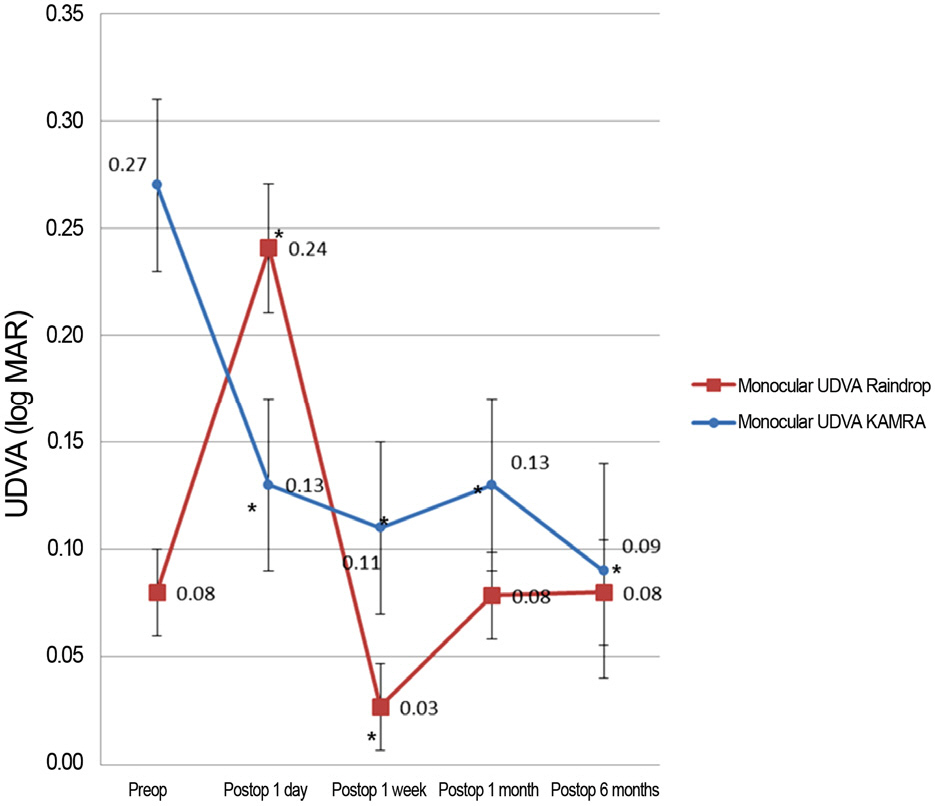
Figure 2. Perioperative changes in mean and standard devia-tion of monocular UDVA (log MAR) of surgical eyes over 6 months of follow-up. Preop = preoperative; Postop = post-perative; UDVA = uncorrected distance visual acuity. * p < 0.05, the comparison with just before time point.
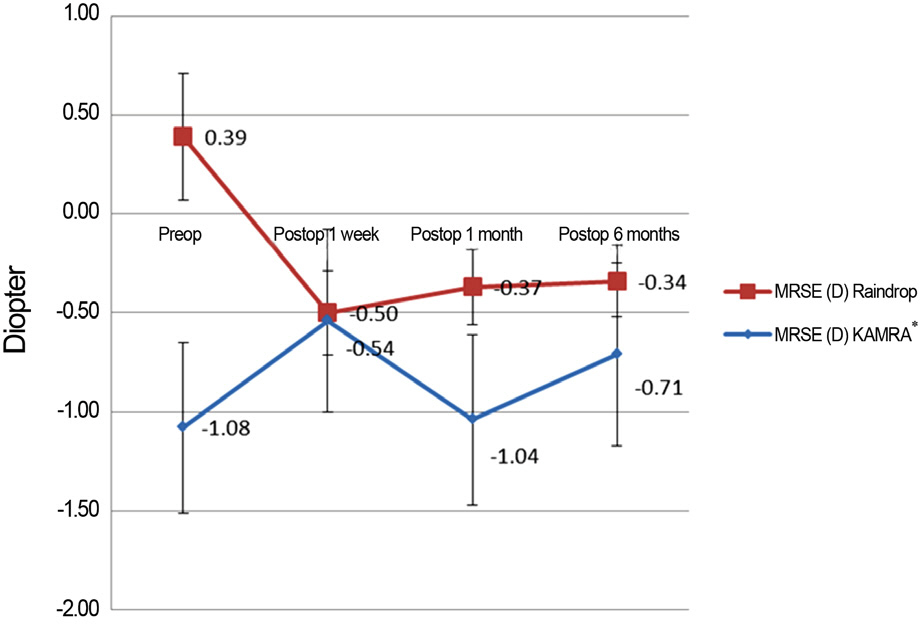
Figure 3. Perioperative changes in mean and standard devia-tion of spherical equivalent (diopters) of surgical eyes over 6 months of follow-up. Preop = preoperative; Postop = post-perative; MRSE = manifest refraction spherical equivalent. * KAMRA data obtained from only Asan Medical Center (total 6 patients).

Figure 4. Perioperative changes in mean and standard devia-tion of keratometric values (diopters) of surgical eyes over 6 months of follow-up. Preop = preoperative; Postop = post-perative; K = keratometric reading. * KAMRA data obtained from only Asan Medical Center (total 6 patients).

Figure 5. Perioperative changes in mean and standard devia-tion of preference reading distance (cm) of surgical eyes over 6 months of follow-up. Postop = postoperative. * p < 0.05, the comparison with just before time point; † KAMRA data ob-tained from only Asan Medical Center (total 6 patients).
Reference
-
References
1. Duane A. A modified accommodation line and Prince's rule. Trans Am Ophthalmol Soc. 1921; 19:178–9.2. Seyeddain O, Bachernegg A, Riha W. . Femtosecond laser-as-sisted small-aperture corneal inlay implantation for corneal com-pensation of presbyopia: two-year follow-up. J Cataract Refractive Surg. 2013; 39:234–41.
Article3. Kim TJ. Presbyopia and contact lenses. J Korean Med Assoc. 2013; 56:303–9.
Article4. Lee YS. Presbyopic contact lens fitting. Kim MG, Kim TJ, Park YG, Lee YG, editors. Contact Lens Principles and Practice. 1st. Seoul: Naeoehaksul;2007; 133–41.5. Lee HY, Her J. Clinical evaluation of monovision after cataract surgery. J Korean Ophthalmol Soc. 2008; 49:1437–42.
Article6. Mantry S, Shah S. Surgical management of presbyopia. Cont Lens Anterior Eye. 2004; 27:171–5.
Article7. Torricelli AA, Junior JB, Santhiago MR, Bechara SJ. Surgical management of presbyopia. Clin Ophthalmol. 2012; 6:1459–66.
Article8. Arlt E, Krall E, Moussa S. . Implantable inlay devices for pres-byopia: the evidence to date. Clin Ophthalmol. 2015; 9:129–37.9. Lindstrom RL, Macrae SM, Pepose JS, Hoopes PC Sr. Corneal in-lays for presbyopia correction. Current Opin Ophthalmol. 2013; 24:281–7.
Article10. Yilmaz OF, Bayraktar S, Agca A. . Intracorneal inlay for the surgical correction of presbyopia. J Cataract Refract Surg. 2008; 34:1921–7.
Article11. Alió JL, Abbouda A, Huseynli S. . Removability of a small aperture intracorneal inlay for presbyopia correction. J Refract Surg. 2013; 29:550–6.
Article12. Garza EB, Gomez S, Chayet A, Dishler J. One-year safety and effi-cacy results of a hydrogel inlay to improve near vision in patients with emmetropic presbyopia. J Refract Surg. 2013; 29:166–72.
Article13. Dexl AK, Jell G, Strohmaier C. . Long-term outcomes after monocular corneal inlay implantation for the surgical compensa-tion of presbyopia. J Cataract Refrac Surg. 2015; 41:566–75.
Article14. Seyeddain O, Hohensinn M, Riha W. . Small-aperture corneal inlay for the correction of presbyopia: 3-year follow-up. J Cataract Refract Surg. 2012; 38:35–45.
Article15. Dexl AK, Seyeddain O, Riha W. . Reading performance and patient satisfaction after corneal inlay implantation for presbyopia correction: two-year follow-up. J Cataract Refract Surg. 2012; 38:1808–16.
Article16. Dexl AK, Seyeddain O, Riha W. . Reading performance and patient satisfaction after corneal inlay implantation for presbyopia correction: two-year follow-up. J Cataract Refract Surg. 2012; 38:1808–16.
Article17. Dexl AK, Seyeddain O, Riha W. . One-year visual outcomes and patient satisfaction after surgical correction of presbyopia with an intracorneal inlay of a new design. J Cataract Refract Surg. 2012; 38:262–9.
Article18. Tomita M, Kanamori T, Waring GO. 4th. . Simultaneous cor-neal inlay implantation and laser in situ keratomileusis for presby-opia in patients with hyperopia, myopia, or emmetropia: six-month results. J Cataract Refract Surg. 2012; 38:495–506.
Article19. Gatinel D, El Danasoury A, Rajchles S, Saad A. Recentration of a small-aperture corneal inlay. J Cataract Refract Surg. 2012; 38:2186–91.
Article20. Chayet A, Barragan Garza E. Combined hydrogel inlay and laser in situ keratomileusis to compensate for presbyopia in hyperopic pa-tients: one-year safety and efficacy. J Cataract Refract Surg. 2013; 39:1713–21.
Article21. Santhiago MR, Barbosa FL, Agrawal V. . Short-term cell death and inflammation after intracorneal inlay implantation in rabbits. J Refract Surg. 2012; 28:144–9.
Article22. Mulet ME, Alio JL, Knorz MC. Hydrogel intracorneal inlays for the correction of hyperopia: outcomes and complications after 5 years of follow-up. Ophthalmology. 2009; 116:1455–60. 1460.e1.23. Alió JL, Mulet ME, Zapata LF. . Intracorneal inlay compli-cated by intrastromal epithelial opacification. Arch Ophthalmol. 2004; 122:1441–6.
Article24. Huseynova T, Kanamori T, Waring GO, Tomita M. Small-aper-ture corneal inlay in presbyopic patients with prior phakic intra-ocular lens implantation surgery: 3-month results. Clin Ophthalmol. 2013; 7:1683–6.
- Full Text Links
-
- Actions
-
Cited
- CITED
-
- Close
- Share
-
- Similar articles
-
- Surgical treatment of presbyopia I
- Surgical treatment of presbyopia
- Long-term Clinical Outcome of Refractive Corneal Inlays for Compensation of Presbyopia
- Nonsurgical correction of presbyopia
- Arthroscopic Reconstruction of the Posterior Cruciate Ligament : Comparison of Tibial Inlay and Tibial Tunnel Techniques