
Detection of Cryptosporidium parvum in Environmental Soil and Vegetables

- Affiliations
-
- 1Department of Radiation Oncology & Research Institute of Medical Science, Konkuk University School of Medicine, Seoul, Korea.
- 2Department of Environmental and Tropical Medicine & Research Institute of Medical Science, Konkuk University School of Medicine, Seoul, Korea. maria205@kku.ac.kr
- 3Department of Radiation Oncology, College of Medicine, Chungbuk National University, Cheongju, Korea.
- KMID: 2129626
- DOI: http://doi.org/10.3346/jkms.2014.29.10.1367
Abstract
- Cryptosporidium parvum is a zoonotic protozoan parasite that causes cryptosporidial enteritis. Numerous outbreaks of cryptosporidiosis have been reported worldwide. Cryptosporidium is transmitted to hosts via consumption of contaminated water and food but also by direct contact with contaminated soil or infected hosts. The present study investigated farm soil collected from 34 locations along the western Korean peninsula and 24 vegetables purchased from local grocery markets in Seoul. The soil and vegetable samples were examined by real-time polymerase chain reaction (qPCR) to estimate the risk of infection. Eleven of 34 locations (32.4%) and 3 of 24 vegetable samples (12.5%) were contaminated with Cryptosporidium parvum, as confirmed by TaqI enzyme digestion of qPCR products and DNA sequencing. It is suggested that Cryptosporidium infection can be mediated via farm soil and vegetables. Therefore, it is necessary to reduce contamination of this organism in view of public health.
Keyword
MeSH Terms
Figure
-
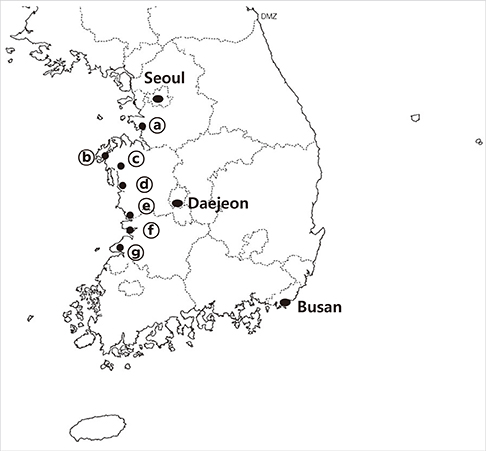
Fig. 1 Locations of the surveyed areas. (a) Hwaseong-si, (b) Seosan-si, (c) Hongsung-gun, (d) Boryeong-si, (e) Seocheon-gun, (f) Gunsan-si, (g) Buan-gun.
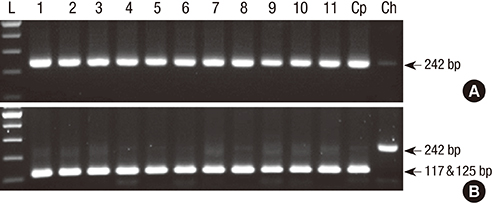
Fig. 2 Agarose gel electrophoresis of the qPCR products from soil samples. qPCR was performed to detect Cryptosporidium parvum SWI2/SNF2 ATPase, a Rad16 ortholog gene (GenBank No. XM_625623). (A) qPCR products of soil samples (242 bp). (B) DNA fragments generated from TaqI enzyme digests of the qPCR products. L, 100-bp ladder; ① soils from Hwaseong-si, ② Seosan-si, ③-⑧ Hongseong-gun, ⑨-⑩ Boryeong-si, ⑪ Seocheon-si; Cp, C. parvum DNA; Ch, C. hominis DNA.
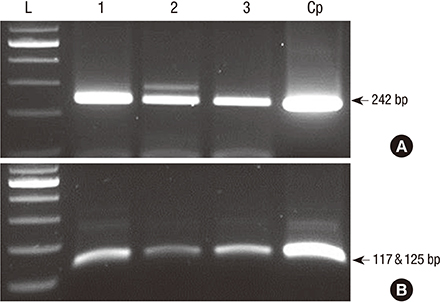
Fig. 3 Agarose gel electrophoresis of the qPCR products from food samples. qPCR was performed to detect the C. parvum SWI2/SNF2 ATPase, Rad16 ortholog gene (GenBank No. XM_625623). (A) qPCR products of food samples (242 bp). (B) DNA fragments generated by TaqI enzyme digestion of the qPCR products. L, 100-bp ladder; 1, carrot; 2, winter-grown cabbage; 3, blueberry; Cp, C. parvum DNA.

Fig. 4 Alignment of the qPCR product sequences belonging to the positive soil (A) and food (B) samples generated by using the Clone Manager 7. qPCR was performed to detect C. parvum SWI2/SNF2 ATPase, Rad16 ortholog gene (GenBank No. XM_625623).
Reference
-
1. Baldursson S, Karanis P. Waterborne transmission of protozoan parasites: review of worldwide outbreaks - an update 2004-2010. Water Res. 2011; 45:6603–6614.2. Mac Kenzie WR, Hoxie NJ, Proctor ME, Gradus MS, Blair KA, Peterson DE, Kazmierczak JJ, Addiss DG, Fox KR, Rose JB, et al. A massive outbreak in Milwaukee of cryptosporidium infection transmitted through the public water supply. N Engl J Med. 1994; 331:161–167.3. Smith HV, Rose JB. Waterborne cryptosporidiosis: current status. Parasitol Today. 1998; 14:14–22.4. Moon S, Kwak W, Lee S, Kim W, Oh J, Youn SK. Epidemiological characteristics of the first water-borne outbreak of cryptosporidiosis in Seoul, Korea. J Korean Med Sci. 2013; 28:983–989.5. Fayer R. Cryptosporidium: a water-borne zoonotic parasite. Vet Parasitol. 2004; 126:37–56.6. Zilberman A, Zimmels Y, Starosvetsky J, Zuckerman U, Armon R. A two-phase separation method for recovery of Cryptosporidium oocysts from soil samples. Water Air Soil Pollut. 2009; 203:325–334.7. Petersen HH, Enemark HL, Olsen A, Amin MG, Dalsgaard A. Transport of Cryptosporidium parvum oocysts in soil columns following applications of raw and separated liquid slurries. Appl Environ Microbiol. 2012; 78:5994–6000.8. Putignani L, Menichella D. Global distribution, public health and clinical impact of the protozoan pathogen cryptosporidium. Interdiscip Perspect Infect Dis. 2010; 2010:pii: 753512.9. Chaidez C, Soto M, Gortares P, Mena K. Occurrence of Cryptosporidium and Giardia in irrigation water and its impact on the fresh produce industry. Int J Environ Health Res. 2005; 15:339–345.10. Shields JM, Joo J, Kim R, Murphy HR. Assessment of three commercial DNA extraction kits and a laboratory-developed method for detecting Cryptosporidium and Cyclospora in raspberry wash, basil wash and pesto. J Microbiol Methods. 2013; 92:51–58.11. Lee SU, Joung M, Ahn MH, Huh S, Song H, Park WY, Yu JR. CP2 gene as a useful viability marker for Cryptosporidium parvum. Parasitol Res. 2008; 102:381–387.12. Cheun HI, Kim K, Yoon S, Lee WJ, Park WY, Sim S, Yu JR. Cryptosporidium hominis infection diagnosed by real-time PCR-RFLP. Korean J Parasitol. 2013; 51:353–355.13. Slifko TR, Smith HV, Rose JB. Emerging parasite zoonoses associated with water and food. Int J Parasitol. 2000; 30:1379–1393.14. Dado D, Izquierdo F, Vera O, Montoya A, Mateo M, Fenoy S, Galván AL, García S, García A, Aránguez E, et al. Detection of zoonotic intestinal parasites in public parks of Spain. Potential epidemiological role of microsporidia. Zoonoses Public Health. 2012; 59:23–28.15. Yu JR, Seo M. Infection status of pigs with Cryptosporidium parvum. Korean J Parasitol. 2004; 42:45–47.16. Yu JR, Lee JK, Seo M, Kim SI, Sohn WM, Huh S, Choi HY, Kim TS. Prevalence of cryptosporidiosis among the villagers and domestic animals in several rural areas of Korea. Korean J Parasitol. 2004; 42:1–6.17. Park JH, Guk SM, Han ET, Shin EH, Kim JL, Chai JY. Genotype analysis of Cryptosporidium spp. prevalent in a rural village in Hwasun-gun, Republic of Korea. Korean J Parasitol. 2006; 44:27–33.18. Robertson LJ, Chalmers RM. Foodborne cryptosporidiosis: is there really more in Nordic countries? Trends Parasitol. 2013; 29:3–9.19. Smith HV, Cacciò S, Cook N, Nichols RA, Tait A. Cryptosporidium and Giardia as foodborne zoonoses. Vet Parasitol. 2007; 149:29–40.20. Vuong TA, Nguyen TT, Klank LT, Phung DC, Dalsgaard A. Faecal and protozoan parasite contamination of water spinach (Ipomoea aquatica) cultivated in urban wastewater in Phnom Penh, Cambodia. Trop Med Int Health. 2007; 12:73–81.21. Schets FM, van den Berg HH, Engels GB, Lodder WJ, de Roda Husman AM. Cryptosporidium and Giardia in commercial and non-commercial oysters (Crassostrea gigas) and water from the Oosterschelde, The Netherlands. Int J Food Microbiol. 2007; 113:189–194.22. Amorós I, Alonso JL, Cuesta G. Cryptosporidium oocysts and giardia cysts on salad products irrigated with contaminated water. J Food Prot. 2010; 73:1138–1140.23. Armon R, Gold D, Brodsky M, Oron G. Surface and subsurface irrigation with effluents of different qualities and presence of Cryptosporidium oocysts in soil and on crops. Water Sci Technol. 2002; 46:115–122.24. Robertson LJ, Gjerde B. Occurrence of parasites on fruits and vegetables in Norway. J Food Prot. 2001; 64:1793–1798.25. Monge R, Arias ML. Presence of various pathogenic microorganisms in fresh vegetables in Costa Rica. Arch Latinoam Nutr. 1996; 46:292–294.26. Okhuysen PC, Chappell CL, Crabb JH, Sterling CR, DuPont HL. Virulence of three distinct Cryptosporidium parvum isolates for healthy adults. J Infect Dis. 1999; 180:1275–1281.27. Shields JM, Lee MM, Murphy HR. Use of a common laboratory glassware detergent improves recovery of Cryptosporidium parvum and Cyclospora cayetanensis from lettuce, herbs and raspberries. Int J Food Microbiol. 2012; 153:123–128.28. Cook N, Paton CA, Wilkinson N, Nichols RA, Barker K, Smith HV. Towards standard methods for the detection of Cryptosporidium parvum on lettuce and raspberries. Part 1: development and optimization of methods. Int J Food Microbiol. 2006; 109:215–221.29. Cook N, Paton CA, Wilkinson N, Nichols RA, Barker K, Smith HV. Towards standard methods for the detection of Cryptosporidium parvum on lettuce and raspberries. Part 2: validation. Int J Food Microbiol. 2006; 109:222–228.
- Full Text Links
-
- Actions
-
Cited
- CITED
-
- Close
- Share
-
- Similar articles
-
- Simultaneous Molecular Detection of Cryptosporidium and Cyclospora from Raw Vegetables in Korea
- Comparison of Resistance to gamma-Irradiation between Cryptosporidium parvum and Cryptosporidium muris Using In Vivo Infection
- Comparative Sensitivity of PCR Primer Sets for Detection of Cryptosporidium parvum
- Cryptosporidiosis
- Experimental Cryptosporidium parvum infection in a Korean native calf isolated from a Korean mouse


