
Chonnam Med J.
2011 Aug;47(2):66-71. 10.4068/cmj.2011.47.2.66.
Vascular Dementia
- Affiliations
-
- 1Department of Neurology, Chungnam National University College of Medicine, Daejeon, Korea. aelee@cnu.ac.kr
- KMID: 2048787
- DOI: http://doi.org/10.4068/cmj.2011.47.2.66
Abstract
- Cerebrovascular disease is the second leading cause of cognitive impairment in the elderly, either alone or in combination with Alzheimer's disease (AD). Vascular dementia (VaD) is heterogeneous in terms of both clinical phenotype and pathogenetic mechanisms. It may result from multiple cortical infarctions due to cerebral large vessel pathologies or to subcortical ischemic changes such as leukoaraiosis or lacunar infarction due to cerebral small artery disease. Clinical symptoms and signs vary depending on the location and size of the stroke lesion, and no single neuropsychological profile characteristic of VaD has been defined, although dysexecutive function is common. A slightly higher mortality rate and slower progression are reported in VaD compared with AD. VaD is potentially preventable by rigorous identification and treatment of cardiovascular disease risk factors, and modest symptomatic improvement with cholinesterase inhibitors has been reported.
MeSH Terms
Figure
-

FIG. 1 Multi-infarc dementia type of vascular dementia on T2-weighted brain MRI.
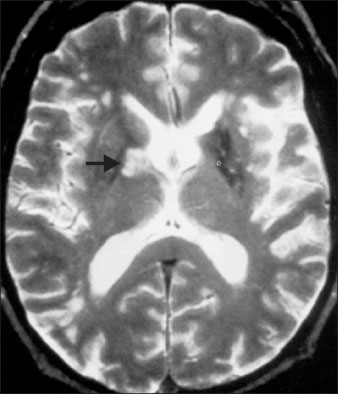
FIG. 2 Strategic infarct dementia type of vascular dementia on T2-weighted brain MRI.

FIG. 3 Subcortical vascular dementia type of vascular dementia on fluid attenuated inversion recovery (FLAIR) brain MRI.
Reference
-
1. Knopman DS. Dementia and cerebrovascular disease. Mayo Clin Proc. 2006. 81:223–230.
Article2. Fratiglioni L, Rocca WA. Boller F, Cappa SF, editors. Epidemiology of dementia. Aging and Dementia. Handbook of Neu-ropsychology. 2001. Vol. 6:2nd ed. Amsterdam: Elsevier;193–215.
Article3. Pinkston JB, Alekseeva N, González Toledo E. Stroke and dementia. Neurol Res. 2009. 31:824–831.
Article4. de Leeuw FE, de Groot JC, Achten E, Oudkerk M, Ramos LM, Heijboer R, et al. Prevalence of cerebral white matter lesions in elderly people: a population based magnetic resonance imaging study. The Rotterdam Scan Study. J Neurol Neurosurg Psychiatry. 2001. 70:9–14.
Article5. Chui HC, Nielsen-Brown N. Vascular cognitive impairment. Continuum Lifelong Learning Neurol. 2007. 13:109–143.
Article6. Fitzpatrick AL, Kuller LH, Ives DG, Lopez OL, Jagust W, Breitner JC, et al. Incidence and prevalence of dementia in the Cardiovascular Health Study. J Am Geriatr Soc. 2004. 52:195–204.
Article7. Skoog I. Status of risk factors for vascular dementia. Neuroepidemiology. 1998. 17:2–9.
Article8. Neuropathology Group. Medical Research Council Cognitive Function and Aging Study. Pathological correlates of late-onset dementia in a multicentre, community-based population in England and Wales. Neuropathology Group of the Medical Research Council Cognitive Function and Ageing Study (MRC CFAS). Lancet. 2001. 357:169–175.9. Snowdon DA, Greiner LH, Mortimer JA, Riley KP, Greiner PA, Markesbery WR. Brain infarction and the clinical expression of Alzheimer disease. The Nun Study. JAMA. 1997. 277:813–817.
Article10. Bowler JV, Munoz DG, Merskey H, Hachinski V. Fallacies in the pathological confirmation of the diagnosis of Alzheimer's disease. J Neurol Neurosurg Psychiatry. 1998. 64:18–24.
Article11. Lopez OL, Kuller LH, Becker JT, Jagust WJ, DeKosky ST, Fitzpatrick A, et al. Classification of vascular dementia in the Cardiovascular Health Study Cognition Study. Neurology. 2005. 64:1539–1547.
Article12. Román GC, Erkinjuntti T, Wallin A, Pantoni L, Chui HC. Subcortical ischaemic vascular dementia. Lancet Neurol. 2002. 1:426–436.
Article13. Reed BR, Eberling JL, Mungas D, Weiner M, Kramer JH, Jagust WJ. Effects of white matter lesions and lacunes on cortical function. Arch Neurol. 2004. 61:1545–1550.
Article14. Knopman DS, Parisi JE, Boeve BF, Cha RH, Apaydin H, Salviati A, et al. Vascular dementia in a population-based autopsy study. Arch Neurol. 2003. 60:569–575.
Article15. Scheltens P, Barkhof F, Leys D, Wolters EC, Ravid R, Kamphorst W. Histopathologic correlates of white matter changes on MRI in Alzheimer's disease and normal aging. Neurology. 1995. 45:883–888.
Article16. Udaka F, Sawada H, Kameyama M. White matter lesions and dementia: MRI-pathological correlation. Ann N Y Acad Sci. 2002. 977:411–415.
Article17. Wallin A, Sjögren M, Edman A, Blennow K, Regland B. Symptoms, vascular risk factors and blood-brain barrier function in relation to CT white-matter changes in dementia. Eur Neurol. 2000. 44:229–235.
Article18. Brun A. Pathology and pathophysiology of cerebrovascular dementia: pure subgroups of obstructive and hypoperfusive etiology. Dementia. 1994. 5:145–147.
Article19. Goldstein IB, Bartzokis G, Guthrie D, Shapiro D. Ambulatory blood pressure and the brain: a 5-year follow-up. Neurology. 2005. 64:1846–1852.
Article20. Yamamoto Y, Akiguchi I, Oiwa K, Hayashi M, Ohara T, Ozasa K. The relationship between 24-hour blood pressure readings, subcortical ischemic lesions and vascular dementia. Cerebrovasc Dis. 2005. 19:302–308.
Article21. American Psychiatric Association. Diagnostic and Statistical Manual of Mental Disorders. 1994. Fourth Edition (DSM-IV). Washington, DC: American Psychiatric Association.22. World Health Organization. The ICD-10 Classification of Mental and Behavioural Disorders: Diagnostic Criteria for Research. 1993. Geneva: WHO.23. Chui HC, Victoroff JI, Margolin D, Jagust W, Shankle R, Katzman R. Criteria for the diagnosis of ischemic vascular dementia proposed by the State of California Alzheimer's Disease Diagnostic and Treatment Centers. Neurology. 1992. 42:473–480.
Article24. Román GC, Tatemichi TK, Erkinjuntti T, Cummings JL, Masdeu JC, Garcia JH, et al. Vascular dementia: diagnostic criteria for research studies. Report of the NINDS-AIREN International Workshop. Neurology. 1993. 43:250–260.
Article25. Chui H, Lee AE. Clinical criteria for dementia subtypes. Evidence-based dementia practice. 2002. Oxford, England: Blackwell Science;106–119.26. Chui HC, Lee AY. Evidence-based diagnosis of Alzheimer disease. Neurologia. 2000. 15:suppl. 8–14.27. Pohjasvaara T, Mäntylä R, Ylikoski R, Kaste M, Erkinjuntti T. Comparison of different clinical criteria (DSM-III, ADDTC, ICD-10, NINDS-AIREN, DSM-IV) for the diagnosis of vascular dementia. National Institute of Neurological Disorders and Stroke-Association Internationale pour la Recherche et l'Enseignement en Neurosciences. Stroke. 2000. 31:2952–2957.
Article28. Pohjasvaara T, Mäntylä R, Salonen O, Aronen HJ, Ylikoski R, Hietanen M, et al. MRI correlates of dementia after first clinical ischemic stroke. J Neurol Sci. 2000. 181:111–117.
Article29. Molnar FJ, Man-Son-Hing M, Fergusson D. Systematic review of measures of clinical significance employed in randomized controlled trials of drugs for dementia. J Am Geriatr Soc. 2009. 57:536–546.
Article30. Wilkinson D, Doody R, Helme R, Taubman K, Mintzer J, Kertesz A, et al. Donepezil 308 Study Group. Donepezil in vascular dementia: a randomized, placebo-controlled study. Neurology. 2003. 61:479–486.
Article31. Black S, Román GC, Geldmacher DS, Salloway S, Hecker J, Burns A, et al. Donepezil 307 Vascular Dementia Study Group. Efficacy and tolerability of donepezil in vascular dementia: positive results of a 24-week, multicenter, international, randomized, placebo-controlled clinical trial. Stroke. 2003. 34:2323–2330.
Article32. Wilkinson D, Róman G, Salloway S, Hecker J, Boundy K, Kumar D, et al. The long-term efficacy and tolerability of donepezil in patients with vascular dementia. Int J Geriatr Psychiatry. 2010. 25:305–313.
Article33. Auchus AP, Brashear HR, Salloway S, Korczyn AD, De Deyn PP, Gassmann-Mayer C. GAL-INT-26 Study Group. Galantamine treatment of vascular dementia: a randomized trial. Neurology. 2007. 69:448–458.
Article34. Craig D, Birks J. Galantamine for vascular cognitive impairment. Cochrane Database Syst Rev. 2006. (1):CD004746.
Article35. Ballard C, Sauter M, Scheltens P, He Y, Barkhof F, van Straaten EC, et al. Efficacy, safety and tolerability of rivastigmine capsules in patients with probable vascular dementia: the VantagE study. Curr Med Res Opin. 2008. 24:2561–2574.
Article36. Orgogozo JM, Rigaud AS, Stöffler A, Möbius HJ, Forette F. Efficacy and safety of memantine in patients with mild to moderate vascular dementia: a randomized, placebo-controlled trial (MMM 300). Stroke. 2002. 33:1834–1839.
Article37. Wilcock G, Möbius HJ, Stöffler A. MMM 500 group. A double-blind, placebo-controlled multicentre study of memantine in mild to moderate vascular dementia (MMM500). Int Clin Psychopharmacol. 2002. 17:297–305.
Article38. Cummings JL. The Black Book of Alzheimer's Disease, Part 2. Primary Psychiatry. 2008. 15:69–90.39. Seshadri S, Wolf PA. Lifetime risk of stroke and dementia: current concepts, and estimates from the Framingham Study. Lancet Neurol. 2007. 6:1106–1114.
Article40. Ravaglia G, Forti P, Maioli F, Martelli M, Servadei L, Brunetti N, et al. Incidence and etiology of dementia in a large elderly Italian population. Neurology. 2005. 64:1525–1530.
Article


