
J Korean Acad Conserv Dent.
2005 Jan;30(1):58-65. 10.5395/JKACD.2005.30.1.058.
A comparison of shaping ability of the three ProTaper(R) instrumentation techniques in simulated canals
- Affiliations
-
- 1Department of Conservative Dentistry, College of Dentistry, Pusan National University, Korea. golddent@pusan.ac.kr
- KMID: 1986997
- DOI: http://doi.org/10.5395/JKACD.2005.30.1.058
Abstract
- The purpose of this study was to compare the shaping ability of the three ProTaper(R) instrumentation techniques in simulated canals. Thirty resin blocks were divided into 3 groups with 10 canals each. Each group was instrumented with manual ProTaper(R) (Group M), rotary ProTaper(R) (Group R), and hybrid technique (Group H). Canal preparation time was recorded. The images of pre- and post-instrumented root canals were scanned and superimposed. The amounts of canal deviation, total canal width, inner canal width, outer canal width and centering ratio were measured at apical 1, 2, 3, 4, 5 and 6 mm levels. 1. Canal preparation time was the shortest in R group (p < 0.05). 2. The amounts of total canal width in R group was generally larger than the other groups, but no significant differences were observed except at the 1, 3 mm levels (p > 0.05). 3. The amounts of inner canal width in R group was larger than M group at the 1 mm level and H group was larger than R group at the 6 mm level (p < 0.05). The amounts of outer canal width in R group was larger than H group only at the 1 mm level (p < 0.05). 4. The direction of canal deviation in H, R group at the 1, 2, 3 mm levels was outward and that in M group at the 1, 2 mm levels was inward. The amounts of canal deviation in H group was larger than R group at the 6 mm level (p < 0.05). 5. The amounts of centering ratio in H group was larger than R group at the 6 mm level (p < 0.05).
MeSH Terms
Figure
-
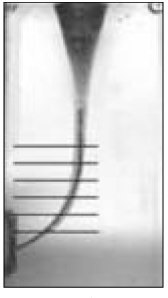
Figure 1 Determination of the resulting canal shape at six levels.
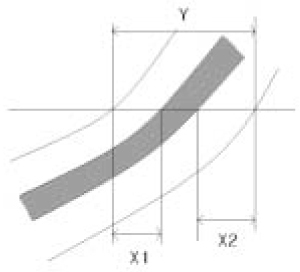
Figure 2 This drawing represents a measuring method. X1 represents the maximum extent of canal movements in one direction and X2 is the movement in the opposite direction. Y is the diameter of the final canal preparation.
Reference
-
1. Schilder H. Cleaning and shaping the root canal. Dent Clin North Am. 1974. 18(2):269–296.2. Weine F, Kelly R, Lio P. The effect of preparation procedures on the original canal shape and on apical foramen shape. J Endod. 1975. 1:255–262.
Article3. Walia H, Brantley WA, Gerstein H. An initial investigation of the bending and torsional properties of Nitinol root canal files. J Endod. 1988. 14:346–351.
Article4. Esposito PT, Cunningham CJ. A comparison of canal preparation with Nickel-Titanium and Stainless steel instruments. J Endod. 1995. 21:173–176.
Article5. Glossen CR, Haller RH, Dove SB, del Rio CE. A comparison of root canal preparations using Ni-Ti hand, Ni-Ti engine-driven, and K-Flex endodontic instruments. J Endod. 1995. 21:146–151.
Article6. Ruddle CJ. The ProTaper endodontic system: geometries, features, and guidelines for use. Dent Today. 2001. 20:60–67.7. Walsch H. The hybrid concept of nickel-titanium rotary instrumentation. Dent Clin North Am. 2004. 48:183–202.
Article8. Clauder T, Baumann MA. ProTaper NT system. Dent Clin North Am. 2004. 48:87–111.
Article9. Schneider SW. A comparison of canal preparations in straight and curved root canals. Oral Surg Oral Med Oral Pathol. 1971. 32:271–275.
Article10. Kuhn WG, Carnes DL Jr, Clement DJ, Walker WA III. Effect of tip design of nickel-titanium and stainless steel files on root canal preparation. J Endod. 1997. 23:735–738.
Article11. Calhoun G, Montgomery S. The effects of four instrumentation techniques on root canal shape. J Endod. 1988. 14:273–277.
Article12. Kosa DA, Marshall G, Baumgartner JC. An analysis of canal centering using mechanical instrumentation techniques. J Endod. 1999. 25:441–445.
Article13. Buchanan LS. The standardized-taper root canal preparation-Part 1. Concepts for variably tapered shaping instruments. Int Endod J. 2000. 33:516–529.
Article14. Coleman CL, Svec TA. Analysis of Ni-Ti versus stainless steel instrumentation in resin simulated canals. J Endod. 1997. 23:232–235.
Article15. Iqbal MK, Firic S, Tulcan J, Karabucak B, Kim S. Comparison of apical transportation between ProFile and ProTaper NiTi rotary instruments. Int Endod J. 2004. 37:359–364.
Article16. Ankrum MT, Hartwell GR, Truitt JE. K3 Endo, ProTaper, and ProFile systems: breakage and distortion in severely curved roots of molars. J Endod. 2004. 30:234–237.
Article17. Schafer E, Schulz-Bongert U, Tulus G. Comparison of hand stainless steel and nickel titanium rotary instrumentation: a clinical study. J Endod. 2004. 30:432–435.
Article18. Calberson FL, Deroose CA, Hommez GM, De Moor RJ. Shaping ability of ProTaper nickel-titanium files in simulated resin root canals. Int Endod J. 2004. 37:613–623.
Article19. Bergmans L, Van Cleynenbreugel J, Beullens M, Van Meerbeek B, Lambrechts P. Progressive versus constant tapered shaft design using NiTi rotary instruments. Int Endod J. 2003. 36:288–295.
Article20. Peters OA, Schnenberger K, Barbakow F. ProTaper rotary root canal preparation: effects of canal anatomy on final shape analysed by micro CT. Int Endod J. 2003. 36:86–92.
Article21. Schäfer E, Vlassis M. Comparative investigation of two rotary nickel-titanium instruments: ProTaper versus RaCe. Part 1. Shaping ability in simulated curved canals. Int Endod J. 2004. 37:229–238.
Article22. Bergmans L, Van Cleynenbreugel J, Wevers M, Lambrechts P. Mechanical root canal preparation with NiTi rotary instruments: rationale, performance and safety. Status report for the American Journal of Dentistry. Am J Dent. 2001. 14:324–333.23. Yun HH, Kim SK. A comparison of the shaping abilities of 4 nickel-titanium rotary instruments in simulated root canals. Oral Surg Oral Med Oral Pathol Oral Radiol Endod. 2003. 95:228–233.
Article24. Lee CH, Cho KM, Hong CU. Effect of various canal preparation techniques using rotary nickel-titanium files on the maintenance of canal curvature. J Korean Acad Conserv Dent. 2003. 28:41–49.
Article25. Berutti E, Chiandussi G, Gaviglio I, Ibba A. Comparative analysis of torsional and bending stresses in two mathematical models of nickel-titanium rotary instruments: ProTaper versus ProFile. J Endod. 2003. 29:15–19.
Article
- Full Text Links
-
- Actions
-
Cited
- CITED
-
- Close
- Share
-
- Similar articles
-
- Comparison of shaping ability using various Nickel-Titanium rotary files and hybrid technique
- A comparative study of the canal configuration after shaping by protaper rotary and hand files in resin simulated canals
- A comparison of the shaping ability of reciprocating NiTi instruments in simulated curved canals
- A comparative study on the canal configuration after shaping by ProFile, ProTaper(TM) and K-Flexofile in simulated canals with different angles of curvature
- A comparison of the shaping ability of four rotary nickel-titanium files in simulated root canals


