
J Korean Med Sci.
2007 Oct;22(5):825-831. 10.3346/jkms.2007.22.5.825.
TAP1 and TAP2 Gene Polymorphisms in Korean Patients with Allergic Rhinitis
- Affiliations
-
- 1Department of Otolaryngology-Head and Neck Surgery, School of Medicine, Hanyang University, Seoul, Korea. kytae@hanyang.ac.kr
- KMID: 1713288
- DOI: http://doi.org/10.3346/jkms.2007.22.5.825
Abstract
- Antigen peptides are actively transported across the endoplasmic reticulum by the transporters associated with antigen presentation (TAP). TAP genes polymorphism could influence the selection process that determines which antigen peptides play a role in the pathogenesis of allergic rhinitis. The aim of this study was to investigate the association of TAP genes polymorphism with allergic rhinitis. TAP1 and TAP2 genotyping were performed on 110 allergic rhinitis patients and 107 healthy controls. TAP1 polymorphic residues at codons 333 and 637, and TAP2 polymorphic residues at codons 379, 565, 651, and 665 were analyzed by the amplification refractory mutation system-polymerase chain reaction (ARMS-PCR). Analysis of TAP1 gene polymorphism demonstrated decreased frequencies of Ile/Val genotype at codon 333, Asp/Gly genotype at codon 637, and haplotype A and B in allergic rhinitis patients when compared to controls (p<0.05). However, there was no significant difference in the genotype, phenotype, or allele frequencies at four TAP2 codons between controls and allergic rhinitis patients. In conclusion, TAP1 gene polymorphism may be an important factor contributing to the genetic susceptibility in the development of allergic rhinitis in the Korean population.
Keyword
MeSH Terms
Figure
-
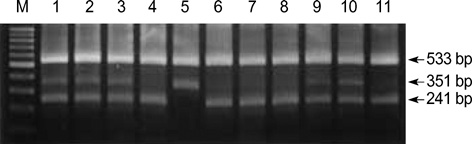
Fig. 1 TAP1 codon 333 genotyping by ARMS-PCR. Four oligonucleotides were included in each polymerase chain reaction mix. Lanes 4, 6, 7, 8 and 11 consist of one control and one allele-specific 241 bp fragment defining the Ile/Ile homozygote. Lanes 1, 2, 3, 9 and 10 consist of one control and two allele-specific, smaller fragments (241 bp and 351 bp) defining the Ile/Val heterozygote. Lane 5 consists of one control and one allele-specific 351 bp fragment defining the Val/Val homozygote.
Cited by 1 articles
-
Overview and challenges of current genetic research on allergic diseases in Korean children
Myunghyun Sohn
Allergy Asthma Respir Dis. 2018;6(Suppl 1):S77-S84. doi: 10.4168/aard.2018.6.S1.S77.
Reference
-
1. Cox HE, Moffatt MF, Faux JA, Walley AJ, Coleman R, Trembath RC, Cookson WO, Harper JI. Association of atopic dermatitis to the beta subunit of the high affinity immunoglobulin E receptor. Br J Dermatol. 1998. 138:182–187.
Article2. Ismail A, Bousaffara R, Kaziz J, Jili J, el Kamel A, Tahar Sfar M, Remadi S, Chouchane L. Polymorphism in transporter antigen peptides gene (TAP1) associated with atopy in Tunisians. J Allergy Clin Immunol. 1997. 99:216–223.
Article3. Moffatt MF, Traherne JA, Abecasis GR, Cookson WO. Single nucleotide polymorphism and linkage disequilibrium within the TCR alpha/delta locus. Hum Mol Genet. 2000. 9:1011–1019.
Article4. Kim JJ, Kim MS, Lee JH, Choi TW, Choi SH, Chung HT. STAT6 gene polymorphisms in allergic rhinitis. Genomics Inform. 2004. 2:126–130.5. Chae SC, Park YR, Li CS, Lee JH, Yang YS, Zhang Q, Kim KS, Chung HT. Analysis of the variations in IL-28RA gene and their association with allergic rhinitis. Exp Mol Med. 2006. 38:302–309.
Article6. Middleton E Jr. Adkinson NF, Yunginger JW, Busse WW, Bochner BS, Holgate ST, Simons FE, editors. Antigen presentation. Middleton's allergy-principle and practice. 2003. Vol 1:6th edition. PA: Mosby;177–188.7. Suto R, Srivastava PK. A mechanism for the specific immunogenicity of heat shock protein-chaperoned peptides. Science. 1995. 269:1585–1588.
Article8. Deverson EV, Gow IR, Coadwell WJ, Monaco JJ, Butcher GW, Howard JC. MHC class II region encoding proteins related to the multidrug resistance family of transmembrane transporters. Nature. 1990. 348:738–741.9. Trowsdale J, Hanson I, Mockridge I, Beck S, Townsend A, Kelly A. Sequences encoded in the class II region of the MHC related to the "ABC" superfamily of transporters. Nature. 1990. 348:741–744.
Article10. Yu MC, Huang CM, Wu MC, Wu JY, Tsai FJ. Association of TAP2 gene polymorphisms in Chinese patients with rheumatoid arthritis. Clin Rheumatol. 2004. 23:35–39.
Article11. Correa RA, Molina JF, Pinto LF, Arcos-Burgos M, Herrera M, Anaya JM. TAP1 and TAP2 polymorphisms analysis in northwestern Colombian patients with systemic lupus erythematosus. Ann Rheum Dis. 2003. 62:363–365.
Article12. Takeuchi K, Abe S, Masuda S, Yuta A, Majima Y, Sakakura Y. Lack of association between gene polymorphism of transporters associated with antigen processing and allergic rhinitis in a Japanese population. Ann Otol Rhinol Laryngol. 2002. 111:460–463.
Article13. Zhang SL, Chabod J, Penfornis A, Reviron D, Tiberghien P, Wendling D, Toussirot E. TAP1 and TAP2 gene polymorphism in rheumatoid arthritis in a population in eastern France. Eur J Immunogenet. 2002. 29:241–249.
Article14. Newton CR, Graham A, Heptinstall LE, Powell SJ, Summers C, Kalsheker N, Smith JC, Markham AF. Analysis of any point mutation in DNA. The amplification refractory mutation system (ARMS). Nucleic Acids Res. 1989. 11:2503–2516.
Article15. Powis SH, Tonks S, Mockridge I, Kelly AP, Bodmer JG, Trowsdale J. Alleles and haplotypes of the MHC-encoded ABC transporters TAP1 and TAP2. Immunogenetics. 1993. 37:373–380.
Article16. Jackson DG, Capra JD. TAP2 association with insulin-dependent diabetes mellitus is secondary to HLA-DQB1. Hum immunol. 1995. 43:57–65.
Article17. Takeuchi F, Kuwata S, Nakano K, Nabeta H, Hong GH, Shibata Y, Tanimoto K, Ito K. Association of TAP1 and TAP2 with systemic sclerosis in Japanese. Clin Exp Rheumatol. 1996. 14:513–521.18. Cresswell P. Invariant chain structure and MHC class II function. Cell. 1996. 23:505–507.
Article19. Kellar-Wood HF, Powis SH, Gray J, Compston DA. MHC-encoded TAP1 and TAP2 dimorphisms in multiple sclerosis. Tissue Antigens. 1994. 43:129–132.
Article20. Rau H, Nicolay A, Usadel KH, Finke R, Donner H, Walfish PG, Badenhoop K. Polymorphisms of TAP1 and TAP2 genes in Grave's disease. Tissue Antigens. 1997. 49:16–22.21. van Endert PM, Liblau RS, Patel SD, Fugger L, Lopez T, Pociot F, Nerup J, McDevitt HO. Major histocompatibility complex-encoded antigen processing gene polymorphism in IDDM. Diabetes. 1994. 43:110–117.
Article
- Full Text Links
-
- Actions
-
Cited
- CITED
-
- Close
- Share
-
- Similar articles
-
- A Study of Genetic Polymorphisms of New HLA Genes, TAP1 and TAP2
- Polymorphism of Antigen Processing ( TAP, HLA-DM, LMP ) Genes in Korean Population
- Family Study of TAP Gene Polymorphism and HLA-TAP Haplotypes in Koreans
- Polymorphism of the Transporters Associated with Antigen Processing 1 (TAP1) Gene in Korean Patients with Allergic Rhinitis
- Polymorphisms of TAP2 Gene in Schizophrenia


