
J Korean Med Sci.
2024 Jan;39(4):e44. 10.3346/jkms.2024.39.e44.
Antibiotic Resistance of Helicobacter pylori: Mechanisms and Clinical Implications

- Affiliations
-
- 1Department of Internal Medicine, Hallym University College of Medicine, Chuncheon, Korea
- KMID: 2551972
- DOI: http://doi.org/10.3346/jkms.2024.39.e44
Abstract
- Helicobacter pylori is a pathogenic bacterium associated with various gastrointestinal diseases, including chronic gastritis, peptic ulcers, mucosa-associated lymphoid tissue lymphoma, and gastric cancer. The increasing rates of H. pylori antibiotic resistance and the emergence of multidrug-resistant strains pose significant challenges to its treatment. This comprehensive review explores the mechanisms underlying the resistance of H. pylori to commonly used antibiotics and the clinical implications of antibiotic resistance. Additionally, potential strategies for overcoming antibiotic resistance are discussed. These approaches aim to improve the treatment outcomes of H. pylori infections while minimizing the development of antibiotic resistance. The continuous evolution of treatment perspectives and ongoing research in this field are crucial for effectively combating this challenging infection.
Figure
-
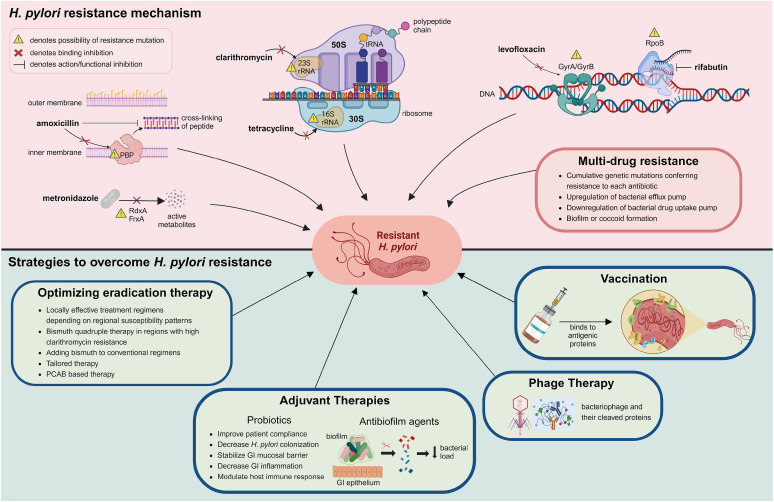
Fig. 1 Overview of molecular mechanism of antibiotic resistance in H. pylori and strategies to overcome this resistance. This image was created with BioRender.com.FrxA = NAD(P)H flavin oxidoreductase, GI = gastrointestinal, GyrA = DNA gyrase subunit A, GyrB = DNA gyrase subunit B, PBP = penicillin-binding protein, PCAB = potassium-competitive acid blocker, RdxA = oxygen-insensitive NAD(P)H nitroreductase, RpoB = β-subunit of DNA-dependent RNA polymerase, rRNA = ribosomal RNA, tRNA = transfer RNA.
Reference
-
1. Suerbaum S, Michetti P. Helicobacter pylori infection. N Engl J Med. 2002; 347(15):1175–1186. PMID: 12374879.2. Kusters JG, van Vliet AH, Kuipers EJ. Pathogenesis of Helicobacter pylori infection. Clin Microbiol Rev. 2006; 19(3):449–490. PMID: 16847081.3. Kayali S, Manfredi M, Gaiani F, Bianchi L, Bizzarri B, Leandro G, et al. Helicobacter pylori, transmission routes and recurrence of infection: state of the art. Acta Biomed. 2018; 89(8-S):72–76.4. Yokota S, Konno M, Fujiwara S, Toita N, Takahashi M, Yamamoto S, et al. Intrafamilial, preferentially mother-to-child and intraspousal, Helicobacter pylori infection in Japan determined by mutilocus sequence typing and random amplified polymorphic DNA fingerprinting. Helicobacter. 2015; 20(5):334–342. PMID: 25664889.5. McColl KE. Clinical practice. Helicobacter pylori infection. N Engl J Med. 2010; 362(17):1597–1604. PMID: 20427808.6. Hooi JK, Lai WY, Ng WK, Suen MM, Underwood FE, Tanyingoh D, et al. Global prevalence of Helicobacter pylori infection: systematic review and meta-analysis. Gastroenterology. 2017; 153(2):420–429. PMID: 28456631.7. Tshibangu-Kabamba E, Yamaoka Y. Helicobacter pylori infection and antibiotic resistance - from biology to clinical implications. Nat Rev Gastroenterol Hepatol. 2021; 18(9):613–629. PMID: 34002081.8. Lee JH, Choi KD, Jung HY, Baik GH, Park JK, Kim SS, et al. Seroprevalence of Helicobacter pylori in Korea: a multicenter, nationwide study conducted in 2015 and 2016. Helicobacter. 2018; 23(2):e12463. PMID: 29345022.9. Li Y, Choi H, Leung K, Jiang F, Graham DY, Leung WK. Global prevalence of Helicobacter pylori infection between 1980 and 2022: a systematic review and meta-analysis. Lancet Gastroenterol Hepatol. 2023; 8(6):553–564. PMID: 37086739.10. Nagy P, Johansson S, Molloy-Bland M. Systematic review of time trends in the prevalence of Helicobacter pylori infection in China and the USA. Gut Pathog. 2016; 8(1):8. PMID: 26981156.11. Malfertheiner P, Megraud F, Rokkas T, Gisbert JP, Liou JM, Schulz C, et al. Management of Helicobacter pylori infection: the Maastricht VI/Florence consensus report. Gut. 2022; 71(9):1724–1762.12. Jung HK, Kang SJ, Lee YC, Yang HJ, Park SY, Shin CM, et al. Evidence-based guidelines for the treatment of Helicobacter pylori infection in Korea 2020. Gut Liver. 2021; 15(2):168–195. PMID: 33468712.13. Dore MP, Lu H, Graham DY. Role of bismuth in improving Helicobacter pylori eradication with triple therapy. Gut. 2016; 65(5):870–878. PMID: 26848181.14. Thung I, Aramin H, Vavinskaya V, Gupta S, Park JY, Crowe SE, et al. Review article: the global emergence of Helicobacter pylori antibiotic resistance. Aliment Pharmacol Ther. 2016; 43(4):514–533. PMID: 26694080.15. Savoldi A, Carrara E, Graham DY, Conti M, Tacconelli E. Prevalence of antibiotic resistance in Helicobacter pylori: a systematic review and meta-analysis in World Health Organization Regions. Gastroenterology. 2018; 155(5):1372–1382.e17. PMID: 29990487.16. Lee JW, Kim N, Choi SI, Jang JY, Song CH, Nam RH, et al. Prevalence and trends of multiple antimicrobial resistance of Helicobacter pylori in one tertiary hospital for 20 years in Korea. Helicobacter. 2023; 28(1):e12939. PMID: 36478622.17. Ho JJ, Navarro M, Sawyer K, Elfanagely Y, Moss SF. Helicobacter pylori antibiotic resistance in the united states between 2011 and 2021: a systematic review and meta-analysis. Am J Gastroenterol. 2022; 117(8):1221–1230. PMID: 35509128.18. Kim SE, Park MI, Park SJ, Moon W, Choi YJ, Cheon JH, et al. Trends in Helicobacter pylori eradication rates by first-line triple therapy and related factors in eradication therapy. Korean J Intern Med. 2015; 30(6):801–807. PMID: 26552455.19. Gong EJ, Yun SC, Jung HY, Lim H, Choi KS, Ahn JY, et al. Meta-analysis of first-line triple therapy for Helicobacter pylori eradication in Korea: is it time to change? J Korean Med Sci. 2014; 29(5):704–713. PMID: 24851029.20. Choe Y. Antibiotic resistance and Helicobacter pylori eradication therapy. Korean J Helicobacter Up Gastrointest Res. 2023; 23(3):218–221.21. Megraud F, Bruyndonckx R, Coenen S, Wittkop L, Huang TD, Hoebeke M, et al. Helicobacter pylori resistance to antibiotics in Europe in 2018 and its relationship to antibiotic consumption in the community. Gut. 2021; 70(10):1815–1822. PMID: 33837118.22. Shin WG, Lee SW, Baik GH, Huh KC, Lee SI, Chung JW, et al. Eradication rates of Helicobacter pylori in Korea over the past 10 years and correlation of the amount of antibiotics use: nationwide survey. Helicobacter. 2016; 21(4):266–278. PMID: 26470999.23. Boltin D, Levi Z, Gingold-Belfer R, Gabay H, Shochat T, Niv Y, et al. Impact of previous exposure to macrolide antibiotics on Helicobacter pylori infection treatment outcomes. Am J Gastroenterol. 2019; 114(6):900–906. PMID: 31095531.24. Tacconelli E, Carrara E, Savoldi A, Harbarth S, Mendelson M, Monnet DL, et al. Discovery, research, and development of new antibiotics: the WHO priority list of antibiotic-resistant bacteria and tuberculosis. Lancet Infect Dis. 2018; 18(3):318–327. PMID: 29276051.25. Gong EJ, Ahn JY, Kim JM, Lee SM, Na HK, Lee JH, et al. Genotypic and phenotypic resistance to clarithromycin in Helicobacter pylori strains. J Clin Med. 2020; 9(6):1930. PMID: 32575584.26. Tuan VP, Narith D, Tshibangu-Kabamba E, Dung HD, Viet PT, Sokomoth S, et al. A next-generation sequencing-based approach to identify genetic determinants of antibiotic resistance in Cambodian Helicobacter pylori clinical isolates. J Clin Med. 2019; 8(6):858. PMID: 31208076.27. Lauener FN, Imkamp F, Lehours P, Buissonnière A, Benejat L, Zbinden R, et al. Genetic determinants and prediction of antibiotic resistance phenotypes in Helicobacter pylori . J Clin Med. 2019; 8(1):53. PMID: 30621024.28. Aldred KJ, Kerns RJ, Osheroff N. Mechanism of quinolone action and resistance. Biochemistry. 2014; 53(10):1565–1574. PMID: 24576155.29. Zhang Z, Liu ZQ, Zheng PY, Tang FA, Yang PC. Influence of efflux pump inhibitors on the multidrug resistance of Helicobacter pylori . World J Gastroenterol. 2010; 16(10):1279–1284. PMID: 20222174.30. Mégraud F. H pylori antibiotic resistance: prevalence, importance, and advances in testing. Gut. 2004; 53(9):1374–1384. PMID: 15306603.31. Yonezawa H, Osaki T, Kamiya S. Biofilm formation by Helicobacter pylori and its involvement for antibiotic resistance. BioMed Res Int. 2015; 2015:914791. PMID: 26078970.32. Kadkhodaei S, Siavoshi F, Akbari Noghabi K. Mucoid and coccoid Helicobacter pylori with fast growth and antibiotic resistance. Helicobacter. 2020; 25(2):e12678. PMID: 31880001.33. Dore MP, Leandro G, Realdi G, Sepulveda AR, Graham DY. Effect of pretreatment antibiotic resistance to metronidazole and clarithromycin on outcome of Helicobacter pylori therapy: a meta-analytical approach. Dig Dis Sci. 2000; 45(1):68–76. PMID: 10695616.34. Binh TT, Shiota S, Suzuki R, Matsuda M, Trang TT, Kwon DH, et al. Discovery of novel mutations for clarithromycin resistance in Helicobacter pylori by using next-generation sequencing. J Antimicrob Chemother. 2014; 69(7):1796–1803. PMID: 24648504.35. Tshibangu-Kabamba E, Ngoma-Kisoko PJ, Tuan VP, Matsumoto T, Akada J, Kido Y, et al. Next-generation sequencing of the whole bacterial genome for tracking molecular insight into the broad-spectrum antimicrobial resistance of Helicobacter pylori clinical isolates from the Democratic Republic of Congo. Microorganisms. 2020; 8(6):8.36. Domanovich-Asor T, Motro Y, Khalfin B, Craddock HA, Peretz A, Moran-Gilad J. Genomic analysis of antimicrobial resistance genotype-to-phenotype agreement in Helicobacter pylori . Microorganisms. 2020; 9(1):2. PMID: 33374988.37. Nakamura M, Spiller RC, Barrett DA, Wibawa JI, Kumagai N, Tsuchimoto K, et al. Gastric juice, gastric tissue and blood antibiotic concentrations following omeprazole, amoxicillin and clarithromycin triple therapy. Helicobacter. 2003; 8(4):294–299. PMID: 12950601.38. Zullo A. The current role of dual therapy for treatment of Helicobacter pylori: back to the future? Eur J Gastroenterol Hepatol. 2020; 32(5):555–556. PMID: 31922977.39. Gerrits MM, van Vliet AH, Kuipers EJ, Kusters JG. Helicobacter pylori and antimicrobial resistance: molecular mechanisms and clinical implications. Lancet Infect Dis. 2006; 6(11):699–709. PMID: 17067919.40. Wilke MS, Lovering AL, Strynadka NC. Beta-lactam antibiotic resistance: a current structural perspective. Curr Opin Microbiol. 2005; 8(5):525–533. PMID: 16129657.41. Kuo YT, Liou JM, El-Omar EM, Wu JY, Leow AH, Goh KL, et al. Primary antibiotic resistance in Helicobacter pylori in the Asia-Pacific region: a systematic review and meta-analysis. Lancet Gastroenterol Hepatol. 2017; 2(10):707–715. PMID: 28781119.42. Gong EJ, Ahn JY. Antimicrobial resistance of Helicobacter pylori isolates in Korea. Korean J Helicobacter Up Gastrointest Res. 2018; 18(2):82–88.43. Cosme A, Torrente Iranzo S, Montes Ros M, Fernández-Reyes Silvestre M, Alonso Galán H, Lizasoain J, et al. Helicobacter pylori antimicrobial resistance during a 5-year period (2013-2017) in northern Spain and its relationship with the eradication therapies. Helicobacter. 2019; 24(1):e12557. PMID: 30460730.44. Bujanda L, Nyssen OP, Vaira D, Saracino IM, Fiorini G, Lerang F, et al. Antibiotic resistance prevalence and trends in patients infected with Helicobacter pylori in the period 2013-2020: results of the European Registry on H. pylori Management (Hp-EuReg). Antibiotics (Basel). 2021; 10(9):1058. PMID: 34572640.45. Gerrits MM, Godoy AP, Kuipers EJ, Ribeiro ML, Stoof J, Mendonça S, et al. Multiple mutations in or adjacent to the conserved penicillin-binding protein motifs of the penicillin-binding protein 1A confer amoxicillin resistance to Helicobacter pylori . Helicobacter. 2006; 11(3):181–187. PMID: 16684266.46. Kwon YH, Kim JY, Kim N, Park JH, Nam RH, Lee SM, et al. Specific mutations of penicillin-binding protein 1A in 77 clinically acquired amoxicillin-resistant Helicobacter pylori strains in comparison with 77 amoxicillin-susceptible strains. Helicobacter. 2017; 22(6):e12437.47. Kim JM, Kim JS, Kim N, Kim SG, Jung HC, Song IS. Comparison of primary and secondary antimicrobial minimum inhibitory concentrations for Helicobacter pylori isolated from Korean patients. Int J Antimicrob Agents. 2006; 28(1):6–13. PMID: 16750904.48. Kim BJ, Kim JG. Substitutions in penicillin-binding protein 1 in amoxicillin-resistant Helicobacter pylori strains isolated from Korean patients. Gut Liver. 2013; 7(6):655–660. PMID: 24312705.49. Rimbara E, Noguchi N, Kawai T, Sasatsu M. Mutations in penicillin-binding proteins 1, 2 and 3 are responsible for amoxicillin resistance in Helicobacter pylori . J Antimicrob Chemother. 2008; 61(5):995–998. PMID: 18276599.50. Tseng YS, Wu DC, Chang CY, Kuo CH, Yang YC, Jan CM, et al. Amoxicillin resistance with beta-lactamase production in Helicobacter pylori . Eur J Clin Invest. 2009; 39(9):807–812. PMID: 19614952.51. Co EM, Schiller NL. Resistance mechanisms in an in vitro-selected amoxicillin-resistant strain of Helicobacter pylori . Antimicrob Agents Chemother. 2006; 50(12):4174–4176. PMID: 17000747.52. Qureshi NN, Gallaher B, Schiller NL. Evolution of amoxicillin resistance of Helicobacter pylori in vitro: characterization of resistance mechanisms. Microb Drug Resist. 2014; 20(6):509–516. PMID: 24901497.53. Park SY, Lee EH, Kim D, Song YG, Jeong SJ. Novel mutations conferring amoxicillin resistance in Helicobacter pylori in South Korea. Antibiotics (Basel). 2023; 12(4):748. PMID: 37107110.54. Rodvold KA. Clinical pharmacokinetics of clarithromycin. Clin Pharmacokinet. 1999; 37(5):385–398. PMID: 10589373.55. Erah PO, Goddard AF, Barrett DA, Shaw PN, Spiller RC. The stability of amoxycillin, clarithromycin and metronidazole in gastric juice: relevance to the treatment of Helicobacter pylori infection. J Antimicrob Chemother. 1997; 39(1):5–12. PMID: 9044021.56. Versalovic J, Shortridge D, Kibler K, Griffy MV, Beyer J, Flamm RK, et al. Mutations in 23S rRNA are associated with clarithromycin resistance in Helicobacter pylori . Antimicrob Agents Chemother. 1996; 40(2):477–480. PMID: 8834903.57. Taylor DE, Ge Z, Purych D, Lo T, Hiratsuka K. Cloning and sequence analysis of two copies of a 23S rRNA gene from Helicobacter pylori and association of clarithromycin resistance with 23S rRNA mutations. Antimicrob Agents Chemother. 1997; 41(12):2621–2628. PMID: 9420030.58. Lyu T, Cheung KS, Deng Z, Ni L, Chen C, Wu J, et al. Whole genome sequencing reveals novel genetic mutations of Helicobacter pylori associating with resistance to clarithromycin and levofloxacin. Helicobacter. 2023; 28(4):e12972. PMID: 36965192.59. Hirata K, Suzuki H, Nishizawa T, Tsugawa H, Muraoka H, Saito Y, et al. Contribution of efflux pumps to clarithromycin resistance in Helicobacter pylori . J Gastroenterol Hepatol. 2010; 25(Suppl 1):S75–S79. PMID: 20586871.60. Choi JH, Yang YJ, Bang CS, Lee JJ, Baik GH. Current status of the third-line Helicobacter pylori eradication. Gastroenterol Res Pract. 2018; 2018:6523653. PMID: 29853863.61. Liou JM, Lee YC, Wu MS. Taiwan Gastrointestinal Disease and Helicobacter Consortium. Treatment of refractory Helicobacter pylori infection-tailored or empirical therapy. Gut Liver. 2022; 16(1):8–18. PMID: 33782215.62. Redgrave LS, Sutton SB, Webber MA, Piddock LJ. Fluoroquinolone resistance: mechanisms, impact on bacteria, and role in evolutionary success. Trends Microbiol. 2014; 22(8):438–445. PMID: 24842194.63. Yoshida H, Bogaki M, Nakamura M, Nakamura S. Quinolone resistance-determining region in the DNA gyrase gyrA gene of Escherichia coli . Antimicrob Agents Chemother. 1990; 34(6):1271–1272. PMID: 2168148.64. Yoshida H, Bogaki M, Nakamura M, Yamanaka LM, Nakamura S. Quinolone resistance-determining region in the DNA gyrase gyrB gene of Escherichia coli . Antimicrob Agents Chemother. 1991; 35(8):1647–1650. PMID: 1656869.65. Lee JW, Kim N, Nam RH, Park JH, Kim JM, Jung HC, et al. Mutations of Helicobacter pylori associated with fluoroquinolone resistance in Korea. Helicobacter. 2011; 16(4):301–310. PMID: 21762270.66. Rimbara E, Noguchi N, Kawai T, Sasatsu M. Fluoroquinolone resistance in Helicobacter pylori: role of mutations at position 87 and 91 of GyrA on the level of resistance and identification of a resistance conferring mutation in GyrB. Helicobacter. 2012; 17(1):36–42.67. Miyachi H, Miki I, Aoyama N, Shirasaka D, Matsumoto Y, Toyoda M, et al. Primary levofloxacin resistance and gyrA/B mutations among Helicobacter pylori in Japan. Helicobacter. 2006; 11(4):243–249. PMID: 16882327.68. Debets-Ossenkopp YJ, Namavar F, MacLaren DM. Effect of an acidic environment on the susceptibility of Helicobacter pylori to trospectomycin and other antimicrobial agents. Eur J Clin Microbiol Infect Dis. 1995; 14(4):353–355. PMID: 7649202.69. Dingsdag SA, Hunter N. Metronidazole: an update on metabolism, structure-cytotoxicity and resistance mechanisms. J Antimicrob Chemother. 2018; 73(2):265–279. PMID: 29077920.70. Martínez-Júlvez M, Rojas AL, Olekhnovich I, Espinosa Angarica V, Hoffman PS, Sancho J. Structure of RdxA--an oxygen-insensitive nitroreductase essential for metronidazole activation in Helicobacter pylori. FEBS J. 2012; 279(23):4306–4317. PMID: 23039228.71. Gong Y, Zhai K, Sun L, He L, Wang H, Guo Y, et al. RdxA diversity and mutations associated with metronidazole resistance of Helicobacter pylori . Microbiol Spectr. 2023; 11(2):e0390322. PMID: 36943041.72. Lee SM, Kim N, Kwon YH, Nam RH, Kim JM, Park JY, et al. rdxA, frxA, and efflux pump in metronidazole-resistant Helicobacter pylori: their relation to clinical outcomes. J Gastroenterol Hepatol. 2018; 33(3):681–688. PMID: 28748532.73. Goodwin A, Kersulyte D, Sisson G, Veldhuyzen van Zanten SJ, Berg DE, Hoffman PS. Metronidazole resistance in Helicobacter pylori is due to null mutations in a gene (rdxA) that encodes an oxygen-insensitive NADPH nitroreductase. Mol Microbiol. 1998; 28(2):383–393. PMID: 9622362.74. Jeong JY, Mukhopadhyay AK, Dailidiene D, Wang Y, Velapatiño B, Gilman RH, et al. Sequential inactivation of rdxA (HP0954) and frxA (HP0642) nitroreductase genes causes moderate and high-level metronidazole resistance in Helicobacter pylori . J Bacteriol. 2000; 182(18):5082–5090. PMID: 10960091.75. Binh TT, Suzuki R, Trang TT, Kwon DH, Yamaoka Y. Search for novel candidate mutations for metronidazole resistance in Helicobacter pylori using next-generation sequencing. Antimicrob Agents Chemother. 2015; 59(4):2343–2348. PMID: 25645832.76. Albert TJ, Dailidiene D, Dailide G, Norton JE, Kalia A, Richmond TA, et al. Mutation discovery in bacterial genomes: metronidazole resistance in Helicobacter pylori . Nat Methods. 2005; 2(12):951–953. PMID: 16299480.77. Kwon DH, Kato M, El-Zaatari FA, Osato MS, Graham DY. Frame-shift mutations in NAD(P)H flavin oxidoreductase encoding gene (frxA) from metronidazole resistant Helicobacter pylori ATCC43504 and its involvement in metronidazole resistance. FEMS Microbiol Lett. 2000; 188(2):197–202. PMID: 10913705.78. Kim SY, Joo YM, Lee HS, Chung IS, Yoo YJ, Merrell DS, et al. Genetic analysis of Helicobacter pylori clinical isolates suggests resistance to metronidazole can occur without the loss of functional rdxA. J Antibiot (Tokyo). 2009; 62(1):43–50. PMID: 19132060.79. Zhang S, Wang X, Wise MJ, He Y, Chen H, Liu A, et al. Mutations of Helicobacter pylori RdxA are mainly related to the phylogenetic origin of the strain and not to metronidazole resistance. J Antimicrob Chemother. 2020; 75(11):3152–3155. PMID: 32676634.80. An B, Moon BS, Lim HC, Lee YC, Kim H, Lee G, et al. Analysis of gene mutations associated with antibiotic resistance in Helicobacter pylori strains isolated from Korean patients. Korean J Helicobacter Up Gastrointest Res. 2014; 14(2):95–102.81. Lee SY, Lee YC, Pyo JH, Kwon DH, Rhee JC, Kim JJ. Quasispecies of antibacterial heteroresistant Helicobacter pylori . Korean J Helicobacter Up Gastrointest Res. 2004; 4(1):7–14.82. Kwon DH, El-Zaatari FA, Kato M, Osato MS, Reddy R, Yamaoka Y, et al. Analysis of rdxA and involvement of additional genes encoding NAD(P)H flavin oxidoreductase (FrxA) and ferredoxin-like protein (FdxB) in metronidazole resistance of Helicobacter pylori . Antimicrob Agents Chemother. 2000; 44(8):2133–2142. PMID: 10898687.83. Tsugawa H, Suzuki H, Satoh K, Hirata K, Matsuzaki J, Saito Y, et al. Two amino acids mutation of ferric uptake regulator determines Helicobacter pylori resistance to metronidazole. Antioxid Redox Signal. 2011; 14(1):15–23. PMID: 20518707.84. Attaran B, Falsafi T, Ghorbanmehr N. Effect of biofilm formation by clinical isolates of Helicobacter pylori on the efflux-mediated resistance to commonly used antibiotics. World J Gastroenterol. 2017; 23(7):1163–1170. PMID: 28275296.85. Graham DY. Antibiotic resistance in Helicobacter pylori: implications for therapy. Gastroenterology. 1998; 115(5):1272–1277. PMID: 9797384.86. Chopra I, Roberts M. Tetracycline antibiotics: mode of action, applications, molecular biology, and epidemiology of bacterial resistance. Microbiol Mol Biol Rev. 2001; 65(2):232–260. PMID: 11381101.87. Lee JH, Ahn JY, Choi KD, Jung HY, Kim JM, Baik GH, et al. Nationwide antibiotic resistance mapping of Helicobacter pylori in Korea: a prospective multicenter study. Helicobacter. 2019; 24(4):e12592. PMID: 31111572.88. Dailidiene D, Bertoli MT, Miciuleviciene J, Mukhopadhyay AK, Dailide G, Pascasio MA, et al. Emergence of tetracycline resistance in Helicobacter pylori: multiple mutational changes in 16S ribosomal DNA and other genetic loci. Antimicrob Agents Chemother. 2002; 46(12):3940–3946. PMID: 12435699.89. Gerrits MM, de Zoete MR, Arents NL, Kuipers EJ, Kusters JG. 16S rRNA mutation-mediated tetracycline resistance in Helicobacter pylori . Antimicrob Agents Chemother. 2002; 46(9):2996–3000. PMID: 12183259.90. Trieber CA, Taylor DE. Mutations in the 16S rRNA genes of Helicobacter pylori mediate resistance to tetracycline. J Bacteriol. 2002; 184(8):2131–2140. PMID: 11914344.91. Wu JY, Kim JJ, Reddy R, Wang WM, Graham DY, Kwon DH. Tetracycline-resistant clinical Helicobacter pylori isolates with and without mutations in 16S rRNA-encoding genes. Antimicrob Agents Chemother. 2005; 49(2):578–583. PMID: 15673736.92. Rothstein DM. Rifamycins, alone and in combination. Cold Spring Harb Perspect Med. 2016; 6(7):a027011. PMID: 27270559.93. Crabol Y, Catherinot E, Veziris N, Jullien V, Lortholary O. Rifabutin: where do we stand in 2016? J Antimicrob Chemother. 2016; 71(7):1759–1771. PMID: 27009031.94. Gisbert JP, Calvet X. Review article: rifabutin in the treatment of refractory Helicobacter pylori infection. Aliment Pharmacol Ther. 2012; 35(2):209–221. PMID: 22129228.95. Hays C, Burucoa C, Lehours P, Tran CT, Leleu A, Raymond J. Molecular characterization of Helicobacter pylori resistance to rifamycins. Helicobacter. 2018; 23(1):e12451.96. Choi YI, Jeong SH, Chung JW, Park DK, Kim KO, Kwon KA, et al. Rifabutin and furazolidone could be the candidates of the rescue regimen for antibiotic-resistant H. pylori in Korea. Can J Infect Dis Med Microbiol. 2019; 2019:9351801. PMID: 31360270.97. Heep M, Beck D, Bayerdörffer E, Lehn N. Rifampin and rifabutin resistance mechanism in Helicobacter pylori . Antimicrob Agents Chemother. 1999; 43(6):1497–1499. PMID: 10348780.98. Nishizawa T, Suzuki H, Matsuzaki J, Muraoka H, Tsugawa H, Hirata K, et al. Helicobacter pylori resistance to rifabutin in the last 7 years. Antimicrob Agents Chemother. 2011; 55(11):5374–5375. PMID: 21896915.99. Heep M, Lehn N, Brandstätter B, Rieger U, Senzenberger S, Wehrl W. Detection of rifabutin resistance and association of rpoB mutations with resistance to four rifamycin derivatives in Helicobacter pylori . Eur J Clin Microbiol Infect Dis. 2002; 21(2):143–145. PMID: 11939398.100. Suzuki S, Suzuki H, Nishizawa T, Kaneko F, Ootani S, Muraoka H, et al. Past rifampicin dosing determines rifabutin resistance of Helicobacter pylori . Digestion. 2009; 79(1):1–4. PMID: 19142036.101. Mori H, Suzuki H, Matsuzaki J, Tsugawa H, Fukuhara S, Miyoshi S, et al. Rifabutin-based 10-day and 14-day triple therapy as a third-line and fourth-line regimen for Helicobacter pylori eradication: a pilot study. United European Gastroenterol J. 2016; 4(3):380–387.102. Tsugawa H, Suzuki H, Muraoka H, Ikeda F, Hirata K, Matsuzaki J, et al. Enhanced bacterial efflux system is the first step to the development of metronidazole resistance in Helicobacter pylori . Biochem Biophys Res Commun. 2011; 404(2):656–660. PMID: 21147064.103. Ge X, Cai Y, Chen Z, Gao S, Geng X, Li Y, et al. Bifunctional enzyme SpoT Is involved in biofilm formation of Helicobacter pylori with multidrug resistance by upregulating efflux pump Hp1174 (gluP). Antimicrob Agents Chemother. 2018; 62(11):e00957-18. PMID: 30181372.104. Liu ZQ, Zheng PY, Yang PC. Efflux pump gene hefA of Helicobacter pylori plays an important role in multidrug resistance. World J Gastroenterol. 2008; 14(33):5217–5222. PMID: 18777600.105. Cai Y, Wang C, Chen Z, Xu Z, Li H, Li W, et al. Transporters HP0939, HP0497, and HP0471 participate in intrinsic multidrug resistance and biofilm formation in Helicobacter pylori by enhancing drug efflux. Helicobacter. 2020; 25(4):e12715. PMID: 32548895.106. Singh S, Singh SK, Chowdhury I, Singh R. Understanding the mechanism of bacterial biofilms resistance to antimicrobial agents. Open Microbiol J. 2017; 11(1):53–62. PMID: 28553416.107. Flemming HC, Wingender J, Szewzyk U, Steinberg P, Rice SA, Kjelleberg S. Biofilms: an emergent form of bacterial life. Nat Rev Microbiol. 2016; 14(9):563–575. PMID: 27510863.108. Koo H, Allan RN, Howlin RP, Stoodley P, Hall-Stoodley L. Targeting microbial biofilms: current and prospective therapeutic strategies. Nat Rev Microbiol. 2017; 15(12):740–755. PMID: 28944770.109. Yonezawa H, Osaki T, Kurata S, Zaman C, Hanawa T, Kamiya S. Assessment of in vitro biofilm formation by Helicobacter pylori . J Gastroenterol Hepatol. 2010; 25(Suppl 1):S90–S94. PMID: 20586874.110. Carron MA, Tran VR, Sugawa C, Coticchia JM. Identification of Helicobacter pylori biofilms in human gastric mucosa. J Gastrointest Surg. 2006; 10(5):712–717. PMID: 16713544.111. Cole SP, Harwood J, Lee R, She R, Guiney DG. Characterization of monospecies biofilm formation by Helicobacter pylori . J Bacteriol. 2004; 186(10):3124–3132. PMID: 15126474.112. Wong EH, Ng CG, Chua EG, Tay AC, Peters F, Marshall BJ, et al. Comparative genomics revealed multiple Helicobacter pylori genes associated with biofilm formation in vitro. PLoS One. 2016; 11(11):e0166835. PMID: 27870886.113. Bode G, Mauch F, Malfertheiner P. The coccoid forms of Helicobacter pylori. Criteria for their viability. Epidemiol Infect. 1993; 111(3):483–490. PMID: 8270008.114. Kusters JG, Gerrits MM, Van Strijp JA, Vandenbroucke-Grauls CM. Coccoid forms of Helicobacter pylori are the morphologic manifestation of cell death. Infect Immun. 1997; 65(9):3672–3679. PMID: 9284136.115. El-Halfawy OM, Valvano MA. Antimicrobial heteroresistance: an emerging field in need of clarity. Clin Microbiol Rev. 2015; 28(1):191–207. PMID: 25567227.116. Kocsmár É, Kocsmár I, Buzás GM, Szirtes I, Wacha J, Takáts A, et al. Helicobacter pylori heteroresistance to clarithromycin in adults-new data by in situ detection and improved concept. Helicobacter. 2020; 25(1):e12670. PMID: 31701608.117. Kim JJ, Kim JG, Kwon DH. Mixed-infection of antibiotic susceptible and resistant Helicobacter pylori isolates in a single patient and underestimation of antimicrobial susceptibility testing. Helicobacter. 2003; 8(3):202–206. PMID: 12752732.118. Lee SY, Kim JJ, Kwon DH. Synchronous infection of heteroresistant Helicobacter pylori . Korean J Helicobacter Res Pract. 2003; 3(2):110–116.119. Kao CY, Lee AY, Huang AH, Song PY, Yang YJ, Sheu SM, et al. Heteroresistance of Helicobacter pylori from the same patient prior to antibiotic treatment. Infect Genet Evol. 2014; 23:196–202. PMID: 24576534.120. Arévalo-Jaimes BV, Rojas-Rengifo DF, Jaramillo CA, de Molano BM, Vera-Chamorro JF, Del Pilar Delgado M. Genotypic determination of resistance and heteroresistance to clarithromycin in Helicobacter pylori isolates from antrum and corpus of Colombian symptomatic patients. BMC Infect Dis. 2019; 19(1):546. PMID: 31226948.121. van der Ende A, van Doorn LJ, Rooijakkers S, Feller M, Tytgat GN, Dankert J. Clarithromycin-susceptible and -resistant Helicobacter pylori isolates with identical randomly amplified polymorphic DNA-PCR genotypes cultured from single gastric biopsy specimens prior to antibiotic therapy. J Clin Microbiol. 2001; 39(7):2648–2651. PMID: 11427586.122. Keikha M, Karbalaei M. Prevalence of antibiotic heteroresistance associated with Helicobacter pylori infection: a systematic review and meta-analysis. Microb Pathog. 2022; 170:105720. PMID: 35964816.123. Li H, Shen Y, Song X, Tang X, Hu R, Marshall BJ, et al. Need for standardization and harmonization of Helicobacter pylori antimicrobial susceptibility testing. Helicobacter. 2022; 27(2):e12873. PMID: 35151236.124. Kim YJ, Chung WC. Eradication therapy for Helicobacter pylori with diagnostic test for clarithromycin resistance. Korean J Helicobacter Up Gastrointest Res. 2019; 19(4):225–230.125. Woo HY, Park DI, Park H, Kim MK, Kim DH, Kim IS, et al. Dual-priming oligonucleotide-based multiplex PCR for the detection of Helicobacter pylori and determination of clarithromycin resistance with gastric biopsy specimens. Helicobacter. 2009; 14(1):22–28. PMID: 19191892.126. Redondo JJ, Keller PM, Zbinden R, Wagner K. A novel RT-PCR for the detection of Helicobacter pylori and identification of clarithromycin resistance mediated by mutations in the 23S rRNA gene. Diagn Microbiol Infect Dis. 2018; 90(1):1–6. PMID: 29111147.127. Binmaeil H, Hanafiah A, Mohamed Rose I, Raja Ali RA. Development and validation of multiplex quantitative PCR assay for detection of Helicobacter pylori and mutations conferring resistance to clarithromycin and levofloxacin in gastric biopsy. Infect Drug Resist. 2021; 14:4129–4145. PMID: 34675558.128. Lehours P, Siffré E, Mégraud F. DPO multiplex PCR as an alternative to culture and susceptibility testing to detect Helicobacter pylori and its resistance to clarithromycin. BMC Gastroenterol. 2011; 11(1):112. PMID: 22004003.129. Nahm JH, Kim WK, Kwon Y, Kim H. Detection of Helicobacter pylori with clarithromycin resistance-associated mutations using peptide nucleic acid probe-based melting point analysis. Helicobacter. 2019; 24(5):e12634. PMID: 31304664.130. Cambau E, Allerheiligen V, Coulon C, Corbel C, Lascols C, Deforges L, et al. Evaluation of a new test, genotype HelicoDR, for molecular detection of antibiotic resistance in Helicobacter pylori . J Clin Microbiol. 2009; 47(11):3600–3607. PMID: 19759218.131. Lee JW, Kim N, Nam RH, Park JH, Choi YJ, Kim JM, et al. GenoType HelicoDR test in the determination of antimicrobial resistance of Helicobacter pylori in Korea. Scand J Gastroenterol. 2014; 49(9):1058–1067. PMID: 24957849.132. Schabereiter-Gurtner C, Hirschl AM, Dragosics B, Hufnagl P, Puz S, Kovách Z, et al. Novel real-time PCR assay for detection of Helicobacter pylori infection and simultaneous clarithromycin susceptibility testing of stool and biopsy specimens. J Clin Microbiol. 2004; 42(10):4512–4518. PMID: 15472302.133. Jehanne Q, Bénéjat L, Mégraud F, Bessède E, Lehours P. Evaluation of the Allplex™ H pylori and ClariR PCR Assay for Helicobacter pylori detection on gastric biopsies. Helicobacter. 2020; 25(4):e12702. PMID: 32426894.134. Kim I, Maeng LS, Kim JS, Kim BW, Cheung DY, Kim JI, et al. Quantitative multiplex real-time polymerase chain reaction assay for the detection of Helicobacter pylori and clarithromycin resistance. BMC Microbiol. 2023; 23(1):155. PMID: 37237357.135. Van den Poel B, Gils S, Micalessi I, Carton S, Christiaens P, Cuyle PJ, et al. Molecular detection of Helicobacter pylori and clarithromycin resistance in gastric biopsies: a prospective evaluation of RIDA®GENE Helicobacter pylori assay. Acta Clin Belg. 2021; 76(3):177–183. PMID: 31662122.136. Park CG, Kim S, Jeon HS, Han S. Validation of loop-mediated isothermal amplification to detect Helicobacter pylori and 23S rRNA mutations: a prospective, observational clinical cohort study. J Clin Lab Anal. 2021; 35(1):e23563. PMID: 32893424.137. Yari F, Abiri R, Aryan E, Ahmadi Jouybari T, Navabi J, Alvandi A. Loop-mediated isothermal amplification as a fast noninvasive method of Helicobacter pylori diagnosis. J Clin Lab Anal. 2016; 30(5):464–470. PMID: 26351213.138. Kakiuchi T, Okuda M, Matsuo M, Fujimoto K. Smart Gene™ as an effective non-invasive point-of-care test to detect Helicobacter pylori clarithromycin-resistant mutation. J Gastroenterol Hepatol. 2022; 37(9):1719–1725. PMID: 35562319.139. Liu M, Zhu P, Zhang L, Gong Y, Wang C, Sun L, et al. Single-cell identification, drug susceptibility test, and whole-genome sequencing of Helicobacter pylori directly from gastric biopsy by clinical antimicrobial susceptibility test Ramanometry. Clin Chem. 2022; 68(8):1064–1074. PMID: 35714147.140. Saruuljavkhlan B, Yamaoka Y. Benefits of a molecular-based method for the detection of clarithromycin-resistant Helicobacter pylori . Gut Liver. 2021; 15(4):487–489. PMID: 34261816.141. Hulten KG, Genta RM, Kalfus IN, Zhou Y, Zhang H, Graham DY. Comparison of culture with antibiogram to next-generation sequencing using bacterial isolates and formalin-fixed, paraffin-embedded gastric biopsies. Gastroenterology. 2021; 161(5):1433–1442.e2. PMID: 34293298.142. Graham DY. Helicobacter pylori update: gastric cancer, reliable therapy, and possible benefits. Gastroenterology. 2015; 148(4):719–731.e3. PMID: 25655557.143. Zou Y, Qian X, Liu X, Song Y, Song C, Wu S, et al. The effect of antibiotic resistance on Helicobacter pylori eradication efficacy: a systematic review and meta-analysis. Helicobacter. 2020; 25(4):e12714. PMID: 32533599.144. Fallone CA, Moss SF, Malfertheiner P. Reconciliation of recent Helicobacter pylori treatment guidelines in a time of increasing resistance to antibiotics. Gastroenterology. 2019; 157(1):44–53. PMID: 30998990.145. Shiotani A, Roy P, Lu H, Graham DY. Helicobacter pylori diagnosis and therapy in the era of antimicrobial stewardship. Therap Adv Gastroenterol. 2021; 14:17562848211064080.146. Kim N, Kim JM, Kim CH, Park YS, Lee DH, Kim JS, et al. Institutional difference of antibiotic resistance of Helicobacter pylori strains in Korea. J Clin Gastroenterol. 2006; 40(8):683–687. PMID: 16940878.147. Ko SW, Kim YJ, Chung WC, Lee SJ. Bismuth supplements as the first-line regimen for Helicobacter pylori eradication therapy: systemic review and meta-analysis. Helicobacter. 2019; 24(2):e12565. PMID: 30698318.148. Wenzhen Y, Yumin L, Quanlin G, Kehu Y, Lei J, Donghai W, et al. Is antimicrobial susceptibility testing necessary before first-line treatment for Helicobacter pylori infection? Meta-analysis of randomized controlled trials. Intern Med. 2010; 49(12):1103–1109. PMID: 20558925.149. Bae JH, Jo HH, Kwon JG, Kim EY. Efficacy of 7-day tailored therapy for Helicobacter pylori eradication based on clarithromycin resistance. Korean J Gastroenterol. 2023; 82(1):10–17. PMID: 37489077.150. Cho SH, Park MS, Park SY, Kim DH, You HS, Kim HS. Effectiveness of 7-day triple therapy with half-dose clarithromycin for the eradication of Helicobacter pylori without the A2143G and A2142G point mutations of the 23S rRNA gene in a high clarithromycin resistance area. Front Med (Lausanne). 2023; 10:1150396. PMID: 37035320.151. Nyssen OP, Espada M, Gisbert JP. Empirical vs. susceptibility-guided treatment of Helicobacter pylori infection: a systematic review and meta-analysis. Front Microbiol. 2022; 13:913436. PMID: 35774456.152. López-Góngora S, Puig I, Calvet X, Villoria A, Baylina M, Muñoz N, et al. Systematic review and meta-analysis: susceptibility-guided versus empirical antibiotic treatment for Helicobacter pylori infection. J Antimicrob Chemother. 2015; 70(9):2447–2455. PMID: 26078393.153. Gingold-Belfer R, Niv Y, Schmilovitz-Weiss H, Levi Z, Boltin D. Susceptibility-guided versus empirical treatment for Helicobacter pylori infection: a systematic review and meta-analysis. J Gastroenterol Hepatol. 2021; 36(10):2649–2658. PMID: 34114673.154. Du RC, Ouyang YB, Lu NH, Hu Y. Research trends on vonoprazan-based therapy for Helicobacter pylori eradication: a bibliometric analysis from 2015 to 2023. Helicobacter. 2023; 28(5):e13012. PMID: 37515414.155. Sugimoto M, Yamaoka Y. Role of vonoprazan in Helicobacter pylori eradication therapy in Japan. Front Pharmacol. 2019; 9:1560. PMID: 30697158.156. Lee JW, Kim N, Nam RH, Yu JE, Son JH, Lee SM, et al. Efficacy of tegoprazan for improving the susceptibility of antimicrobial agents against antibiotic-resistant Helicobacter pylori . Gut Liver. 2021; 15(1):53–60. PMID: 33191308.157. Yeom DH, Kim YS. History and pharmacological mechanism of gastric acid-suppressive drugs. Korean J Helicobacter Up Gastrointest Res. 2023; 23(3):159–166.158. Murakami K, Sakurai Y, Shiino M, Funao N, Nishimura A, Asaka M. Vonoprazan, a novel potassium-competitive acid blocker, as a component of first-line and second-line triple therapy for Helicobacter pylori eradication: a phase III, randomised, double-blind study. Gut. 2016; 65(9):1439–1446. PMID: 26935876.159. Chey WD, Mégraud F, Laine L, López LJ, Hunt BJ, Howden CW. Vonoprazan triple and dual therapy for Helicobacter pylori infection in the United States and Europe: randomized clinical trial. Gastroenterology. 2022; 163(3):608–619. PMID: 35679950.160. Yang C, Li S, Huang T, Lin H, Jiang Z, He Y, et al. Effectiveness and safety of vonoprazan-based regimen for Helicobacter pylori eradication: a meta-analysis of randomized clinical trials. J Clin Pharm Ther. 2022; 47(7):897–904. PMID: 35247003.161. Kato M, Ota H, Okuda M, et al. Guidelines for the management of Helicobacter pylori infection in Japan: 2016 Revised Edition. Helicobacter. 2019; 24(4):e12597. PMID: 31111585.162. Ouyang Y, Wang M, Xu YL, Zhu Y, Lu NH, Hu Y. Amoxicillin-vonoprazan dual therapy for Helicobacter pylori eradication: a systematic review and meta-analysis. J Gastroenterol Hepatol. 2022; 37(9):1666–1672. PMID: 35716370.163. Suzuki S, Kusano C, Horii T, Ichijima R, Ikehara H. The ideal Helicobacter pylori treatment for the present and the future. Digestion. 2022; 103(1):62–68. PMID: 34662879.164. Graham DY. Why the vonoprazan Helicobacter pylori therapies in the US-European trial produced unacceptable cure rates. Dig Dis Sci. 2023; 68(5):1691–1697. PMID: 36856926.165. Sue S, Maeda S. Is a potassium-competitive acid blocker truly superior to proton pump inhibitors in terms of Helicobacter pylori eradication? Gut Liver. 2021; 15(6):799–810. PMID: 33850058.166. Mohtasham M, Joukar F, Maroufizadeh S, Mojtahedi K, Asgharnezhad M, Mansour-Ghanaei F. Lactobacillus ruteri compared with placebo as an adjuvant in quadruple therapy for Helicobacter pylori eradication: a randomized, double-blind, controlled trial. Arab J Gastroenterol. 2023; 24(1):40–44. PMID: 36372695.167. Wang Y, Wang X, Cao XY, Zhu HL, Miao L. Comparative effectiveness of different probiotics supplements for triple Helicobacter pylori eradication: a network meta-analysis. Front Cell Infect Microbiol. 2023; 13:1120789. PMID: 37256113.168. Hsieh PS, Tsai YC, Chen YC, Teh SF, Ou CM, King VA. Eradication of Helicobacter pylori infection by the probiotic strains Lactobacillus johnsonii MH-68 and L. salivarius ssp. salicinius AP-32. Helicobacter. 2012; 17(6):466–477. PMID: 23067294.169. Gotteland M, Brunser O, Cruchet S. Systematic review: are probiotics useful in controlling gastric colonization by Helicobacter pylori? Aliment Pharmacol Ther. 2006; 23(8):1077–1086. PMID: 16611267.170. Oh B, Kim BS, Kim JW, Kim JS, Koh SJ, Kim BG, et al. The effect of probiotics on gut microbiota during the Helicobacter pylori eradication: randomized controlled trial. Helicobacter. 2016; 21(3):165–174. PMID: 26395781.171. Yuan Z, Xiao S, Li S, Suo B, Wang Y, Meng L, et al. The impact of Helicobacter pylori infection, eradication therapy, and probiotics intervention on gastric microbiota in young adults. Helicobacter. 2021; 26(6):e12848. PMID: 34448282.172. Huynh HQ, Couper RT, Tran CD, Moore L, Kelso R, Butler RN. N-acetylcysteine, a novel treatment for Helicobacter pylori infection. Dig Dis Sci. 2004; 49(11-12):1853–1861. PMID: 15628716.173. Gurbuz AK, Ozel AM, Ozturk R, Yildirim S, Yazgan Y, Demirturk L. Effect of N-acetyl cysteine on Helicobacter pylori . South Med J. 2005; 98(11):1095–1097. PMID: 16351030.174. Cammarota G, Branca G, Ardito F, Sanguinetti M, Ianiro G, Cianci R, et al. Biofilm demolition and antibiotic treatment to eradicate resistant Helicobacter pylori: a clinical trial. Clin Gastroenterol Hepatol. 2010; 8(9):817–820.e3. PMID: 20478402.175. Chen X, Li P, Shen Y, Zou Y, Yuan G, Hu H. Rhamnolipid-involved antibiotics combinations improve the eradication of Helicobacter pylori biofilm in vitro: a comparison with conventional triple therapy. Microb Pathog. 2019; 131:112–119. PMID: 30951818.176. Brüssow H. Infection therapy: the problem of drug resistance - and possible solutions. Microb Biotechnol. 2017; 10(5):1041–1046. PMID: 28737021.177. Loc-Carrillo C, Abedon ST. Pros and cons of phage therapy. Bacteriophage. 2011; 1(2):111–114. PMID: 22334867.178. Vale FF, Nunes A, Oleastro M, Gomes JP, Sampaio DA, Rocha R, et al. Genomic structure and insertion sites of Helicobacter pylori prophages from various geographical origins. Sci Rep. 2017; 7(1):42471. PMID: 28205536.179. Lehours P, Vale FF, Bjursell MK, Melefors O, Advani R, Glavas S, et al. Genome sequencing reveals a phage in Helicobacter pylori . mBio. 2011; 2(6):e00239-11. PMID: 22086490.180. Abdel-Haliem ME, Askora A. Isolation and characterization of bacteriophages of Helicobacter pylori isolated from Egypt. Future Virol. 2013; 8(8):821–826.181. Cuomo P, Papaianni M, Fulgione A, Guerra F, Capparelli R, Medaglia C. An innovative approach to control H. pylori-induced persistent inflammation and colonization. Microorganisms. 2020; 8(8):1214. PMID: 32785064.182. Michetti P, Kreiss C, Kotloff KL, Porta N, Blanco JL, Bachmann D, et al. Oral immunization with urease and Escherichia coli heat-labile enterotoxin is safe and immunogenic in Helicobacter pylori-infected adults. Gastroenterology. 1999; 116(4):804–812. PMID: 10092302.183. Kreiss C, Buclin T, Cosma M, Corthésy-Theulaz I, Michetti P. Safety of oral immunisation with recombinant urease in patients with Helicobacter pylori infection. Lancet. 1996; 347(9015):1630–1631.184. DiPetrillo MD, Tibbetts T, Kleanthous H, Killeen KP, Hohmann EL. Safety and immunogenicity of phoP/phoQ-deleted Salmonella typhi expressing Helicobacter pylori urease in adult volunteers. Vaccine. 1999; 18(5-6):449–459. PMID: 10519934.185. Angelakopoulos H, Hohmann EL. Pilot study of phoP/phoQ-deleted Salmonella enterica serovar typhimurium expressing Helicobacter pylori urease in adult volunteers. Infect Immun. 2000; 68(4):2135–2141. PMID: 10722611.186. Kotloff KL, Sztein MB, Wasserman SS, Losonsky GA, DiLorenzo SC, Walker RI. Safety and immunogenicity of oral inactivated whole-cell Helicobacter pylori vaccine with adjuvant among volunteers with or without subclinical infection. Infect Immun. 2001; 69(6):3581–3590. PMID: 11349017.187. Bumann D, Metzger WG, Mansouri E, Palme O, Wendland M, Hurwitz R, et al. Safety and immunogenicity of live recombinant Salmonella enterica serovar Typhi Ty21a expressing urease A and B from Helicobacter pylori in human volunteers. Vaccine. 2001; 20(5-6):845–852. PMID: 11738748.188. Sougioultzis S, Lee CK, Alsahli M, Banerjee S, Cadoz M, Schrader R, et al. Safety and efficacy of E. coli enterotoxin adjuvant for urease-based rectal immunization against Helicobacter pylori . Vaccine. 2002; 21(3-4):194–201. PMID: 12450694.189. Banerjee S, Medina-Fatimi A, Nichols R, Tendler D, Michetti M, Simon J, et al. Safety and efficacy of low dose Escherichia coli enterotoxin adjuvant for urease based oral immunisation against Helicobacter pylori in healthy volunteers. Gut. 2002; 51(5):634–640. PMID: 12377799.190. Metzger WG, Mansouri E, Kronawitter M, Diescher S, Soerensen M, Hurwitz R, et al. Impact of vector-priming on the immunogenicity of a live recombinant Salmonella enterica serovar typhi Ty21a vaccine expressing urease A and B from Helicobacter pylori in human volunteers. Vaccine. 2004; 22(17-18):2273–2277. PMID: 15149786.191. Aebischer T, Bumann D, Epple HJ, Metzger W, Schneider T, Cherepnev G, et al. Correlation of T cell response and bacterial clearance in human volunteers challenged with Helicobacter pylori revealed by randomised controlled vaccination with Ty21a-based Salmonella vaccines. Gut. 2008; 57(8):1065–1072. PMID: 18417532.192. Malfertheiner P, Selgrad M, Wex T, Romi B, Borgogni E, Spensieri F, et al. Efficacy, immunogenicity, and safety of a parenteral vaccine against Helicobacter pylori in healthy volunteers challenged with a Cag-positive strain: a randomised, placebo-controlled phase 1/2 study. Lancet Gastroenterol Hepatol. 2018; 3(10):698–707. PMID: 30042064.193. Malfertheiner P, Schultze V, Rosenkranz B, Kaufmann SH, Ulrichs T, Novicki D, et al. Safety and immunogenicity of an intramuscular Helicobacter pylori vaccine in noninfected volunteers: a phase I study. Gastroenterology. 2008; 135(3):787–795. PMID: 18619971.194. Zeng M, Mao XH, Li JX, Tong WD, Wang B, Zhang YJ, et al. Efficacy, safety, and immunogenicity of an oral recombinant Helicobacter pylori vaccine in children in China: a randomised, double-blind, placebo-controlled, phase 3 trial. Lancet. 2015; 386(10002):1457–1464. PMID: 26142048.
- Full Text Links
-
- Actions
-
Cited
- CITED
-
- Close
- Share
-
- Similar articles
-
- Antibiotic Resistance in Helicobacter pylori
- Eradication Therapy for Helicobacter pylori with Diagnostic Test for Clarithromycin Resistance
- Antibiotics resistance of Helicobacter pylori and treatment modalities in children with H. pylori infection
- Management of Helicobacter pylori Infection in Europe: Focusing on the Maastricht V/Florence Consensus
- Clinical Characteristicsof Patients with Failed Eradication of Helicobacter pylori and Antibiotic Resistance


