
Encainide, a class Ic anti-arrhythmic agent, blocks voltage-dependent potassium channels in coronary artery smooth muscle cells
- Affiliations
-
- 1Institute of Translational Medicine, Medical College, Yangzhou University, Yangzhou 225001, China
- 2Laboratory of Integrated Traditional Chinese and Western Medicine for Prevention and Treatment for Senile Diseases, Yangzhou University, Yangzhou 225001, China
- 3Department of Physiology, Kangwon National University School of Medicine, Chuncheon 24341, Korea
- KMID: 2544141
- DOI: http://doi.org/10.4196/kjpp.2023.27.4.399
Abstract
- Voltage-dependent K + (Kv) channels are widely expressed on vascular smooth muscle cells and regulate vascular tone. Here, we explored the inhibitory effect of encainide, a class Ic anti-arrhythmic agent, on Kv channels of vascular smooth muscle from rabbit coronary arteries. Encainide inhibited Kv channels in a concentration-dependent manner with an IC50 value of 8.91 ± 1.75 μM and Hill coefficient of 0.72 ± 0.06. The application of encainide shifted the activation curve toward a more positive potential without modifying the inactivation curve, suggesting that encainide inhibited Kv channels by altering the gating property of channel activation. The inhibition by encainide was not significantly affected by train pulses (1 and 2 Hz), indicating that the inhibition is not use (state)-dependent. The inhibitory effect of encainide was reduced by pretreatment with the Kv1.5 subtype inhibitor. However, pretreatment with the Kv2.1 subtype inhibitor did not alter the inhibitory effects of encainide on Kv currents. Based on these results, encainide inhibits vascular Kv channels in a concentration-dependent and use (state)-independent manner by altering the voltage sensor of the channels. Furthermore, Kv1.5 is the main Kv subtype involved in the effect of encainide.
Keyword
Figure
-

Fig. 1 Effects of encainide on voltage-dependent K+ (Kv) currents in rabbit coronary arterial smooth muscle cells. The Kv currents were recorded using a 600-ms depolarizing pulse from −80 to +60 mV in steps of 10 mV at a holding potential of −80 mV under the control condition (A) and in the presence of 10 μM encainide (B). (C) Summary of the current voltage (I-V) relationship at steady-state Kv currents in the control condition (○) and in the presence of 10 μM encainide (●). n = 6. All n means the number of cells. Only one cell was examined from a rabbit to minimize individual differences. *p < 0.05 (control vs. encainide, at each voltage).
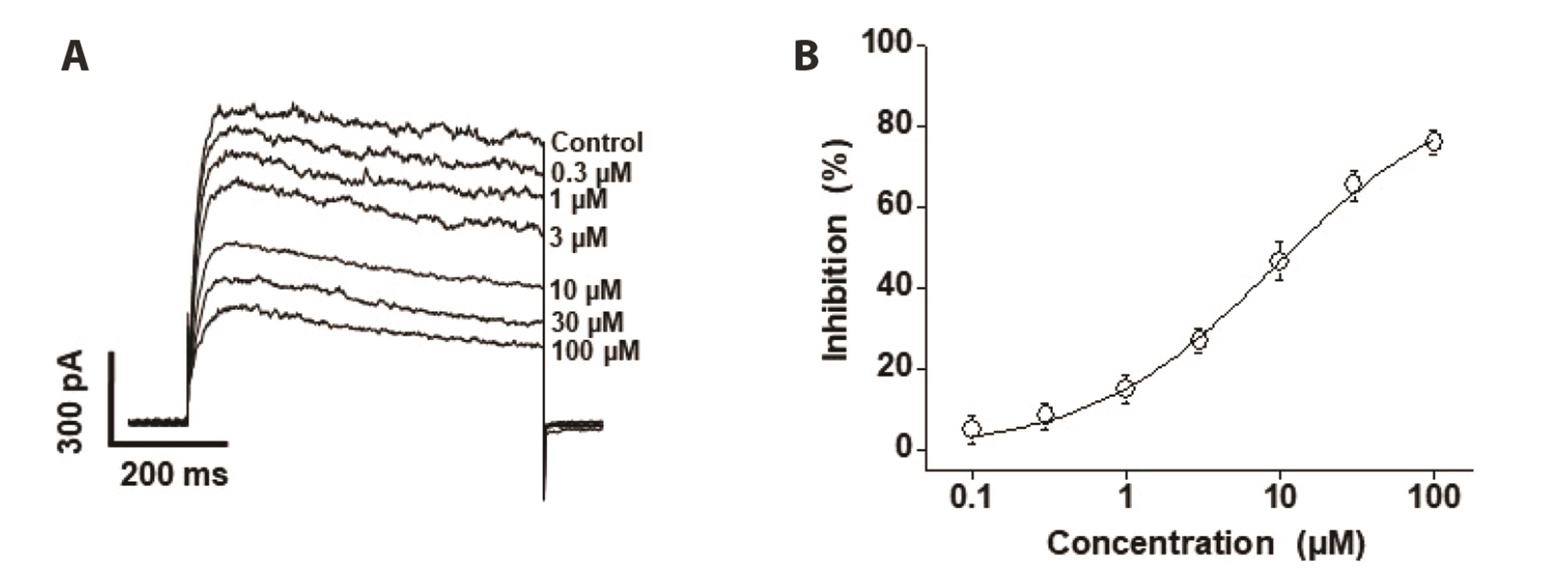
Fig. 2 Concentration-dependent inhibition of the voltage-dependent K+ (Kv) channel by encainide. (A) Representative current traces were elicited by 600-ms depolarizing pulses from a holding potential of −80 mV in the presence of 0, 0.1, 0.3, 1, 3, 10, 30, and 100 μM encainide. (B) Concentration-dependent curve for the inhibitory effect of encainide on the Kv current was measured at steady-state (○) and normalized to the current amplitude observed in the absence of encainide (control). Normalized currents were fitted using the Hill equation. n = 6 for all.
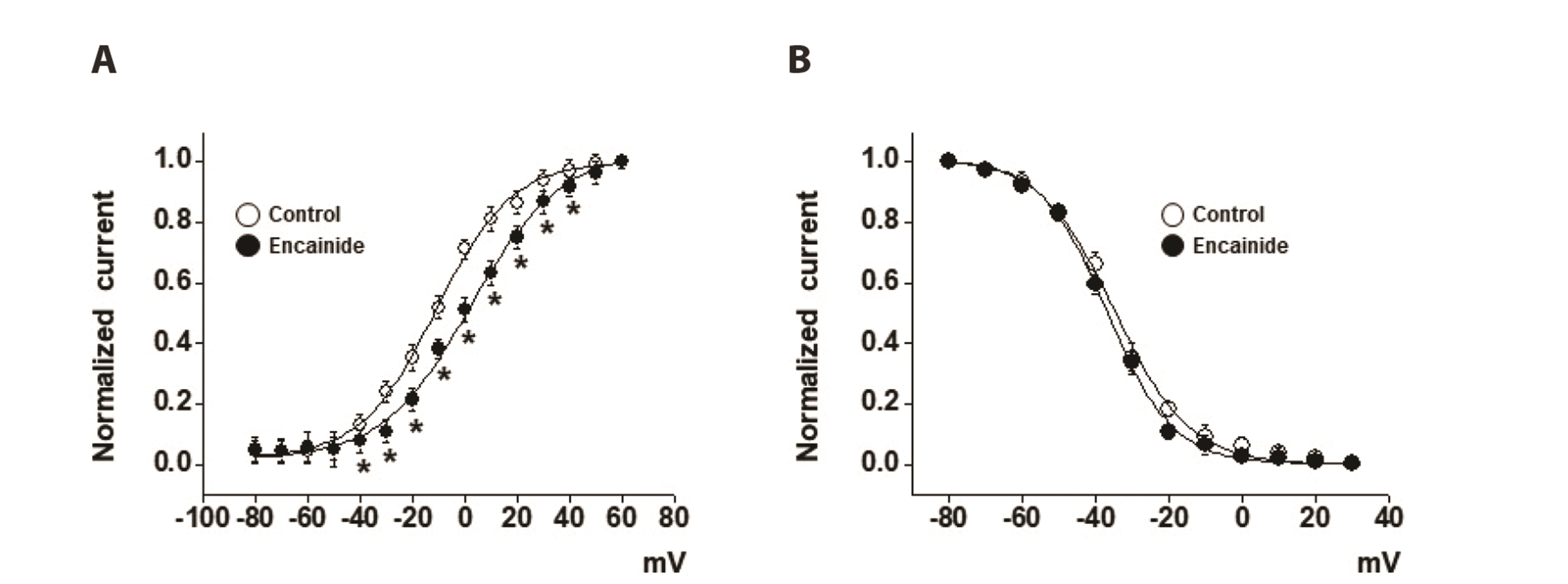
Fig. 3 Influence of encainide on steady-state activation and inactivation curves. (A) Activation curves under the control conditions (○) and in the presence of 10 μM encainide (●). Activation curves were drawn based on analysis of tail currents, which were induced by applying a short depolarizing step from −80 to +60 mV in 10-mV increments at an −80 mV holding potential, followed by a return potential of −40 mV. The acquired tail currents were normalized to the maximum value of the tail current. n = 6. *p < 0.05 (control vs. encainide, at each voltage). (B) Inactivation curves under the control conditions (○) and in the presence of 10 μM encainide (●). Inactivation curves were obtained by applying a test step to +40 mV after 7-s pre-conditioning at different voltages. The currents induced by the test step were normalized to the peak amplitude of the pre-conditioning step-induced currents. n = 5.
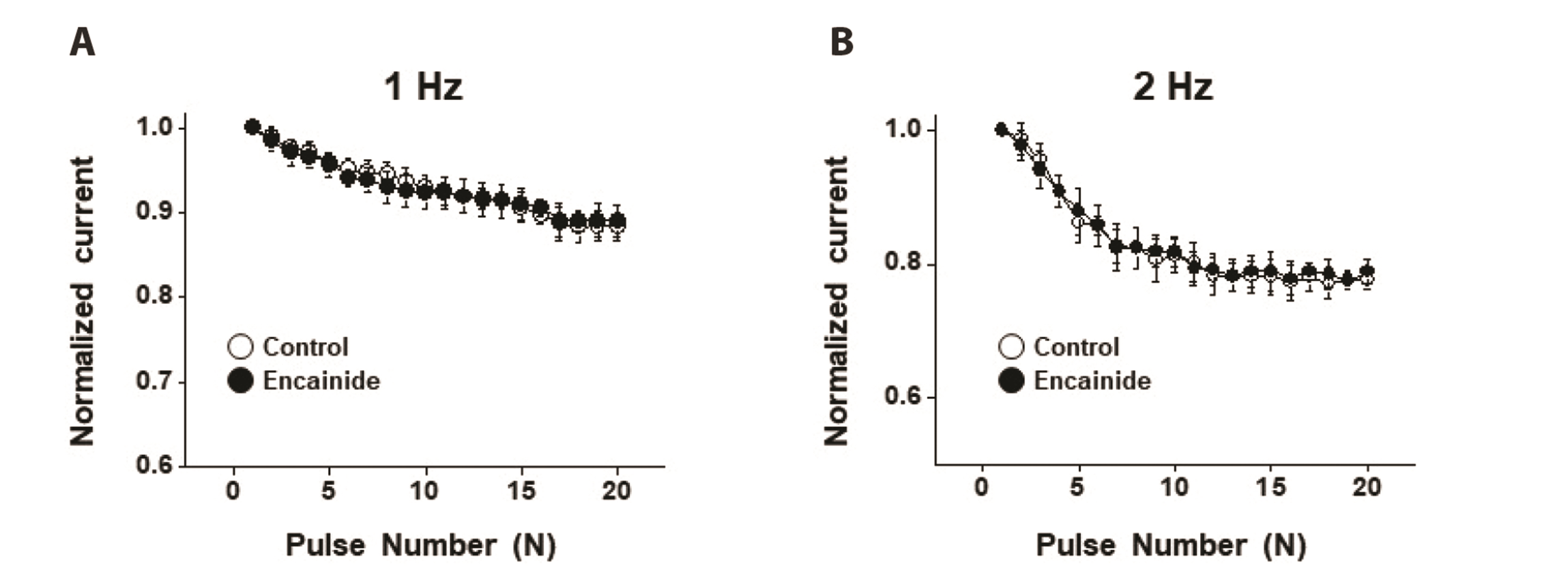
Fig. 4 Use (state)-independent effect of encainide on voltage-dependent K+ currents. Twenty repeated depolarizing pulses were applied from a holding potential of −80 mV to +60 mV at frequencies of 1 (A) and 2 (B) Hz in the absence (○) and presence (●) of 10 μM encainide The peak currents were normalized using the peak current recorded after the first pulse and plotted against the pulse number. n = 6.

Fig. 5 Roles of Kv1.5 and Kv2.1 subtypes in encainide-induced inhibition of Kv channels. Representative Kv currents were recorded using 600-ms depolarizing steps of +60 mV from a holding potential of −80 mV. (A) Superimposed currents under control conditions and in the presence of 1 μM DPO-1 or 1 μM DPO-1 + 10 μM encainide. (B) Summary of the results shown in panel (A). n = 5. NS, not significant (DPO-1 vs. DPO-1 + encainide). (C) Superimposed currents under control conditions and in the presence of 100 nM guangxitoxin or 100 nM guangxitoxin + 10 μM encainide. (D) Summary of the results shown in panel (C). n = 5. *p < 0.05 (guangxitoxin vs. guangxitoxin + encainide). Kv, voltage-dependent K+.

Fig. 6 Effect of encainide on resting membrane potential. (A) Alterations of membrane potential caused by 10 μM encainide. (B) Summary of the effects of encainide on membrane potential. n = 4. *p < 0.05.
Reference
-
1. Goette A, Lendeckel U. 2021; Atrial cardiomyopathy: pathophysiology and clinical consequences. Cells. 10:2605. DOI: 10.3390/cells10102605. PMID: 34685585. PMCID: PMC8533786. PMID: efe620b81afd4d7e9187c6b34b055d6b.
Article2. Sagris M, Vardas EP, Theofilis P, Antonopoulos AS, Oikonomou E, Tousoulis D. 2021; Atrial fibrillation: pathogenesis, predisposing factors, and genetics. Int J Mol Sci. 23:6. DOI: 10.3390/ijms23010006. PMID: 35008432. PMCID: PMC8744894. PMID: fd0c330177d2492aa2d755a92ec15a67.
Article3. Black N, D'Souza A, Wang Y, Piggins H, Dobrzynski H, Morris G, Boyett MR. 2019; Circadian rhythm of cardiac electrophysiology, arrhythmogenesis, and the underlying mechanisms. Heart Rhythm. 16:298–307. DOI: 10.1016/j.hrthm.2018.08.026. PMID: 30170229. PMCID: PMC6520649.
Article4. Schmitt N, Grunnet M, Olesen SP. 2014; Cardiac potassium channel subtypes: new roles in repolarization and arrhythmia. Physiol Rev. 94:609–653. DOI: 10.1152/physrev.00022.2013. PMID: 24692356.
Article5. Zhang Q, Chen J, Qin Y, Wang J, Zhou L. 2018; Mutations in voltage-gated L-type calcium channel: implications in cardiac arrhythmia. Channels (Austin). 12:201–218. DOI: 10.1080/19336950.2018.1499368. PMID: 30027834. PMCID: PMC6104696.
Article6. Vaughan Williams EM. 1975; Classification of antidysrhythmic drugs. Pharmacol Ther B. 1:115–138. DOI: 10.1016/0306-039X(75)90019-7. PMID: 772700.
Article7. Antonaccio MJ, Gomoll AW, Byrne JE. 1989; Encainide. Cardiovasc Drugs Ther. 3:691–710. DOI: 10.1007/BF01857621. PMID: 2518680.
Article8. Lüderitz B, Mletzko R, Jung W, Manz M. 1991; Combination of antiarrhythmic drugs. J Cardiovasc Pharmacol. 17 Suppl 6:S48–S52. DOI: 10.1097/00005344-199100176-00011.9. Soyka LF. 1986; Safety of encainide for the treatment of ventricular arrhythmias. Am J Cardiol. 58:96C–103C. DOI: 10.1016/0002-9149(86)90111-6. PMID: 3092626.
Article10. Li H, Zhuang W, Xiong T, Park WS, Zhang S, Zha Y, Yao J, Wang F, Yang Y, Chen Y, Cai L, Ling L, Yu D, Liang J. 2022; Nrf2 deficiency attenuates atherosclerosis by reducing LOX-1-mediated proliferation and migration of vascular smooth muscle cells. Atherosclerosis. 347:1–16. DOI: 10.1016/j.atherosclerosis.2022.02.025. PMID: 35299056.
Article11. Shi J, Yang Y, Cheng A, Xu G, He F. 2020; Metabolism of vascular smooth muscle cells in vascular diseases. Am J Physiol Heart Circ Physiol. 319:H613–H631. DOI: 10.1152/ajpheart.00220.2020. PMID: 32762559.
Article12. Zhang L, Wang Y, Wu G, Rao L, Wei Y, Yue H, Yuan T, Yang P, Xiong F, Zhang S, Zhou Q, Chen Z, Li J, Mo BW, Zhang H, Xiong W, Wang CY. 2020; Blockade of JAK2 protects mice against hypoxia-induced pulmonary arterial hypertension by repressing pulmonary arterial smooth muscle cell proliferation. Cell Prolif. 53:e12742. DOI: 10.1111/cpr.12742. PMID: 31943454. PMCID: PMC7046303.
Article13. Tykocki NR, Boerman EM, Jackson WF. 2017; Smooth muscle ion channels and regulation of vascular tone in resistance arteries and arterioles. Compr Physiol. 7:485–581. DOI: 10.1002/cphy.c160011. PMID: 28333380. PMCID: PMC5575875.
Article14. Dogan MF, Yildiz O, Arslan SO, Ulusoy KG. 2019; Potassium channels in vascular smooth muscle: a pathophysiological and pharmacological perspective. Fundam Clin Pharmacol. 33:504–523. DOI: 10.1111/fcp.12461. PMID: 30851197.
Article15. Ko EA, Han J, Jung ID, Park WS. 2008; Physiological roles of K+ channels in vascular smooth muscle cells. J Smooth Muscle Res. 44:65–81. DOI: 10.1540/jsmr.44.65. PMID: 18552454.16. Bobi J, Garabito M, Solanes N, Cidad P, Ramos-Pérez V, Ponce A, Rigol M, Freixa X, Pérez-Martínez C, Pérez de Prado A, Fernández-Vázquez F, Sabaté M, Borrós S, López-López JR, Pérez-García MT, Roqué M. 2020; Kv1.3 blockade inhibits proliferation of vascular smooth muscle cells in vitro and intimal hyperplasia in vivo. Transl Res. 224:40–54. DOI: 10.1016/j.trsl.2020.06.002. PMID: 32522668.
Article17. Jackson WF. 2010; KV1.3: a new therapeutic target to control vascular smooth muscle cell proliferation. Arterioscler Thromb Vasc Biol. 30:1073–1074. DOI: 10.1161/ATVBAHA.110.206565. PMID: 20484702. PMCID: PMC2891047.18. An JR, Li H, Seo MS, Park WS. 2018; Inhibition of voltage-dependent K+ current in rabbit coronary arterial smooth muscle cells by the class Ic antiarrhythmic drug propafenone. Korean J Physiol Pharmacol. 22:597–605. DOI: 10.4196/kjpp.2018.22.5.597. PMID: 30181706. PMCID: PMC6115351.
Article19. An JR, Kim HW, Li H, Seo MS, Jung WK, Ha KS, Han ET, Hong SH, Firth AL, Choi IW, Park WS. 2018; Inhibition of the voltage-dependent K+ current by the class Ic antiarrhythmic drug flecainide in rabbit coronary arterial smooth muscle cells. Clin Exp Pharmacol Physiol. 45:1286–1292. DOI: 10.1111/1440-1681.13015. PMID: 30028903.
Article20. Li H, Zhuang W, Seo MS, An JR, Yang Y, Zha Y, Liang J, Xu ZX, Park WS. 2021; Inhibition of voltage-dependent K+ channels in rabbit coronary arterial smooth muscle cells by the class Ic antiarrhythmic agent lorcainide. Eur J Pharmacol. 904:174158. DOI: 10.1016/j.ejphar.2021.174158. PMID: 33971179.21. Hasan R, Jaggar JH. 2018; KV channel trafficking and control of vascular tone. Microcirculation. 25:10.1111/micc.12418. DOI: 10.1111/micc.12418. PMID: 28963858. PMCID: PMC5760341.22. Lu Y, Hanna ST, Tang G, Wang R. 2002; Contributions of Kv1.2, Kv1.5 and Kv2.1 subunits to the native delayed rectifier K(+) current in rat mesenteric artery smooth muscle cells. Life Sci. 71:1465–1473. DOI: 10.1016/S0024-3205(02)01922-7. PMID: 12127166.
Article23. Jaillon P. 1990; Pharmacokinetics and metabolism of encainide. Cardiovasc Drugs Ther. 4 Suppl 3:561–565. DOI: 10.1007/BF00357031. PMID: 2125833.
Article
- Full Text Links
-
- Actions
-
Cited
- CITED
-
- Close
- Share
-
- Similar articles
-
- Inhibition of voltage-dependent K⺠current in rabbit coronary arterial smooth muscle cells by the class Ic antiarrhythmic drug propafenone
- Effects of Fluoxetine on Potassium Channels in Cat Gastric Smooth Muscle Cells
- The Effect Erythrocyte lysate on Intracellular Calcium Concentration and the Potassium Channel in Cerebral Vasular Smooth Muscle Cells
- Effects of Propofol in Voltage-dependent Potassium Channels in Human Neurl Stem Cells
- Physiological Roles and Properties of Ion Channels in Corporal Smooth Muscle


