
J Korean Assoc Oral Maxillofac Surg.
2021 Oct;47(5):388-393. 10.5125/jkaoms.2021.47.5.388.
Factors to consider for surgical in elderly patients with oral cancer

- Affiliations
-
- 1Department of Oral and Maxillofacial Surgery, School of Dentistry, Kyungpook National University, Daegu, Korea
- KMID: 2521796
- DOI: http://doi.org/10.5125/jkaoms.2021.47.5.388
Abstract
- At present, in Korea, due to developments in medicine and technology and an increasing mean lifespan, the expected lifetime for elderly people is increasing (at 70 years, the expected additional lifespan is 14.8 years for males and 18.3 years for females). However, among all causes of death, malignant neoplasm is ranked first for all ages. Further, the incidence rate of oral cancer tends to increase with age. Thus, oral and maxillofacial surgeons have increased opportunity to experience the ‘oldest old’ patients with oral cancer. Elderly patients commonly have several comorbidities, poor general condition, limited socioeconomic support, fear of various postoperative complications, and perception of short for the rest of their life. In this situation, the patient, caregiver, and surgeon often choose undergraded treatment rather than standard treatment for oral squamous cell carcinoma owing to patient age. In elderly patients with oral cancer, ablation of tumor or reconstructive surgery is challenging for surgeons. Oral and maxillofacial surgeons must evaluate carefully the patient’s medical condition and make a decision regarding treatment plans after sufficient discussion with patient and caregivers. We review the literature to consider the factors involved for deciding on a treatment plan regarding surgery in elderly patients with oral cancer.
Keyword
Figure
-
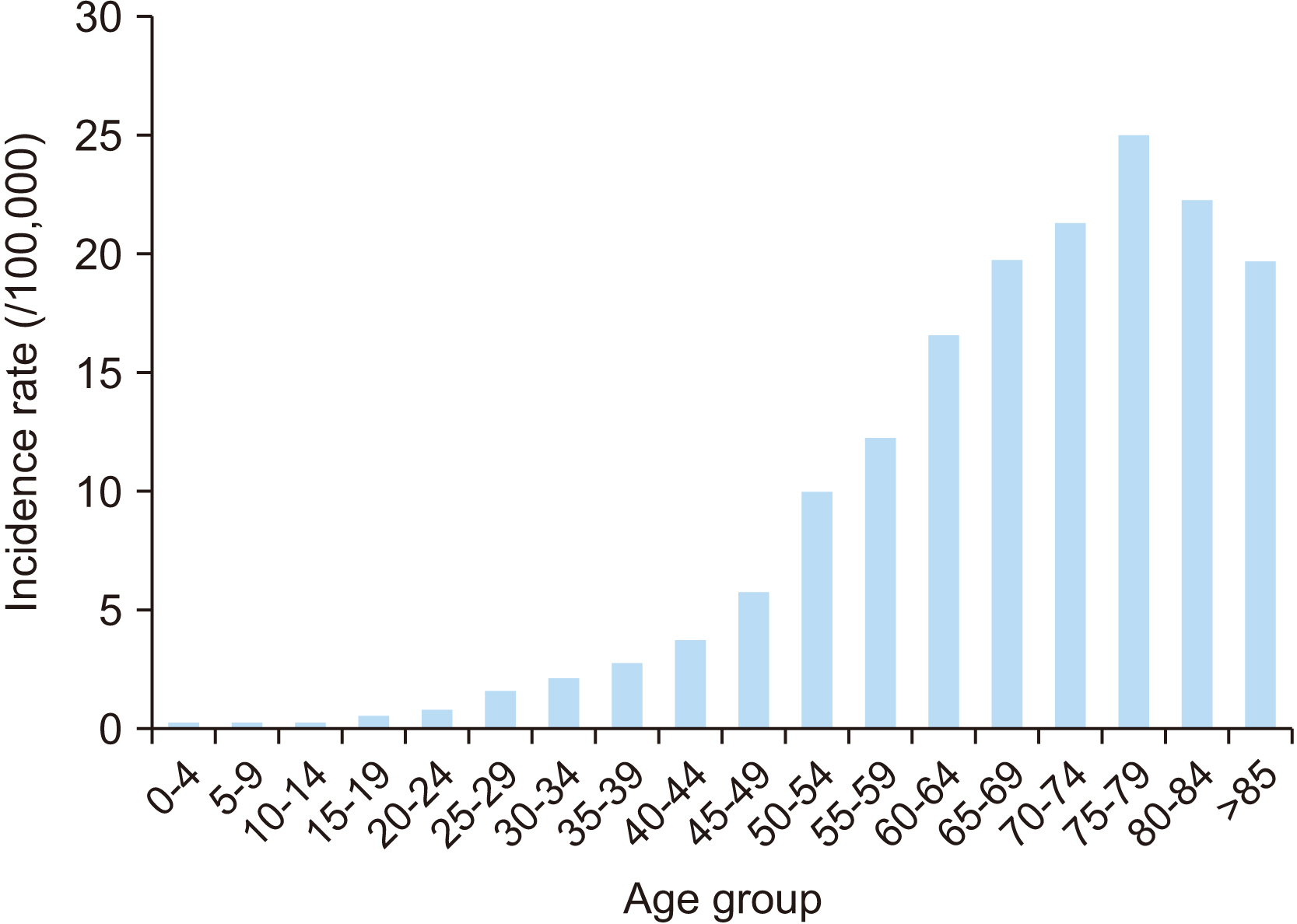
Fig. 1 Cancer incidence rate by age group in Korea, 2016 (KOSIS [Korean Statistical Information Service]).
Reference
-
References
1. KKOSIS (Korean Statistical Information Service). 2020. Death rates for the 10 leading causes of death by age [Internet]. Statistics Korea;Daejeon: Available from: https://kosis.kr/publication/publicationThema.do . cited 2020 Aug 1.2. Bøje CR, Dalton SO, Grønborg TK, Primdahl H, Kristensen CA, Andersen E, et al. 2013; The impact of comorbidity on outcome in 12 623 Danish head and neck cancer patients: a population based study from the DAHANCA database. Acta Oncol. 52:285–93. https://doi.org/10.3109/0284186X.2012.742964 . DOI: 10.3109/0284186X.2012.742964. PMID: 23320773.
Article3. Chen RC, Royce TJ, Extermann M, Reeve BB. 2012; Impact of age and comorbidity on treatment and outcomes in elderly cancer patients. Semin Radiat Oncol. 22:265–71. https://doi.org/10.1016/j.semradonc.2012.05.002 . DOI: 10.1016/j.semradonc.2012.05.002. PMID: 22985808.
Article4. Fang QG, Shi S, Li M, Zhang X, Liu FY, Sun CF. 2014; Free flap reconstruction versus non-free flap reconstruction in treating elderly patients with advanced oral cancer. J Oral Maxillofac Surg. 72:1420–4. https://doi.org/10.1016/j.joms.2014.01.010 . DOI: 10.1016/j.joms.2014.01.010. PMID: 24613030.
Article5. Sasaki T, Moles DR, Imai Y, Speight PM. 2005; Clinico-pathological features of squamous cell carcinoma of the oral cavity in patients <40 years of age. J Oral Pathol Med. 34:129–33. https://doi.org/10.1111/j.1600-0714.2004.00291.x . DOI: 10.1111/j.1600-0714.2004.00291.x.
Article6. KOSIS (Korean Statistical Information Service). 2020. Cancer incident cases and incidence rates by site (24 items), sex, age group [Internet]. Statistics Korea;Daejeon: Available from: http://kosis.kr/statHtml/statHtml.do?orgId=117&tblId=DT_117N_A00023&conn_path=I3 . cited 2020 Aug 1.7. Parker SL, Tong T, Bolden S, Wingo PA. 1997; Cancer statistics, 1997. CA Cancer J Clin. 47:5–27. https://doi.org/10.3322/canjclin.47.1.5 . DOI: 10.3322/canjclin.47.1.5. PMID: 8996076.
Article8. Fentiman IS. 1996; Are the elderly receiving appropriate treatment for cancer? Ann Oncol. 7:657–8. https://doi.org/10.1093/oxfordjournals.annonc.a010712 . DOI: 10.1093/oxfordjournals.annonc.a010712. PMID: 8905021.
Article9. Clayman GL, Eicher SA, Sicard MW, Razmpa E, Goepfert H. 1998; Surgical outcomes in head and neck cancer patients 80 years of age and older. Head Neck. 20:216–23. https://doi.org/10.1002/(sici)1097-0347(199805)20:3<216::aid-hed6>3.0.co;2-3 . DOI: 10.1002/(sici)1097-0347(199805)20:3<216::aid-hed6>3.0.co;2-3. PMID: 9570627.
Article10. Gambotti L, Schwob E, Schouman T, Murcier G, Goudot P, Mallet A, et al. 2018; Are elderly patients presenting with squamous cell carcinoma of the oral cavity given the appropriate treatment? Surg Oncol. 27:715–21. https://doi.org/10.1016/j.suronc.2018.04.005 . DOI: 10.1016/j.suronc.2018.04.005. PMID: 30449498.
Article11. Piccirillo JF, Vlahiotis A. 2006; Comorbidity in patients with cancer of the head and neck: prevalence and impact on treatment and prognosis. Curr Oncol Rep. 8:123–9. https://doi.org/10.1007/s11912-006-0047-z . DOI: 10.1007/s11912-006-0047-z. PMID: 16507222.
Article12. Reid BC, Alberg AJ, Klassen AC, Samet JM, Rozier RG, Garcia I, et al. 2001; Comorbidity and survival of elderly head and neck carcinoma patients. Cancer. 92:2109–16. https://doi.org/10.1002/1097-0142(20011015)92:8<2109::aid-cncr1552>3.0.co;2-m . DOI: 10.1002/1097-0142(20011015)92:8<2109::aid-cncr1552>3.0.co;2-m.
Article13. Sanabria A, Carvalho AL, Vartanian JG, Magrin J, Ikeda MK, Kowalski LP. 2007; Comorbidity is a prognostic factor in elderly patients with head and neck cancer. Ann Surg Oncol. 14:1449–57. https://doi.org/10.1245/s10434-006-9296-1 . DOI: 10.1245/s10434-006-9296-1. PMID: 17235712.
Article14. Wu Y, Zhang B, Huang Z, Ruan Y, Huang Z. 2018; Study of surgical treatment for elderly patients with head and neck cancer. Int J Oral Maxillofac Surg. 47:824–9. https://doi.org/10.1016/j.ijom.2018.01.018 . DOI: 10.1016/j.ijom.2018.01.018. PMID: 29429844.
Article15. Piccirillo JF, Tierney RM, Costas I, Grove L, Spitznagel EL Jr. 2004; Prognostic importance of comorbidity in a hospital-based cancer registry. JAMA. 291:2441–7. https://doi.org/10.1001/jama.291.20.2441 . DOI: 10.1001/jama.291.20.2441. PMID: 15161894.
Article16. Ferrier MB, Spuesens EB, Le Cessie S. Baatenburg de Jong RJ. 2005; Comorbidity as a major risk factor for mortality and complications in head and neck surgery. Arch Otolaryngol Head Neck Surg. 131:27–32. https://doi.org/10.1001/archotol.131.1.27 . DOI: 10.1001/archotol.131.1.27. PMID: 15655181.
Article17. Derks W, De Leeuw JR, Hordijk GJ, Winnubst JA. 2003; Elderly patients with head and neck cancer: short-term effects of surgical treatment on quality of life. Clin Otolaryngol Allied Sci. 28:399–405. https://doi.org/10.1046/j.1365-2273.2003.00718.x . DOI: 10.1046/j.1365-2273.2003.00718.x. PMID: 12969340.
Article18. Chen JJ, Shah JL, Harris JP, Bui TT, Schaberg K, Kong CS, et al. 2017; Clinical outcomes in elderly patients treated for oral cavity squamous cell carcinoma. Int J Radiat Oncol Biol Phys. 98:775–83. https://doi.org/10.1016/j.ijrobp.2017.03.017 . DOI: 10.1016/j.ijrobp.2017.03.017. PMID: 28602409.
Article19. Birim O, Kappetein AP, Bogers AJ. 2005; Charlson comorbidity index as a predictor of long-term outcome after surgery for nonsmall cell lung cancer. Eur J Cardiothorac Surg. 28:759–62. https://doi.org/10.1016/j.ejcts.2005.06.046 . DOI: 10.1016/j.ejcts.2005.06.046. PMID: 16157485.
Article20. Chang CM, Yin WY, Wei CK, Wu CC, Su YC, Yu CH, et al. 2016; Adjusted age-adjusted Charlson comorbidity index score as a risk measure of perioperative mortality before cancer surgery. PLoS One. 11:e0148076. https://doi.org/10.1371/journal.pone.0148076 . DOI: 10.1371/journal.pone.0148076. PMID: 26848761. PMCID: PMC4744039.
Article21. Suzuki H, Hanai N, Nishikawa D, Fukuda Y, Koide Y, Kodaira T, et al. 2016; The Charlson comorbidity index is a prognostic factor in sinonasal tract squamous cell carcinoma. Jpn J Clin Oncol. 46:646–51. https://doi.org/10.1093/jjco/hyw049 . DOI: 10.1093/jjco/hyw049. PMID: 27162318.
Article22. Charlson ME, Pompei P, Ales KL, MacKenzie CR. 1987; A new method of classifying prognostic comorbidity in longitudinal studies: development and validation. J Chronic Dis. 40:373–83. https://doi.org/10.1016/0021-9681(87)90171-8 . DOI: 10.1016/0021-9681(87)90171-8. PMID: 3558716.
Article23. Colinet B, Jacot W, Bertrand D, Lacombe S, Bozonnat MC, Daurès JP, et al. 2005; ; oncoLR health network. A new simplified comorbidity score as a prognostic factor in non-small-cell lung cancer patients: description and comparison with the Charlson's index. Br J Cancer. 93:1098–105. https://doi.org/10.1038/sj.bjc.6602836 . DOI: 10.1038/sj.bjc.6602836.
Article24. Volk ML, Hernandez JC, Lok AS, Marrero JA. 2007; Modified Charlson comorbidity index for predicting survival after liver transplantation. Liver Transpl. 13:1515–20. https://doi.org/10.1002/lt.21172 . DOI: 10.1002/lt.21172. PMID: 17969207.
Article25. Roseland ME, Pressler ME, Lamerato LE, Krajenta R, Ruterbusch JJ, Booza JC, et al. 2015; Racial differences in breast cancer survival in a large urban integrated health system. Cancer. 121:3668–75. https://doi.org/10.1002/cncr.29523 . DOI: 10.1002/cncr.29523. PMID: 26110691.
Article26. Bøje CR, Dalton SO, Primdahl H, Kristensen CA, Andersen E, Johansen J, et al. 2014; Evaluation of comorbidity in 9388 head and neck cancer patients: a national cohort study from the DAHANCA database. Radiother Oncol. 110:91–7. https://doi.org/10.1016/j.radonc.2013.11.009 . DOI: 10.1016/j.radonc.2013.11.009. PMID: 24412015.
Article27. Audisio RA, Pope D, Ramesh HS, Gennari R, van Leeuwen BL, et al. PACE participants. 2008; Shall we operate? Preoperative assessment in elderly cancer patients (PACE) can help. A SIOG surgical task force prospective study. Crit Rev Oncol Hematol. 65:156–63. https://doi.org/10.1016/j.critrevonc.2007.11.001 . DOI: 10.1016/j.critrevonc.2007.11.001. PMID: 18082416.
Article28. Repetto L, Fratino L, Audisio RA, Venturino A, Gianni W, Vercelli M, et al. 2002; Comprehensive geriatric assessment adds information to Eastern Cooperative Oncology Group performance status in elderly cancer patients: an Italian Group for Geriatric Oncology Study. J Clin Oncol. 20:494–502. https://doi.org/10.1200/JCO.2002.20.2.494 . DOI: 10.1200/JCO.2002.20.2.494. PMID: 11786579.
Article29. ECOG Performance Status [Internet]. 2021. ECOG-ACRIN Cancer Research Group;Philadelphia (PA): Available from: https://ecog-acrin.org/resources/ecog-performance-status . cited 2021 Jan 18.30. Leu YS, Chang YF, Lee JC, Liu CJ, Hsiao HT, Chen YJ, et al. 2009; Squamous cell carcinoma of the oral cavity in the elderly. Int J Gerontol. 3:75–80. https://doi.org/10.1016/S1873-9598(09)70023-7 . DOI: 10.1016/S1873-9598(09)70023-7.
Article31. Ferrari S, Copelli C, Bianchi B, Ferri A, Poli T, Ferri T, et al. 2013; Free flaps in elderly patients: outcomes and complications in head and neck reconstruction after oncological resection. J Craniomaxillofac Surg. 41:167–71. https://doi.org/10.1016/j.jcms.2012.07.005 . DOI: 10.1016/j.jcms.2012.07.005. PMID: 22883078.
Article32. Tsai CH, Chang KP, Hung SY, Chen WF, Cheng MH, Kao HK. 2012; Postoperative morbidity in head and neck cancer ablative surgery followed by microsurgical free tissue transfer in the elderly. Oral Oncol. 48:811–6. https://doi.org/10.1016/j.oraloncology.2012.03.006 . DOI: 10.1016/j.oraloncology.2012.03.006. PMID: 22494788.
Article33. Peters TT, Langendijk JA, Plaat BE, Wedman J, Roodenburg JL, van Dijk BA, et al. 2011; Co-morbidity and treatment outcomes of elderly pharyngeal cancer patients: a matched control study. Oral Oncol. 47:1159–64. https://doi.org/10.1016/j.oraloncology.2011.08.004 . DOI: 10.1016/j.oraloncology.2011.08.004. PMID: 21885328.
Article34. Peters TT, van Dijk BA, Roodenburg JL, van der Laan BF, Halmos GB. 2014; Relation between age, comorbidity, and complications in patients undergoing major surgery for head and neck cancer. Ann Surg Oncol. 21:963–70. https://doi.org/10.1245/s10434-013-3375-x . DOI: 10.1245/s10434-013-3375-x. PMID: 24248531.
Article35. Sarini J, Fournier C, Lefebvre JL, Bonafos G, Van JT, Coche-Dequéant B. 2001; Head and neck squamous cell carcinoma in elderly patients: a long-term retrospective review of 273 cases. Arch Otolaryngol Head Neck Surg. 127:1089–92. https://doi.org/10.1001/archotol.127.9.1089 . DOI: 10.1001/archotol.127.9.1089. PMID: 11556858.
Article36. Kim YH, Roh JL, Kim SB, Choi SH, Nam SY, Kim SY. 2018; Risk factors for competing non-cancer mortality after definitive treatment for advanced-stage head and neck cancer. Oral Dis. 24:1217–25. https://doi.org/10.1111/odi.12904 . DOI: 10.1111/odi.12904. PMID: 29804327.
Article37. Yang R, Lubek JE, Dyalram D, Liu X, Ord RA. 2014; Head and neck cancer surgery in an elderly patient population: a retrospective review. Int J Oral Maxillofac Surg. 43:1413–7. https://doi.org/10.1016/j.ijom.2014.08.008 . DOI: 10.1016/j.ijom.2014.08.008. PMID: 25223605.
Article
- Full Text Links
-
- Actions
-
Cited
- CITED
-
- Close
- Share
-
- Similar articles
-
- Surgical management for elderly patients with pancreatic cancer
- Three Cases of Elderly Women with Breast Cancer treated with Non-operative Methods
- Endoscopic Resection of Early Gastric Cancer in Elderly
- Low Serum Albumin Level, Male Sex, and Total Gastrectomy Are Risk Factors of Severe Postoperative Complications in Elderly Gastric Cancer Patients
- Factors Related to Morbidity in Elderly Gastric Cancer Patients Undergoing Gastrectomies


