
Validity of the Thoracolumbar Injury Classification System for Thoracolumbar Spine Injuries
- Affiliations
-
- 1Department of Orthopedic Surgery, Chonnam National University Hospital, Korea. surimayorsniper@hanmail.net
- KMID: 2402838
- DOI: http://doi.org/10.4184/jkss.2017.24.1.16
Abstract
- STUDY DESIGN: Retrospective study.
OBJECTIVES
To evaluate the validity of the thoracolumbar injury classification system (TLICS) when making treatment decisions in a group of thoracolumbar fracture patients. SUMMARY OF LITERATURE REVIEW: Few studies have evaluated the validity of the TLICS in consecutively treated patients, although many have evaluated the application of the TLICS to thoracolumbar injuries.
MATERIALS AND METHODS
A retrospective study was performed among the 230 patients who were treated from 2003 to 2015 in our hospital for thoracolumbar injuries. Evaluations were made of clinical outcomes and radiologic results, and each case was analysed and scored according to the American Spinal Injury Association scale, the Magerl/AO classification, and the TLICS classification by 2 spinal surgeons.
RESULTS
Of the 230 patients, 116 (50.4%) received conservative treatment and 114 (49.6%) received surgical treatment. Of the 116 patients who received conservative treatment, 112 (96.6%) were treated according to the TLICS guidelines. Conservative treatment failed for 2 of the 4 patients (1.7%) whose treatment did not correspond with TLICS, and they required surgical treatment. Of the 114 patients who underwent surgical treatment, in 87 (76.3%) the treatment corresponded to the TLICS guidelines.
CONCLUSIONS
The TLICS classification showed high validity for the conservative treatment of thoracolumbar injuries.
Figure
-

Fig. 1. A 64-year-old male patient who underwent conservative treatment for a T12 flexion-distraction injury was changed to operative treatment after collapse was observed on radiography. (A) Misdiagnosis of the flexion-distraction injury as a burst fracture in the early stage. (B) Computed tomography shows an increase in the interspinous interval and fracture of the spinous process. (C) Magnetic resonance imaging shows damage in the posterior ligamentous complex. (D) Kyphosis increased along with the collapse of the body after 3 months. (E) Implementation of posterior instrumentation. (F) Radiograph 1 year after the operation.
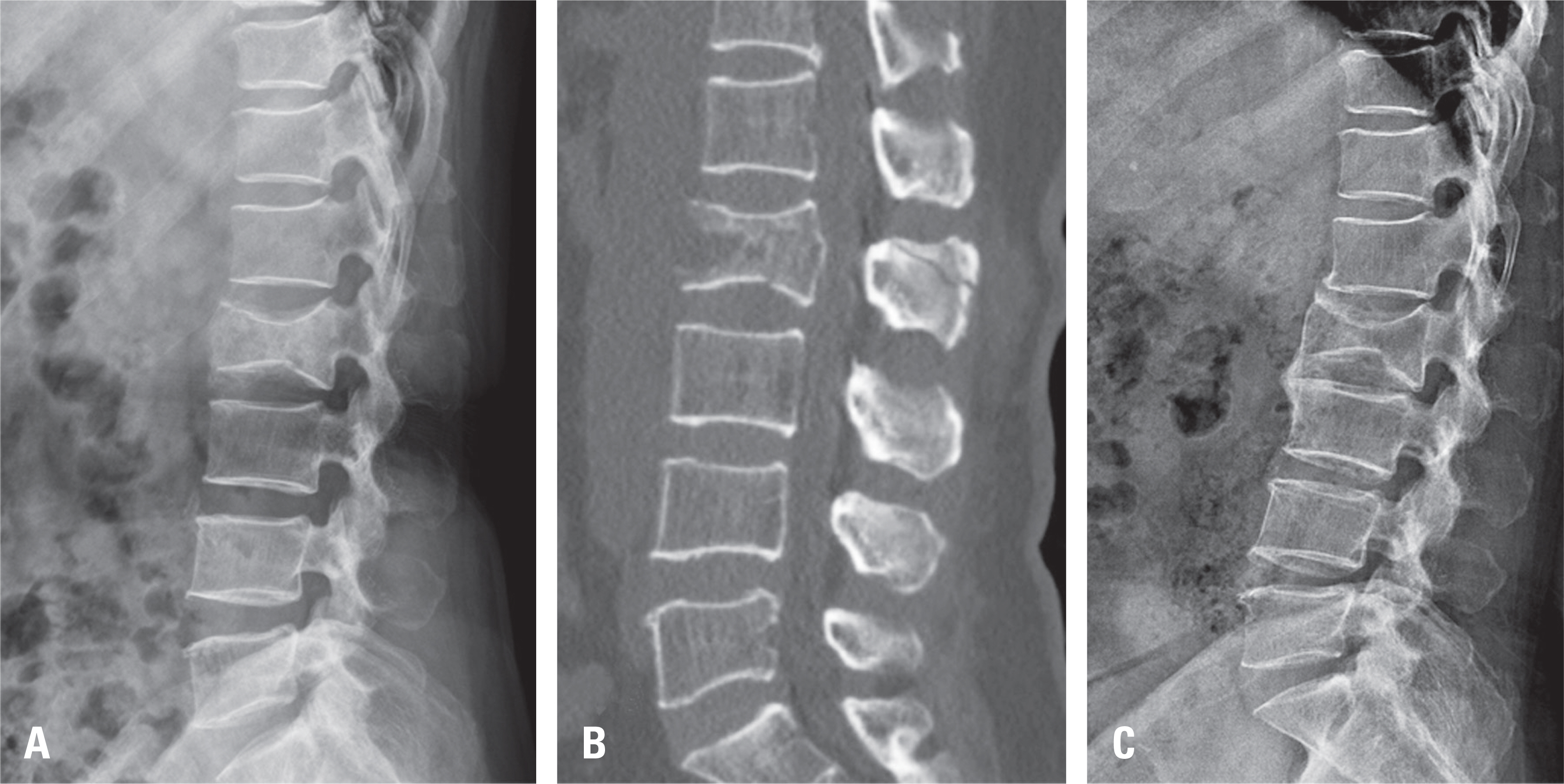
Fig. 2. A 50-year-old female patient with an L2 flexion-distraction injury who received conservative treatment. (A) Initial radiograph. (B) Computed tomography shows an increase in the interspinous interval and fracture of the spinous process. (C) After 2 years, the collapse showed minor progress, but was stabilized, and the kyphosis was also stabilized, showing no increase.
Reference
-
1. Heary RF, Kumar S. Decision-making in burst fractures of the thoracolumbar and lumbar spine. Indian J Orthop. 2007; 41:268–76.
Article2. Denis F. The three column spine and its significance in the classification of acute thoracolumbar spinal injuries. Spine (Phila Pa 1976). 1983; 8:817–31.
Article3. McAfee PC, Yuan HA, Fredrickson BE, et al. The value of computed tomography in thoracolumbar fractures. An analysis of one hundred consecutive cases and a new classification. J Bone Joint Surg Am. 1983; 65:461–73.
Article4. Magerl F, Aebi M, Gertzbein SD, et al. A comprehensive classification of thoracic and lumbar injuries. Eur Spine J. 1994; 3:184–201.
Article5. Panjabi MM, Oxland TR, Kifune M, et al. Validity of the three-column theory of thoracolumbar fractures. A biomechanic investigation. Spine (Phila Pa 1976). 1995; 20:1122–7.6. Wood KB, Khanna G, Vaccaro AR, et al. Assessment of two thoracolumbar fracture classification systems as used by multiple surgeons. J Bone Joint Surg Am. 2005; 87:1423–9.
Article7. Vaccaro AR, Lehman RA Jr, Hurlbert RJ, et al. A new classification of thoracolumbar injuries: the importance of injury morphology, the integrity of the posterior ligamentous complex, and neurologic status. Spine (Phila Pa 1976). 2005; 30:2325–33.8. Patel AA, Vaccaro AR, Albert TJ, et al. The adoption of a new classification system: time-dependent variation in interobserver reliability of the thoracolumbar injury severity score classification system. Spine (Phila Pa 1976). 2007; 32:E105–10.9. Raja Rampersaud Y, Fisher C, Wilsey J, et al. Agreement between orthopedic surgeons and neurosurgeons regarding a new algorithm for the treatment of thoracolumbar injuries: a multicenter reliability study. J Spinal Disord Tech. 2006; 19:477–82.10. Vaccaro AR, Baron EM, Sanfilippo J, et al. Reliability of a novel classification system for thoracolumbar injuries: the Thoracolumbar Injury Severity Score. Spine (Phila Pa 1976). 2006; 31(Suppl):62–9.11. Joaquim AF, Fernandes YB, Cavalcante RA, et al. Evaluation of the thoracolumbar injury classification system in thoracic and lumbar spinal trauma. Spine (Phila Pa 1976). 2011; 36:33–6.
Article12. Wood K, Buttermann G, Mehbod A, et al. Operative compared with nonoperative treatment of a thoracolumbar burst fracture without neurological deficit. A prospective, randomized study. J Bone Joint Surg Am. 2003; 85:773–81.13. Wood KB, Buttermann GR, Phukan R, et al. Operative compared with nonoperative treatment of a thoracolumbar burst fracture without neurological deficit: a prospective randomized study with follow-up at sixteen to twenty-two years. J Bone Joint Surg Am. 2015; 97:3–9.14. Siebenga J, Leferink VJ, Segers MJ, et al. Treatment of traumatic thoracolumbar spine fractures: a multicenter prospective randomized study of operative versus nonsurgical treatment. Spine (Phila Pa 1976). 2006; 31:2881–90.
Article
- Full Text Links
-
- Actions
-
Cited
- CITED
-
- Close
- Share
-
- Similar articles
-
- Mechanisms and Classifications of Thoracolumbar Fractures
- Comparision of Classifications in the Thoracolumbar Burst Fractures
- Reliability and Validity of Thoracolumbar Injury Classification and Severity Score (TLICS)
- Applicability of Thoracolumbar Injury Classification and Severity Score to Criteria of Korean Health Insurance Review and Assessment Service in Treatment Decision of Thoracolumbar Injury
- A Clinical Study of Unstable Fractures and Fracture-Dislocations of the Thoracolumbar Spine - Comparision Between Holdsworth, Denis and McAfee Classification -


