
Occupational Lead Exposure from Indoor Firing Ranges in Korea

- Affiliations
-
- 1Department of Occupational and Environmental Medicine, Chonnam National University Hwasun Hospital, Hwasun, Korea. luvoem@gmail.com
- 2Department of Occupational and Environmental Medicine, Aerospace Medical Research Center, Republic of Korea Air Force, Cheongju, Korea.
- KMID: 2363686
- DOI: http://doi.org/10.3346/jkms.2016.31.4.497
Abstract
- Military personnel often use ammunitions that contain lead. The present study aimed to identify the risks for lead exposure and lead poisoning among workers at indoor firing ranges. A special health examination, including blood lead level (BLL) testing, was performed for all 120 workers at the indoor firing ranges of the Republic of Korea's Air Force, Navy, and Armed Forces Athletic Corps. The overall mean BLL was 11.3 ± 9.4 µg/dL (range: 2.0-64.0 µg/dL). The arithmetic mean of the BLL for professional shooters belong to Armed Forces Athletic Corps was 14.0 ± 8.3 µg/dL, while those of shooting range managers and shooting range supervisors were 13.8 ± 11.1 µg/dL and 6.4 ± 3.1 µg/dL, respectively. One individual had a BLL of 64 µg/dL, and ultimately completed chelation treatment (with CaNa2-ethylenediaminetetraacetic acid) without any adverse effects. These findings indicate that indoor firing range workers are exposed to elevated levels of lead. Therefore, when constructing an indoor firing range, a specialist should be engaged to design and assess the ventilation system; and safety guidelines regarding ammunition and waste handling must be mandatory. Moreover, workplace environmental monitoring should be implemented for indoor firing ranges, and the workers should undergo regularly scheduled special health examinations.
MeSH Terms
Figure
-

Fig. 1 Workplace environmental monitoring results from indoor firing ranges. TWA, time weighted average. *Results are presented as the mean (range). †Results are presented as (number of standard excess sites)/(number of monitoring sites) (%). The Occupational Safety and Health Administration (OSHA) standard for lead exposure is 0.05 mg/m3 of air, averaged over an 8 hours period.
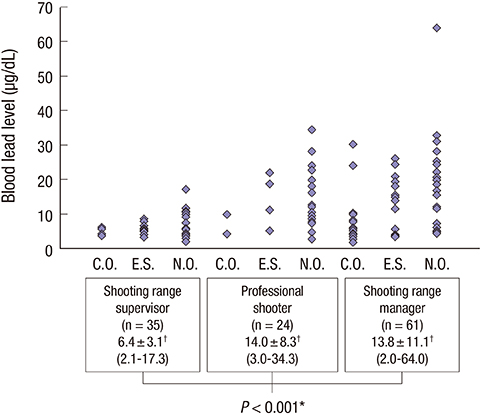
Fig. 2 Distribution of blood lead levels according to job type and rank. CO, commissioned officer; ES, enlisted soldier; NO, non-commissioned officer. *Comparison by analysis of variance. †Results are presented as the arithmetic mean ± standard deviation (range).
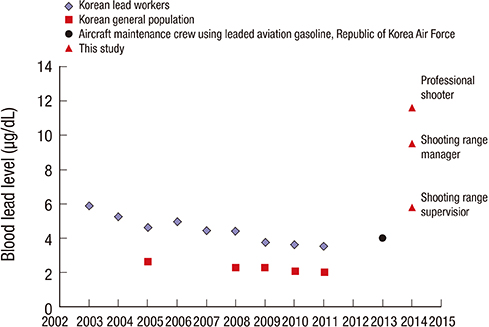
Fig. 3 Geometric means of blood lead levels from Korean lead workers, general population and this study’s subjects.
Reference
-
1. Fischbein A, Hu H. Occupational and environmental exposure to lead. In : Rom WN, editor. Environmental and Occupational Medicine. 4th ed. Philadelphia, PA: Lippincott Williams % Wilkins;2007. p. 954–990.2. Lewis R, Kosnett MJ. Metals. In : LaDou J, Harrison R, editors. Current Occupational and Environmental Medicine. 5th ed. New York, NY: McGraw-Hill;2014. p. 463–485.3. Muntner P, Menke A, DeSalvo KB, Rabito FA, Batuman V. Continued decline in blood lead levels among adults in the United States: the National Health and Nutrition Examination Surveys. Arch Intern Med. 2005; 165:2155–2161.4. Centers for Disease Control and Prevention (CDC). Blood lead levels--United States, 1999-2002. MMWR Morb Mortal Wkly Rep. 2005; 54:513–516.5. Kim JH, Kim EA, Koh DH, Byun K, Ryu HW, Lee SG. Blood lead levels of Korean lead workers in 2003-2011. Ann Occup Environ Med. 2014; 26:30.6. Kim H, Cho SH. Estimation of the geometric means and the reference values of blood lead levels among Koreans. J Korean Med Sci. 1994; 9:304–312.7. Centers for Disease Control and Prevention (US). Adult blood lead epidemiology & surveillance (ABLES). accessed on 16 June 2015. Available at http://www.cdc.gov/niosh/topics/ABLES/description.html.8. Gidlow DA. Lead toxicity. Occup Med (Lond). 2015; 65:348–356.9. Flora G, Gupta D, Tiwari A. Toxicity of lead: a review with recent updates. Interdiscip Toxicol. 2012; 5:47–58.10. Kim NS, Lee BK. National estimates of blood lead, cadmium, and mercury levels in the Korean general adult population. Int Arch Occup Environ Health. 2011; 84:53–63.11. Kim NH, Hyun YY, Lee KB, Chang Y, Ryu S, Oh KH, Ahn C. Environmental heavy metal exposure and chronic kidney disease in the general population. J Korean Med Sci. 2015; 30:272–277.12. Park WJ, Gu HM, Lee SH. Blood lead level and types of aviation fuel in aircraft maintenance crew. Aviat Space Environ Med. 2013; 84:1087–1091.13. Seo JW, Kim BG, Kim YM, Kim RB, Chung JY, Lee KM, Hong YS. Trend of blood lead, mercury, and cadmium levels in Korean population: data analysis of the Korea National Health and Nutrition Examination Survey. Environ Monit Assess. 2015; 187:146.14. Jeong SW, Lee CK, Suh CH, Kim KH, Son BC, Kim JH, Lee JT, Lee SW, Park YB, Lee JW, et al. Blood lead concentration and related factors in Korea from the 2008 National Survey for Environmental Pollutants in the Human Body. Int J Hyg Environ Health. 2014; 217:871–877.15. Occupational Safety and Health Administration (US). OSHA lead standards. accessed on 16 June 2015. Available at http://www.osha.gov/SLTC/lead.16. Koo BH, Kim YK, Lee SG, Kang DM, Kim JE. Detection of cases and a cause of lead exposure in Korean steel company. Korean J Occup Environ Med. 2012; 24:441–448.17. Kang PK, Kim YB, Ahn IS, Lee JK, Han KS, Kim HS, Hwang KY, Lee GS, Ahn KD, Lee BK. Occupational lead exposure of storage battery industry workers in Korea. Korean J Occup Environ Med. 1998; 10:438–449.18. Kang SK, Kim EA. Occupational diseases in Korea. J Korean Med Sci. 2010; 25:S4–12.19. Song Y, Suh C, Kim SA, Kim N, Kim SM, Jeong SW, Kim SY, Kim KH, Kim JH, Son BC, et al. High lead exposure in two leaded bronze ingot foundry workers. Ann Occup Environ Med. 2014; 26:38.20. Rhee KY, Choe SW. Management system of occupational diseases in Korea: statistics, report and monitoring system. J Korean Med Sci. 2010; 25:S119–S126.21. Beaucham C, Page E, Alarcon WA, Calvert GM, Methner M, Schoonover TM; Centers for Disease Control and Prevention (CDC). Indoor firing ranges and elevated blood lead levels - United States, 2002-2013. MMWR Morb Mortal Wkly Rep. 2014; 63:347–351.22. Centers for Disease Control and Prevention (CDC). Lead exposure from indoor firing ranges among students on shooting teams--Alaska, 2002-2004. MMWR Morb Mortal Wkly Rep. 2005; 54:577–579.23. Svensson BG, Schütz A, Nilsson A, Skerfving S. Lead exposure in indoor firing ranges. Int Arch Occup Environ Health. 1992; 64:219–221.24. Centers for Disease Control and Prevention (CDC). Adult blood lead epidemiology and surveillance--United States, 2008-2009. MMWR Morb Mortal Wkly Rep. 2011; 60:841–845.
- Full Text Links
-
- Actions
-
Cited
- CITED
-
- Close
- Share
-
- Similar articles
-
- Lead Poisoning at an Indoor Firing Range
- A review on mathematical models for estimating indoor radon concentrations
- Occupational Diseases among Office Workers
- Detection of Cases and a Cause of Lead Exposure in Korean Steel Company
- Occupational Health Management in the Lead Industry: The Korean Experience


