Tuberc Respir Dis.
2010 Jan;68(1):22-28.
Immunohistochemical Expression and Prognostic Value of VEGF, HIF-1alpha, EGFR in Non-Small Cell Lung Cancer
- Affiliations
-
- 1Department of Internal Medicine, The Catholic University of Korea College of Medicine, Seoul, Korea. cmcpsh@catholic.ac.kr
Abstract
- BACKGROUND
Vascular endothelial growth factor (VEGF) is a potent mediator of angiogenesis. VEGF production is regulated by HIF-1alpha and EGFR. This study examined the relationship between the clinicopathological factors and VEGF, HIF-1alpha and EGFR protein overexpression, and evaluated their prognostic value in patients with a surgically resected non-small cell lung cancer (NSCLC).
METHODS
Patients who underwent a surgical resection at Kangnam St. Mary's hospital were reviewed retrospectively. The core biopsy samples from 54 patients with NSCLC were assembled on a tissue microarray (TMA), and immunohistochemical staining for the VEGF, HIF-1alpha and EGFR proteins was performed. The overexpression of these proteins was evaluated in relation to age, gender, histology and staging by univariate analysis. The clinicopathological prognostic factors were analyzed.
RESULTS
Multivariate analysis performed by Cox regression (odds ratio 2.8, 95% CI 1.0~8.2, p=0.046) revealed HIF-1alpha overexpression to be an unfavorable factor. There was no correlation between the overexpression of these proteins and the clinicopathological factors. VEGF showed a positive relationship with EGFR, but there was no statistical significance [p(chi2)=0.06].
CONCLUSION
HIF-1alpha overexpression predicts shorter survival in patients with a surgically resected NSCLC. Therefore, HIF-1alpha may be a poor prognostic factor in NSCLC.
MeSH Terms
Figure
-
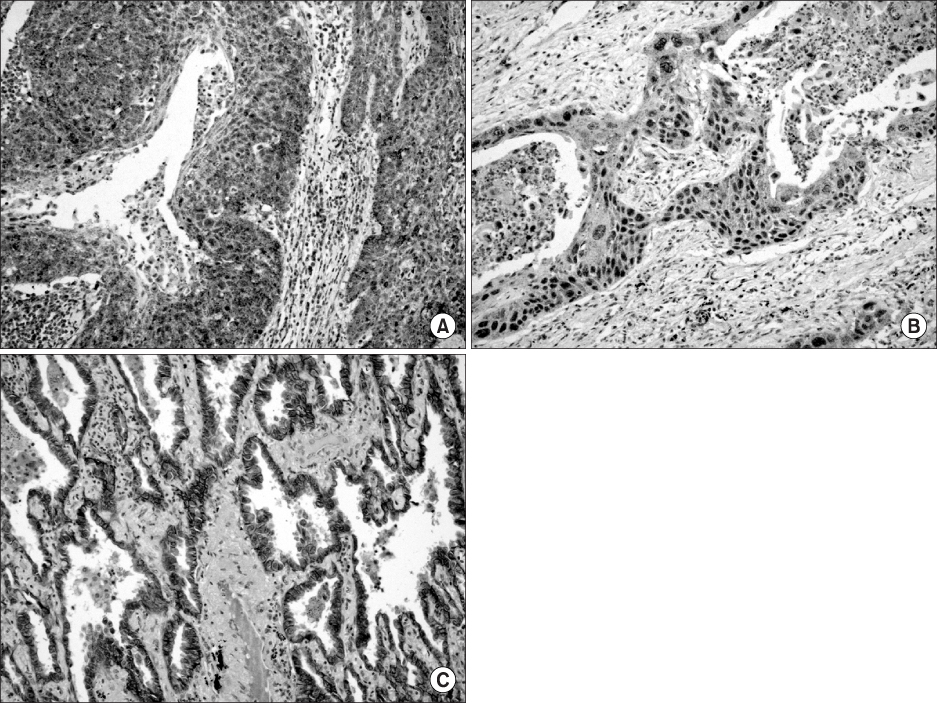
Figure 1 Immunohistochemical staining for VEGF, HIF-1α and EGFR of non-small cell lung cancer. Positive cells show brown cytoplasmic staining for VEGF (A, ×200), brown nuclear staining for HIF-1α (B, ×200), brown cell membrane staining for EGFR (C, ×200).

Figure 2 Kaplan-Meier overall survival curves in patients with non-small cell lung cancer according to HIF-1α expression.
Reference
-
1. Zhu CQ, Shih W, Ling CH, Tsao MS. Immunohistochemical markers of prognosis in non-small cell lung cancer: a review and proposal for a multiphase approach to marker evaluation. J Clin Pathol. 2006. 59:790–800.2. Onn A, Herbst RS. Angiogenesis and lung cancer: implications for prognosis and treatment. Lancet Oncol. 2007. 8:460–461.3. Bremnes RM, Camps C, Sirera R. Angiogenesis in non-small cell lung cancer: the prognostic impact of neoangiogenesis and the cytokines VEGF and bFGF in tumours and blood. Lung Cancer. 2006. 51:143–158.4. Han H, Silverman JF, Santucci TS, Macherey RS, d'Amato TA, Tung MY, et al. Vascular endothelial growth factor expression in stage I non-small cell lung cancer correlates with neoangiogenesis and a poor prognosis. Ann Surg Oncol. 2001. 8:72–79.5. Neufeld G, Cohen T, Gengrinovitch S, Poltorak Z. Vascular endothelial growth factor (VEGF) and its receptors. FASEB J. 1999. 13:9–22.6. Hicklin DJ, Ellis LM. Role of the vascular endothelial growth factor pathway in tumor growth and angiogenesis. J Clin Oncol. 2005. 23:1011–1027.7. Levy AP, Levy NS, Wegner S, Goldberg MA. Transcriptional regulation of the rat vascular endothelial growth factor gene by hypoxia. J Biol Chem. 1995. 270:13333–13340.8. Ke Q, Costa M. Hypoxia-inducible factor-1 (HIF-1). Mol Pharmacol. 2006. 70:1469–1480.9. Rini BI, Small EJ. Biology and clinical development of vascular endothelial growth factor-targeted therapy in renal cell carcinoma. J Clin Oncol. 2005. 23:1028–1043.10. Zhong H, Chiles K, Feldser D, Laughner E, Hanrahan C, Georgescu MM, et al. Modulation of hypoxia-inducible factor 1 alpha expression by the epidermal growth factor/phosphatidylinositol 3-kinase/PTEN/AKT/FRAP pathway in human prostate cancer cells: implications for tumor angiogenesis and therapeutics. Cancer Res. 2000. 60:1541–1545.11. Maity A, Pore N, Lee J, Solomon D, O'Rourke DM. Epidermal growth factor receptor transcriptionally up-regulates vascular endothelial growth factor expression in human glioblastoma cells via a pathway involving phosphatidylinositol 3'-kinase and distinct from that induced by hypoxia. Cancer Res. 2000. 60:5879–5886.12. Pore N, Jiang Z, Gupta A, Cerniglia G, Kao GD, Maity A. EGFR tyrosine kinase inhibitors decrease VEGF expression by both hypoxia-inducible factor (HIF)-1-independent and HIF-1-dependent mechanisms. Cancer Res. 2006. 66:3197–3204.13. Giatromanolaki A, Koukourakis MI, Sivridis E, Turley H, Talks K, Pezzella F, et al. Relation of hypoxia inducible factor 1 alpha and 2 alpha in operable nonsmall cell lung cancer to angiogenic/molecular profile of tumours and survival. Br J Cancer. 2001. 85:881–890.14. Zhong H, De Marzo AM, Laughner E, Lim M, Hilton DA, Zagzag D, et al. Overexpression of hypoxia-inducible factor 1alpha in common human cancers and their metastases. Cancer Res. 1999. 59:5830–5835.15. Semenza GL. Targeting HIF-1 for cancer therapy. Nat Rev Cancer. 2003. 3:721–732.16. Cho SR, Byun JH, Kim JI, Lee BG, Chun BK. Expression of hypoxia-inducible factor-1alpha in non-small cell lung cancer: relationship to prognosis and tumor biomarkers. Korean J Thorac Cardiovasc Surg. 2006. 39:828–837.17. Fontanini G, Lucchi M, Vignati S, Mussi A, Ciardiello F, De Laurentiis M, et al. Angiogenesis as a prognostic indicator of survival in non-small cell lung carcinoma: a prospective study. J Natl Cancer Inst. 1997. 89:881–886.18. Yilmaz A, Ernam D, Unsal E, Demirag F, Atikcan S, Tastepe I. Vascular endothelial growth factor immunostaining correlates with postoperative relapse and survival in non-small cell lung cancer. Arch Med Res. 2007. 38:764–768.19. Nakamura H, Kawasaki N, Taguchi M, Kabasawa K. Survival impact of epidermal growth factor receptor overexpression in patients with non-small cell lung cancer: a meta-analysis. Thorax. 2006. 61:140–145.20. Ahn JH, Kim SW, Hong SM, Suh C, Kim WK, Lee IC, et al. Epidermal growth factor receptor (EGFR) expression in operable non-small cell lung carcinoma. J Korean Med Sci. 2004. 19:529–535.21. Selvaggi G, Novello S, Torri V, Leonardo E, De Giuli P, Borasio P, et al. Epidermal growth factor receptor overexpression correlates with a poor prognosis in completely resected non-small-cell lung cancer. Ann Oncol. 2004. 15:28–32.22. Meert AP, Martin B, Delmotte P, Berghmans T, Lafitte JJ, Mascaux C, et al. The role of EGF-R expression on patient survival in lung cancer: a systematic review with meta-analysis. Eur Respir J. 2002. 20:975–981.23. Battifora H. The multitumor (sausage) tissue block: novel method for immunohistochemical antibody testing. Lab Invest. 1986. 55:244–248.24. Schmidt LH, Biesterfeld S, Kummel A, Faldum A, Sebastian M, Taube C, et al. Tissue microarrays are reliable tools for the clinicopathological characterization of lung cancer tissue. Anticancer Res. 2009. 29:201–209.
- Full Text Links
-
- Actions
-
Cited
- CITED
-
- Close
- Share
-
- Similar articles
-
- The Relationship between Expression of Hypoxia Inducible Factor-1alpha or Vascular Endothelial Growth Factor and Histopathological Characteristics in Human Transitional Bladder Cancer
- The Relationship between Expression of Hypoxia Inducible Factor-1alpha or Vascular Endothelial Growth Factor and Histopathological Characteristics in Human Renal Cell Carcinoma
- Expression of Hypoxia-inducible Factor-1alpha in Non-small Cell Lung Cancer: Relationship to Prognosis and Tumor Biomarkers
- Expression of Hypoxia-inducible Factor-1 alpha Protein in Stages I and II Squamous Cell Carcinomas of the Uterine Cervix: Relationship with p53 Protein and VEGF Expressions
- Expression of Hypoxia-inducible Factor-1alpha and Vascular Endothelial Growth Factor in Colon Cancer: Relationship to the Prognosis and Tumor Markers