
A Case of Tumor Necrosis Factor-alpha Inhibitors-induced Pustular Psoriasis
- Affiliations
-
- 1Department of Dermatology, Chonnam National University Medical School, Gwangju, Korea. schul@chonnam.ac.kr
- KMID: 2265398
- DOI: http://doi.org/10.5021/ad.2010.22.2.212
Abstract
- Anti-tumor necrosis factor (TNF)-alpha agents promise better disease control for the treatment of ankylosing spondylitis resistant to classical disease-modifying treatments. Etanercept, a recombinant human TNF receptor fusion protein, is used to treat a variety of TNF-alpha-mediated diseases by inhibiting the biological activity of TNF-alpha. We experienced a case of pustular psoriasis in a 32-year-old man during anti-TNF-alpha therapy with etanercept. He had a history of ankylosing spondylitis for 2 years. Two years after treatment of etanercept, erythematous pustules developed on his palms and soles. He had no previous history of pustular psoriasis. The skin lesion improved as the etanercept therapy was stopped, but pustular skin eruption recurred as adalimumab, a different TNF-alpha inhibitor, was administered to manage his ankylosing spondylitis. Several TNF-alpha inhibitors have different molecular structures, but these inhibitors might have a similar potency to induce pustular psoriasis from this case.
MeSH Terms
-
Adult
Antibodies, Monoclonal, Humanized
Humans
Immunoglobulin G
Molecular Structure
Necrosis
Psoriasis
Receptors, Tumor Necrosis Factor
Skin
Spondylitis, Ankylosing
Tumor Necrosis Factor-alpha
Adalimumab
Etanercept
Antibodies, Monoclonal, Humanized
Immunoglobulin G
Receptors, Tumor Necrosis Factor
Tumor Necrosis Factor-alpha
Figure
-

Fig. 1 After 2 years of etanercept therapy for ankylosing spondylitis, erythematous scaly pustular lesions arose on both palms (A) and soles (B).
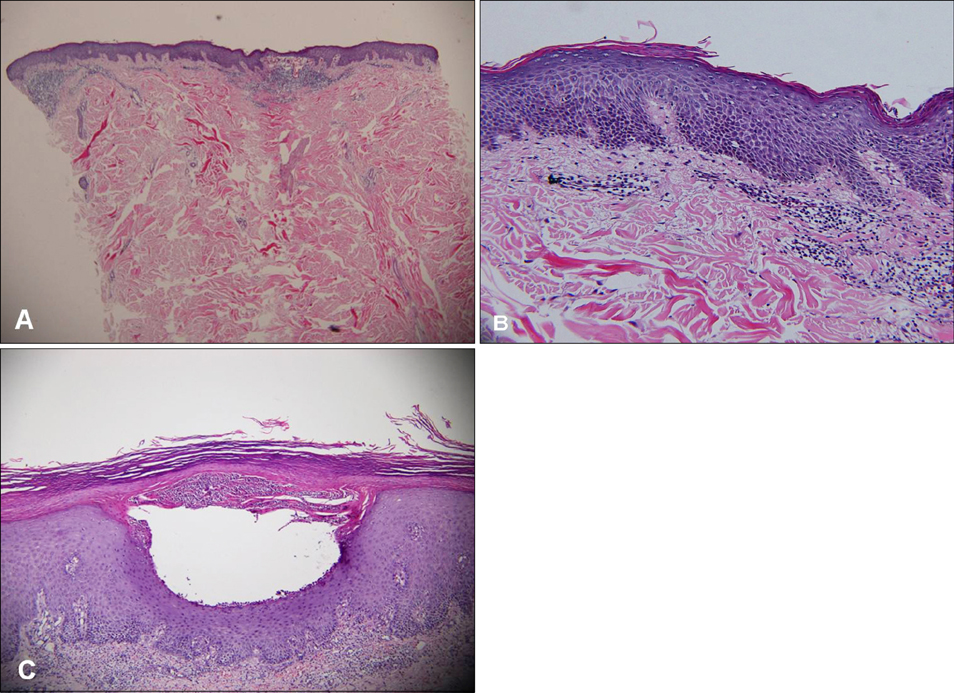
Fig. 2 Epidermal hyperplasia with hyperkeratosis and parakeratosis are shown on horny layer; granular layer has disappeared (A, B). Capillaries in the papillary dermis associated with perivascular lymphocytic infiltration (B). Munro microabscess was shown. Intraepidermal pustule formation was shown (C) (H&E, A: ×40, B: ×100, C: ×200).

Fig. 3 Erythematous scaly patches on both palms (A) and soles (B) have improved following etanercept discontinuation.

Fig. 4 After 4 months of adalimumab therapy for ankylosing spondylitis, erythematous scaly pustular lesion arose on both palms (A) and soles (B).
Cited by 2 articles
-
Pyodermatitis-Pyostomatitis Vegetans Associated with Crohn's Disease
Tae Hyung Kim, Soo-Chan Kim
Ann Dermatol. 2015;27(5):624-625. doi: 10.5021/ad.2015.27.5.624.Eruptive Benign Melanocytic Nevi Formation Following Adalimumab Therapy in a Patient with Crohn's Disease
Ik Jun Moon, Chong Hyun Won, Mi Woo Lee, Jee Ho Choi, Sung Eun Chang
Ann Dermatol. 2016;28(6):777-779. doi: 10.5021/ad.2016.28.6.777.
Reference
-
1. de Gannes GC, Ghoreishi M, Pope J, Russell A, Bell D, Adams S, et al. Psoriasis and pustular dermatitis triggered by TNF-alpha in patients with rheumatologic conditions. Arch Dermatol. 2007. 143:223–231.2. Dika E, Varotti C, Bardazzi F, Maibach HI. Drug-induced psoriasis: an evidence-based overview and the introduction of psoriatic drug eruption probability score. Cutan Ocul Toxicol. 2006. 25:1–11.
Article3. Choi YJ, Kim DS, Park JM, Oh SH, Park YK, Lee JH. A case of psoriasiform eruption triggered by tumor necrosis factor-alpha antagonist therapy. Korean J Dermatol. 2008. 46:721–723.4. Tracey D, Klareskog L, Sasso EH, Salfeld JG, Tak PP. Tumor necrosis factor antagonist mechanisms of action: a comprehensive review. Pharmacol Ther. 2008. 117:244–279.
Article5. Romero-Mate A, Garcia-Donoso C, Cordoba-Guijarro S. Efficacy and safety of etanercept in psoriasis/psoriatic arthritis: an updated review. Am J Clin Dermatol. 2007. 8:143–155.6. Collamer AN, Guerrero KT, Henning JS, Battafarano DF. Psoriatic skin lesions induced by tumor necrosis factor antagonist therapy: a literature review and potential mechanisms of action. Arthritis Rheum. 2008. 59:996–1001.
Article7. Nestle FO, Conrad C, Tun-Kyi A, Homey B, Gombert M, Boyman O, et al. Plasmacytoid predendritic cells initiate psoriasis through interferon-alpha production. J Exp Med. 2005. 202:135–143.
Article8. Olsen NJ, Stein CM. New drugs for rheumatoid arthritis. N Engl J Med. 2004. 350:2167–2179.
Article9. Braun J, Brandt J, Listing J, Zink A, Alten R, Golder W, et al. Treatment of active ankylosing spondylitis with infliximab: a randomised controlled multicentre trial. Lancet. 2002. 359:1187–1193.
Article10. Goffe B, Cather JC. Etanercept: an overview. J Am Acad Dermatol. 2003. 49:S105–S111.
Article11. Solau-Gervais E, Laxenaire N, Cortet B, Dubucquoi S, Duquesnoy B, Flipo RM. Lack of efficacy of a third tumour necrosis factor alpha antagonist after failure of a soluble receptor and a monoclonal antibody. Rheumatology (Oxford). 2006. 45:1121–1124.
Article12. Haibel H, Brandt HC, Song IH, Brandt A, Listing J, Rudwaleit M, et al. No efficacy of subcutaneous methotrexate in active ankylosing spondylitis: a 16-week open-label trial. Ann Rheum Dis. 2007. 66:419–421.
Article13. Lee JG, Park HJ, Lee YA, Hong SJ, Lee SH, Yang HI. Clinical improvement of ankylosing spondylitis on switching tumor necrosis factor inhibitors: a case report. Korean J Med. 2008. 75:S930–S934.14. Laas K, Peltomaa R, Kautiainen H, Leirisalo-Repo M. Clinical impact of switching from infliximab to etanercept in patients with rheumatoid arthritis. Clin Rheumatol. 2008. 27:927–932.
Article15. Bombardieri S, Ruiz AA, Fardellone P, Geusens P, McKenna F, Unnebrink K, et al. Effectiveness of adalimumab for rheumatoid arthritis in patients with a history of TNF-antagonist therapy in clinical practice. Rheumatology (Oxford). 2007. 46:1191–1199.
Article16. Conti F, Ceccarelli F, Marocchi E, Magrini L, Spinelli FR, Spadaro A, et al. Switching tumour necrosis factor alpha antagonists in patients with ankylosing spondylitis and psoriatic arthritis: an observational study over a 5-year period. Ann Rheum Dis. 2007. 66:1393–1397.
Article
- Full Text Links
-
- Actions
-
Cited
- CITED
-
- Close
- Share
-
- Similar articles
-
- Infliximab: Effective Therapy for Pustular Psoriasis
- A Case of Recurrent Generalized Pustular Psoriasis Treated with a Combination of Infliximab with Methotrexate and Retinoid
- A Case of Pustular Psoriasis Developed during Infliximab Treatment for Crohn's Disease
- Repeated Paradoxical Aggravation of Preexisting Psoriasis during Infliximab Treatment for Crohn's Disease
- Etanercept in the Treatment of Generalized Annular Pustular Psoriasis


