J Korean Neurosurg Soc.
2012 Aug;52(2):107-113. 10.3340/jkns.2012.52.2.107.
Long-Term Follow-Up Radiologic and Clinical Evaluation of Cylindrical Cage for Anterior Interbody Fusion in Degenerative Cervical Disc Disease
- Affiliations
-
- 1Department of Neurosurgery, Hanyang University Medical Center, Seoul, Korea. tdy815@hanyang.ac.kr
- 2Department of Anesthesiology, Hanyang University Medical Center, Seoul, Korea.
- 3Red Cross College of Nursing, Chung-Ang University, Seoul, Korea.
- KMID: 2190548
- DOI: http://doi.org/10.3340/jkns.2012.52.2.107
Abstract
OBJECTIVE
Various procedures have been introduced for anterior interbody fusion in degenerative cervical disc disease including plate systems with autologous iliac bone, carbon cages, and cylindrical cages. However, except for plate systems, the long-term results of other methods have not been established. In the present study, we evaluated radiologic findings for cylindrical cervical cages over long-term follow up periods.
METHODS
During 4 year period, radiologic findings of 138 patients who underwent anterior cervical fusion with cylindrical cage were evaluated at 6, 12, 24, and 36 postoperative months using plain radiographs. We investigated subsidence, osteophyte formation (anterior and posterior margin), cage direction change, kyphotic angle, and bone fusion on each radiograph.
RESULTS
Among the 138 patients, a minimum of 36 month follow-up was achieved in 99 patients (mean follow-up : 38.61 months) with 115 levels. Mean disc height was 7.32 mm for preoperative evaluations, 9.00 for immediate postoperative evaluations, and 4.87 more than 36 months after surgery. Osteophytes were observed in 107 levels (93%) of the anterior portion and 48 levels (41%) of the posterior margin. The mean kyphotic angle was 9.87degrees in 35 levels showing cage directional change. There were several significant findings : 1) related subsidence [T-score (p=0.039) and anterior osteophyte (p=0.009)], 2) accompanying posterior osteophyte and outcome (p=0.05).
CONCLUSION
Cage subsidence and osteophyte formation were radiologically observed in most cases. Low T-scores may have led to subsidence and kyphosis during bone fusion although severe neurologic aggravation was not found, and therefore cylindrical cages should be used in selected cases.
Keyword
Figure
-
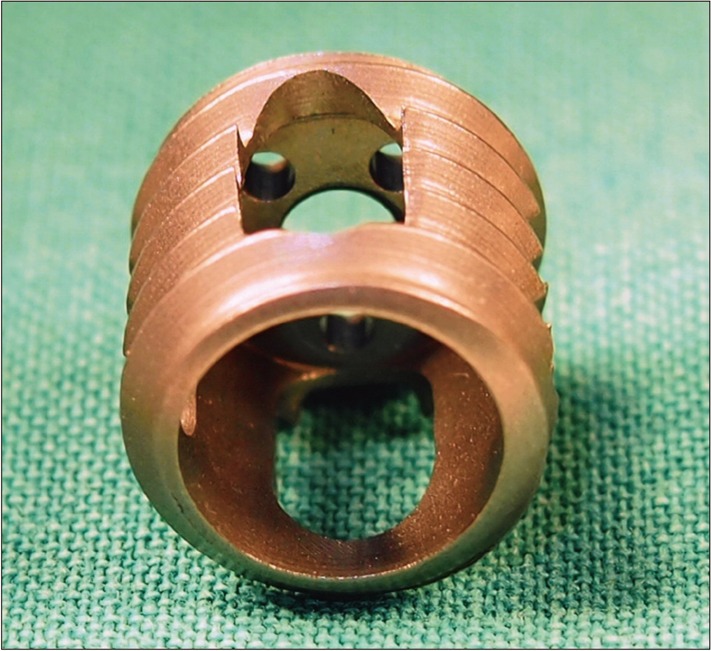
Fig. 1 The cylindrical titanium cage (AMSLU™ cage, Eurosurgical, Amsterdam, The Netherlands) used in the present study.
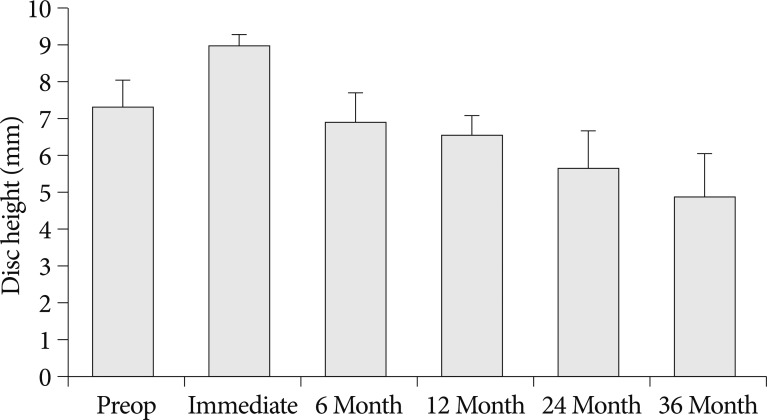
Fig. 2 Graph presented the change pattern of subsidence according to the follow-up period. Subsidence progressed as time passed.
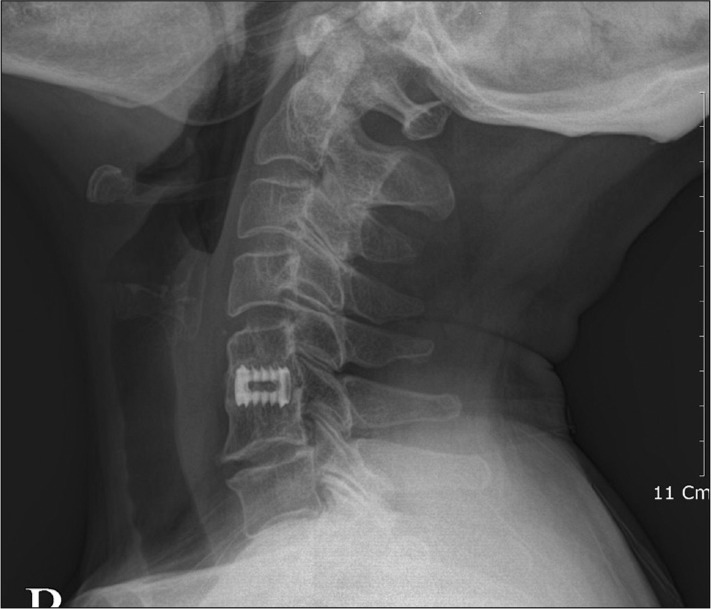
Fig. 3 Grade IV osteophyte at the anterior and posterior margin in lateral X-ray.
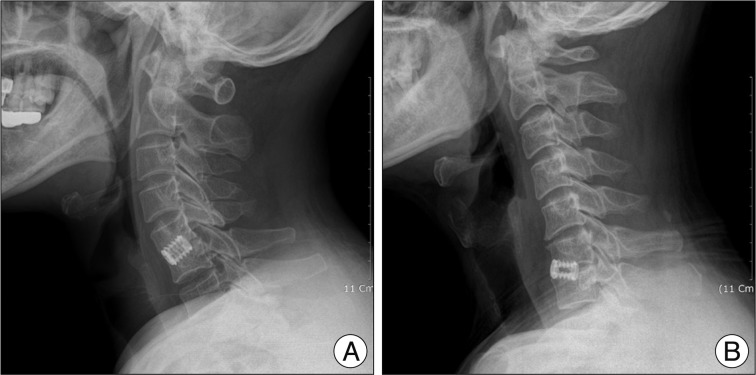
Fig. 4 Kyphosis related cage direction change. The cage migrated upward causing cervical kyphosis (A). Cervical kyphosis caused by downward cage migration (B).
Reference
-
1. al-Hami S. Cervical monosegmental interbody fusion using titanium implants in degenerative, intervertebral disc disease. Minim Invasive Neurosurg. 1999; 42:10–17. PMID: 10228933.
Article2. Arrington ED, Smith WJ, Chambers HG, Bucknell AL, Davino NA. Complications of iliac crest bone graft harvesting. Clin Orthop Relat Res. 1996; 300–309. PMID: 8769465.
Article3. Auguste KI, Chin C, Acosta FL, Ames CP. Expandable cylindrical cages in the cervical spine : a review of 22 cases. J Neurosurg Spine. 2006; 4:285–291. PMID: 16619674.
Article4. Bartels RH, Donk RD, Feuth T. Subsidence of stand-alone cervical carbon fiber cages. Neurosurgery. 2006; 58:502–508. discussion 502-508. PMID: 16528190.
Article5. Benneker LM, Heini PF, Anderson SE, Alini M, Ito K. Correlation of radiographic and MRI parameters to morphological and biochemical assessment of intervertebral disc degeneration. Eur Spine J. 2005; 14:27–35. PMID: 15723249.
Article6. Bishop RC, Moore KA, Hadley MN. Anterior cervical interbody fusion using autogeneic and allogeneic bone graft substrate : a prospective comparative analysis. J Neurosurg. 1996; 85:206–210. PMID: 8755747.
Article7. Bohlman HH, Eismont FJ. Surgical techniques of anterior decompression and fusion for spinal cord injuries. Clin Orthop Relat Res. 1981; 57–67. PMID: 7471590.
Article8. Bovim G, Schrader H, Sand T. Neck pain in the general population. Spine (Phila Pa 1976). 1994; 19:1307–1309. PMID: 8066508.
Article9. Brodke DS, Zdeblick TA. Modified Smith-Robinson procedure for anterior cervical discectomy and fusion. Spine (Phila Pa 1976). 1992; 17:S427–S430. PMID: 1440038.
Article10. Brown TD, Pedersen DR, Gray ML, Brand RA, Rubin CT. Toward an identification of mechanical parameters initiating periosteal remodeling : a combined experimental and analytic approach. J Biomech. 1990; 23:893–905. PMID: 2211734.
Article11. Buckwalter JA. Aging and degeneration of the human intervertebral disc. Spine (Phila Pa 1976). 1995; 20:1307–1314. PMID: 7660243.
Article12. Emery SE, Bolesta MJ, Banks MA, Jones PK. Robinson anterior cervical fusion comparison of the standard and modified techniques. Spine (Phila Pa 1976). 1994; 19:660–663. PMID: 8009330.13. Fernyhough JC, White JI, LaRocca H. Fusion rates in multilevel cervical spondylosis comparing allograft fibula with autograft fibula in 126 patients. Spine (Phila Pa 1976). 1991; 16:S561–S564. PMID: 1801273.
Article14. Fountas KN, Kapsalaki EZ, Smith BE, Nikolakakos LG, Richardson CH, Smisson HF, et al. Interobservational variation in determining fusion rates in anterior cervical discectomy and fusion procedures. Eur Spine J. 2007; 16:39–45. PMID: 16799781.
Article15. Goel VK, Ramirez SA, Kong W, Gilbertson LG. Cancellous bone Young's modulus variation within the vertebral body of a ligamentous lumbar spine--application of bone adaptive remodeling concepts. J Biomech Eng. 1995; 117:266–271. PMID: 8618378.
Article16. Gore DR, Sepic SB, Gardner GM. Roentgenographic findings of the cervical spine in asymptomatic people. Spine (Phila Pa 1976). 1986; 11:521–524. PMID: 3787320.
Article17. Graham JJ. Complications of cervical spine surgery. A five-year report on a survey of the membership of the Cervical Spine Research Society by the Morbidity and Mortality Committee. Spine (Phila Pa 1976). 1989; 14:1046–1050. PMID: 2588051.18. Grob D, Frauenfelder H, Mannion AF. The association between cervical spine curvature and neck pain. Eur Spine J. 2007; 16:669–678. PMID: 17115202.
Article19. Hald HJ, Danz B, Schwab R, Burmeister K, Bähren W. [Radiographically demonstrable spinal changes in asymptomatic young men]. Rofo. 1995; 163:4–8. PMID: 7626752.20. Hida K, Iwasaki Y, Yano S, Akino M, Seki T. Long-term follow-up results in patients with cervical disk disease treated by cervical anterior fusion using titanium cage implants. Neurol Med Chir (Tokyo). 2008; 48:440–446. discussion 446. PMID: 18948677.
Article21. Hwang SL, Hwang YF, Lieu AS, Lin CL, Kuo TH, Su YF, et al. Outcome analyses of interbody titanium cage fusion used in the anterior discectomy for cervical degenerative disc disease. J Spinal Disord Tech. 2005; 18:326–331. PMID: 16021013.
Article22. Juhl JH, Miller SM, Roberts GW. Roentgenographic variations in the normal cervical spine. Radiology. 1962; 78:591–597.
Article23. Joung YI, Oh SH, Ko Y, Yi HJ, Lee SK. Subsidence of cylindrical cage (AMSLUtrade mark Cage) : postoperative 1 year follow-up of the cervical anterior interbody fusion. J Korean Neurosurg Soc. 2007; 42:367–370. PMID: 19096571.
Article24. Katsuura A, Hukuda S, Saruhashi Y, Mori K. Kyphotic malalignment after anterior cervical fusion is one of the factors promoting the degenerative process in adjacent intervertebral levels. Eur Spine J. 2001; 10:320–324. PMID: 11563618.
Article25. Kim YE, Goel VK, Weinstein JN, Lim TH. Effect of disc degeneration at one level on the adjacent level in axial mode. Spine (Phila Pa 1976). 1991; 16:331–335. PMID: 2028305.
Article26. Kolstad F, Nygaard ØP, Andresen H, Leivseth G. Anterior cervical arthrodesis using a "stand alone" cylindrical titanium cage : prospective analysis of radiographic parameters. Spine (Phila Pa 1976). 2010; 35:1545–1550. PMID: 20581756.
Article27. Kumaresan S, Yoganandan N, Pintar FA. Finite element analysis of anterior cervical spine interbody fusion. Biomed Mater Eng. 1997; 7:221–230. PMID: 9408574.
Article28. Kumaresan S, Yoganandan N, Pintar FA, Maiman DJ, Goel VK. Contribution of disc degeneration to osteophyte formation in the cervical spine : a biomechanical investigation. J Orthop Res. 2001; 19:977–984. PMID: 11562150.
Article29. Lopez-Espina CG, Amirouche F, Havalad V. Multilevel cervical fusion and its effect on disc degeneration and osteophyte formation. Spine (Phila Pa 1976). 2006; 31:972–978. PMID: 16641772.
Article30. López-Oliva Muñoz F, García de las Heras B, Concejero López V, Asenjo Siguero JJ. Comparison of three techniques of anterior fusion in single-level cervical disc herniation. Eur Spine J. 1998; 7:512–516. PMID: 9883963.
Article31. Majd ME, Vadhva M, Holt RT. Anterior cervical reconstruction using titanium cages with anterior plating. Spine (Phila Pa 1976). 1999; 24:1604–1610. PMID: 10457582.
Article32. Matge G. Anterior interbody fusion with the BAK-cage in cervical spondylosis. Acta Neurochir (Wien). 1998; 140:1–8. PMID: 9522900.
Article33. Nathan H. Osteophytes of the vertebral column. Ananatomical study of their development according to age, race and sex with considerations as to their etiology and significance. J Bone Joint Surg. 1962; 44:243–268.34. Nojiri K, Matsumoto M, Chiba K, Maruiwa H, Nakamura M, Nishizawa T, et al. Relationship between alignment of upper and lower cervical spine in asymptomatic individuals. J Neurosurg. 2003; 99:80–83. PMID: 12859065.
Article35. Odom GL, Finney W, Woodhall B. Cervical disk lesions. J Am Med Assoc. 1958; 166:23–28. PMID: 13491305.
Article36. Orr RD, Zdeblick TA. Cervical spondylotic myelopathy. Approaches to surgical treatment. Clin Orthop Relat Res. 1999; 58–66. PMID: 10078129.37. Robertson JT, Papadopoulos SM, Traynelis VC. Assessment of adjacent-segment disease in patients treated with cervical fusion or arthroplasty : a prospective 2-year study. J Neurosurg Spine. 2005; 3:417–423. PMID: 16381202.
Article38. Robinson RA, Smith GW. Anterior cervical disc removal and interbody fusion for cervical disc syndrome. Bull Johns Hopkins Hosp. 1955; 96:223–224.39. Sawin PD, Traynelis VC, Menezes AH. A comparative analysis of fusion rates and donor-site morbidity for autogeneic rib and iliac crest bone grafts in posterior cervical fusions. J Neurosurg. 1998; 88:255–265. PMID: 9452233.
Article40. Senter HJ, Kortyna R, Kemp WR. Anterior cervical discectomy with hydroxylapatite fusion. Neurosurgery. 1989; 25:39–42. discussion 42-43. PMID: 2547182.
Article41. Thomé C, Krauss JK, Zevgaridis D. A prospective clinical comparison of rectangular titanium cages and iliac crest autografts in anterior cervical discectomy and fusion. Neurosurg Rev. 2004; 27:34–41. PMID: 12905078.
Article42. Türeyen K. Disc height loss after anterior cervical microdiscectomy with titanium intervertebral cage fusion. Acta Neurochir (Wien). 2003; 145:565–569. discussion 569-570. PMID: 12910399.
Article43. Wilke HJ, Kettler A, Goetz C, Claes L. Subsidence resulting from simulated postoperative neck movements : an in vitro investigation with a new cervical fusion cage. Spine (Phila Pa 1976). 2000; 25:2762–2770. PMID: 11064521.
- Full Text Links
-
- Actions
-
Cited
- CITED
-
- Close
- Share
-
- Similar articles
-
- Anterior Cervical Bisegmental Interbody Fusion with Titanium Cage(RABEA) in Degenerative Cervical Disease: Comparative Analysis with Monosegmental Interbody Fusion
- Clinical Experience with Double Cylindrical Cages for Anterior Cervical Interbody Fusion
- Short-term Results of Anterior Cervical Fusion with Cylindrical Cage(AMSLU(TM))
- Anterior Cervical Interbody Fusion with Carbon-Composite Cages and Local Autobone for Cervical Disc Disease
- Anterior Cervical Fusion with the PCB Instrumentation (Cervical Plate Cage System) in Degenerative Cervical Disease