Spinal Dysraphism and Tethered Cord Syndrome
- Affiliations
-
- 1Department of Neurosurgery, Yonsei University College of Medicine, Korea. dskim33@yuhs.ac
- KMID: 2137736
- DOI: http://doi.org/10.5124/jkma.2009.52.1.78
Abstract
- Spinal dysraphism is a common birth defect that causes different kinds of secondary impairments, including joint deformities, reduced mobility, and bowel or bladder dysfunction. Various dysraphic spinal abnormalities result in tethered cord syndrome, a progressive form of neurological deterioration that results from spinal cord tethering. The surgery and management of children who have spinal dysraphism require multidisciplinary care and long-term follow-up by multiple specialists in birth defects. This article reviews the clinical presentation, pathophysiology, diagnostic strategies, and therapeutic management of spinal dysraphism in infancy.
Keyword
MeSH Terms
Figure
-

Figure 1 Diagram of spina bifida and MR axial view. (A, E): normal, (B): spina bifida occulta, (C, F): spina bifida cytica-meningocele, (D, G): spina bifida cytica-myelomeningocele.
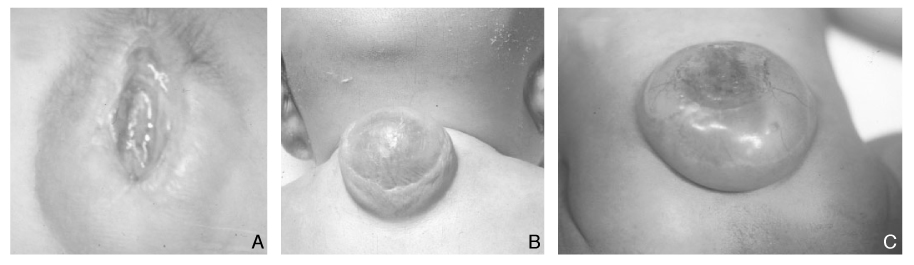
Figure 2 Spina bifida, open. (A) Myeloschisis, (B) Spina bifida cystica-meningocle, (C) Spina bifida cystica-myelomeningocle.
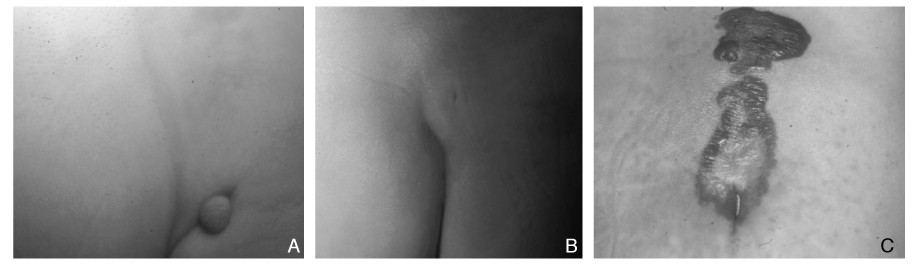
Figure 3 Various dermatologic feature in closed spina bifida. (A) Lipoma, (B) Skin depression, (C) Capillary telangiectasis.

Figure 4 Location of conus medullaris. (A) Postovulation 8 wks, (B) Postovulation 24 wks, (C) Birth, (D) Normal adult.

Figure 5 (A) Dorsal lipomyelomeningocele, (B) Transitional lipomyelomeningocele.

Figure 6 Caudal lipomyelomeingocele Preop (left) and postop (right).
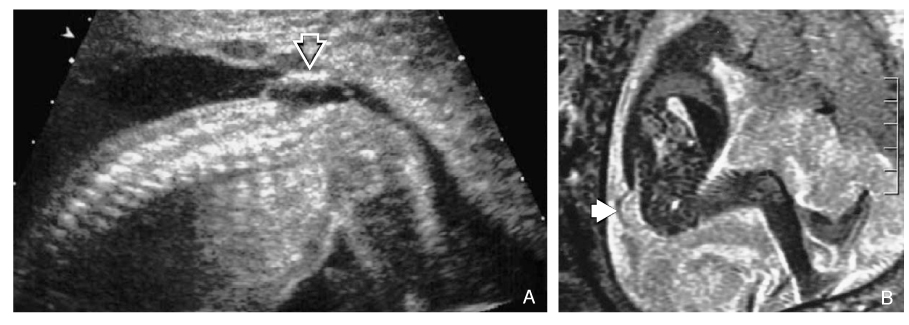
Figure 7 Fetal sonography (left) and fetal MRI (right) showing mylelomeningocele at post gestation 22wks.

Figure 8 Spina bifida cystica-myelomeningocele.
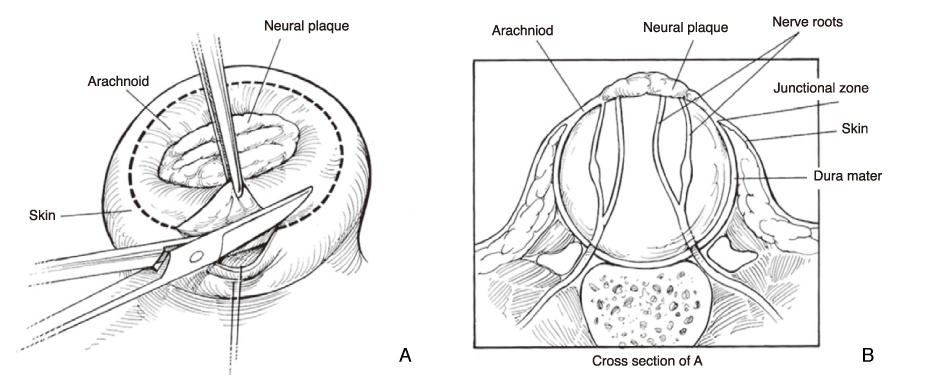
Figure 9 (A) Initial incision follows the circumferential white line formed by the junction of the arachnoid and skin, (B) Cross section of A.
Reference
-
1. Atala A, Bauer SB, Dyro FM, Shefner J, Shillito J, Sathi S, Scott RM. Bladder functional changes resulting from lipomyelomeningocele repair. J Urol. 1992. 148:592–594.
Article2. Aufschnaiter K, Fellner F, Wurm G. Surgery in adult onset tethered cord syndrome (ATCS): review of literature on occasion of an exceptional case. Neurosurg Rev. 2008.
Article3. Bellin MH, Sawin KJ, Roux G, Buran CF, Brei TJ. The experience of adolescent women living with spina bifida part I: self-concept and family relationships. Rehabil Nurs. 2007. 32:57–67.4. Benton TJ, Cheema R, Nirgiotis JG. A newborn with a skin lesion on the back. J Fam Pract. 2007. 56:E1–E3.5. Bowman RM, McLone DG, Grant JA, Tomita T, Ito JA. Spina bifida outcome: a 25-year prospective. Pediatr Neurosurg. 2001. 34:114–120.
Article6. Brand MC. Part 3: examination of the newborn with closed spinal dysraphism. Adv Neonatal Care. 2007. 7:30–40. quiz 2007; 41-32.7. Brophy JD, Sutton LN, Zimmerman RA, Bury E, Schut L. Magnetic resonance imaging of lipomyelomeningocele and tethered cord. Neurosurgery. 1989. 25:336–340.
Article8. Bruner JP, Richards WO, Tulipan NB, Arney TL. Endoscopic coverage of fetal myelomeningocele in utero. Am J Obstet Gynecol. 1999. 180:153–158.
Article9. Bui CJ, Tubbs RS, Oakes WJ. Tethered cord syndrome in children: a review. Neurosurg Focus. 2007. 23:1–9.
Article10. Byrne RW, Hayes EA, George TM, McLone DG. Operative resection of 100 spinal lipomas in infants less than 1 year of age. Pediatr Neurosurg. 1995. 23:182–186. discussion 186-187.
Article11. Cabaret AS, Loget P, Loeuillet L, Odent S, Poulain P. Embryology of neural tube defects: information provided by associated malformations. Prenat Diagn. 2007. 27:738–742.
Article12. Chapman PH. Congenital intraspinal lipomas: anatomic considerations and surgical treatment. Childs Brain. 1982. 9:37–47.13. Chaseling RW, Johnston IH, Besser M. Meningoceles and the tethered cord syndrome. Childs Nerv Syst. 1985. 1:105–108.
Article14. Colak A, Pollack IF, Albright AL. Recurrent tethering: a common long-term problem after lipomyelomeningocele repair. Pediatr Neurosurg. 1998. 29:184–190.
Article15. Daszkiewicz P, Barszcz S, Roszkowski M, Maryniak A. Tethered cord syndrome in children-impact of surgical treatment on functional neurological and urological outcome. Neurol Neurochir Pol. 2007. 41:427–435.16. Dias MS, Walker ML. The embryogenesis of complex dysraphic malformations: a disorder of gastrulation? Pediatr Neurosurg. 1992. 18:229–253.
Article17. Finn MA, Walker ML. Spinal lipomas: clinical spectrum, embryology, and treatment. Neurosurg Focus. 2007. 23:1–12.
Article18. Ghi T, Pilu G, Falco P, Segata M, Carletti A, Cocchi G, Santini D, Bonasoni P, Tani G, Rizzo N. Prenatal diagnosis of open and closed spina bifida. Ultrasound Obstet Gynecol. 2006. 28:899–903.
Article19. Guerra LA, Pike J, Milks J, Barrowman N, Leonard M. Outcome in patients who underwent tethered cord release for occult spinal dysraphism. J Urol. 2006. 176:1729–1732.
Article20. Hahn YS. Open myelomeningocele. Neurosurg Clin N Am. 1995. 6:231–241.
Article21. Herman JM, McLone DG, Storrs BB, Dauser RC. Analysis of 153 patients with myelomeningocele or spinal lipoma reoperated upon for a tethered cord. Presentation, management and outcome. Pediatr Neurosurg. 1993. 19:243–249.
Article22. Hoffman HJ, Taecholarn C, Hendrick EB, Humphreys RP. Management of lipomyelomeningoceles. Experience at the Hospital for Sick Children, Toronto. J Neurosurg. 1985. 62:1–8.23. Horton D, Barnes P, Pendleton BD, Pollay M. Spina bifida occulta: early clinical and radiographic diagnosis. J Okla State Med Assoc. 1989. 82:15–19.24. Kanev PM, Lemire RJ, Loeser JD, Berger MS. Management and long-term follow-up review of children with lipomyelomeningocele, 1952-1987. J Neurosurg. 1990. 73:48–52.
Article25. Kim SY, McGahan JP, Boggan JE, McGrew W. Prenatal diagnosis of lipomyelomeningocele. J Ultrasound Med. 2000. 19:801–805.
Article26. Korner I, Schluter C, Lax H, Rubben H, Radmayr C. [Health-related quality of life in children with spina bifida]. Urologe A. 2006. 45:620–625.27. La Marca F, Grant JA, Tomita T, McLone DG. Spinal lipomas in children: outcome of 270 procedures. Pediatr Neurosurg. 1997. 26:8–16.
Article28. Lemelle JL, Guillemin F, Aubert D, Guys JM, Lottmann H, Lortat-Jacob S, Moscovici J, Mouriquand P, Ruffion A, Schmitt M. A multicenter evaluation of urinary incontinence management and outcome in spina bifida. J Urol. 2006. 175:208–212.
Article29. Lemelle JL, Guillemin F, Aubert D, Guys JM, Lottmann H, Lortat-Jacob S, Mouriquand P, Ruffion A, Moscovici J, Schmitt M. Quality of life and continence in patients with spina bifida. Qual Life Res. 2006. 15:1481–1492.
Article30. Lew SM, Kothbauer KF. Tethered cord syndrome: an updated review. Pediatr Neurosurg. 2007. 43:236–248.
Article31. Lorber J. Results of treatment of myelomeningocele. An analysis of 524 unselected cases, with special reference to possible selection for treatment. Dev Med Child Neurol. 1971. 13:279–303.32. Lunardi P, Missori P, Ferrante L, Fortuna A. Long-term results of surgical treatment of spinal lipomas. Report of 18 cases. Acta Neurochir (Wien). 1990. 104:64–68.33. Martinez-Lage JF, Niguez BF, Perez-Espejo MA, Almagro MJ, Maeztu C. Midline cutaneous lumbosacral lesions: not always a sign of occult spinal dysraphism. Childs Nerv Syst. 2006. 22:623–627.
Article34. McLaughlin MR, O'Connor NR, Ham P. Newborn skin: Part II. Birthmarks. Am Fam Physician. 2008. 77:56–60.35. McLone DG. Technique for closure of myelomeningocele. Childs Brain. 1980. 6:65–73.
Article36. McLone DG. Results of treatment of children born with a myelomeningocele. Clin Neurosurg. 1983. 30:407–412.
Article37. McLone DG, Dias MS. Complications of myelomeningocele closure. Pediatr Neurosurg. 1991. 17:267–273.
Article38. Nelson MD Jr, Bracchi M, Naidich TP, McLone DG. The natural history of repaired myelomeningocele. Radiographics. 1988. 8:695–706.
Article39. Padmanabhan R. Etiology, pathogenesis and prevention of neural tube defects. Congenit Anom (Kyoto). 2006. 46:55–67.
Article40. Pang D. Wilkins RH, Rengachary SS, editors. Tethered cord sysdrome. Neurosurgery. 1996. New York: McGraw-Hill;3465–3496.41. Park TS. Albright L, Pollack I, Adelson D, editors. Myelomeningocele. Principles and Practice of Pediatric Neurosurgery. 1999. New York: Thiem Medical;291–320.42. Perera GK, Atherton D. The value of MRI in a patient with occult spinal dysraphism. Pediatr Dermatol. 2006. 23:24–26.
Article43. Pierre-Kahn A, Lacombe J, Pichon J, Giudicelli Y, Renier D, Sainte-Rose C, Perrigot M, Hirsch JF. Intraspinal lipomas with spina bifida. Prognosis and treatment in 73 cases. J Neurosurg. 1986. 65:756–761.44. Reigel DH. Cheek WR, Marlin AE, McLone DG, editors. Tethered spinal cord. Pediatric Neurosurgery; Surgery of the Developing Nervous System. 1994. Philadelphia: WB Saunders;77–95.45. Schenk JP, Herweh C, Gunther P, Rohrschneider W, Zieger B, Troger J. Imaging of congenital anomalies and variations of the caudal spine and back in neonates and small infants. Eur J Radiol. 2006. 58:3–14.
Article46. Schropp C, Sorensen N, Collmann H, Krauss J. Cutaneous lesions in occult spinal dysraphism-correlation with intraspinal findings. Childs Nerv Syst. 2006. 22:125–131.
Article47. Schropp C, Speer CP, Schweitzer T, Krauss J. [Congenital skin lesions in occult spinal dysraphism-what is typical?]. Z Geburtshilfe Neonatol. 2006. 210:222–227.48. Schut L, Bruce DA, Sutton LN. The management of the child with a lipomyelomeningocele. Clin Neurosurg. 1983. 30:464–476.
Article49. Shurtleff DB, Lemire RJ. Epidemiology, etiologic factors, and prenatal diagnosis of open spinal dysraphism. Neurosurg Clin N Am. 1995. 6:183–193.
Article50. Steinbok P, Irvine B, Cochrane DD, Irwin BJ. Long-term outcome and complications of children born with meningomyelocele. Childs Nerv Syst. 1992. 8:92–96.
Article51. Sutton LN. Lipomyelomeningocele. Neurosurg Clin N Am. 1995. 6:325–338.
Article52. Tamaki N, Shirataki K, Kojima N, Shouse Y, Matsumoto S. Tethered cord syndrome of delayed onset following repair of myelomeningocele. J Neurosurg. 1988. 69:393–398.
Article53. Tubbs RS, Oakes WJ. A simple method to deter retethering in patients with spinal dysraphism. Childs Nerv Syst. 2006. 22:715–716.
Article54. Tulipan N, Hernanz-Schulman M, Bruner JP. Reduced hindbrain herniation after intrauterine myelomeningocele repair: A report of four cases. Pediatr Neurosurg. 1998. 29:274–278.
Article55. Williams H. A unifying hypothesis for hydrocephalus, Chiari malformation, syringomyelia, anencephaly and spina bifida. Cerebrospinal Fluid Res. 2008. 5:7.
Article56. Wills KE, Holmbeck GN, Dillon K, McLone DG. Intelligence and achievement in children with myelomeningocele. J Pediatr Psychol. 1990. 15:161–176.
Article57. Zide BM. How to reduce the morbidity of wound closure following extensive and complicated laminectomy and tethered cord surgery. Pediatr Neurosurg. 1992. 18:157–166.
Article
- Full Text Links
-
- Actions
-
Cited
- CITED
-
- Close
- Share
-
- Similar articles
-
- Two Cases of Tethered Cord Syndome
- Sequelae Associated with Spinal Anesthesia in a Undiagnosed Tethered Cord Syndrome Patient: A case report
- A Case of Tethered Cord Syndrome
- Tethered Cord Syndrome in Spina Bifida Occulta: A Case Report
- Nerve injury in an undiagnosed adult tethered cord syndrome patients following spinal anesthesia: A case report