
Ann Clin Microbiol.
2014 Dec;17(4):105-109. 10.5145/ACM.2014.17.4.105.
Effect of Preincubation of Blood Culture Bottles in a BacT/Alert Unit Outside Laboratory Operating Hours on Detection Time
- Affiliations
-
- 1Department of Nursing, Jinju Health College, Jinju, Korea.
- 2Medical Safety Division, Busan Regional Ministry of Food and Drug Safety, Busan, Korea.
- 3Department of Laboratory Medicine, Gyeongsang National University School of Medicine, Gyeongsang Health Science Institute, Jinju, Korea. sjkim8239@hanmail.net
- KMID: 1971104
- DOI: http://doi.org/10.5145/ACM.2014.17.4.105
Abstract
- BACKGROUND
The pre-storage condition of blood culture bottles prior to entering the automated blood culture system may affect the time to detection (TTD) of microorganisms and the final report days.
METHODS
We compared the TTD and final report days according to the pre-incubation conditions after laboratory operating hours: room temperature (RT) vs. a BacT/Alert unit (BioMerieux Inc.) for 3 months respectively. All bottles were inserted into the main BacT/Alert system the next morning.
RESULTS
TTD was significantly reduced by pre-incubating bottles in a BacT/Alert unit (median, 8.4 h) compared to pre-storage at RT (median, 12.4 h) (P< 0.001). The final report of bacterial identification and drug susceptibility within 2 days was available for 24.4% of bottles pre-incubated in a BacT/Alert unit compared to 14.9% of those incubated at RT. The false positive results were significantly higher for pre-incubation in a BacT/Alert unit (0.81%) than for that (0.29%) at RT (P<0.001).
CONCLUSION
If a clinical microbiology laboratory is not operational for 24 hours, an automated blood culture unit might be a good alternative to reduce TTD and allow the submission of a faster final report compared to pre-storage at RT. However, false positive readings increased more than two-fold by pre-incubation in a BacT/Alert unit.
MeSH Terms
Figure
-
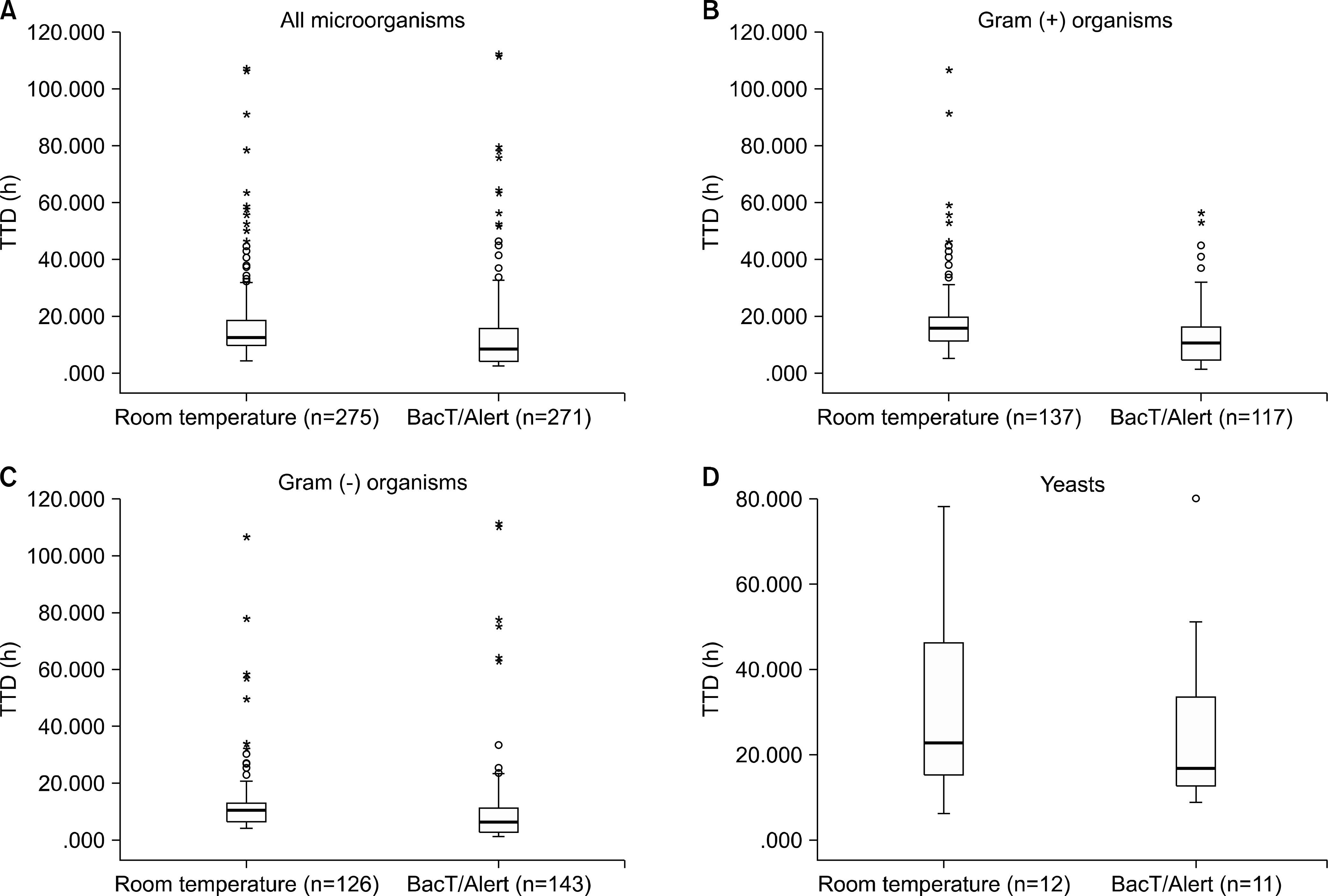
Fig. 1. Comparison of time to detection (TTD) of (A) all microorganisms, (B) Gram (+) organisms, (C) Gram (-) organisms, and (D) yeasts according to prestorage of blood culture bottles at room temperature and in a BacT/Alert unit outside laboratory operating hours. P<0.001 in (A), (B), and (C) by Mann-Whitney U test.

Fig. 2. Final report days of blood culture from bottle entry preincubated at room temperature (RT) or in a BacT/Alert unit outside laboratory operating hours. P=0.052 by χ2 test.
Reference
-
1.Seegmüller I., Eschenbach U., Kamereck K., Miethke T. Sensitivity of the BacT/ALERT FA-medium for detection of Pseudomonas aeruginosa in preincubated blood cultures and its temperature- dependence. J Med Microbiol. 2004. 53:869–74.2.Koh EH., Lee DH., Kim S. Effects of preincubating blood culture bottles at 37°C during the night shift and of collected blood vol-ume on time to detection and days to final report. Ann Clin Microbiol. 2014. 17:14–9.3.CLSI. Principles and procedures for blood cultures; approved guidline. CLSI document M47-A. Wayne, PA: Clinical and Laboratory Standards Institute. 2007.4.van der Velden LB., Vos FJ., Mouton JW., Sturm PD. Clinical im-pact of preincubation of blood cultures at 37°C. J Clin Microbiol. 2011. 49:275–80.
Article5.Kerremans JJ., van der Bij AK., Goessens W., Verbrugh HA., Vos MC. Immediate incubation of blood cultures outside routine laboratory hours of operation accelerates antibiotic switching. J Clin Microbiol. 2009. 47:3520–3.
Article6.Saito T., Iinuma Y., Takakura S., Nagao M., Matsushima A., Shirano M, et al. Delayed insertion of blood culture bottles into automated continuously monitoring blood culture systems increases the time from blood sample collection to the detection of microorganisms in bacteremic patients. J Infect Chemother. 2009. 15:49–53.
Article7.Janapatla RP., Yan JJ., Chien ML., Chen HM., Wu HM., Wu JJ. Effect of overnight storage of blood culture bottles on bacterial detection time in the BACTEC 9240 blood culture system. J Microbiol Immunol Infect. 2010. 43:126–32.
Article8.Lee DH., Koh EH., Choi SR., Kim S. Growth dynamics of Staphylococcus aureus, Escherichia coli, and Pseudomonas aeruginosa as a function of time to detection in BacT/alert 3D blood culture bottles with various preincubation conditions. Ann Lab Med. 2013. 33:406–9.9.Jardine LA., Sturgess BR., Inglis GD., Davies MW. Neonatal blood cultures: effect of delayed entry into the blood culture machine and bacterial concentration on the time to positive growth in a si-mulated model. J Paediatr Child Health. 2009. 45:210–4.
Article
- Full Text Links
-
- Actions
-
Cited
- CITED
-
- Close
- Share
-
- Similar articles
-
- Comparison of the BACTEC Peds Plus Pediatric Blood Culture Bottle to the BacT/Alert PF Pediatric Blood Culture Bottle for Culturing Blood from Pediatric Patients
- Growth Dynamics of Staphylococcus aureus, Escherichia coli, and Pseudomonas aeruginosa as a Function of Time to Detection in BacT/Alert 3D Blood Culture Bottles with Various Preincubation Conditions
- Comparison of Clinical Performance Between BacT/Alert Virtuo and BacT/Alert 3D Blood Culture Systems
- Comparison of BACTEC Plus Aerobic/F Media and BacT/Alert FA Media to Detect Bacteria in Blood Culture Bottles Containing Peak Therapeutic Levels of Antimicrobials
- Evaluation of FAN-aerobic Blood Culture Bottle in BacT/Alert3D System


