
Considerations of Blood Properties, Outlet Boundary Conditions and Energy Loss Approaches in Computational Fluid Dynamics Modeling

- Affiliations
-
- 1Department of Radiology and Research Institute of Radiology, University of Ulsan, College of Medicine, Asan Medical Center, Seoul, Korea. dcsuh@amc.seoul.kr
- 2School of Mechanical Engineering, Yonsei University, Seoul, Korea. joonlee@yonsei.ac.kr
- KMID: 1910768
- DOI: http://doi.org/10.5469/neuroint.2014.9.1.1
Abstract
- Despite recent development of computational fluid dynamics (CFD) research, analysis of computational fluid dynamics of cerebral vessels has several limitations. Although blood is a non-Newtonian fluid, velocity and pressure fields were computed under the assumptions of incompressible, laminar, steady-state flows and Newtonian fluid dynamics. The pulsatile nature of blood flow is not properly applied in inlet and outlet boundaries. Therefore, we present these technical limitations and discuss the possible solution by comparing the theoretical and computational studies.
Keyword
Figure
-
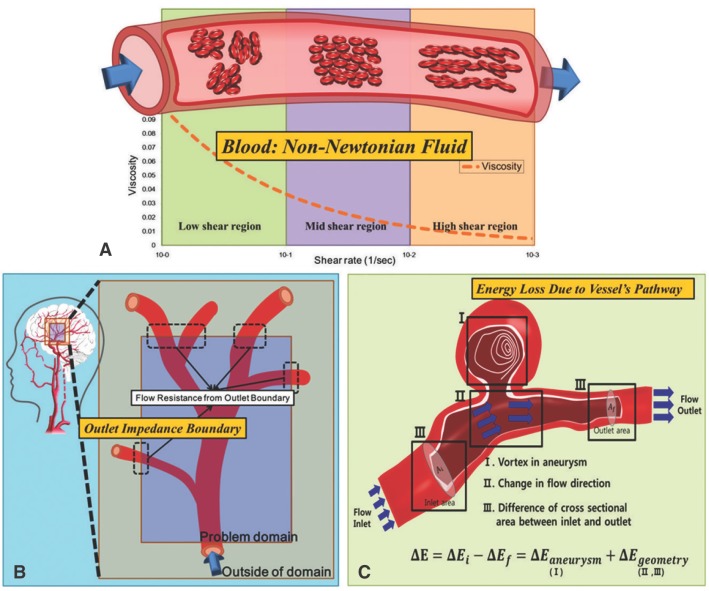
Fig. 1 The three main considerations in circulatory system modeling: A. non-Newtonian properties of blood, B. outlet boundary conditions of the model, and C. additional energy loss due to vessel geometry.
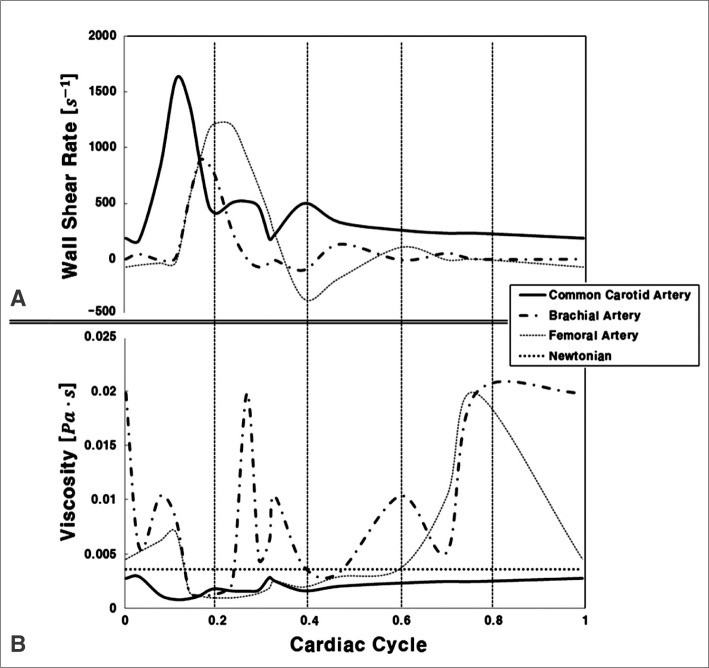
Fig. 2 A. Wall shear rate predicted using the flow rate and radii common carotid, brachial, and femoral arteries reported by Stroev et al.[30] (Reprinted with permission) B. Viscosity calculated using shear rate from Carreau-Yasuda model ( = (1+(λη)a)(n-1)/a, µ0=0.0022 Paty c a=0.644, n=0.392, λ=0.110s) in common carotid, brachial, and femoral arteries compared to Newtonian viscosity[31].
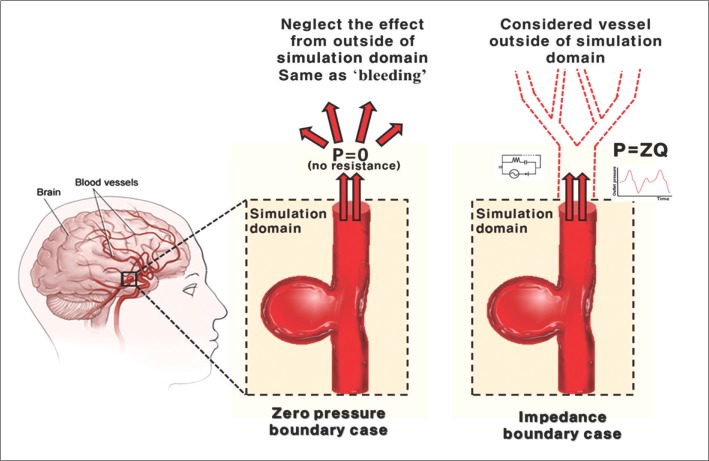
Fig. 3 Comparison between the zero pressure boundary condition and the impedance boundary condition. Zero pressure boundary condition assumes that pressure at the outlet boundary is zero, as if bleeding were occurring, without considering any influences from the vessels outside of the simulation domain. However, in impedance boundary case, as shown at right, the term Z is adopted to demonstrate the wave reflection caused by the outer domain. By regarding the blood flow of the whole vascular system as if it were electrical current running through a circuit, and so adopting the impedance term to express resistance of vessel to blood flow, the wave reflection is successfully accounted for at the outlet of the simulation domain.
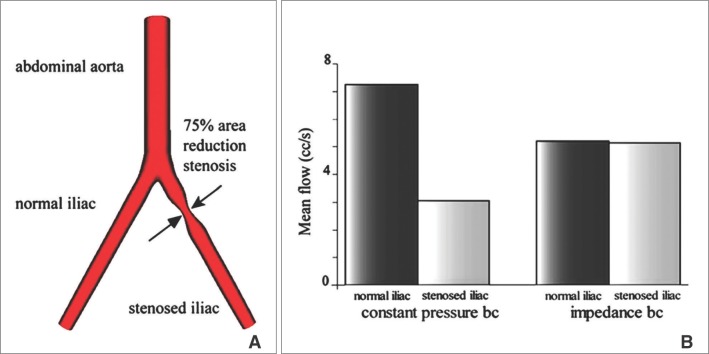
Fig. 4 The simulation of mean flow rate at the stenotic blood vessel with two different boundary conditions: the constant pressure and the impedance boundary condition [18]. (Reprinted with permission) A. Geometry of a bifurcated blood vessel with stenosis that reduces the cross sectional area by 75%. B. Flow distribution between normal and stenotic iliac vessels. Flow rate is calculated at the bottom end of each bifurcation. For the case of constant pressure boundary, the left branch of bifurcation with stenosis has a drastically different flow rate compared to the right branch, which is completely unrealistic. In the case of impedance boundary, however, the difference between the two branches is much smaller as the pressure from the outer domain has been applied properly.
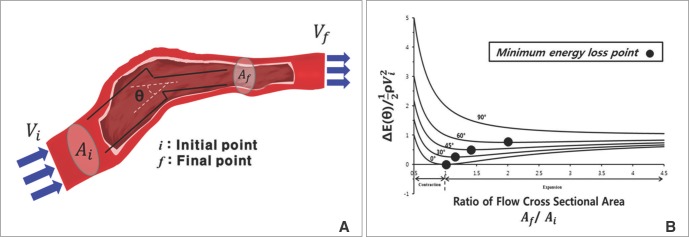
Fig. 5 A. Schematic representation of a stream of fluid traversing a vessel from an initial position i to a final position f. Uniform flow experiences a sudden change in its cross-sectional area A and direction θ. The symbols Ai and Af each represent the cross-sectional area, and Vi and Vf represent the corresponding average velocities of flow. B. The relationship between geometrical energy loss and cross-sectional area ratio. Each line represents the degree of change in flow angle. Each dot represents the point where the loss becomes minimum at the listed angles (0°, 30°, 45°, 60°, 90°).[26, 28] (Reprinted with permission)
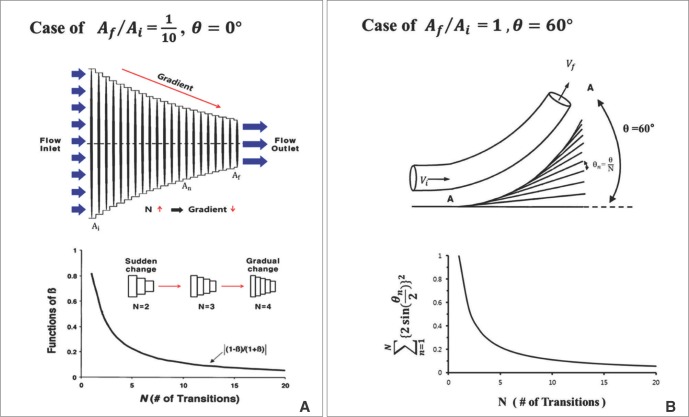
Fig. 6 A. Gradual change of cross-sectional area and magnitude the function of β for increasing values of N (# of changes) at = 1/10. B. Change in angle where there is no change in cross-sectional area. The graph at the bottom shows that a larger number of transitions causes the angle change to become more gradual resulting in lower 'loss factor'. Both cases have directional change of 60°[26]. (Reprinted with permission)
Reference
-
1. Chen J, Lu XY. Numerical investigation of the non-Newtonian blood flow in a bifurcation model with a non-planar branch. J Biomech. 2004; 37:1899–1911. PMID: 15519598.
Article2. Olufsen MS, Peskin CS, Kim WY, Pedersen EM, Nadim A, Larsen J. Numerical simulation and experimental validation of blood flow in arteries with structured-tree outflow conditions. Ann Biomed Eng. 2000; 28:1281–1299. PMID: 11212947.
Article3. Darne B, Girerd X, Safar M, Cambien F, Guize L. Pulsatile versus steady component of blood pressure: a cross-sectional analysis and a prospective analysis on cardiovascular mortality. Hypertension. 1989; 13:392–400. PMID: 2522417.
Article4. Johnson DA, Spaeth JR, Rose WC, Naik UP, Beris AN. An impedance model for blood flow in the human arterial system. Part i: Model development and matlab implementation. Comput Chem Eng. 2011; 35:1304–1316.
Article5. Suh DC, Park ST, Oh TS, Park SO, Lim OK, Park S, et al. High shear stress at the surface of enhancing plaque in the systolic phase is related to the symptom presentation of severe M1 stenosis. Korean J Radiol. 2011; 12:515–518. PMID: 21852914.
Article6. Suh DC, Ko YB, Park ST, Yoon K, Lim OK, Oh JS, et al. Computational flow dynamics of the severe m1 stenosis before and after stenting. Neurointervention. 2011; 6:13–16. PMID: 22125742.
Article7. Park ST, Kim JK, Yoon KH, Park SO, Park SW, Kim JS, et al. Atherosclerotic carotid stenoses of apical versus body lesions in high-risk carotid stenting patients. AJNR Am J Neuroradiol. 2010; 31:1106–1112. PMID: 20093309.
Article8. Oh TS, Ko YB, Park ST, Yoon KH, Lee SW, Park JW, et al. Computational flow dynamics study in severe carotid bulb stenosis with ulceration. Neurointervention. 2010; 5:97–102.
Article9. Shojima M, Oshima M, Takagi K, Torii R, Hayakawa M, Katada K, et al. Magnitude and role of wall shear stress on cerebral aneurysm: computational fluid dynamic study of 20 middle cerebral artery aneurysms. Stroke. 2004; 35:2500–2505. PMID: 15514200.10. Xiang J, Natarajan SK, Tremmel M, Ma D, Mocco J, Hopkins LN, et al. Hemodynamic-morphologic discriminants for intracranial aneurysm rupture. Stroke. 2011; 42:144–152. PMID: 21106956.
Article11. Luo B, Yang X, Wang S, Li H, Chen J, Yu H, et al. High shear stress and flow velocity in partially occluded aneurysms prone to recanalization. Stroke. 2011; 42:745–753. PMID: 21233477.
Article12. Takao H, Murayama Y, Otsuka S, Qian Y, Mohamed A, Masuda S, et al. Hemodynamic differences between unruptured and ruptured intracranial aneurysms during observation. Stroke. 2012; 43:1436–1439. PMID: 22363053.
Article13. Johnston BM, Johnston PR, Corney S, Kilpatrick D. Non-Newtonian blood flow in human right coronary arteries: steady state simulations. J Biomech. 2004; 37:709–720. PMID: 15047000.
Article14. Gijsen FJ, van de Vosse FN, Janssen JD. The influence of the non-Newtonian properties of blood on the flow in large arteries: steady flow in a carotid bifurcation model. J Biomech. 1999; 32:601–608. PMID: 10332624.
Article15. Molla MM, Paul MC. LES of non-Newtonian physiological blood flow in a model of arterial stenosis. Med Eng Phys. 2012; 34:1079–1087. PMID: 22153320.
Article16. Fisher C, Rossmann JS. Effect of non-Newtonian behavior on hemodynamics of cerebral aneurysms. J Biomech Eng. 2009; 131:091004. PMID: 19725693.
Article17. Kim YH, Xu X, Lee JS. The effect of stent porosity and strut shape on saccular aneurysm and its numerical analysis with lattice Boltzmann method. Ann Biomed Eng. 2010; 38:2274–2292. PMID: 20300847.
Article18. Vignon-Clementel IE, Figueroa CA, Jansen KE, Taylor CA. Outflow boundary conditions for 3D simulations of non-periodic blood flow and pressure fields in deformable arteries. Comput Methods Biomech Biomed Engin. 2010; 13:625–640. PMID: 20140798.
Article19. Salvi P, Bellasi A, Di Iorio B. Does it make sense to measure only the brachial blood pressure? Blood Purification. 2013; 36:21–22. PMID: 23735431.
Article20. Weber T, Auer J, O'Rourke MF, Kvas E, Lassnig E, Berent R, et al. Arterial stiffness, wave reflections, and the risk of coronary artery disease. Circulation. 2004; 109:184–189. PMID: 14662706.
Article21. Nichols W, O'Rourke MF. Mcdonald's blood flow in arteries: Theoretical, experimental, and clinical principles. London: Edward Arnold;1998.22. Passerini T, Sangalli L, Vantini S, Piccinelli M, Bacigaluppi S, Antiga L, et al. An integrated statistical investigation of internal carotid arteries of patients affected by cerebral aneurysms. Cardiovasc Eng Technol. 3:26–40.
Article23. Qian Y, Takao H, Umezu M, Murayama Y. Risk analysis of unruptured aneurysms using computational fluid dynamics technology: preliminary results. AJNR Am J Neuroradiol. 2011; 32:1948–1955. PMID: 21903914.
Article24. Qian Y, Liu J, Itatani K, Miyaji K, Umezu M. Computational hemodynamic analysis in congenital heart disease: simulation of the norwood procedure. Ann Biomed Eng. 2010; 38:2302–2313. PMID: 20195758.
Article25. Akins CW, Travis B, Yoganathan AP. Energy loss for evaluating heart valve performance. J Thorac Cardiovasc Surg. 2008; 136:820–833. PMID: 18954618.
Article26. Ascuitto RJ, Kydon DW, Ross-Ascuitto NT. Streamlining fluid pathways lessens flow energy dissipation: relevance to atriocavopulmonary connections. Pediatr Cardiol. 2003; 24:249–258. PMID: 12522658.
Article27. Guillot M, Ross-Ascuitto N, Ascuitto RJ. Fluid-flow energetics for curved or angulated pathways associated with staged operations for the modified fontan procedure. Congenit Cardiol Today. 2012; 10:1–13.28. Ascuitto RJ, Kydon DW, Ross-Ascuitto NT. Pressure loss from flow energy dissipation: relevance to Fontan-type modifications. Pediatr Cardiol. 2001; 22:110–115. PMID: 11178663.
Article29. Ensley AE, Lynch P, Chatzimavroudis GP, Lucas C, Sharma S, Yoganathan AP. Toward designing the optimal total cavopulmonary connection: an in vitro study. Ann Thorac Surg. 1999; 68:1384–1390. PMID: 10543511.
Article
- Full Text Links
-
- Actions
-
Cited
- CITED
-
- Close
- Share
-
- Similar articles
-
- Computational Fluid Dynamics Modeling in Aortic Diseases
- Influence of Parent Artery Segmentation and Boundary Conditions on Hemodynamic Characteristics of Intracranial Aneurysms
- Computational Fluid Dynamics in Three Dimensional Angiography: Preliminary Hemodynamic Results of Various Proximal Geometry
- Applications of Computer Modeling and Simulation in Cartilage Tissue Engineering
- Computational Fluid Dynamics in Cardiovascular Disease


