
Praziquantel Treatment of an Eosinophilic Pleuritis Patient Suspected to Be Due to Sparganum Infection
- Affiliations
-
- 1Department of Internal Medicine, Kwak's Hospital, Daegu, Korea. antitine@hanmail.net
- 2Department of Pathology, Kwak's Hospital, Daegu, Korea.
- KMID: 1806947
- DOI: http://doi.org/10.3947/ic.2012.44.6.522
Abstract
- Human sparganosis is caused by the larval tapeworm of genus Spirometra. This parasite commonly invades subcutaneous tissues and muscles. However, infection in the pleural cavity is rare. A 65-year-old male patient, who had undergone surgical excision of subcutaneous masses due to a parasite infection (presumed to have been sparganosis) approximately 10 years ago, showed pleural effusion and peripheral eosinophilia. The anti-sparganum specific IgG antibody levels in the serum and pleural fluid were significantly higher than the normal control levels. Three consecutive doses of praziquantel (75 mg/kg/day) were administered for control of pleural effusion and peripheral eosinophilia. In this patient, sparganosis was suspected, and the probable cause of the infection was ingestion of raw snakes and frogs. Immunoserologic tests using ELISA can be helpful in diagnosis of pleural sparganosis and praziquantel is suggested as an alternative treatment for surgically unresectable cases.
Keyword
MeSH Terms
Figure
-
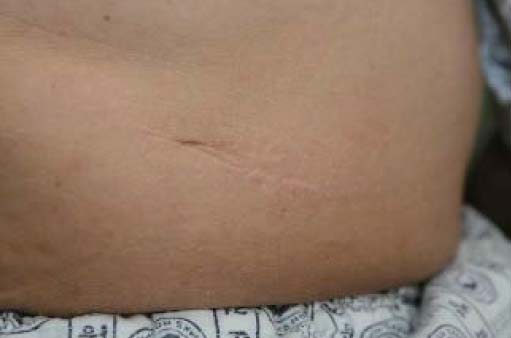
Figure 1 Two post-excision scars on the right flank, measuring 4 cm in length.
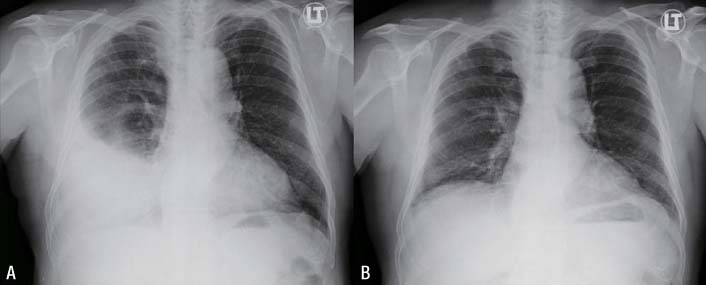
Figure 2 (A) An initial chest radiograph showing right-sided pleural effusion. (B) A follow-up chest radiograph one month after praziquantel treatment showing disappearance of right-sided pleural effusion.
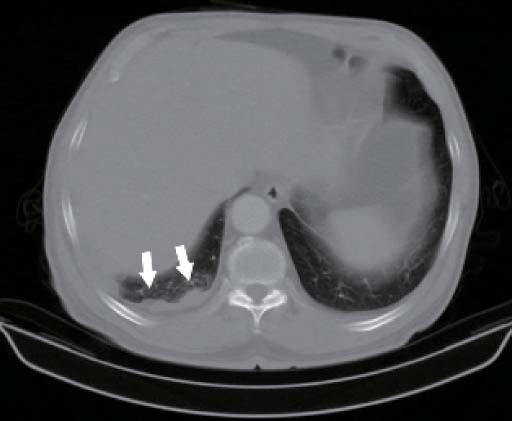
Figure 3 Chest CT shows irregular pleural thickening with subpleural fibrosis at praziquantel the posterior basal segment of the right lower lobe (arrow).
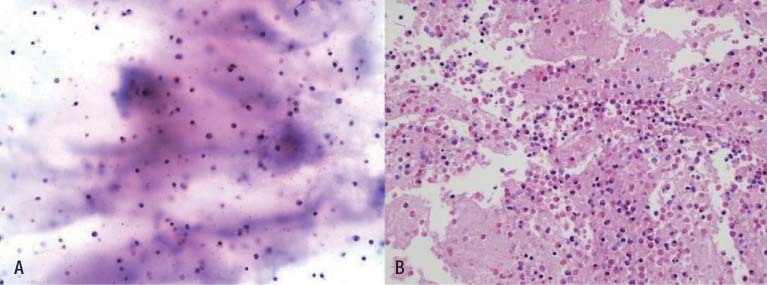
Figure 4 (A) Cytology of the pleural fluid showing many eosinophils in the necrotic background (Papanicolaou stain, ×400). (B) A pleural biopsy shows numerous eosinophil infiltration with fibrinoid necrosis (H&E stain, ×400).
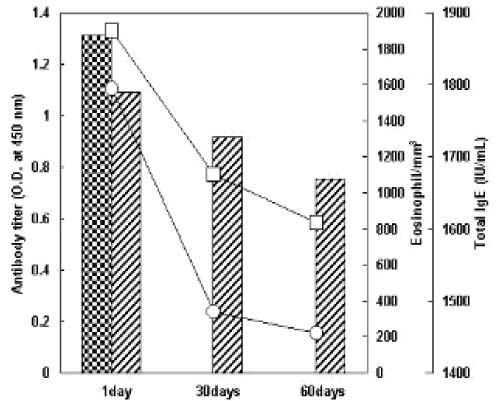
Figure 5 Clinical courses at first, after 30 and 60 days. ○, eosinophil count; □, total IgE; hatched column, specific antibody titer in serum; dotted column, specific antibody titer in pleural effusion.
Reference
-
1. Mueller JF. The biology of Spirometra. J Parasitol. 1974. 60:3–14.
Article2. Choi WJ. Migration and distribution of spargana in body of experimentally infected mice. Kisaengchunghak Chapchi. 1984. 22:229–237.
Article3. Cho SY, Bae JH, Seo BS, Lee SH. Some aspects of human sparganosis in Korea. Kisaengchunghak Chapchi. 1975. 13:60–77.
Article4. Park HY, Lee SU, Kim SH, Lee PC, Huh S, Yang YS, Kong Y. Epidemiological Significance of sero-positive inhabitants against sparganum in Kangwon-do, Korea. Yonsei Med J. 2001. 42:371–374.
Article5. Koh TW, Lee JW, Sohn DS, Cho DY, Yang KM, Kong Y, Cho SY. Empyema thoracis associated with sparganosis: a case report. Korean J Thorac Cardiovasc Surg. 1988. 21:761–765.6. Kim DH, Yi IH, Youn HC, Kim SC, Kim BS, Cho KS, Park JC, Kwak YT. Pleural sparganosis. Korean J Thorac Cardiovasc Surg. 2006. 39:502–504.7. Ishii H, Mukae H, Inoue Y, Kadota J, Kohno S, Uchiyama F, Nawa Y. A rare case of eosinophilic pleuritis due to sparganosis. Intern Med. 2001. 40:783–785.
Article8. Tanaka S, Maruyama H, Ishiwata K, Nawa Y. A case report of pleural sparganosis. Parasitol Int. 1997. 46:73–75.
Article9. Iwatani K, Kubota I, Hirotsu Y, Wakimoto J, Yoshioka M, Mori T, Ito T, Nomori H. Sparganum mansoni parasitic infection in the lung showing a nodule. Pathol Int. 2006. 56:674–677.
Article10. Oh YJ, Kim MJ, Cho JH, Cha CW, Kim DH, Oh MJ, Chin JY, Choi SS, Kwon KW. A case of pulmonary sparganosis in a patient with a history of recurrent sparganum infections. Tuberc Respir Dis. 2009. 67:229–233.
Article11. Kim H, Kim SI, Cho SY. Serologic diagnosis of human sparganosis by means of micro-ELISA. Korean J Parasitol. 1984. 22:222–228.
Article12. Chai JY, Yu JR, Lee SH, Kim SI, Cho SY. Ineffectiveness of praziquantel treatment for human sparganosis (A case report). Seoul J Med. 1988. 29:397–399.13. Sohn WM, Hong ST, Chai JY, Lee SH. Infectivity of the sparganum treated by praziquantel, gamma-irradiation and mechanical cutting. Korean J Parasitol. 1993. 31:135–139.
Article
- Full Text Links
-
- Actions
-
Cited
- CITED
-
- Close
- Share
-
- Similar articles
-
- Eosinophilic Pleuritis due to Sparganum: A Case Report
- Praziquantel Treatment of Eosinophilic Gastritis Suspected to Be Due to Cerebral Sparganosis
- A Case of Sparganosis with Eosinophilic Panniculitis
- Infectivity of the sparganum treated by praziquantel, gamma-irradiation and mechanical cutting
- A Case of Cysticercosis Treated with Praziquantel


