
J Korean Med Sci.
2012 May;27(Suppl):S21-S24. 10.3346/jkms.2012.27.S.S21.
Sustainability of Korean National Health Insurance
- Affiliations
-
- 1Graduate School of Public Health, Yonsei University, Seoul, Korea.
- 2Department of Preventive Medicine & Institute of Health Services Research, Yonsei University College of Medicine, Seoul, Korea. ecpark@yuhs.ac
- KMID: 1714484
- DOI: http://doi.org/10.3346/jkms.2012.27.S.S21
Abstract
- Korean National Health Insurance (NHI) was established during only 12 yr from its inception (1977-1989), providing universal medical coverage to the entire nation and making a huge contribution to medical security. However, the program now faces many challenges in terms of sustainability. The low birth rates, aging population, low economic growth, and escalating demands for welfare, as well as unification issues, all add pressure to the sustainability of NHI. The old paradigm of low contribution - low benefits coverage - low NHI's fee schedule needs to be replaced by a new paradigm of proper contribution - adequate benefit coverage - fair NHI's fee schedule. This new paradigm will require reform of NHI's operating system, funding, and spending.
MeSH Terms
Figure
-
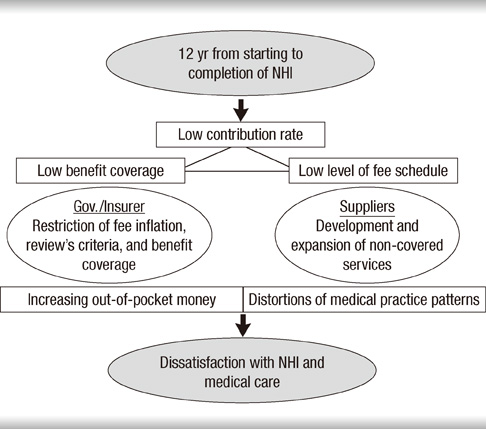
Fig. 1 Schematic diagram of Korean NHI's problems.
Cited by 4 articles
-
Health policy for the new government
Eun-Cheol Park
J Korean Med Assoc. 2012;55(11):1040-1042. doi: 10.5124/jkma.2012.55.11.1040.Health policy for the new government
Eun-Cheol Park
J Korean Med Assoc. 2012;55(11):1040-1042. doi: 10.5124/jkma.2012.55.11.1040.The diagnosis of healthcare policy problems in Korea
Eun-Cheol Park, Sung-In Jang
J Korean Med Assoc. 2012;55(10):932-939. doi: 10.5124/jkma.2012.55.10.932.Healthcare Policy Agenda for a Sustainable Healthcare System in Korea: Building Consensus Using the Delphi Method
Seung Hoon Kim, Hye Jin Joo, Joo Youn Kim, Hyo Jeong Kim, Eun-Cheol Park
J Korean Med Sci. 2022;37(39):e284. doi: 10.3346/jkms.2022.37.e284.
Reference
-
1. National Health Insurance Cooperation. 2010 Statistics of national health insurance. 2011.2. Soe SR, Choi ID, Moon SW, Kim JS, Hwang RI. Satisfaction survey of national health insurance, 2008. 2008. National Health Insurance Cooperation.3. OECD. OECD health data. 2010.4. Xu K, Evans DB, Carrin G, Aguilar-Rivera AM, Musgrove P, Evans T. Protecting households from catastrophic health spending. Health Aff (Millwood). 2007. 26:972–983.5. Yu SH, Park EC, editors. Medical security. 2009. Seoul: Shinkwang Publication Co..6. Park EC. The current status and directions of improving benefit coverage in National Health Insurance. Healthc Policy Forum. 2010. 8:26–33.7. Bodenheimer T. The Oregon Health Plan: the lessons for the nation. N Engl J Med. 1997. 337:651–655.
- Full Text Links
-
- Actions
-
Cited
- CITED
-
- Close
- Share
-
- Similar articles
-
- Direction of Healthcare Reform for Sustainability
- Achievements and Challenges of 40th Anniversary Health Insurance
- The Roles of the National Health Insurance Service in the Public Health Security
- Reorganization of the Medical Delivery System: A Cause for the Patients
- Current Status of National Health Promotion Fund in Korea


