
Tension Band Wiring for Distal Clavicle Fracture: Radiologic Analysis and Clinical Outcome
- Affiliations
-
- 1Department of Orthopaedic Surgery, Kyung Hee University Medical Center, Seoul, Korea. shoulderrhee@hanmail.com
- KMID: 1703111
- DOI: http://doi.org/10.12671/jkfs.2014.27.2.127
Abstract
- PURPOSE
The purpose of this study is to evaluate the radiologic and clinical outcomes after tension band wire fixation of Neer type II distal clavicle fractures.
MATERIALS AND METHODS
Twenty-six patients with Neer type II distal clavicle fractures who underwent tension band wire fixation from March 2002 to May 2011 were included in the study. Fifteen cases were classified as Neer type IIa and 11 cases as type IIb. The postoperative mean follow-up period was 14.3 months. Clinical and radiologic evaluation was performed at two weeks, six weeks, three months, six months, and 12 months postoperatively.
RESULTS
Bony union on X-rays was observed at an average of 11.7 weeks (range 8-20 weeks) postoperatively. The overall visual analogue scale score for pain was 1.23+/-2.75 postoperatively. The overall postoperative University of California at Los Angeles score increased to 33.5+/-2.15 from the preoperative score of 21.6+/-1.91 (p<0.05).
CONCLUSION
Among various methods of treatment for Neer type II distal clavicle fracture, K-wire and tension band fixation was used and relatively satisfactory radiological and clinical results were obtained. This surgical method yields excellent clinical results, owing to its relatively easy technique, fewer complications, and allowance of early rehabilitation.
Keyword
Figure
-
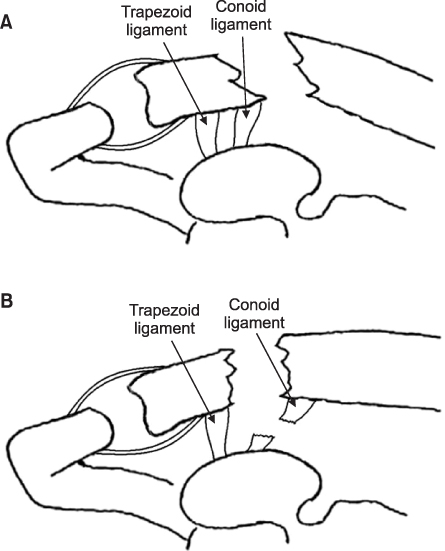
Fig. 1 (A) Neer and Rockwood classification of distal clavicle fracture IIa: both the conoid and the trapezoid ligaments remain attached to the distal fragment. (B) Neer and Rockwood classification of distal clavicle fracture IIb: medial fragment instability is a result of disruption of the conoid ligament.
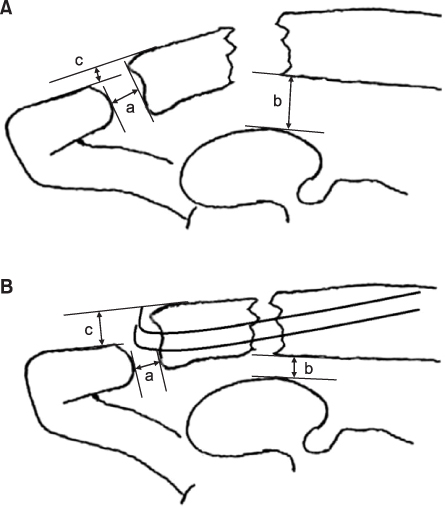
Fig. 2 (A) Preoperative radiologic analysis. a: acromioclavicular distance (ACD), b: coracoclavicular distance (CCD), c: acromioclavicular interval (ACI). (B) Postoperative radiologic analysis. a: ACD, b: CCD, c: ACI after K-wire insertion. ACI is increased. But, CCD is decreased.
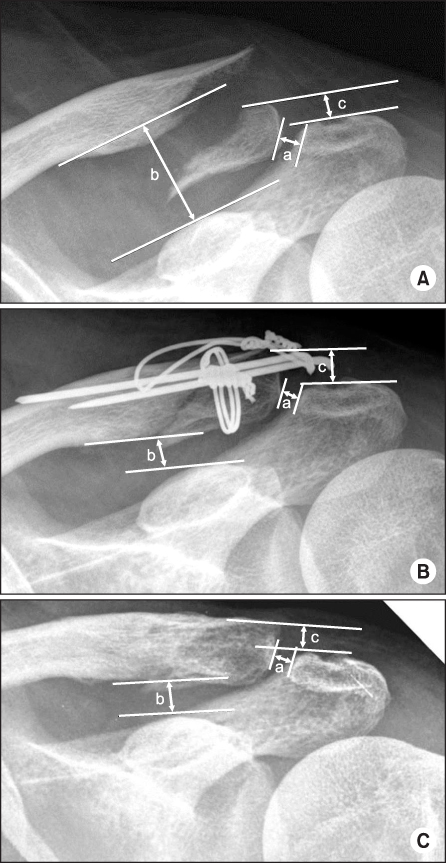
Fig. 3 A 47-year-old women injured by traffic accident. Type IIa. (A) The radiograph shows a type IIa distal clavicle fracture of the left shoulder. Coracoclavicular (CC) distance b increased. (B) Postoperative radiograph shows a distal clavicle fracture fixed with tension band wiring. CC distance b was decreased, acromioclavicular (AC) interval c was increased. (C) After removal of wires at postoperative one year, AC interval c was reduced as compared with immediate postoperative radiograph.
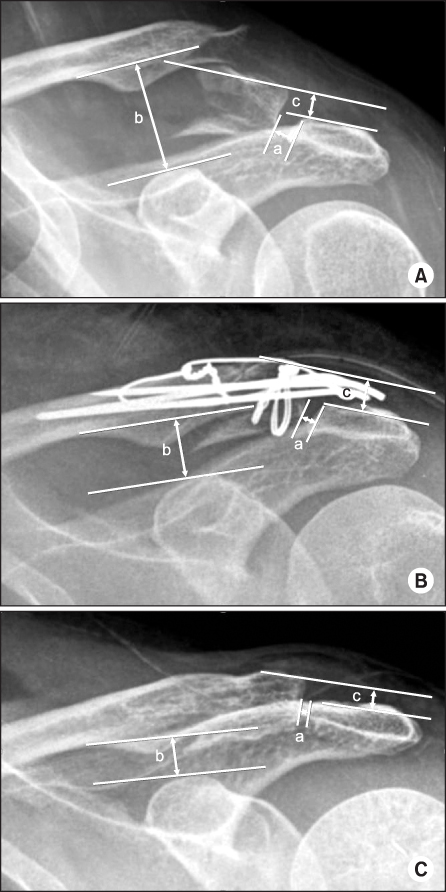
Fig. 4 A 24-year-old man injured by falling down. Type IIb. (A) The radiograph shows a type IIb distal clavicle fracture of the left shoulder. Coracoclavicular (CC) distance b increased. (B) Postoperative radiograph shows a distal clavicle fracture fixed with tension band wiring. CC distance b was decreased, acromioclavicular (AC) interval c was increased. (C) After removal of wires at postoperative one year, AC interval c was reduced as compared with immediate postoperative radiograph.
Reference
-
1. Robinson CM, Cairns DA. Primary nonoperative treatment of displaced lateral fractures of the clavicle. J Bone Joint Surg Am. 2004; 86:778–782.
Article2. Neer CS 2nd. Nonunion of the clavicle. J Am Med Assoc. 1960; 172:1006–1011.
Article3. Neer CS 2nd. Fracture of the distal clavicle with detachment of the coracoclavicular ligaments in adults. J Trauma. 1963; 3:99–110.
Article4. Neer CS 2nd. Fractures of the distal third of the clavicle. Clin Orthop Relat Res. 1968; 58:43–50.5. Herrmann S, Schmidmaier G, Greiner S. Stabilisation of vertical unstable distal clavicular fractures (Neer 2b) using locking T-plates and suture anchors. Injury. 2009; 40:236–239.
Article6. Hessmann M, Kirchner R, Baumgaertel F, Gehling H, Gotzen L. Treatment of unstable distal clavicular fractures with and without lesions of the acromioclavicular joint. Injury. 1996; 27:47–52.
Article7. Lyons FA, Rockwood CA Jr. Migration of pins used in operations on the shoulder. J Bone Joint Surg Am. 1990; 72:1262–1267.
Article8. Ahn BW, Yoon JH, Kim CK, et al. Internal fixation of clavicle lateral and fracture with mini T-plate. J Korean Fract Soc. 2005; 18:410–414.
Article9. Zenni EJ Jr, Krieg JK, Rosen MJ. Open reduction and internal fixation of clavicular fractures. J Bone Joint Surg Am. 1981; 63:147–151.
Article10. Flinkkilä T, Ristiniemi J, Hyvönen P, Hämäläinen M. Surgical treatment of unstable fractures of the distal clavicle: a comparative study of Kirschner wire and clavicular hook plate fixation. Acta Orthop Scand. 2002; 73:50–53.
Article11. Fukuda K, Craig EV, An KN, Cofield RH, Chao EY. Biomechanical study of the ligamentous system of the acromioclavicular joint. J Bone Joint Surg Am. 1986; 68:434–440.
Article12. Mall JW, Jacobi CA, Philipp AW, Peter FJ. Surgical treatment of fractures of the distal clavicle with polydioxanone suture tension band wiring: an alternative osteosynthesis. J Orthop Sci. 2002; 7:535–537.
Article13. Renfree KJ, Wright TW. Anatomy and biomechanics of the acromioclavicular and sternoclavicular joints. Clin Sports Med. 2003; 22:219–237.
Article14. Neviaser RJ. Injuries to the clavicle and acromioclavicular joint. Orthop Clin North Am. 1987; 18:433–438.
Article15. Renger RJ, Roukema GR, Reurings JC, Raams PM, Font J, Verleisdonk EJ. The clavicle hook plate for Neer type II lateral clavicle fractures. J Orthop Trauma. 2009; 23:570–574.
Article16. Banerjee R, Waterman B, Padalecki J, Robertson W. Management of distal clavicle fractures. J Am Acad Orthop Surg. 2011; 19:392–401.
Article17. Chung WY, Lee WS, Jeon TS, Kim DH, Kim KK, Lim JW. Treatment of distal clavicle type II fracture using K-wires and tension band wiring. J Korean Soc Fract. 2003; 16:215–221.
Article18. Nordqvist A, Petersson C, Redlund-Johnell I. The natural course of lateral clavicle fracture. 15 (11-21) year follow-up of 110 cases. Acta Orthop Scand. 1993; 64:87–91.
Article19. Edwards DJ, Kavanagh TG, Flannery MC. Fractures of the distal clavicle: a case for fixation. Injury. 1992; 23:44–46.
Article20. Eskola A, Vainionpää S, Pätiälä H, Rokkanen P. Outcome of operative treatment in fresh lateral clavicular fracture. Ann Chir Gynaecol. 1987; 76:167–169.21. Kona J, Bosse MJ, Staeheli JW, Rosseau RL. Type II distal clavicle fractures: a retrospective review of surgical treatment. J Orthop Trauma. 1990; 4:115–120.22. Leppilahti J, Jalovaara P. Migration of Kirschner wires following fixation of the clavicle--a report of 2 cases. Acta Orthop Scand. 1999; 70:517–519.
Article23. Yamaguchi H, Arakawa H, Kobayashi M. Results of the Bosworth method for unstable fractures of the distal clavicle. Int Orthop. 1998; 22:366–368.
Article24. Kao FC, Chao EK, Chen CH, Yu SW, Chen CY, Yen CY. Treatment of distal clavicle fracture using Kirschner wires and tension-band wires. J Trauma. 2001; 51:522–525.
Article25. Chun JM, Kim SY, Lee KW, Shin SJ, Kim EG. Modified tenson band fixation for unstable fracture of the distal clavicle. J Korean Orthop Assoc. 2002; 37:416–420.
Article
- Full Text Links
-
- Actions
-
Cited
- CITED
-
- Close
- Share
-
- Similar articles
-
- Treatment of Distal Clavicle Type II Fracture using K-Wires and Tension Band Wiring
- Tension band wiring and Modified tension band wiring in the Operative Treatment of Patella Fracture
- Operative Treatment of patellar Fractures
- Modified Tenson Band Fixation for Unstable Fracture of the Distal Clavicle
- Coracoclavicular Screw Fixation and Tension Band Wiring in Treatment of Distal Clavicle Fracture


