
J Korean Acad Nurs.
2011 Feb;41(1):47-60. 10.4040/jkan.2011.41.1.47.
Development and Evaluation of a Web-based Education Program to Prevent Secondary Stroke
- Affiliations
-
- 1Department of Nursing, Cheongju University, Cheongju, Korea.
- 2College of Nursing, Seoul National University, Seoul, Korea. hapark@snu.ac.kr
- KMID: 1007008
- DOI: http://doi.org/10.4040/jkan.2011.41.1.47
Abstract
- PURPOSE
This study was conducted to develop and evaluate a web-based education program for secondary stroke prevention.
METHODS
A web-based secondary stroke prevention education program was developed using the system's life cycle methods and evaluated by comparing the effects of education among three groups, a web group, a booklet group and a control group.
RESULTS
Knowledge level of both patients and family, as well as some health behavior compliance in the web-based and booklet education groups were significantly higher than those of the control group. Family support in the web-based and booklet education groups was significantly higher than that of the control group after 12 weeks. The urine cotinine level in the web-based education group was significantly lower than that of the control group after 12 weeks. Medication adherence, blood pressure and perceived health status were not statistically different among the three groups at any time.
CONCLUSION
Web-based and booklet education programs were equally effective regarding the level of knowledge of patients and their families, family support, health behavior compliance, and urine cotinine level. These results demonstrate the potential use of a web-based education program for secondary stroke prevention.
Keyword
MeSH Terms
Figure
-
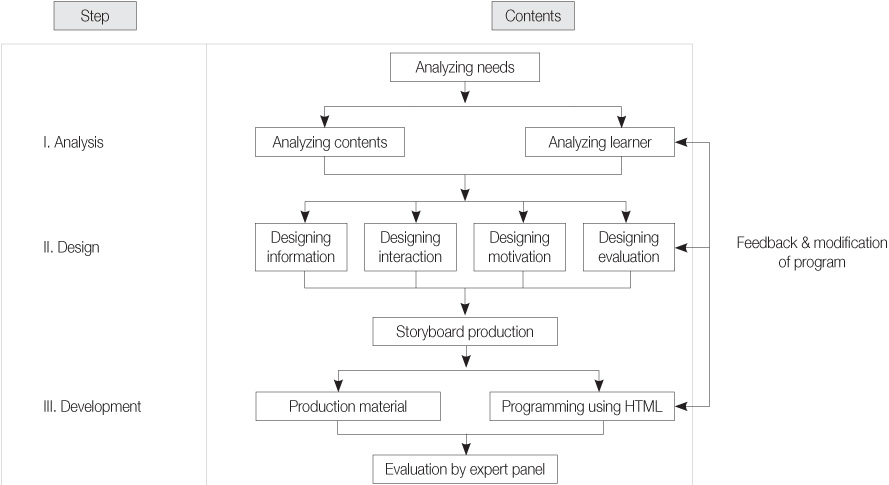
Figure 1 Development process of web-based education program.
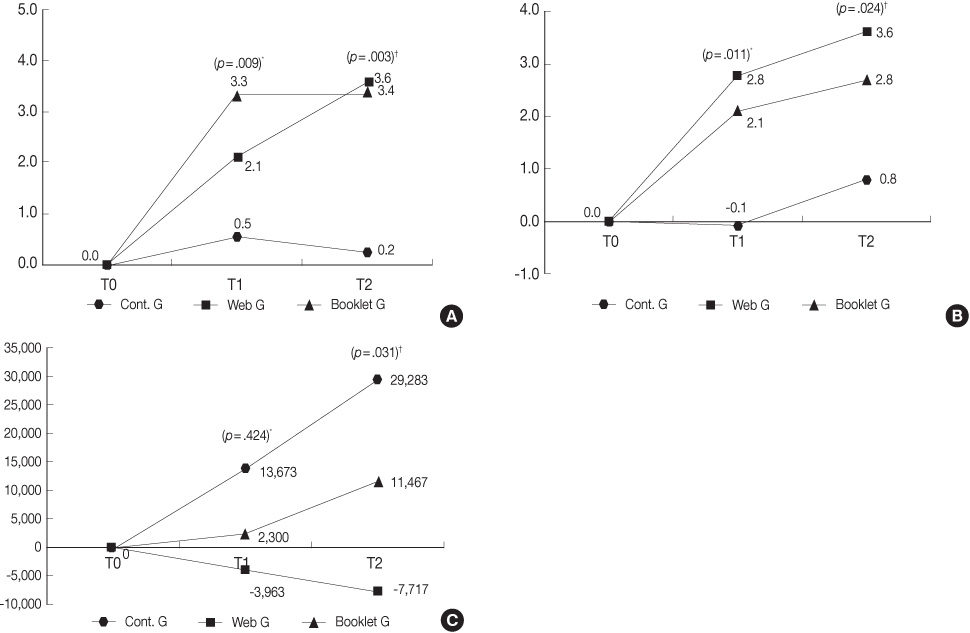
Figure 2 The change of outcome variables by group and time. (A) Patient's knowledge, (B) Family's knowledge, (C) Urine cotinine level. *Cross Sectional difference in the 4th week; †Cross Sectional difference in the 12th week.
Cited by 1 articles
-
Development of Pre-discharge Group Education Program for Liver Transplant Patients
Ji Seon Yun, Kyung Choon Lim, Jae Sim Jeong, Hea Seon Ha, Jung Ja Hong, Soon Haeng Lee, Lee Young Kim, Yeon Hee Kim, Shin Hwang
J Korean Soc Transplant. 2017;31(1):34-42. doi: 10.4285/jkstn.2017.31.1.34.
Reference
-
1. Benowitz NL. Cotinine as a biomarker of environmental tobacco smoke exposure. Epidemiologic Reviews. 1996. 18:188–204.2. Bigelow JH, Fonkych K, Fung C, Wang J. Analysis of healthcare interventions that change patient trajectories. 2005. Santa Monica, CA: RAND Corporation.3. Carlsson R, Lindberg G, Westin L, Israelsson B. Influence of coronary nursing management follow up on lifestyle after acute myocardial infarction. Heart. 1997. 77:256–259.4. Choi-Kwon S, Kwon SU, Kim JS. Compliance with risk factor modification: Early-onset versus late-onset stroke patients. European Neurology. 2005. 54:204–211.5. Choi S, Kwon SU, Ahn JS, Kim JS. Different perspectives of stroke education between patients and medical personnel. Korean Journal of Stroke. 2002. 4:78–87.6. Cohen J. Statistical power analysis for the behavioral sciences. 1988. 2nd ed. Hillsdale, NJ: Erlbaum.7. Collins TC, Petersen NJ, Menke TJ, Souchek J, Foster W, Ashton CM. Short-term, intermediate-term, and long-term mortality in patients hospitalized for stroke. Journal of Clinical Epidemiology. 2003. 56:81–87.8. Han AK. Effects of a family participated education program on the self care behavior and family support behavior of cardiac patients. 1998. Seoul: Yonsei University;Unpublished doctoral dissertation.9. Jo HS, Kim KJ. The effects of a cardiac rehabilitation program on health behavior compliance, cardiovascular function, and quality of life for the patients with ischemic heart disease. Journal of Korean Academy of Nursing. 2000. 30:560–570.10. Jung YY. The development of a internet-based computer assisted instruction program and analysis of its educational effects on patients with coronary artery disease. 2002. Seoul: Seoul National University;Unpublished doctoral dissertation.11. Kang SM. An effect of the secondary stroke prevention education program on self-care of acute ischemic stroke patients. 2005. Chungju: Konkuk University;Unpublished master's thesis.12. Kim HJ. The effect of health promotion program for stroke patient in home. 2004. Daegu: Keimyung University;Unpublished doctoral dissertation.13. Kim HS. Effects of web-based diabetic education in obese diabetic patients. Journal of Korean Academy of Nursing. 2005. 35:924–930.14. Kim MH. An explanatory model for health-promoting behaviors in patients living at home who have post stroke hemiplegia. Journal of Korean Academy of Nursing. 2006. 36:1065–1075.15. Koh IS, Kim HC, Kwon SB, Hwang SH, Kwon KH, Kim SM, et al. The compliance of stroke patients for secondary prevention: In Seoul & Kyunggi province. Journal of the Korean Neurological Association. 1999. 17:472–477.16. Korea Centers for Disease Control and Prevention. 2008 Public health statistics. 2009. Seoul: Author.17. Lawton MP, Moss M, Fulcomer M, Kleban MH. A research and service oriented multilevel assessment instrument. Journal of Gerontology. 1982. 37:91–99.18. Lee BR, Yu KH, Ma HI, Jung S, Jung S, Lee BC. The compliance of stroke patients for secondary prevention in newly developed city, Pyungchon. Korean Journal of Stroke. 2000. 2:158–163.19. Lorig KR, Ritter PL, Laurent DD, Plant K. Internet-based chronic disease self-management: A randomized trial. Medical Care. 2006. 44:964–971.20. Modrego PJ, Pina MA, Fraj MM, Llorens N. Type, causes, and prognosis of stroke recurrence in the province of Teruel, Spain. A 5-year analysis. Neurological Sciences. 2000. 21:355–360.21. Na IJ. Web-based education. 1999. Seoul: Kyouook Kwahak Sa.22. Disease statistics. National Health Insurance Corporation. 2010. 08. 09. Retrieved August 9, 2010. from http://www.nhic.or.kr/portal/site/main/menuitem.18832217ea22fd38b31148b4062310a0.23. Ovbiagele B, Saver JL, Fredieu A, Suzuki S, Selco S, Rajajee V, et al. In-hospital initiation of secondary stroke prevention therapies yields high rates of adherence at follow-up. Stroke. 2004. 35:2879–2883.24. Park HA, Kim HJ, Song MS, Song TM, Chung YC. Development of a web-based health information service system for health promotion in the elderly. Journal of Korean Society of Medical Informatics. 2002. 8(3):37–45.25. Bak HK. The effects of the health promotion program on functional status of the in-house stroke patients. Korean Journal of Rehabilitation Nursing. 2003. 6:213–225.26. Rudd AG, Lowe D, Hoffman A, Irwin P, Pearson M. Secondary prevention for stroke in the United Kingdom: Results from the national sentinel audit of stroke. Age and Ageing. 2004. 33:280–286.27. 2008 Report on the cause of death statistics. Statistics Korea. 2009. 09. 20. Retrieved September 20, 2009. from http://www.kostat.go.kr/nso_main/nsoMainAction.do?method=search&catgrp=nso2009&catid1=k090000&catid2=k09i0000&forward=search.28. Steele JM, Ruzicki D. An evaluation of the effectiveness of cardiac teaching during hospitalization. Heart & Lung. 1987. 16:306–311.29. Stein J, editor. Stroke recovery µ rehabilitation. 2009. New York, YN: Demos Medical Publishing.30. Yoo SH, Kang DW, Kwon SU, Kim JS. The secondary prevention of stroke: Attitude of patients admitted to a tertiary hospital. Korean Journal of Stroke. 2005. 7:78–86.
- Full Text Links
-
- Actions
-
Cited
- CITED
-
- Close
- Share
-
- Similar articles
-
- Development and Evaluation of a Web-based Ostomy Self-care Education Program
- Development and Evaluation of a Web-based Education Program on Appropriate Antibiotic Use in Korean Adolescents
- Development and Evaluation of a Web-based Support Program for the Maternal Role of Primiparas
- Development and Evaluation of a Web-based Education Program for Nursing Students on Control of Vancomycin-resistant Enterococcus Infection
- An Effect of the Secondary Stroke Prevention Education Program on Self-care of Acute Ischemic Stroke Patients


