
Effects of Abdominal Breathing on State Anxiety, Stress, and Tocolytic Dosage for Pregnant Women in Preterm Labor
- Affiliations
-
- 1Department of Nursing, Dankook University Hospital, Cheonan, Korea.
- 2Department of Nursing, Dankook University, Cheonan, Korea. songje@dankook.ac.kr
- KMID: 987591
- DOI: http://doi.org/10.4040/jkan.2010.40.3.442
Abstract
- PURPOSE
The purpose of this study was to identify the effects of abdominal breathing on state anxiety, stress and tocolytic dosage for pregnant women in preterm labor.
METHODS
The participants were 60 pregnant women in preterm labor who were hospitalized from April to July, 2009. Thirty participants were assigned to the experimental group and 30 to the control group. None of them had any other complications except preterm labor. The modified Mason's breathing technique was used with the experimental group 3 times a day for 3 days. Data were collected using a self-report questionnaire and chart review, and analyzed with the SPSS 13.0 WIN program.
RESULTS
"State anxiety of the experimental group will be lower than that of the control group" was supported. "Stress of the experimental group will be lower than that of the control group" was supported. "The Ritodrine dosage for the experimental group will be lower than that of the control group" was supported. "The Atosiban dosage for the experimental group will be lower than that of the control group" was supported.
CONCLUSION
These results indicate that abdominal breathing is an effective nursing intervention for pregnant women in preterm labor.
Keyword
MeSH Terms
Figure
-
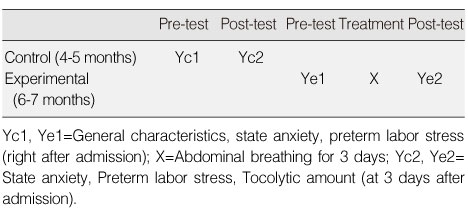
Figure 1 Research design.

Figure 2 Research framework.
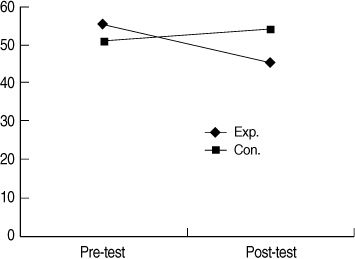
Figure 3 Changes in state anxiety score. Exp=experimental group; Con=control group.
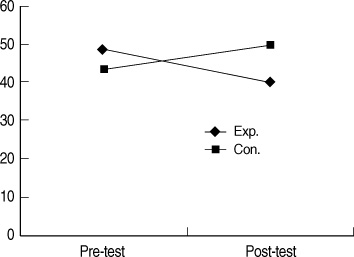
Figure 4 Changes in preterm labor stress score. Exp=experimental group; Con=control group.
Cited by 6 articles
-
Effects of a supportive program on uncertainty, anxiety, and maternal-fetal attachment in women with high-risk pregnancy
Hyun Jin Kim, Nami Chun
Korean J Women Health Nurs. 2020;26(2):180-190. doi: 10.4069/kjwhn.2020.06.17.Stress, Coping Style and Nursing Needs for Hospitalized Pregnant Women due to Preterm Labor
Su Hyun Kim, Hyang-In Cho Chung
Korean J Women Health Nurs. 2015;21(2):83-92. doi: 10.4069/kjwhn.2015.21.2.83.Factors Influencing Stress in Spouses of Hospitalized Women Diagnosed with Preterm Labor
Jeong Im Lee, Sehoon Hong
Korean J Women Health Nurs. 2019;25(4):459-473. doi: 10.4069/kjwhn.2019.25.4.459.Effects of nonpharmacological interventions on the psychological health of high-risk pregnant women: a systematic review and meta-analysis
Hyeji Yoo, Sukhee Ahn
Korean J Women Health Nurs. 2021;27(3):180-195. doi: 10.4069/kjwhn.2021.09.17.Effects of the Unpleasant Symptom-Relief Program on Preterm Labor Stress, Anxiety, Physical Discomfort, and Situational Discomfort among Hospitalized High-Risk Pregnant Women: A Nonrandomized Controlled Trial
Guy Nam Kim, Eun-Young Jun
J Korean Soc Matern Child Health. 2021;25(4):269-281. doi: 10.21896/jksmch.2021.25.4.269.Effects of Music Therapy on Stress of Preterm Labor and Uterine Contraction in Pregnant Women with Preterm Labor
Hye-Jin Park, Mi-Hae Sung
Korean J Women Health Nurs. 2017;23(2):109-116. doi: 10.4069/kjwhn.2017.23.2.109.
Reference
-
1. An JD. The effect of Taekwondo players' stress decrease on abdominal breathing and meditation program. Journal of Korean Society for the Study of Physical Education. 2004. 8:172–187.2. An SE. Effects of abdominal breathing on anxiety and labor time in primipara women. Korean Journal of Women Health Nursing. 2008. 14:196–204.3. Bastani F, Hidarnia A, Kazemnejad A, Vafaei M, Kashanian M. A randomized controlled trial of the effects of applied relaxation training on reducing anxiety and perceived stress in pregnant women. Journal of Midwifery and Women's Health. 2005. 50:36–40.4. Chang SB, Kim HS, Ko YH, Bae CH, An SE. Effects of abdominal breathing on anxiety, blood pressure, peripheral skin temperature and saturation oxygen of pregnant women in preterm labor. Korean Journal of Women Health Nursing. 2009. 15:32–43.5. Chang SB, Park HJ, Bae CH, Shim JO. The effects of abdominal breathing on preterm labor anxiety and frequency of uterine contraction. Clinical Nursing Research. 2007. 13(3):31–41.6. Cunningham FG, Leveno KJ, Bloom S, Hauth JC. Williams obstetrics. 2009. 23rd ed. New York, NY: McGraw-Hill.7. Debra PJ. The nursing management of women experiencing preterm labor: Clinical guidelines and why they are needed. Journal of Obstetrics and Gynecology and Neonatal Nursing. 1996. 26:569–573.8. Jacobson E. Progressive relaxation: A physiological and clinical investigation of muscular states and their significance in psychology and medical practice. 1974. 2nd ed. Chicago, IL: University of Chicago Press.9. Jang MS, Ha YS, Jeong JS, Yu BH. The effect of biofeedback-assisted relaxation on the clinical symptoms and stress responses in patients with chronic headache. Journal of Korean Neuropsychiatric Association. 2004. 43:697–705.10. Janke J. The effect of relaxation therapy on preterm labor outcome. Journal of Obstetric Gynecologic and Neonatal Nursing. 1999. 28:255–263.11. Joyce AM, Brady EH, Paul DS, Stephanie JV, Fay M, Martha LM, et al. Final data for 2003, National Vital Statistics Reports. 2005. Hyattsville: National Center for Health Statistics.12. Kim HK. Stress and copying style of women with preterm labor. 2003. Seoul: Seoul National University;Unpublished master's thesis.13. Kim JT, Shin DK. A study based on the standardization of the STAI for Korea. New Medical Journal. 1978. 21:1220–1223.14. Kim KS, Lee SW, Choe MA, Yi MS, Choi S, Kwon SH. Effects of abdominal breathing training using biofeedback on stress, immune response and quality of life in patients with a mastectomy for breast cancer. Journal of Korean Academy of Nursing. 2005. 35:1295–1303.15. Kim MA, Kho HJ, Park KM, Kwon YS, Kim CN, Park YS, et al. Psycho-neuro-immunological effects of health management program for middle-aged women with low back pain. Journal of the Korean Society of Maternal and Child Health. 2001. 5:29–42.16. Kim MO. The effect of a mind-body therapeutic program for infertile women repeating IVF treatment on uncertainty, anxiety, and implantation rate. 2008. Seoul: Yonsei University;Unpublished master's thesis.17. Live births by period of pregnancy: Provinces. Korean Statistical Information Service. 2007. Retrieved January 19, 2009. from http://www.kosis.kr.18. Lee PS, Yu EG. A study on the physical and emotional status, and nursing needs of the pregnant women hospitalized by premature labor. Journal of Korean Academy of Women's Health Nursing. 1996. 2:76–91.19. Mason LJ. Guide to stress reduction. 1985. Berkeley: Celestial Arts.20. Moon DH. The comparative study with fatigue, anxiety and stress between full-term and preterm pregnancy. 2006. Daejeon: Chungnam University;Unpublished master's thesis.21. Moon H, Park OI. The effect of the Yoga exercise in expectant mothers. The Korean Journal of Community Living Science. 2006. 1:96–99.22. Park SH, Lee PS, Han KS. Effect of relaxation therapy on anxiety through meta-Analysis. Journal of Korean Academy of Psychiatric and Mental health Nursing. 2004. 10:317–323.23. Satyapriya M, Nagendra HR, Nagarathna R, Padmalatha V. Effect of integrated Yoga on stress and heart rate variability in pregnant women. International Journal of Gynecology. 2009. 104:218–222.24. Shim JO, Chang SB. The effects of abdominal breathing on preterm labor anxiety. Korean Journal of Women Health Nursing. 2006. 12:106–114.25. Shin IH, Park JW, Kim HK, Kim TY, Kang EG, Lee IH, et al. Solution medical statistics. 2008. Seoul: Kunja.26. Spielberger CD. Anxiety current trends in theory and research. 1972. New York, NY: Academic Press.27. Teixeira J, Martin D, Prendiville O, Glover V. The effects of acute relaxation on indices of anxiety during pregnancy. Journal of Psychosomatic Obstetrics & Gynecology. 2005. 26:271–276.28. Yang MS. Experience in daily life related to the preterm labor of mother. Qualitative Research. 2007. 6:65–69.29. Yen SC, Jaffe RB. Reproductive endocrinology. 1991. 2nd ed. West Washington Square, PA: W. B Saunders.
- Full Text Links
-
- Actions
-
Cited
- CITED
-
- Close
- Share
-
- Similar articles
-
- The Effect of a Breathing Relaxation Therapy for Pregnant Women with Preterm Labor Pain: a Systematic Review and Meta-Analysis
- Effects of Music Therapy on Stress of Preterm Labor and Uterine Contraction in Pregnant Women with Preterm Labor
- The Effects of Relaxation Therapy on Anxiety and Stress of Pregnant Women with Preterm Labor
- Effects of Abdominal Breathing on Preterm Labor Anxiety
- Relationship Between Maternal Fetal Attachment and State Anxiety of Pregnant Women in the Preterm Labor


