
Comparison of robotic and laparoscopic lateral transperitoneal adrenalectomies

- Affiliations
-
- 1Department of Surgery, Korea University College of Medicine, Seoul, Korea
- KMID: 2545157
- DOI: http://doi.org/10.4174/astr.2023.105.2.69
Abstract
- Purpose
This study aimed to compare the intraoperative and postoperative outcomes between robotic and laparoscopic transperitoneal adrenalectomies.
Methods
In this retrospective study, 93 patients underwent adrenalectomy using 2 surgical modalities: 45 patients underwent adrenalectomy using the da Vinci Xi system (robotic group), and 48 patients using laparoscopic devices (laparoscopic group). We compared the operation time, intraoperative bleeding, and hospital stay according to the surgical modality and tumor characteristics.
Results
There were no significant differences in the operative time (P = 0.827), hospital stay (P = 0.177), and intraoperative bleeding (P = 0.174) between the groups. However, the robotic group showed a lower coefficient of variation in total operative time than that of the laparoscopic group (100.6 ± 23.3 minutes vs. 101.9±32.7 minutes, 0.230 vs. 0.321). When divided into 2 subgroups based on the tumor size (<3 cm and ≥3 cm), the robotic group with a tumor sized >3 cm had a shorter operative time than that of the laparoscopic group (P = 0.032). The robotic group also had fewer cases of intraoperative bleeding (P = 0.034).
Conclusions
Compared to the laparoscopic transperitoneal adrenalectomy, the robotic one achieved a lower deviation in total operative time and showed less bleeding and a shorter operative time, especially for tumors sized >3 cm.
Keyword
Figure
-

Fig. 1 Flow chart of the study population.
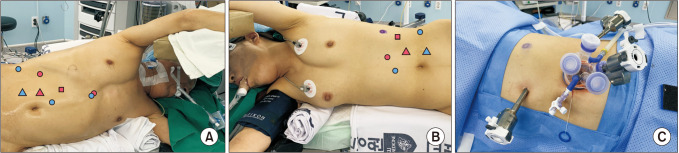
Fig. 2 (A) A photo showing the left lateral decubitus position and port placement for right adrenalectomy, (B) A photo showing the right lateral decubitus position and port placement for left adrenalectomy, (C) A photo showing the camera port replacement through the glove port in robotic adrenalectomy. Blue circles, 8 mm trocars for robotic devices; blue triangle, 8-mm trocar for a robotic camera; red circles, 5-mm trocars for left-handed laparoscopic device and liver-retractor; red triangle, 12-mm trocar for the laparoscopic camera; red square, right-handed laparoscopic device. Written informed consent was obtained from the patients for the publication of clinical images.

Fig. 3 Liver retraction (A) using a robotic device by a surgeon itself in robotic adrenalectomy, (B) using retractor by an assistant in laparoscopic adrenalectomy.
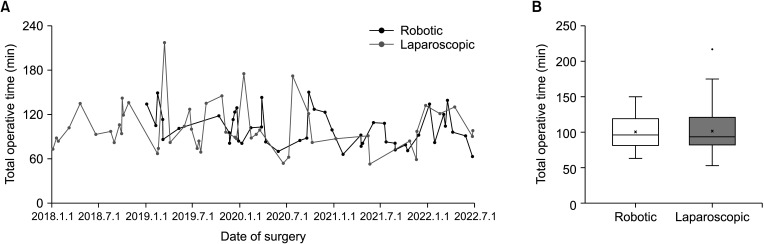
Fig. 4 (A) The duration, (B) average, and standard deviation of total operative time; the mean time of total operative time is not statistically different in both groups (100.6 ± 23.3 minutes vs. 101.9 ± 32.7 minutes, p = 0.827), but the coefficient of variation of time is lower in the robotic group than in the laparoscopic group (0.230 vs. 0.321).
Reference
-
1. Hyams ES, Stifelman MD. The role of robotics for adrenal pathology. Curr Opin Urol. 2009; 19:89–96. PMID: 19057223.
Article2. Brandao LF, Autorino R, Laydner H, Haber GP, Ouzaid I, De Sio M, et al. Robotic versus laparoscopic adrenalectomy: a systematic review and meta-analysis. Eur Urol. 2014; 65:1154–1161. PMID: 24079955.
Article3. Kumar A, Hyams ES, Stifelman MD. Robot-assisted partial adrenalectomy for isolated adrenal metastasis. J Endourol. 2009; 23:651–654. PMID: 19358687.
Article4. You JY, Lee HY, Son GS, Lee JB, Bae JW, Kim HY. Comparison of robotic adrenalectomy with traditional laparoscopic adrenalectomy with a lateral transperitoneal approach: a single-surgeon experience. Int J Med Robot. 2013; 9:345–350. PMID: 23640899.
Article5. Harris DA, Wheeler MH. History of adrenal surgery. Linos D, Heerden JA, editors. Adrenal glands: diagnostic aspects and surgical therapy. Springer Berlin Heidelberg;2005. p. 1–6.6. Lee KE, Rao J, Youn YK. Endoscopic thyroidectomy with the da Vinci robot system using the bilateral axillary breast approach (BABA) technique: our initial experience. Surg Laparosc Endosc Percutan Tech. 2009; 19:e71–e75. PMID: 19542833.7. Yang HK, Suh YS, Lee HJ. Minimally invasive approaches for gastric cancer: Korean experience. J Surg Oncol. 2013; 107:277–281. PMID: 22806494.8. Mendoza AS 3rd, Han HS, Yoon YS, Cho JY, Choi Y. Laparoscopy-assisted pancreaticoduodenectomy as minimally invasive surgery for periampullary tumors: a comparison of short-term clinical outcomes of laparoscopy-assisted pancreaticoduodenectomy and open pancreaticoduodenectomy. J Hepatobiliary Pancreat Sci. 2015; 22:819–824. PMID: 26455716.
Article9. Go H, Takeda M, Takahashi H, Imai T, Tsutsui T, Mizusawa T, et al. Laparoscopic adrenalectomy for primary aldosteronism: a new operative method. J Laparoendosc Surg. 1993; 3:455–459. PMID: 8251659.
Article10. Suzuki K, Kageyama S, Ueda D, Ushiyama T, Kawabe K, Tajima A, et al. Laparoscopic adrenalectomy: clinical experience with 12 cases. J Urol. 1993; 150:1099–1102. PMID: 8371362.
Article11. Higashihara E, Tanaka Y, Horie S, Aruga S, Nutahara K, Minowada S, et al. Laparoscopic adrenalectomy: the initial 3 cases. J Urol. 1993; 149:973–976. PMID: 8483248.
Article12. Cadière GB, Himpens J, Germay O, Izizaw R, Degueldre M, Vandromme J, et al. Feasibility of robotic laparoscopic surgery: 146 cases. World J Surg. 2001; 25:1467–1477. PMID: 11760751.13. Barbash GI, Glied SA. New technology and health care costs: the case of robot-assisted surgery. N Engl J Med. 2010; 363:701–704. PMID: 20818872.
Article14. Piazza L, Caragliano P, Scardilli M, Sgroi AV, Marino G, Giannone G. Laparoscopic robot-assisted right adrenalectomy and left ovariectomy (case reports). Chir Ital. 1999; 51:465–466. PMID: 10742897.15. Horgan S, Vanuno D. Robots in laparoscopic surgery. J Laparoendosc Adv Surg Tech A. 2001; 11:415–419. PMID: 11814134.
Article16. Winter JM, Talamini MA, Stanfield CL, Chang DC, Hundt JD, Dackiw AP, et al. Thirty robotic adrenalectomies: a single institution’s experience. Surg Endosc. 2006; 20:119–124. PMID: 16333534.17. Brunaud L, Ayav A, Zarnegar R, Rouers A, Klein M, Boissel P, et al. Prospective evaluation of 100 robotic-assisted unilateral adrenalectomies. Surgery. 2008; 144:995–1001. PMID: 19041009.
Article18. Giulianotti PC, Buchs NC, Addeo P, Bianco FM, Ayloo SM, Caravaglios G, et al. Robot-assisted adrenalectomy: a technical option for the surgeon? Int J Med Robot. 2011; 7:27–32. PMID: 21341360.
Article19. D’Annibale A, Lucandri G, Monsellato I, De Angelis M, Pernazza G, Alfano G, et al. Robotic adrenalectomy: technical aspects, early results and learning curve. Int J Med Robot. 2012; 8:483–490. PMID: 23081692.
Article20. Aksoy E, Taskin HE, Aliyev S, Mitchell J, Siperstein A, Berber E. Robotic versus laparoscopic adrenalectomy in obese patients. Surg Endosc. 2013; 27:1233–1236. PMID: 23073684.
Article21. Brandao LF, Autorino R, Zargar H, Krishnan J, Laydner H, Akca O, et al. Robot-assisted laparoscopic adrenalectomy: step-by-step technique and comparative outcomes. Eur Urol. 2014; 66:898–905. PMID: 24830625.
Article22. Lee GS, Arghami A, Dy BM, McKenzie TJ, Thompson GB, Richards ML. Robotic single-site adrenalectomy. Surg Endosc. 2016; 30:3351–3356. PMID: 26487220.
Article23. Greilsamer T, Nomine-Criqui C, Thy M, Ullmann T, Zarnegar R, Bresler L, et al. Robotic-assisted unilateral adrenalectomy: risk factors for perioperative complications in 303 consecutive patients. Surg Endosc. 2019; 33:802–810. PMID: 29998394.
Article24. Kim WW, Lee YM, Chung KW, Hong SJ, Sung TY. Comparison of robotic posterior retroperitoneal adrenalectomy over laparoscopic posterior retroperitoneal adrenalectomy: a single tertiary center experience. Int J Endocrinol. 2019; 2019:9012910. PMID: 31885564.
Article25. Ozdemir M, Dural AC, Sahbaz NA, Akarsu C, Uc C, Sertoz B, et al. Robotic transperitoneal adrenalectomy from inception to ingenuity: the perspective on two high volume endocrine surgery centers. Gland Surg. 2020; 9:815–825. PMID: 32775274.
Article26. Fang AM, Rosen J, Saidian A, Bae S, Tanno FY, Chambo JL, et al. Perioperative outcomes of laparoscopic, robotic, and open approaches to pheochromocytoma. J Robot Surg. 2020; 14:849–854. PMID: 32112185.
Article27. Knežević N, Penezić L, Kuliš T, Zekulić T, Saić H, Hudolin T, et al. Senhance robot-assisted adrenalectomy: a case series. Croat Med J. 2022; 63:197–201. PMID: 35505653.
Article28. Erdemir A, Rasa K. Robotic adrenalectomy: an initial experience in a Turkish regional hospital. Front Surg. 2022; 9:847472. PMID: 35846974.
Article
- Full Text Links
-
- Actions
-
Cited
- CITED
-
- Close
- Share
-
- Similar articles
-
- Robotic Adrenalectomy Using a Lateral Transperitoneal Approach: Initial Experience of Fifteen Consecutive Cases
- Laparoscopic Adrenalectomy: A Comparison of Lateral Transperitoneal vs Posterior Retroperitoneal Approach
- Posterior Retroperitoneoscopic Adrenalectomy for Large Adrenal Pheochromocytoma: A Case Report
- A Clinical Review of 11 Cases of a Laparoscopic Adrenalectomy: Comparison with an Open Adrenalectomy
- Initial Experience of Laparoscopic Adrenalectomy with Retroperitoneal Approach


