
Korean J Transplant.
2021 Dec;35(4):230-237. 10.4285/kjt.21.0028.
Enhanced virtual crossmatch in intestinal transplantation: association with outcomes and application in practice

- Affiliations
-
- 1Recanati Miller Transplantation Institute and Department of Surgery, Icahn School of Medicine at Mount Sinai, New York, NY, USA
- 2Department of Pathology, Icahn School of Medicine at Mount Sinai, New York, NY, USA
- KMID: 2523672
- DOI: http://doi.org/10.4285/kjt.21.0028
Abstract
- Background
The presence of preformed donor-specific antibodies in recipient serum against anti-human leukocyte antigen is a significant risk factor that negatively affects the outcomes of intestinal transplantation. Avoiding high-risk intestinal transplantation by physical and virtual cross matches has had limited success due to time constraints and ineffective correlation, respectively.
Methods
We developed a guideline to improve the association between physical and virtual cross matches using the retrospective data of 56 consecutive primary adult isolated intestinal transplantations from a single center.
Results
The mean fluorescence intensity of 2,000 for positive donor-specific antibodies revealed the best association between physical and virtual cross matches among different cut-off values, but with an unacceptable false positive rate of 54%. An enhanced virtual cross match with the summation of the mean fluorescence intensity of each anti-human leukocyte antigen improved the association between physical and virtual cross matches, with a sensitivity of 83% and specificity of 98%.
Conclusions
This enhanced virtual cross match more effectively predicts high-risk intestinal transplantation and is a better substitute for physical cross-match than the current virtual cross match. It also helps to avoid ill-considered abandonment of intestinal transplantation that is unnecessarily deemed high risk based on a simple virtual cross match.
Keyword
Figure
-
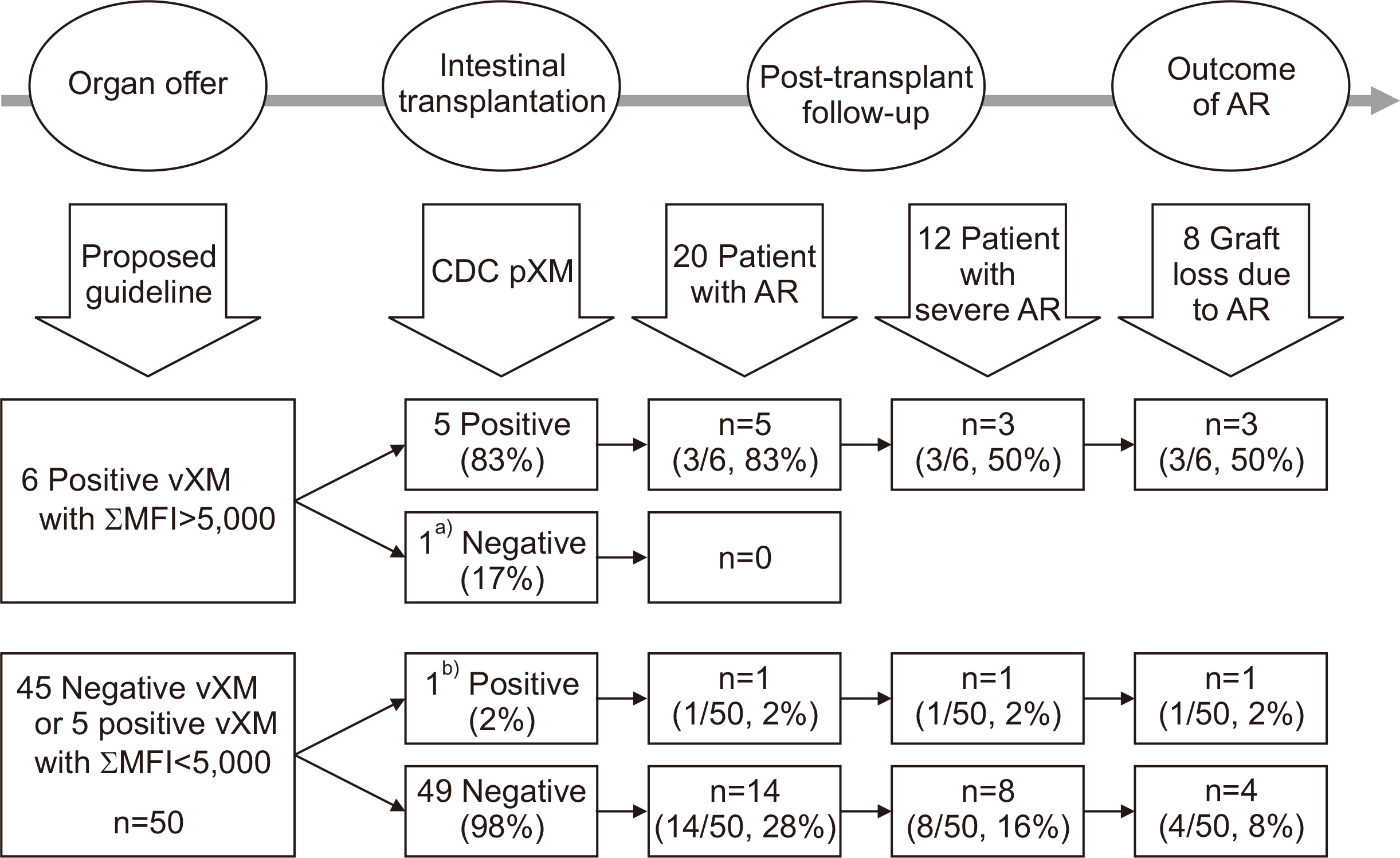
Fig. 1 Post-hoc correlation between proposed guideline using enhanced virtual cross match (vXM) with summation of the mean fluorescence intensity values of each donor-specific antibody (ƩMFI), physical cross-match (pXM), and outcome of intestinal transplantation (ITX). AR, acute rejection; CDC, complement-dependent cytotoxicity; MFI, mean fluorescence intensity. a)Positive xVM with one donor-specific anti-human leukocyte antigen antibody to DR11 (MFI, 14,382) but resulted negative pXM. No episode of AR with good graft function on 6.6 years follow-up; b)Strong auto-Ab due to Lupus. Negative vXM but resulted positive pXM. Developed mild AR 5 month and severe AR 1.5 year after ITX due to non-compliance.
Reference
-
1. Bond G, Reyes J, Mazariegos G, Wu T, Schaefer N, Demetris J, et al. 2000; The impact of positive T-cell lymphocytotoxic crossmatch on intestinal allograft rejection and survival. Transplant Proc. 32:1197–8. DOI: 10.1016/S0041-1345(00)01181-7. PMID: 10995904. PMCID: PMC3005342.
Article2. Abu-Elmagd KM, Costa G, Bond GJ, Soltys K, Sindhi R, Wu T, et al. 2009; Five hundred intestinal and multivisceral transplantations at a single center: major advances with new challenges. Ann Surg. 250:567–81. DOI: 10.1097/SLA.0b013e3181b67725. PMID: 19730240.3. Farmer DG, Venick RS, Colangelo J, Esmailian Y, Yersiz H, Duffy JP, et al. 2010; Pretransplant predictors of survival after intestinal transplantation: analysis of a single-center experience of more than 100 transplants. Transplantation. 90:1574–80. DOI: 10.1097/TP.0b013e31820000a1. PMID: 21107306.
Article4. Tsai HL, Island ER, Chang JW, Gonzalez-Pinto I, Tryphonopoulos P, Nishida S, et al. 2011; Association between donor-specific antibodies and acute rejection and resolution in small bowel and multivisceral transplantation. Transplantation. 92:709–15. DOI: 10.1097/TP.0b013e318229f752. PMID: 21804443.
Article5. Abu-Elmagd KM, Wu G, Costa G, Lunz J, Martin L, Koritsky DA, et al. 2012; Preformed and de novo donor specific antibodies in visceral transplantation: long-term outcome with special reference to the liver. Am J Transplant. 12:3047–60. DOI: 10.1111/j.1600-6143.2012.04237.x. PMID: 22947059.6. Gerlach UA, Lachmann N, Sawitzki B, Arsenic R, Neuhaus P, Schoenemann C, et al. 2014; Clinical relevance of the de novo production of anti-HLA antibodies following intestinal and multivisceral transplantation. Transpl Int. 27:280–9. DOI: 10.1111/tri.12250. PMID: 24279605.7. Kubal C, Mangus R, Saxena R, Lobashevsky A, Higgins N, Fridell J, et al. 2015; Prospective monitoring of donor-specific anti-HLA antibodies after intestine/multivisceral transplantation: significance of de novo antibodies. Transplantation. 99:e49–56. DOI: 10.1097/TP.0000000000000614. PMID: 25769071.8. Cheng EY, Everly MJ, Kaneku H, Banuelos N, Wozniak LJ, Venick RS, et al. 2017; Prevalence and clinical impact of donor-specific alloantibody among intestinal transplant recipients. Transplantation. 101:873–82. DOI: 10.1097/TP.0000000000001391. PMID: 27490417. PMCID: PMC7228620.
Article9. Talayero P, Ramos Boluda E, Gómez Massa E, Castro Panete MJ, Prieto Bozano G, Hernández Oliveros F, et al. 2018; Donor-specific antibodies in pediatric intestinal and multivisceral transplantation: the role of liver and human leukocyte antigen mismatching. Liver Transpl. 24:1726–35. DOI: 10.1002/lt.25323. PMID: 30112820.
Article10. Thenmozhi M, Jeyaseelan V, Jeyaseelan L, Isaac R, Vedantam R. 2019; Survival analysis in longitudinal studies for recurrent events: applications and challenges. Clin Epidemiol Glob Health. 7:253–60. DOI: 10.1016/j.cegh.2019.01.013.
Article11. Twisk JW, Smidt N, de Vente W. 2005; Applied analysis of recurrent events: a practical overview. J Epidemiol Community Health. 59:706–10. DOI: 10.1136/jech.2004.030759. PMID: 16020650. PMCID: PMC1733116.
Article12. Hawksworth JS, Rosen-Bronson S, Island E, Girlanda R, Guerra JF, Valdiconza C, Matsumoto CS, et al. 2012; Successful isolated intestinal transplantation in sensitized recipients with the use of virtual crossmatching. Am J Transplant. 12 Suppl 4:S33–42. DOI: 10.1111/j.1600-6143.2012.04238.x. PMID: 22947089.
Article13. Moon JI, Schiano TD, Iyer KR. 2019; Routine surveillance endoscopy and biopsy after isolated intestinal transplantation-revisiting the gold standard. Clin Transplant. 33:e13684. DOI: 10.1111/ctr.13684. PMID: 31374126.
Article14. Moon JI, Zhang H, Waldron L, Iyer KR. 2020; "Stoma or no stoma": first report of intestinal transplantation without stoma. Am J Transplant. 20:3550–7. DOI: 10.1111/ajt.16065. PMID: 32431016.
Article
- Full Text Links
-
- Actions
-
Cited
- CITED
-
- Close
- Share
-
- Similar articles
-
- Virtual crossmatch versus complement-dependent cytotoxicity crossmatch in deceased kidney paired donations: a single-center experience from India
- A Living Donor Liver Transplantation after Therapeutic Plasmapheresis in a Patient with Positive HLA Crossmatch
- Intestinal and Multivisceral Transplantation
- Motor Learning by Novel Therapeutic Approaches: Virtual Reality and Robotics
- Multivisceral Transplantation


