
Short-Term Walking Outcomes in Diabetic and Non-Diabetic Unilateral Transtibial Amputees

- Affiliations
-
- 1Department of Physical Medicine and Rehabilitation, Yeungnam University College of Medicine, Daegu, Korea.
- 2Shinsegae Prosthesis & Orthosis Center, Korea.
- 3Division of Endocrinology and Metabolism, Department of Internal Medicine, Yeungnam University College of Medicine, Daegu, Korea.
- KMID: 2513020
- DOI: http://doi.org/10.4093/dmj.2019.0080
Abstract
This study compared short-term walking outcomes in diabetic amputees after prosthesis fitting compared to that in non-diabetic amputees. We retrospectively investigated walking outcomes at 3 months after starting gait training with a prosthesis. Forty-four unilateral transtibial amputees with (
n =18) and without diabetes (n =26) were included. At 3 months after gait training with a prosthesis, only 2/18 (11.1%) and 3/18 (16.7%) diabetic amputees were capable of independent outdoor and indoor walking without cane, respectively. However, 21/26 (80.8%) and 24/26 (92.3%) non-diabetic amputees were capable of independent outdoor and indoor walking without cane, respectively. With assistance of cane, most of non-diabetic amputees (n =24, 92.3%) were capable of walking in both outdoor and indoor but only seven (38.9%) and nine (50.0%) diabetic amputees were capable, respectively. Thus, short-term walking outcome were poor in transtibial amputee with diabetes compare to those without diabetes, and these results suggest intensive rehabilitation would be needed to them.
Keyword
Figure
-
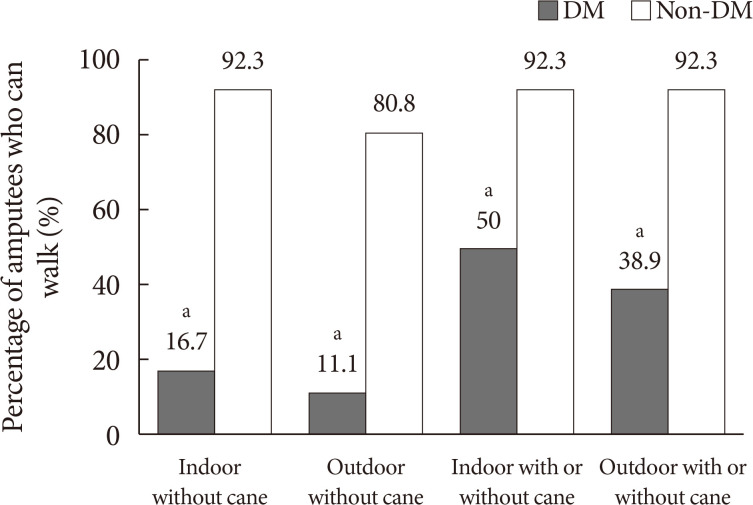
Fig. 1 Walking outcomes with and without a cane in diabetic and non-diabetic amputees. Indoor/outdoor included walking outcome with and without cane. DM, diabetes mellitus. aSignificantly different between the diabetic and non-diabetic amputees, P<0.001.
Reference
-
1. Collin C, Wade DT, Cochrane GM. Functional outcome of lower limb amputees with peripheral vascular disease. Clin Rehabil. 1992; 6:13–21.
Article2. Pohjolainen T, Alaranta H. Predictive factors of functional ability after lower-limb amputation. Ann Chir Gynaecol. 1991; 80:36–39. PMID: 1888111.3. Putting feet first in diabetes. Lancet. 2005; 366:1674.4. Grodstein F, Chen J, Wilson RS, Manson JE. Nurses' Health Study. Type 2 diabetes and cognitive function in community-dwelling elderly women. Diabetes Care. 2001; 24:1060–1065. PMID: 11375371.
Article5. Sinclair AJ, Girling AJ, Bayer AJ. Cognitive dysfunction in older subjects with diabetes mellitus: impact on diabetes self-management and use of care services. All Wales Research into Elderly (AWARE) Study. Diabetes Res Clin Pract. 2000; 50:203–212. PMID: 11106835.6. Hamamura S, Chin T, Kuroda R, Akisue T, Iguchi T, Kohno H, Kitagawa A, Tsumura N, Kurosaka M. Factors affecting prosthetic rehabilitation outcomes in amputees of age 60 years and over. J Int Med Res. 2009; 37:1921–1927. PMID: 20146892.
Article7. Nehler MR, Coll JR, Hiatt WR, Regensteiner JG, Schnickel GT, Klenke WA, Strecker PK, Anderson MW, Jones DN, Whitehill TA, Moskowitz S, Krupski WC. Functional outcome in a contemporary series of major lower extremity amputations. J Vasc Surg. 2003; 38:7–14. PMID: 12844082.
Article8. Roberts TL, Pasquina PF, Nelson VS, Flood KM, Bryant PR, Huang ME. Limb deficiency and prosthetic management. 4. Comorbidities associated with limb loss. Arch Phys Med Rehabil. 2006; 87(3 Suppl 1):S21–S27. PMID: 16500190.
Article9. Webster JB, Hakimi KN, Williams RM, Turner AP, Norvell DC, Czerniecki JM. Prosthetic fitting, use, and satisfaction following lower-limb amputation: a prospective study. J Rehabil Res Dev. 2012; 49:1493–1504. PMID: 23516053.
Article10. IJzerman TH, Schaper NC, Melai T, Meijer K, Willems PJ, Savelberg HH. Lower extremity muscle strength is reduced in people with type 2 diabetes, with and without polyneuropathy, and is associated with impaired mobility and reduced quality of life. Diabetes Res Clin Pract. 2012; 95:345–351. PMID: 22104262.
Article11. Kalyani RR, Tra Y, Yeh HC, Egan JM, Ferrucci L, Brancati FL. Quadriceps strength, quadriceps power, and gait speed in older U.S. adults with diabetes mellitus: results from the National Health and Nutrition Examination Survey, 1999-2002. J Am Geriatr Soc. 2013; 61:769–775. PMID: 23617584.
Article12. Perry J, Schoneberger B. Chapter 4, Ankle foot complex. Gait analysis: normal and pathological function. Thorofare: Slack;1992. p. 51–87.13. Raya MA, Gailey RS, Fiebert IM, Roach KE. Impairment variables predicting activity limitation in individuals with lower limb amputation. Prosthet Orthot Int. 2010; 34:73–84. PMID: 20196689.
Article14. Menz HB, Lord SR, St George R, Fitzpatrick RC. Walking stability and sensorimotor function in older people with diabetic peripheral neuropathy. Arch Phys Med Rehabil. 2004; 85:245–252. PMID: 14966709.
Article15. Emam AA, Gad AM, Ahmed MM, Assal HS, Mousa SG. Quantitative assessment of posture stability using computerised dynamic posturography in type 2 diabetic patients with neuropathy and its relation to glycaemic control. Singapore Med J. 2009; 50:614–618. PMID: 19551316.16. Holt RI, de Groot M, Golden SH. Diabetes and depression. Curr Diab Rep. 2014; 14:491. PMID: 24743941.
Article17. Schoppen T, Boonstra A, Groothoff JW, de Vries J, Goeken LN, Eisma WH. Physical, mental, and social predictors of functional outcome in unilateral lower-limb amputees. Arch Phys Med Rehabil. 2003; 84:803–811. PMID: 12808530.18. Houghton AD, Taylor PR, Thurlow S, Rootes E, McColl I. Success rates for rehabilitation of vascular amputees: implications for preoperative assessment and amputation level. Br J Surg. 1992; 79:753–755. PMID: 1393461.
Article19. Munin MC, Espejo-De Guzman MC, Boninger ML, Fitzgerald SG, Penrod LE, Singh J. Predictive factors for successful early prosthetic ambulation among lower-limb amputees. J Rehabil Res Dev. 2001; 38:379–384. PMID: 11563490.20. Evans KK, Attinger CE, Al-Attar A, Salgado C, Chu CK, Mardini S, Neville R. The importance of limb preservation in the diabetic population. J Diabetes Complications. 2011; 25:227–231. PMID: 21447444.
Article21. Miller PD. Chronic kidney disease and osteoporosis: evaluation and management. Bonekey Rep. 2014; 3:542. PMID: 24991405.
- Full Text Links
-
- Actions
-
Cited
- CITED
-
- Close
- Share
-
- Similar articles
-
- Comparison between the Barefeet Gait and the Shoe Gaitin the Transtibial Amputees
- Gait Analysis of Unilateral Transfemoral Amputees with Prosthetics on an Inclined Surface
- Orthotic and Prosthetic Options after Diabetic Foot Amputation
- Differences in Gait Patterns of Unilateral Transtibial Amputees With Two Types of Energy Storing Prosthetic Feet
- Total Surface Bearing Socket for a Transtibial Prosthesis: Preference, Satisfaction, and Clinical Implications


