
Investig Magn Reson Imaging.
2020 Mar;24(1):30-37. 10.13104/imri.2020.24.1.30.
MRI Findings to Predict Neurodevelopmental Outcomes in Preterm Infants Near Term-Equivalent Age
- Affiliations
-
- 1Department of Radiology, Soonchunhyang University Bucheon Hospital, Soonchunhyang University College of Medicine, Bucheon, Korea
- 2Department of Pediatrics, Soonchunhyang University Bucheon Hospital, Soonchunhyang University College of Medicine, Bucheon, Korea
- KMID: 2508215
- DOI: http://doi.org/10.13104/imri.2020.24.1.30
Abstract
- Purpose
Preterm infants are at high risk for adverse neurodevelopmental outcomes. Magnetic resonance imaging (MRI) has been proposed as a means of predicting neurodevelopmental outcomes in this population. It is controversial whether diffuse excessive high signal intensity (DEHSI) represents damage to the white matter or delayed myelination in preterm infants. This study investigated MRI findings for predicting the severity of neurodevelopmental outcomes and assessing whether preterm infants with DEHSI near term-equivalent age have abnormal neurodevelopmental outcomes.
Materials and Methods
Preterm infants (n = 64, gestational age at birth < 35 weeks) undergoing brain MRI near term-equivalent age and subsequent neurodevelopmental outcomes were evaluated between 18 and 24 months of age. The associations of MRI findings and the risk of severe cognitive delay, severe psychomotor delay, cerebral palsy (CP), and neurosensory impairment were analyzed. The associations of DEHSI with risks of severe cognitive delay, severe psychomotor delay, CP, and neurosensory impairment (hearing or visual impairment) were analyzed. Outcome data were evaluated by logistic regression and the Fisher’s exact test.
Results
There were significant associations between abnormal white matter findings and delayed mental development, delayed psychomotor development, neurosensory impairment, and presence of CP. The presence of DEHSI was not correlated with delayed neurodevelopmental outcomes or presence of CP. In multivariate logistic regression analyses, cystic encephalomalacia, punctate lesion, loss of white matter volume and ventricular dilation were significantly associated with CP.
Conclusion
Abnormal MRI findings near term-equivalent age in preterm infants predict adverse neurodevelopmental outcomes. No significant association between DEHSI and adverse neurodevelopmental outcomes was demonstrated.
Keyword
Figure
-

Fig. 1. Axial FLAIR (a) and (b) ADC map showing DEHSI at the level of the centrum semiovale. This male infant was born at 30+5 weeks with a birth weight of 1250 g. MRI was performed at gestational age of 36+2 weeks. He showed accelerated mental development index and psychomotor motor index.
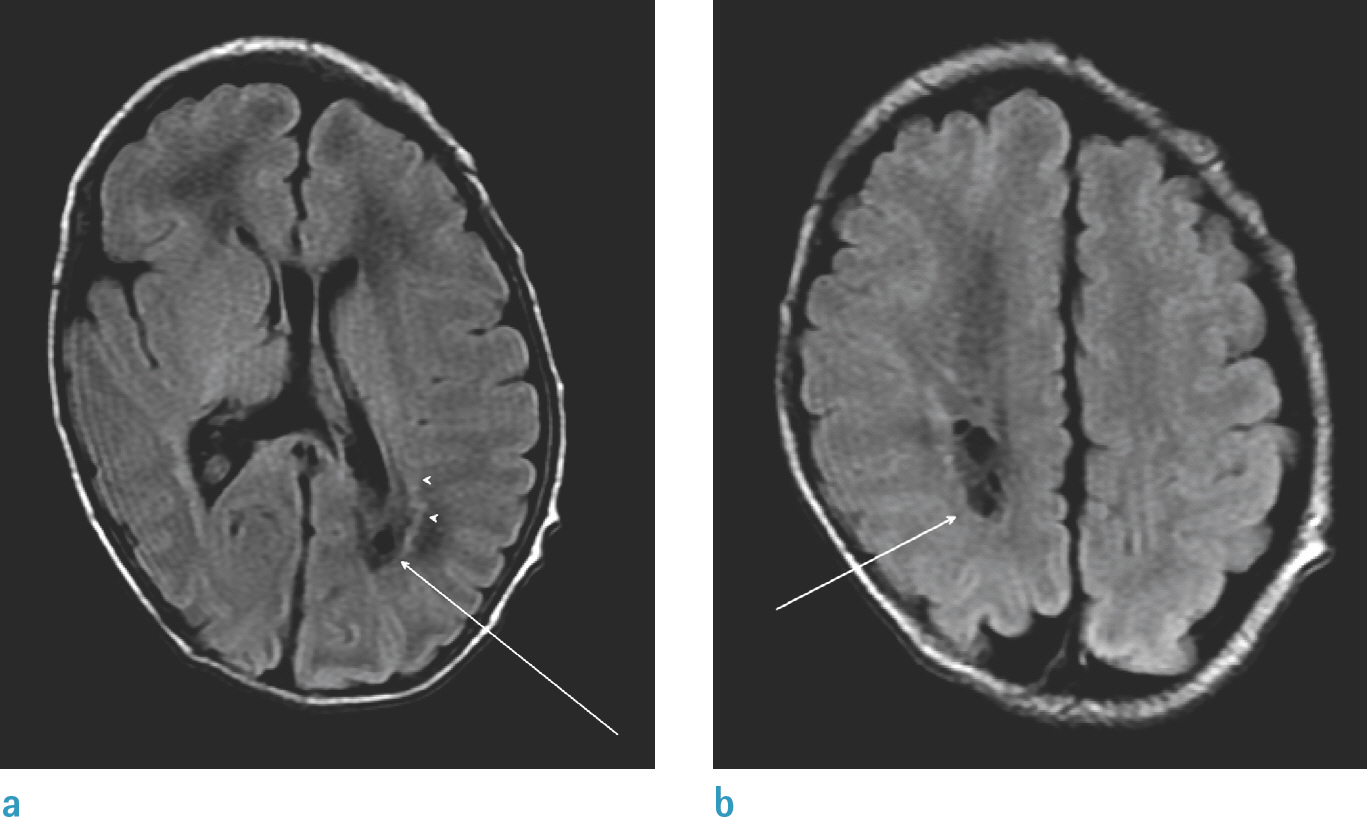
Fig. 2. (a, b) Cystic encephalomalacia (arrows) and punctate lesions (arrowheads) were seen in the parietal white matter. This male infant was born at 30+6 weeks with birth weight of 1620 g. MRI was performed at 38+2 weeks. He had PDA clipping. He showed delayed mental and psychomotor index at 2 years.
Reference
-
1.Inder TE., Warfield SK., Wang H., Huppi PS., Volpe JJ. Abnormal cerebral structure is present at term in premature infants. Pediatrics. 2005. 115:286–294.
Article2.Hoekstra RE., Ferrara TB., Couser RJ., Payne NR., Connett JE. Survival and long-term neurodevelopmental outcome of extremely premature infants born at 23-26 weeks’ gestational age at a tertiary center. Pediatrics. 2004. 113:e1–6.
Article3.Wilson-Costello D., Friedman H., Minich N., Fanaroff AA., Hack M. Improved survival rates with increased neurodevelopmental disability for extremely low birth weight infants in the 1990s. Pediatrics. 2005. 115:997–1003.
Article4.Stewart AL., Rifkin L., Amess PN, et al. Brain structure and neurocognitive and behavioural function in adolescents who were born very preterm. Lancet. 1999. 353:1653–1657.
Article5.Saigal S., Doyle LW. An overview of mortality and sequelae of preterm birth from infancy to adulthood. Lancet. 2008. 371:261–269.
Article6.Wood NS., Marlow N., Costeloe K., Gibson AT., Wilkinson AR. Neurologic and developmental disability after extremely preterm birth. EPICure Study Group. N Engl J Med. 2000. 343:378–384.7.Horsch S., Hallberg B., Leifsdottir K, et al. Brain abnormalities in extremely low gestational age infants: a Swedish population based MRI study. Acta Paediatr. 2007. 96:979–984.
Article8.Horbar JD., Badger GJ., Carpenter JH, et al. Trends in mortality and morbidity for very low birth weight infants, 1991-1999. Pediatrics. 2002. 110:143–151.
Article9.Dyet LE., Kennea N., Counsell SJ, et al. Natural history of brain lesions in extremely preterm infants studied with serial magnetic resonance imaging from birth and neurodevelopmental assessment. Pediatrics. 2006. 118:536.
Article10.Inder TE., Wells SJ., Mogridge NB., Spencer C., Volpe JJ. Defining the nature of the cerebral abnormalities in the premature infant: a qualitative magnetic resonance imaging study. J Pediatr. 2003. 143:171–179.
Article11.Woodward LJ., Anderson PJ., Austin NC., Howard K., Inder TE. Neonatal MRI to predict neurodevelopmental outcomes in preterm infants. N Engl J Med. 2006. 355:685–694.
Article12.Hart AR., Whitby EW., Griffiths PD., Smith MF. Magnetic resonance imaging and developmental outcome following preterm birth: review of current evidence. Dev Med Child Neurol. 2008. 50:655–663.
Article13.Marlow N., Wolke D., Bracewell MA., Samara M. EPICure Study Group. Neurologic and developmental disability at six years of age after extremely preterm birth. N Engl J Med. 2005. 352:9–19.
Article14.Taylor HG., Klein N., Minich NM., Hack M. Middle-school-age outcomes in children with very low birthweight. Child Dev. 2000. 71:1495–1511.
Article15.Maalouf EF., Duggan PJ., Rutherford MA, et al. Magnetic resonance imaging of the brain in a cohort of extremely preterm infants. J Pediatr. 1999. 135:351–357.
Article16.Skiold B., Horsch S., Hallberg B, et al. White matter changes in extremely preterm infants, a population-based diffusion tensor imaging study. Acta Paediatr. 2010. 99:842–849.17.Inder TE., Anderson NJ., Spencer C., Wells S., Volpe JJ. White matter injury in the premature infant: a comparison between serial cranial sonographic and MR findings at term. AJNR Am J Neuroradiol. 2003. 24:805–809.18.Volpe JJ. Cerebral white matter injury of the premature infant-more common than you think. Pediatrics. 2003. 112:176–180.
Article19.Back SA., Riddle A., McClure MM. Maturation-dependent vulnerability of perinatal white matter in premature birth. Stroke. 2007. 38:724–730.
Article20.Gilles FH., Gomez IG. Developmental neuropathology of the second half of gestation. Early Hum Dev. 2005. 81:245–253.
Article21.Hart A., Whitby E., Wilkinson S., Alladi S., Paley M., Smith M. Neuro-developmental outcome at 18 months in premature infants with diffuse excessive high signal intensity on MR imaging of the brain. Pediatr Radiol. 2011. 41:1284–1292.22.Jeon TY., Kim JH., Yoo SY, et al. Neurodevelopmental outcomes in preterm infants: comparison of infants with and without diffuse excessive high signal intensity on MR images at near-term-equivalent age. Radiology. 2012. 263:518–526.
Article23.Park HW., Cho BH. Korean Bayley scales of infant development: interpretation manual. 2nd ed.Seoul: Kidspop Publishing Co.;2006.24.Stephens BE., Vohr BR. Neurodevelopmental outcome of the premature infant. Pediatr Clin North Am. 2009. 56:631–646.
Article25.Evensen KA., Skranes J., Brubakk AM., Vik T. Predictive value of early motor evaluation in preterm very low birth weight and term small for gestational age children. Early Hum Dev. 2009. 85:511–518.
Article26.Aylward GP. Cognitive and neuropsychological outcomes: more than IQ scores. Ment Retard Dev Disabil Res Rev. 2002. 8:234–240.
Article27.Mirmiran M., Barnes PD., Keller K, et al. Neonatal brain magnetic resonance imaging before discharge is better than serial cranial ultrasound in predicting cerebral palsy in very low birth weight preterm infants. Pediatrics. 2004. 114:992–998.
Article28.Roelants-van Rijn AM., Groenendaal F., Beek FJ., Eken P., van Haastert IC., de Vries LS. Parenchymal brain injury in the preterm infant: comparison of cranial ultrasound, MRI and neurodevelopmental outcome. Neuropediatrics. 2001. 32:80–89.
Article29.Valkama AM., Paakko EL., Vainionpaa LK., Lanning FP., Ilkko EA., Koivisto ME. Magnetic resonance imaging at term and neuromotor outcome in preterm infants. Acta Paediatr. 2000. 89:348–355.
Article30.Schouman-Claeys E., Henry-Feugeas MC., Roset F, et al. Periventricular leukomalacia: correlation between MR imaging and autopsy findings during the first 2 months of life. Radiology. 1993. 189:59–64.
Article31.Garel C., Delezoide AL., Elmaleh-Berges M, et al. Contribution of fetal MR imaging in the evaluation of cerebral ischemic lesions. AJNR Am J Neuroradiol. 2004. 25:1563–1568.32.Roelants-van Rijn AM., Nikkels PG., Groenendaal F, et al. Neonatal diffusion-weighted MR imaging: relation with histopathology or follow-up MR examination. Neuropediatrics. 2001. 32:286–294.
Article33.Volpe JJ. Neurology of the newborn. 4th ed.Philadelphia, PA: WB Saunders;2001.34.Counsell SJ., Shen Y., Boardman JP, et al. Axial and radial diffusivity in preterm infants who have diffuse white matter changes on magnetic resonance imaging at term-equivalent age. Pediatrics. 2006. 117:376–386.
Article35.Hagmann CF., De Vita E., Bainbridge A, et al. T2 at MR imaging is an objective quantitative measure of cerebral white matter signal intensity abnormality in preterm infants at term-equivalent age. Radiology. 2009. 252:209–217.
Article36.Hack M., Taylor HG., Drotar D, et al. Poor predictive validity of the Bayley Scales of Infant Development for cognitive function of extremely low birth weight children at school age. Pediatrics. 2005. 116:333–341.
Article
- Full Text Links
-
- Actions
-
Cited
- CITED
-
- Close
- Share
-
- Similar articles
-
- Neurodevelopmental outcomes of preterm infants
- Neurodevelopmental Outcomes and Brain Volumetric Analysis of Low-Grade Intraventricular Hemorrhage
- Neurodevelopmental Outcomes of VLBW Infants with Diffuse Excessive High Signal Intensity (DEHSI) in the White Matter of the Brain MR Imaging around a Near Term-equivalent Age
- Neurodevelopmental Outcomes of Extremely Preterm Infants
- Case Series of Isolated Deep Gray Matter Injuries in Preterm Infants


