
J Korean Acad Psychiatr Ment Health Nurs.
2018 Mar;27(1):64-73. 10.12934/jkpmhn.2018.27.1.64.
Mediating Effect of Adult Attachment on Eating Psychopathology and Depression in Patients with Eating Disorders

- Affiliations
-
- 1Mind & Mind Eating Disorder Clinic, Seoul, Korea.
- 2School of Nursing, Soonchunhyang University, Cheonan, Korea. kongsun@sch.ac.kr
- KMID: 2408064
- DOI: http://doi.org/10.12934/jkpmhn.2018.27.1.64
Abstract
- PURPOSE
The purpose of this study was to investigate the mediating effect of adult attachment in the relationship between eating psychopathology and depression among patients with eating disorders.
METHODS
Patients (N=146) who visited a clinic for eating disorders participated in the study. Data were collected from December 2017 to February 2018 using the Eating Disorder Inventory (EDI-2), Revised Adult Attachment Scale (RAAS), and Beck Depression Inventory (BDI-II).
RESULTS
The subjects showed high scores on eating psychopathology (drive for thinness 15.02±5.11, bulimia 11.77±5.27, and body dissatisfaction 14.16±7.82), adult attachment (attachment avoidance 37.31±6.18 and attachment anxiety 16.63±5.38), and depression (24.26±10.81), and 65.1% of the participants showed above a moderate level of depression. There were significant correlations among eating psychopathology, adult attachment, and depression. We also found that adult attachment fully mediated the association between eating psychopathology and depression.
CONCLUSION
Future interventions for patients with eating disorders who have experienced insecure attachment with their primary caregiver should focus on forming a therapeutic relationship with the therapist. In addition, family therapy might contribute to lowering attachment insecurities and depression by recovering the attachment between the patients and their parents.
Keyword
MeSH Terms
Figure
-
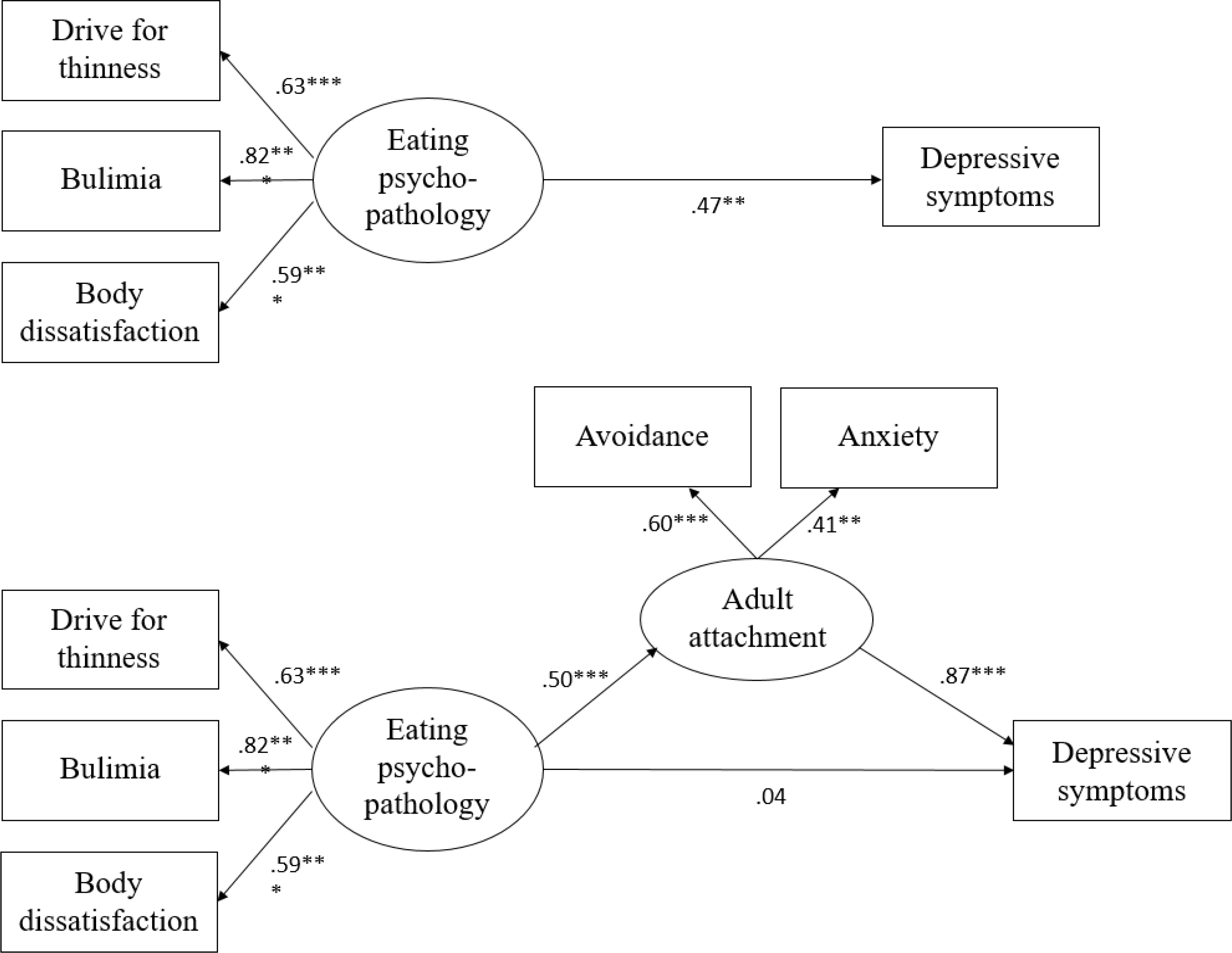
Figure 1. Mediation Model of adult attachment on eating psychopathology and depressive symptoms.
Reference
-
1. Tasca GA, Szadkowski L, Illing V, Trinneer A, Grenon R, De-midenko N, et al. Adult attachment, depression, and eating disorder symptoms: the mediating role of affect regulation strategies. Personality and Individual Difference. 2009; 47(6):662–667. https://doi.org/10.1016/j.paid.2009.06.006.
Article2. Paxton SJ, Neumark-Sztainer D, Hannan PJ, Eisenberg ME. Body dissatisfaction prospectively predicts depressed mood and low self-esteem in adolescent girls and boys. Journal of Clinical Child and Adolescent Psychology. 2006; 35(4):539–549. https://doi.org/10.1207/s15374424jccp3504_5.3. Rozenblat V, Ryan J, Wertheim EH, King R, Olsson CA, Krug I. Investigating direct links between depression, emotional control, and physical punishment with adolescent drive for thinness and bulimic behaviors, including possible moderation by the serotonin transporter 5-HTTLPR polymorphism. Frontiers in Psychology. 2017; 8:1361. https://doi.org/10.3389/fpsyg.2017.01361.
Article4. Sloan E, Hall K, Moulding R, Bryce S, Mildred H, Staiger PK. Emotion regulation as a transdiagnostic treatment construct across anxiety, depression, substance, eating and borderline personality disorders: a systematic review. Clinical Psychology Review. 2017; 57:141–163. https://doi.org/10.1016/j.cpr.2017.09.002.
Article5. Wilson GT, Fairburn CG, Agras WS. Cognitive-behavioral therapy for bulimia nervosa. New York: Guilford Press;1997. p. 528. (Garner DM, Garfinkel PE, editors. Handbook of treatment for eating disorders).6. Collins NL, Read SJ. Adult attachment, working models, and relationship quality in dating couples. Journal of Personality and Social Psychology. 1990; 58(4):644–663. https://doi.org/10.1037/0022-3514.58.4.644.
Article7. Brennan KA, Clark CL, Shaver PR. Self-report measurement of adult attachment: an integrative overview. New York: Guilford Press;1998. p. 438. (Simpson JA, Rholes WA, editors. Attachment theory and close relationships).8. Monteleone AM, Cardi V, Volpe U, Fico G, Ruzzi V, Pellegrino F, et al. Attachment and motivational systems: relevance of sensitivity to punishment for eating disorder psychopathology. Psychiatry Research. 2017; 260:353–359. https://doi.org/10.1016/j.psychres.2017.12.002.
Article9. Shaver PR, Mikulincer M. Attachment-related psychodynamics: another shake to the kaleidoscope. Attachment and Human Development. 2002; 4(2):133–161. https://doi.org/10.1080/14616730210154162.10. Steiger H, Bruce KR. Phenotypes, endophenotypes, and genotypes in bulimia spectrum eating disorders. Canadian Journal of Psychiatry. 2007; 52(4):220–227. https://doi.org/10.1177/070674370705200403.
Article11. Ciechanowski PS, Russo JE, Katon WJ, Walker EA. Attachment theory in health care: the influence of relationship style on medical students' specialty choice. Medical Education. 2004; 38(3):262–270. https://doi.org/10.1046/j.1365-2923.2004.01767.x.
Article12. Mikulincer M, Shaver PR. Attachment in adulthood: structure, dynamics, and change. 2nd ed.New York: Guilford Press;2017. p. 690.13. Tasca GA, Kowal J, Balfour L, Ritchie K, Virley B, Bissada H. An attachment insecurity model of negative affect among women seeking treatment for an eating disorder. Eating Behaviors. 2006; 7(3):252–257. https://doi.org/10.1016/j.eatbeh.2005.09.004.
Article14. American Psychiatric Association. Diagnostic and statistical manual of mental disorders. 5th ed.Washington, DC: Author;2013. p. 991.15. Garner DM. Eating Disorders Inventory 2: professional manual. Odessa, Fla: Psychological Assessment Resources;1991.16. Kim CM, Park JM, Kim SG, Kim MJ, Kang CJ, Kim JH. Factor structure of the Korean Version of Eating Disorder Inventory. The Korean Journal of Psychopathology. 2005; 14(1):11–20.17. Kim EJ, Kwon JH. Interpersonal characteristics related with depressive symptoms: focused in adult attachment. Korean Journal of Clinical Psychology. 1998; 17(1):139–153.18. Beck AT, Steer RA, Brown GK. BDI-II, Beck depression inventory: manual. 2nd ed.San Antonio, TX: The Psychological Corporation;1996.19. Kim MS, Lee IS, Lee CS. The validation study I of Korean BDI-II: in female university students sample. Korean Journal of Clinical Psychology. 2007; 26(4):997–1014. https://doi.org/10.15842/kjcp.2007.26.4.011.20. Dakanalis A, Timko CA, Zanetti MA, Rinaldi L, Prunas A, Carrà G, et al. Attachment insecurities, maladaptive perfectionism, and eating disorder symptoms: a latent mediated and moderated structural equation modeling analysis across diagnostic groups. Psychiatry Research. 2014; 215(1):176–184. https://doi.org/10.1016/j.psychres.2013.10.039.
Article21. Kong S, Bernstein K. Childhood trauma as a predictor of eating psychopathology and its mediating variables in patients with eating disorders. Journal of Clinical Nursing. 2009; 18(13):1897–1907. https://doi.org/10.1111/j.1365-2702.2008.02740.x.
Article22. Pepping CA, O'Donovan A, Zimmer-Gembeck MJ, Hanisch M. Individual differences in attachment and eating pathology: the mediating role of mindfulness. Personality and Individual Differences. 2015; 75:24–29. https://doi.org/10.1016/j.paid.2014.10.040.
Article23. Tasca GA, Taylor D, Ritchie K, Balfour L. Attachment predicts treatment completion in an eating disorders partial hospital program among women with anorexia nervosa. Journal of Personality Assessment. 2004; 83(3):201–212. https://doi.org/10.1207/s15327752jpa8303_04.
Article24. Shakory S, Van Exan J, Mills JS, Sockalingam S, Keating L, Taube-Schiff M. Binge eating in bariatric surgery candidates: the role of insecure attachment and emotion regulation. Appetite. 2015; 91:69–75. https://doi.org/10.1016/j.appet.2015.03.026.
Article25. Shanmugam V, Jowett S, Meyer C. Eating psychopathology amongst athletes: links to current attachment styles. Eating Behaviors. 2012; 13(1):5–12. https://doi.org/10.1016/j.eatbeh.2011.09.004.
Article26. Eggert J, Levendosky A, Klump K. Relationships among attachment styles, personality characteristics, and disordered eating. The International Journal of Eating Disorders. 2007; 40(2):149–155. https://doi.org/10.1002/eat.20351.
Article27. Jeong YJ. The effects of family relationships on successful aging according to the attachment style of the elderly. Journal of the Korean Gerontological Society. 2012; 32(3):869–893.28. Ural C, Belli H, Akbudak M, Solmaz A, Bektas ZD, Celebi F. Relation of binge eating disorder with impulsiveness in obese individuals. World Journal of Psychiatry. 2017; 7(2):114–120. https://doi.org/10.5498/wjp.v7.i2.114.
Article29. Hilbert A, Tuschen-Caffier B. Maintenance of binge eating through negative mood: a naturalistic comparison of binge eating disorder and bulimia nervosa. The International Journal of Eating Disorders. 2007; 40:521–530.
Article30. Lev-Ari L, Baumgarten-Katz I, Zohar AH. Show me your friends, and I shall show you who you are: the way attachment and social comparisons influence body dissatisfaction. European Eating Disorders Review. 2014; 22(6):463–469. https://doi.org/10.1002/erv.2325.
Article
- Full Text Links
-
- Actions
-
Cited
- CITED
-
- Close
- Share
-
- Similar articles
-
- Impact of Eating Psychopathology, Obsessive-Compulsion and Depression on Self-Harm Behavior in Patients with Eating Disorders
- Factors associated with Alcohol Problem in Patients with Eating Disorders
- Relation between depression and dietary practice among middle-aged women: mediating effect of emotional eating
- Clinical Characteristics of Korean Male Patients with Eating Disorders
- Impact of Body Mass Index on Eating Disorders in Adolescents with Type 1 Diabetes: Focusing on Mediating Effect of Body Dissatisfaction, Self-esteem, and Depression


