
Intraosseous anesthesia using a computer-controlled system during non-surgical periodontal therapy (root planing): Two case reports

- Affiliations
-
- 1Department of Periodontology, Sejong Dental Hospital, School of Dentistry, Dankook University, Sejong, Korea.
- 2Department of Pediatric Dentistry, School of Dentistry, Dankook University, Cheonan, Korea. jbkim0222@dankook.ac.kr
- KMID: 2405385
- DOI: http://doi.org/10.17245/jdapm.2018.18.1.65
Abstract
- Local anesthesia is administered to control pain, but it may induce fear and anxiety. Root planing is a non-surgical periodontal therapy; however, when it is performed in an extensive manner, some tissue removal is inevitable. Notably, this removal may be so painful that local anesthesia is required to be administered to the area scheduled for the treatment. Although patients tend to accept root planing easily, they frequently express a fear of local anesthesia. Intraosseous anesthesia (IA) is an intraosseous injection technique, whereby local anesthetic is injected into the cancellous bone supporting the teeth. A computer-controlled IA system (CIAS) exhibits multiple benefits, such as less painful anesthesia, reduced soft tissue numbness, and the provision of palatal or lingual, as well as buccal, anesthesia via single needle penetration. In this report, we present two cases of root planing that were performed under local anesthesia, using a CIAS.
Figure
-
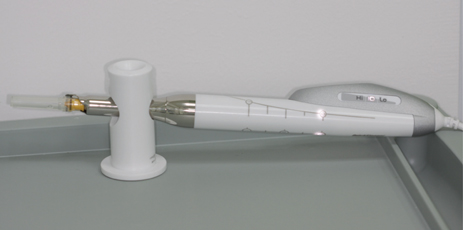
Fig. 1 Computer-controlled anesthetic system (Quicksleeper5®).

Fig. 2 Intraosseous anesthesia administration in the left mandibular area: (A) panoramic view, (B) infiltration, and (C) intraosseous injection.
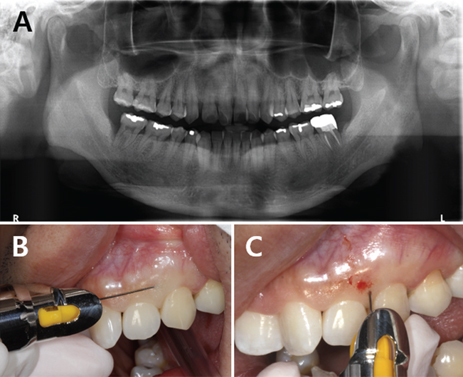
Fig. 3 Intraosseous anesthesia administration in the left maxillary area: (A) panoramic view, (B) infiltration, and (C) intraosseous injection.
Cited by 2 articles
-
Alternative practices of achieving anaesthesia for dental procedures: a review
Zavattini Angelo, Charalambous Polyvios
J Dent Anesth Pain Med. 2018;18(2):79-88. doi: 10.17245/jdapm.2018.18.2.79.Inferior alveolar nerve block by intraosseous injection with Quicksleeper® at the retromolar area in mandibular third molar surgery
Sam Sovatdy, Chakorn Vorakulpipat, Sirichai Kiattavorncharoen, Chavengkiat Saengsirinavin, Natthamet Wongsirichat
J Dent Anesth Pain Med. 2018;18(6):339-347. doi: 10.17245/jdapm.2018.18.6.339.
Reference
-
1. Kleinknecht RA, Klepac RK, Alexander LD. Origins and characteristics of fear of dentistry. J Am Dent Assoc. 1973; 86:842–848.
Article2. Malamed SF. Handbook of local anesthesia-e-book. 6th ed. Amsterdam: Elsevier Health Sciences;2014. p. 131.3. Newman MG, Takei H, Klokkevold PR, Carranza FA. Carranza's clinical periodontology. 11th ed. Amsterdam: Elsevier health sciences;2011. p. 473.4. Saloum FS, Baumgartner JC, Marshall G, Tinkle J. A clinical comparison of pain perception to the wand and a traditional syringe. Oral Surg Oral Med Oral Pathol Oral Radiol Endod. 2000; 89:691–695.
Article5. Feda M, Al Amoudi N, Sharaf A, Hanno A, Farsi N, Masoud I, et al. A comparative study of children's pain reactions and perceptions to amsa injection using CCLAD versus traditional injections. J Clin Pediatr Dent. 2010; 34:217–222.
Article6. Özer S, Yaltirik M, Kirli I, Yargic I. A comparative evaluation of pain and anxiety levels in 2 different anesthesia techniques: Locoregional anesthesia using conventional syringe versus intraosseous anesthesia using a computer-controlled system (quicksleeper). Oral Surg Oral Med Oral Pathol Oral Radiol. 2012; 114:S132–S139.
Article7. Beneito-Brotons R, Peñarrocha-Oltra D, Ata-Ali J, Peñarrocha M. Intraosseous anesthesia with solution injection controlled by a computerized system versus conventional oral anesthesia: A preliminary study. Med Oral Patol Oral Cir Bucal. 2012; 17:e426–e429.
Article8. Rosenberg ES. A computer-controlled anesthetic delivery system in a periodontal practice: Patient satisfaction and acceptance. J Esthet Restor Dent. 2002; 14:39–46.
Article9. Dickinson C, Fiske J. A review of gagging problems in dentistry: 1. Aetiology and classification. Dent Update. 2005; 32:26–28. 31–32.
Article10. Hawker GA, Mian S, Kendzerska T, French M. Measures of adult pain: Visual analog scale for pain (VAS pain), numeric rating scale for pain (NRS pain), McGill pain questionnaire (MPQ), short-form McGill pain questionnaire (SF-MPQ), chronic pain grade scale (CPGS), short form-36 bodily pain scale (SF-36 BPS), and measure of intermittent and constant osteoarthritis pain (ICOAP). Arthritis Care Res (Hoboken). 2011; 63:S240–S252.11. Coggins R, Reader A, Nist R, Beck M, Meyers WJ. Anesthetic efficacy of the intraosseous injection in maxillary and mandibular teeth. Oral Surg Oral Med Oral Pathol Oral Radiol Endod. 1996; 81:634–641.
Article12. Chi D, Kanellis M, Himadi E, Asselin ME. Lip biting in a pediatric dental patient after dental local anesthesia: a case report. J Pediatr Nurs. 2008; 23:490–493.
Article
- Full Text Links
-
- Actions
-
Cited
- CITED
-
- Close
- Share
-
- Similar articles
-
- Clinical Evaluation After Periodontal Flap Surgery with/without Non-Surgical Periodontal Therapy
- The Effectiveness of Subgingival Scaling and Root Planing via Closed Approach in Calculus Removal
- Evaluation of the wear of the periodontal curet's cutting edge
- The effect of periodontal therapy on the gingival thickness in patients with drug-induced gingival enlargement
- A comparative study of the effect of root planing methods and various conditioning agents


