
J Korean Surg Soc.
2013 Aug;85(2):58-62. 10.4174/jkss.2013.85.2.58.
Intramural hematomas of the gastrointestinal system: a 5-year single center experience
- Affiliations
-
- 1Department of General Surgery, Bakirkoy Dr. Sadi Konuk Training and Research Hospital, Istanbul, Turkey. cemdural@hotmail.com
- 2Department of General Surgery, Pervari Public Hospital, Siirt, Turkey.
- 3Department of Trauma and Emergency, Istanbul University School of Medicine, Istanbul, Turkey.
- KMID: 2212517
- DOI: http://doi.org/10.4174/jkss.2013.85.2.58
Abstract
- PURPOSE
Although spontaneous intramural hematomas of the gastrointestinal tract are very rare, they may be observed with the use of oral anticoagulant, though less frequently in cases of hematological malignancy and other bleeding disorders. Cases diagnosed as spontaneous intramural hematoma have been assessed in our clinic.
METHODS
The cases, which were diagnosed as spontaneous intramural hematoma in the gastrointestinal tract (SIHGT) following anamnesis, physical examination, biochemical, radiological and endoscopic findings from July 2008 to July 2012, have been assessed retrospectively.
RESULTS
Seven out of 13 cases were women and the mean age was 65.1 years (34 to 82 years). The most frequent complaint on admission was abdominal pain. The most frequent location of SIHGT was the ileum (n = 8). Oral anticoagulant use was the most common cause of etiology (n = 12). In 10 cases, International normalized ratio values were higher than treatment range (2 to 3, where mechanical valve replacement was 2.5 to 3.5) and mean value was 7.6 (1.70 to 23.13). While 12 cases were discharged without problems with medical treatment, one case with acute myeloid leukemia died in the intensive care unit following cerebrovascular attack.
CONCLUSION
Spontaneus bleeding and hematomas that may arise in connection with bleeding diathesis may be fatal in cases with long-term oral anticoagulant treatment and insufficient follow-up. In management of these cases, it may be necessary to arrange conservative follow up and/or initialize low molecular weight heparin, and administer vitamin K as well as replace blood products and coagulation factors when indicated.
Keyword
MeSH Terms
-
Abdominal Pain
Anticoagulants
Blood Coagulation Factors
Disease Susceptibility
Female
Follow-Up Studies
Gastrointestinal Tract
Hematologic Neoplasms
Hematoma
Hemorrhage
Heparin, Low-Molecular-Weight
Humans
Ileum
Intensive Care Units
International Normalized Ratio
Leukemia, Myeloid, Acute
Physical Examination
Vitamin K
Anticoagulants
Blood Coagulation Factors
Heparin, Low-Molecular-Weight
Vitamin K
Figure
-
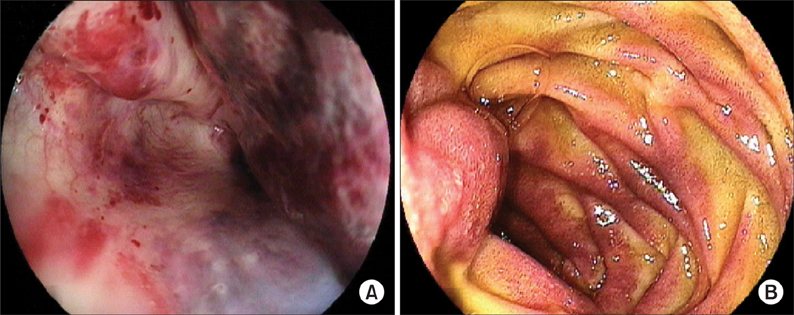
Fig. 1 Submucosal hematoma in stomach (A) and second portion of duodenum (B).
Cited by 1 articles
-
Clinical features and outcomes in spontaneous intramural small bowel hematoma: cohort study and literature review
Eun Ae Kang, Seung Jun Han, Jaeyoung Chun, Hyun Jung Lee, Hyunsoo Chung, Jong Pil Im, Sang Gyun Kim, Joo Sung Kim, Hyuk Yoon, Cheol Min Shin, Young Soo Park, Nayoung Kim, Dong Ho Lee, Hyun Chae Jung
Intest Res. 2019;17(1):135-143. doi: 10.5217/ir.2018.00085.
Reference
-
1. Carkman S, Ozben V, Saribeyoglu K, Somuncu E, Erguney S, Korman U, et al. Spontaneous intramural hematoma of the small intestine. Ulus Travma Acil Cerrahi Derg. 2010. 16:165–169.2. Askey JM. Small bowel obstruction due to intramural hematoma during anticoagulant therapy, a non-surgical condition. Calif Med. 1966. 104:449–453.3. Hale JE. Intramural intestinal haemorrhage: a complication of anticoagulant therapy. Postgrad Med J. 1975. 51:107–110.4. Nakayama Y, Fukushima M, Sakai M, Hisano T, Nagata N, Shirahata A, et al. Intramural hematoma of the cecum as the lead point of intussusception in an elderly patient with hemophilia A: report of a case. Surg Today. 2006. 36:563–565.5. Abbas MA, Collins JM, Olden KW. Spontaneous intramural small-bowel hematoma: imaging findings and outcome. AJR Am J Roentgenol. 2002. 179:1389–1394.6. Judd DR, Taybi H, King H. Intramural hematoma of the small bowel; a report of two cases and a review of the literature. Arch Surg. 1964. 89:527–535.7. Jarry J, Biscay D, Lepront D, Rullier A, Midy D. Spontaneous intra mural haematoma of the sigmoid colon causing acute intestinal obstruction in a haemophiliac: report of a case. Haemophilia. 2008. 14:383–384.8. Sorbello MP, Utiyama EM, Parreira JG, Birolini D, Rasslan S. Spontaneous intramural small bowel hematoma induced by antico agulant therapy: review and case report. Clinics (Sao Paulo). 2007. 62:785–790.9. Abbas MA, Collins JM, Olden KW, Kelly KA. Spontaneous intramural small-bowel hematoma: clinical presentation and long-term outcome. Arch Surg. 2002. 137:306–310.10. Lane MJ, Katz DS, Mindelzun RE, Jeffrey RB Jr. Spontaneous intramural small bowel haemorrhage: importance of non-contrast CT. Clin Radiol. 1997. 52:378–380.11. Shah P, Kraklow W, Lamb G. Unusual complication of coumadin toxicity. Wis Med J. 1994. 93:212–214.12. Hatipoglu AR, Hoscoskun Z, Ahsen M. The acute abdomen due to use of oral anticoagulants: spontaneous intraabdominal hemorrhage (a case report). Ulus Travma Acil Cerrahi Derg. 1997. 3:88–90.13. Kilbas Z, Harlak A, Ersoz N, Ozerhan IH, Mentes O, Eryilmaz M. A rare cause of acute abdomen due to warfarin toxicity: spontaneous intramural intestinal hematoma. JAEM. 2009. 8:43–45.14. Farhoud S, Stephani SM, Bromberg SH. Acute pancreatitis due to intramural hematoma of the duodenum by the use of anticoagulants. Arq Gastroenterol. 2001. 38:53–56.15. Uzun MA, Koksal N, Gunerhan Y, Sahin UY, Onur E, Ozkan OF. Intestinal obstruction due to spontaneous intramural hematoma of the small intestine during warfarin use: a report of two cases. Eur J Emerg Med. 2007. 14:272–273.16. Lorente-Ramos RM, Santiago-Hernando A, Del Valle-Sanz Y, Arjonilla-Lopez A. Sonographic diagnosis of intramural duodenal hematomas. J Clin Ultrasound. 1999. 27:213–216.17. Secil M, Ucar G. Spontaneous duodenal hematoma. J Emerg Med. 2004. 27:291–293.18. Acea Nebril B, Taboada Filgueira L, Sanchez Gonzalez F, Freire Rodriguez D, Fraguela Marina J, Aguirrezabalaga Gon, et al. Acute abdomen in anticoagulated patients: its assessment and the surgical indications. Rev Clin Esp. 1995. 195:463–467.19. Polat C, Dervisoglu A, Guven H, Kaya E, Malazgirt Z, Danaci M, et al. Anticoagulant-induced intramural intestinal hematoma. Am J Emerg Med. 2003. 21:208–211.20. O'Shaughnessy DF, Atterbury C, Bolton Maggs P, Murphy M, Thomas D, Yates S, et al. Guidelines for the use of fresh-frozen plasma, cryoprecipitate and cryosupernatant. Br J Haematol. 2004. 126:11–28.
- Full Text Links
-
- Actions
-
Cited
- CITED
-
- Close
- Share
-
- Similar articles
-
- Spontaneous Intramural Hematoma of the Sigmoid Colon Caused by Anti-platelet Agents
- Jejunal Intramural Hematoma with Bowel Obstruction in a 5-year-old Boy: A Case Report
- A Case of Gastric Intramural Hematoma after an Epinephrine Injection for Gastric Ulcer Bleeding in a Patient Medicated with Aspirin
- Intramural Hematoma of the Duodenum following Endoscopic Biopsy in a Child with Henoch-Schonlein Purpura
- Huge Intramural Duodenal Hematoma Complicated with Obstructive Jaundice following Endoscopic Hemostasis


