
J Korean Acad Nurs.
2015 Jun;45(3):429-438. 10.4040/jkan.2015.45.3.429.
Development and Application of a Performance Prediction Model for Home Care Nursing Based on a Balanced Scorecard using the Bayesian Belief Network
- Affiliations
-
- 1College of Nursing, Gachon University, Incheon, Korea.
- 2College of Nursing, Korea University, Seoul, Korea. seomun@korea.ac.kr
- KMID: 2164384
- DOI: http://doi.org/10.4040/jkan.2015.45.3.429
Abstract
- PURPOSE
This study was conducted to develop key performance indicators (KPIs) for home care nursing (HCN) based on a balanced scorecard, and to construct a performance prediction model of strategic objectives using the Bayesian Belief Network (BBN).
METHODS
This methodological study included four steps: establishment of KPIs, performance prediction modeling, development of a performance prediction model using BBN, and simulation of a suggested nursing management strategy. An HCN expert group and a staff group participated. The content validity index was analyzed using STATA 13.0, and BBN was analyzed using HUGIN 8.0.
RESULTS
We generated a list of KPIs composed of 4 perspectives, 10 strategic objectives, and 31 KPIs. In the validity test of the performance prediction model, the factor with the greatest variance for increasing profit was maximum cost reduction of HCN services. The factor with the smallest variance for increasing profit was a minimum image improvement for HCN. During sensitivity analysis, the probability of the expert group did not affect the sensitivity. Furthermore, simulation of a 10% image improvement predicted the most effective way to increase profit.
CONCLUSION
KPIs of HCN can estimate financial and non-financial performance. The performance prediction model for HCN will be useful to improve performance.
MeSH Terms
Figure
-
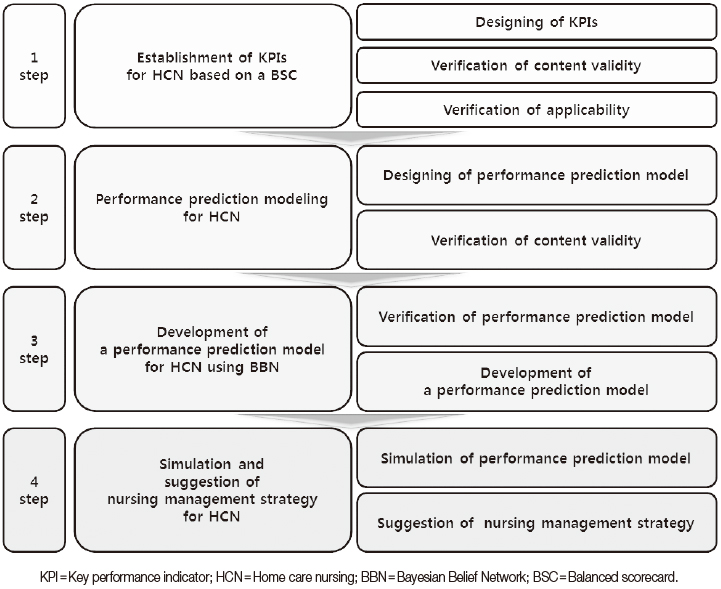
Figure 1 Research process.

Figure 2 Performance prediction model for HCN.
Reference
-
1. Korea Institute for Health and Social Affairs. Research for development and basic investigation for demonstration project of home care nursing in general hospital. Seoul: Author;1994.2. Song C. Home care services: Crisis and prospects. Perspect Nurs Sci. 2009; 6(1):55–65.3. Chin YR, Hong WL. Changes on hospital-based home care services utilization after long-term care insurance launch. J Korean Gerontol Soc. 2011; 31(2):371–380.4. College of Nursing in Seoul National University. Korea Institute for Health and Social Affairs. Ministry of Health and Welfare. Policy directions for establishment and expansion of home nursing care in Korea. Seoul: Ministry of Health and Welfare;2001.5. Ryu H, Jung K, Lim J. Test on the cost and development on the payment system of home health care nursing. J Korean Acad Nurs. 2006; 36(3):503–513.6. Kaplan RS, Norton DP. The balanced scorecard-measures that drive performance. Harv Bus Rev. 1992; 70(1):70–79.7. Park SA, Kim JH, Park KO, Kim MS, Kim SY. Development a tool for evaluating nurses' performance in hospital units. J Korean Clin Nurs Res. 2009; 15(2):5–21.8. Kang KH, Han YH. A study on performance measurement indicators of nursing department in a hospital. J Korean Acad Nurs Adm. 2009; 15(1):106–115.9. Kang KH, Kim IS. Development of performance measure indicators in hospital nursing units. J Korean Acad Nurs. 2005; 35(3):451–460.10. Kim JH. Development of prediction model for the management performance of profit nursing facility using bayesian network [dissertation]. Seoul: Ewha Womans University;2005.11. Choi YJ, Lim JY, Lee YW, Kim HS. Development of nursing key performance indicators for an intensive care unit by using a balanced scorecard. J Korean Acad Nurs. 2008; 38(5):656–666. DOI: 10.4040/jkan.2008.38.5.656.12. Yoo JI. Development of a performance measurement system for the perioperative nursing unit using the balanced scorecard (BSC) [master's thesis]. Seoul: Yonsei University;2001.13. Yoon WS, Lee HK, Maeng SJ, Song JH. Development of key performance indicators (KPI) for the nursing department in the military hospital. J Mil Nurs Res. 2012; 30(1):5–24.14. Hong Y, Hwang KJ, Kim MJ, Park CG. Balanced scorecard for performance measurement of a nursing organization in a Korean hospital. J Korean Acad Nurs. 2008; 38(1):45–54. DOI: 10.4040/jkan.2008.38.1.45.15. Kaplan RS, Norton DP. Using the balanced scorecard as a strategic management system. Harv Bus Rev. 1996; 74(1):75–85.16. Heckerman D. A bayesian approach to learning causal networks. San Francisco, CA: Morgan Kaufmann Publishers;1995. Report No.: TechReport MSR-TR-95-04.17. Lee SM. Applying bayesian network approaches to study health outcomes [dissertation]. Baltimore, MD: University of Maryland;2003.18. Lynn MR. Determination and quantification of content validity. Nurs Res. 1986; 35(6):382–385.19. Shin HS. Development of an outcome indicator of hospital based home health care using the balanced scorecard framework [dissertation]. Seoul: Yonsei University;2013.20. History Compilation Committee of Home Health Care. 20-years history and perspective on home health care. Seoul: HN Science;2014.21. Hamid S, Malik AU, Kamran I, Ramzan M. Job satisfaction among nurses working in the private and public sectors: A qualitative study in tertiary care hospitals in Pakistan. J Multidiscip Healthc. 2013; 7:25–35. DOI: 10.2147/jmdh.s55077.22. Japan Management Association Research Institute Inc. SY Nam . The balanced scorecard for healthcare organizations. Tokyo, JP: Medical Publications;2005.23. Eun HJ, Kim JY. The effects of management control systems through behavior traits of personnels on managerial performances in hospital organizations. Korean J Bus Adm. 2011; 24(6):3551–3580.24. Naranjo-Gil D. Strategic performance in hospitals: The use of the balanced scorecard by nurse managers. Health Care Manage Rev. 2009; 34(2):161–170. DOI: 10.1097/HMR.0b013e31819e8fd0.25. Suh JR, Lee NJ. Mediation effects of BSC use between the cultural traits and corporate performance. Korean J Account Res. 2008; 13(1):71–100.26. Niven PR. Balanced scorecard step-by-step: Maximizing performance and maintaining results. New York, NY: John Wiley & Sons Inc.;2002.27. Chung MJ, Lee SC, Yoon K. A case study on activity-based costing system in hospital management. Korean J Manag Account Res. 2014; 14(1):109–144.28. Kim W. A study on the effect of hotel image upon hotel revenue [master's thesis]. Seongnam: Kyungwon University;2003.29. Jo HY, Bae ES. The effects of non-financial measures on the hospital's revenue. J Finance Account Inf. 2005; 5(1):19–49.30. Chung HT, Kim YS, Kwak SM, Lee YK. The system dynamics model development for management performance forecasting of small and medium hospital. Korean System Dyn Rev. 2007; 8(2):209–234.
- Full Text Links
-
- Actions
-
Cited
- CITED
-
- Close
- Share
-
- Similar articles
-
- Application of a Bayesian Network to Predict Hospitalization among HIV Adults
- Development of Nursing Key Performance Indicators for an Intensive Care Unit by using a Balanced Scorecard
- Bayesian Network Approaches to Health Services Research
- A Hybrid Bayesian Network Model for Predicting Breast Cancer Prognosis
- Development of Performance Measure Indicators in Hospital Nursing Units


