
The Efficiency of Additional Fixation of the Alternative Bone Substitute in Unstable Intertrochanteric Fractures of Femur Treated with Gamma Nail
- Affiliations
-
- 1Department of Orthopedic Surgery, Mokdong Hospital, Ewha Woman's University School of Medicine, Seoul, Korea. ewhamdos@korea.com
- KMID: 1449409
- DOI: http://doi.org/10.12671/jkfs.2011.24.1.1
Abstract
- PURPOSE
To evaluate the efficiency of additional fixation of the alternative bone substitute in unstable intertrochanteric fractures treated with gamma nail and alternative bone substitute and only with gamma nail.
MATERIALS AND METHODS
Radiologic comparison was done between forty-four patients of unstable intertrochanteric fracture (AO type A2.2, A2.3) during six months. The patients were divided into two groups, a group treated with gamma nail and alternative bone substitute (22 patients, group 1) and another group treated only with gamma nail (22 patients, group 2). Postoperative reduction status, Cleveland index, Tip-apex distance and complications during the follow-up period was compared. Lag screw slippage and femoral neck-shaft angle change were measured between two groups.
RESULTS
No significant difference of reduction status, Cleveland index and Tip-apex distance was found. In group II, there was a 1 more case of cutting-out of the lag screw, but also there was a significant difference. Lesser change in lag screw slippage and neck-shaft angle change was investigated.
CONCLUSION
As there are lesser lag screw slippage and neck-shaft angle change, alternative bone substitutes applied in unstable intertrochanteric fractures seems to be useful in maintaining reduction and preventing failure of internal fixation when proper reduction and screw insertion is performed.
Figure
-
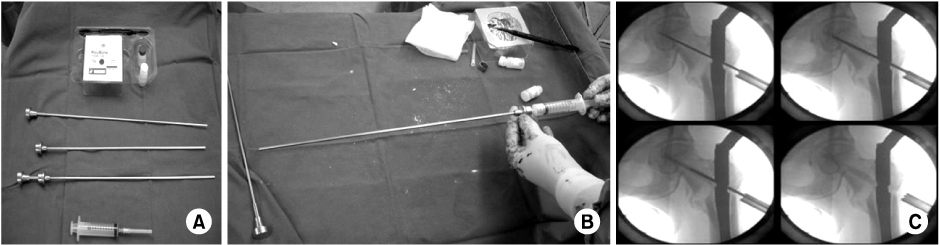
Fig. 1 Injection of PolyBone. (A) Applying the specially manufactured guide and the pusher for insertion of PolyBone. (B) Injection of PolyBone into the guide and pushing to the lag screw insertion area by pusher. (C) C-arm radiograph after PolyBone injection to lag screw insertion site.

Fig. 2 Result of Cleveland index. (A) Result of Group I* - 20 of 22 patients (90.0%) inserted the lag screw in zone 5, 6, 8, 9. (B) Result of Group II† - 19 of 22 patients (86.3%) inserted the lag screw in zone 5, 6, 8, 9. *Group I: Fixation with gamma nail and PolyBone, †Group II: Fixation only with gamma nail.

Fig. 3 Result of neck shaft angle change and lag screw slippage. (A) Lesser change in femoral neck shaft angle is checked during 6 months in group I (p<0.001). (B) Also, there is lesser change in lag screw slippage during follow-up term in group I (p<0.001).
Reference
-
1. Bartucci EJ, Gonzalez MH, Cooperman DR, Freedberg HI, Barmada R, Laros GS. The effect of adjunctive methylmethacrylate on failures of fixation and function in patients with intertrochanteric fractures and osteoporosis. J Bone Joint Surg Am. 1985. 67:1094–1107.
Article2. Baumgaertner MR, Curtin SL, Lindskog DM, Keggi JM. The value of tip-apex distance in predicting failure of fixation of pertrochanteric fractures of the hip. J Bone Joint Surg Am. 1995. 77:1058–1064.
Article3. Bonnaire F, Weber A, Bösl O, Eckhardt C, Schwieger K, Linke B. "Cutting out" in pertrochanteric fractures--problem of osteoporosis. Unfallchirurg. 2007. 110:425–432.
Article4. Choueka J, Koval KJ, Kummer FJ, Zukerman JD. Cement augmentation of intertrochanteric fracture fixation: a cadaver comparison of 2 techniques. Acta Orthop Scand. 1996. 67:153–157.
Article5. Cleveland M, Bosworth DM, Thompson FR, Wilson HJ Jr, Ishizuka T. A ten-year analysis of intertrochanteric fractures of the femur. J Bone Joint Surg Am. 1959. 41:1399–1408.
Article6. Doppelt SH. The sliding compression screw--today's best answer for stabilization of intertrochanteric hip fractures. Orthop Clin North Am. 1980. 11:507–523.
Article7. Eggli PS, Müller W, Schenk RK. Porous hydroxyapatite and tricalcium phosphate cylinders with two different pore size ranges implanted in the cancellous bone of rabbits. A comparative histomorphometric and histologic study of bony ingrowth and implant substitution. Clin Orthop Relat Res. 1988. (232):127–138.8. Flahiff CM, Nelson CL, Gruenwald JM, Hollis JM. A biomechanical evaluation of an intramedullary fixation device for intertrochanteric fractures. J Trauma. 1993. 35:23–27.
Article9. Fogagnolo F, Kfuri M Jr, Paccola CA. Intramedullary fixation of pertrochanteric hip fractures with the short AO-ASIF proximal femoral nail. Arch Orthop Trauma Surg. 2004. 124:31–37.
Article10. Haidukewych GJ. Intertrochanteric fractures: ten tips to improve results. J Bone Joint Surg Am. 2009. 91:712–719.11. Ha YC, Kim SR, Koo KH, et al. An epidemiological study of hip fracture in Jeju Island, Korea. J Korean Orthop Assoc. 2004. 39:131–136.
Article12. Harrington KD. The use of methylmethacrylate as an adjunct in the internal fixation of unstable comminuted intertrochanteric fractures in osteoporotic patients. J Bone Joint Surg. 1975. 57:744–750.
Article13. Kim KC, Shin HK, Son KM, Ko CS. The treatment of unstable intertrochanter fracutures of femur: comparison between proximal femoral nail and dynamic hip screw. J Korean Fract Soc. 2005. 18:369–374.
Article14. Kim YS, Kwon SY, Lee YM, Han SK. Treatment of intertrochanteric fractures in patients with severe osteoporosis with dynamic compression hip screws. J Korean Hip Soc. 2009. 21:29–34.
Article15. Klein CP, Driessen AA, de Groot K, van den Hooff A. Biodegradation behavior of various calcium phosphate materials in bone tissue. J Biomed Mater Res. 1983. 17:769–784.
Article16. Kornberg A, Rao NN, Ault-Riché D. Inorganic polyphosphate: a molecule of many functions. Annu Rev Biochem. 1999. 68:89–125.
Article17. Lee DC, Lee SJ. A comparison study of the gamma nail and the dynamic hip screw for peritrochanteric fracture. J Korean Soc Fract. 1994. 7:616–627.
Article18. Lindner T, Kanakaris NK, Marx B, Cockbain A, Kontakis G, Giannoudis PV. Fractures of the hip and osteoporosis: the role of bone substitutes. J Bone Joint Surg Br. 2009. 91:294–303.19. Moroni A, Faldini C, Pegreffi F, Giannini S. HA-coated screws decrease the incidence of fixation failure in osteoporotic trochanteric fractures. Clin Orthop Relat Res. 2004. 425:87–92.
Article20. Müller ME, Nazarian S. Classification of fractures of the femur and its use in the A.O. index (authors transl). Rev Chir Orthop Reparatrice Appar Mot. 1981. 67:297–309.21. Park MS, Suh DJ, Park JH. The effect of cement augmentation in the iintertrochanteric fracture of the femur treated with sliding hip screw device for senile osteoporotic patients. J Korean Hip Soc. 2004. 16:428–434.22. Schröder HC, Kurz L, Müller WE, Lorenz B. Polyphosphate in bone. Biochemistry (Mosc). 2000. 65:296–303.23. Utrilla AL, Reig JS, Muñoz FM, Tufanisco CB. Trochanteric gamma nail and compression hip screw for trochanteric fractures: a randomized, prospective, comparative study in 210 elderly patients with a new design of the gamma nail. J Orthop Trauma. 2005. 19:229–233.
Article
- Full Text Links
-
- Actions
-
Cited
- CITED
-
- Close
- Share
-
- Similar articles
-
- Treatment of Intertrochanteric Fractures using Gamma Nail
- Treatment of Intertrochanteric Fractures using Gamma Nail
- Treatment of Intertrochanteric Fracture of Femur: A Randomized Prospective Comparative Analysis of the Internal Fixation of Gamma Nail and Compression Hip Screw
- The Gamma Nail for Unstable Peritrochanteric Fractures
- Comparative Study of Intertrochanteric Fracture Treated with the Proximal Femoral Nail Anti-Rotation and the Third Generation of Gamma Nail


