
Secondary Amyloidosis Development in a Patient with Juvenile Rheumatoid Arthritis on TNF-alpha Inhibitors Treatment
- Affiliations
-
- 1Division of Rheumatology, Department of Internal Medicine, Seoul St. Mary's Hospital, College of Medicine, The Catholic University of Korea, Seoul, Korea. juji@catholic.ac.kr
- KMID: 1438537
- DOI: http://doi.org/10.4078/jrd.2012.19.5.280
Abstract
- Secondary amyloidosis is one of the most serious complications in chronic inflammatory diseases such as rheumatoid arthritis. The extracellular deposit of aggregates of amyloid leads to target organ dysfunction. The mainstay treatment of secondary amyloidosis is the control of underlying disease activity. Many reports have reported that TNF-alpha inhibitors improve clinical outcomes. Here, we encountered a 34-year-old patient with juvenile rheumatoid arthritis who developed secondary amyloidosis despite treatment with TNF-alpha inhibitors. We present this case and include a review of the literature.
MeSH Terms
Figure
-
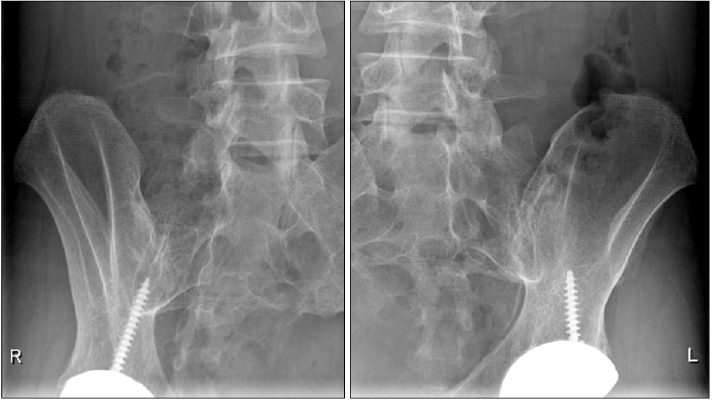
Figure 1 X-ray of sacroiliac joint. Partial fusion of both sacroiliac joints.
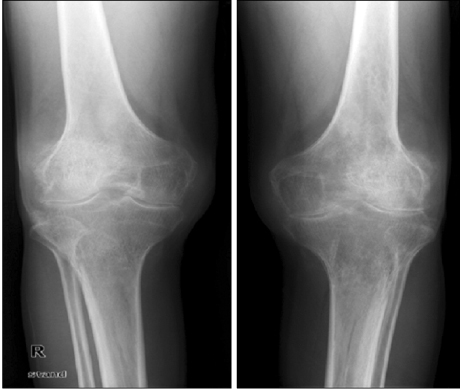
Figure 2 X-ray of knee both AP (stand). Uniform joint space narrowing and periarticular osteopenia.
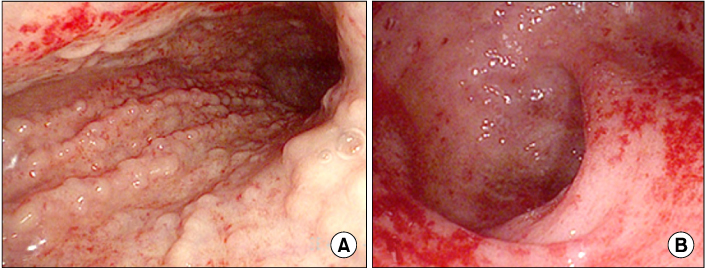
Figure 3 (A) Esophagogastroduodenoscopy, (B) Colonoscopy. (A) Severe atropic change at body and pylorus of stomach, (B) Diffuse petechiae and inflammation and spontaneous bleeding.
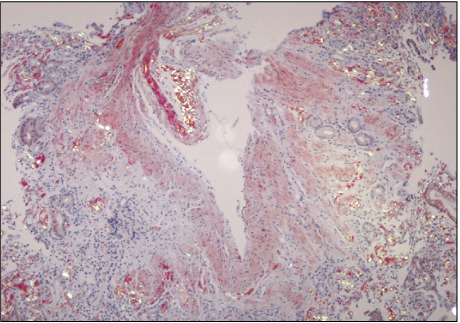
Figure 4 Congo red with polarizing microscope (×100). Moderate chronic inflammation and marked glandular atrophy, as well as amorphous eosinophilic deposits suggestive of amyloidosis (birefringence of apple green color) at the stomach.
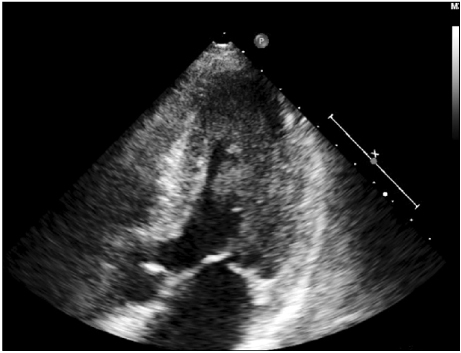
Figure 5 Transthoracic echocardiogram. Severe concentric left ventricular hypertrophy with systolic kissing phenomenon, infiltrative CMP due to fine ground glass appearance of myocardium of left ventricle.
Reference
-
1. Gertz MA, Kyle RA. Secondary systemic amyloidosis: response and survival in 64 patients. Medicine (Baltimore). 1991. 70:246–256.2. Suzuki A, Ohosone Y, Obana M, Mita S, Matsuoka Y, Irimajiri S, et al. Cause of death in 81 autopsied patients with rheumatoid arthritis. J Rheumatol. 1994. 21:33–36.3. Okuda Y, Takasugi K, Oyama T, Onuma M, Oyama H. Amyloidosis in rheumatoid arthritis-clinical study of 124 histologically proven cases. Ryumachi. 1994. 34:939–946.4. Rysavá R, Merta M, Spicka I, Tesar V. Current therapeutic possibilities in primary and secondary amyloidosis and our experience with 31 patients. Nephrol Dial Transplant. 2003. 18:Suppl 5. v38–v40.5. Brunt EM, Tiniakos DG. Metabolic storage diseases: amyloidosis. Clin Liver Dis. 2004. 8:915–930.6. Röcken C, Radun D, Glasbrenner B, Malfertheiner P, Roessner A. Generalized AA-amyloidosis in a 58-yearold Caucasian woman with an 18-month history of gastrointestinal tuberculosis. Virchows Arch. 1999. 434:95–100.7. Benson MD, Cohen AS. Serum amyloid A protein in amyloidosis, rheumatic, and enoplastic diseases. Arthritis Rheum. 1979. 22:36–42.8. Nakamura T, Higashi S, Tomoda K, Tsukano M, Baba S. Efficacy of etanercept in patients with AA amyloidosis secondary to rheumatoid arthritis. Clin Exp Rheumatol. 2007. 25:518–522.9. Komatsuda A, Morita K, Ohtani H, Yamaguchi A, Miura AB. Remission of the nephrotic syndrome in a patient with renal amyloidosis due to rheumatoid arthritis treated with prednisolone and methotrexate. Am J Kidney Dis. 1998. 32:E7.10. Kobak S, Oksel F, Kabasakal Y, Doganavsargil E. Ankylosing spondylitis-related secondary amyloidosis responded well to etanercept: a report of three patients. Clin Rheumatol. 2007. 26:2191–2194.11. Gottenberg JE, Merle-Vincent F, Bentaberry F, Allanore Y, Berenbaum F, Fautrel B, et al. Anti-tumor necrosis factor alpha therapy in fifteen patients with AA amyloidosis secondary to inflammatory arthritides: a followup report of tolerability and efficacy. Arthritis Rheum. 2003. 48:2019–2024.12. Thornton BD, Hoffman HM, Bhat A, Don BR. Successful treatment of renal amyloidosis due to familial cold autoinflammatory syndrome using an interleukin 1 receptor antagonist. Am J Kidney Dis. 2007. 49:477–481.13. Narváez J, Hernández MV, Ruiz JM, Vaquero CG, Juanola X, Nollaa JM. Rituximab therapy for AA-amyloidosis secondary to rheumatoid arthritis. Joint Bone Spine. 2011. 78:101–103.14. Régent A, Mouthon L. Anti-TNFalpha therapy in systemic autoimmune and/or inflammatory diseases. Presse Med. 2009. 38:761–773.15. Roque R, Ramiro S, Cordeiro A, Gonçalves P, Da Canas S, Santos MJ. Development of amyloidosis in patients with rheumatoid arthritis under TNF-blocking agents. Clin Rheumatol. 2011. 30:869–870.
- Full Text Links
-
- Actions
-
Cited
- CITED
-
- Close
- Share
-
- Similar articles
-
- Case of Secondary Amyloidosis in a Patient with Ankylosing Spondylitis Refractory to TNF-alpha Inhibitors
- Rheumatoid Arthritis with Secondary Amyloidosis and Chronic Kidney Disease with a Good Response to Etanercept
- Development of juvenile rheumatoid arthritis in a patient with multiple sclerosis
- TNF-alpha Inhibitor Treatment in an Ankylosing Spondylitis Patient with Secondary Amyloidosis that Manifest with Diarrhea: A Case Report
- Clinical significance of rheumatoid factor in juvenile rheumatoid arthritis


