
Ann Surg Treat Res.
2022 Jun;102(6):353-359. 10.4174/astr.2022.102.6.353.
Short-term outcome of bariatric surgery on nonalcoholic fatty liver disease: a Korean perspective

- Affiliations
-
- 1Department of Surgery, Kosin University College of Medicine, Busan, Korea
- 2Department of Internal Medicine, Kosin University College of Medicine, Busan, Korea
- KMID: 2530390
- DOI: http://doi.org/10.4174/astr.2022.102.6.353
Abstract
- Purpose
Obesity is associated with nonalcoholic fatty liver disease, one of the most common causes of chronic liver disease.We aimed to demonstrate the effectiveness of bariatric surgery for hepatic steatosis and fibrosis in Korean patients.
Methods
A total of 32 consecutive patients were enrolled in this study. Hepatic steatosis and liver fibrosis were assessed before surgery and 6 months after surgery using transient elastography and serologic panels.
Results
Thirteen patients (40.6%) were male and 19 (59.4%) were female, with a mean age of 39.3 ± 11.3 years. The body mass index was significant at the 6th month: 39.1 ± 6.7 and 30.3 ± 4.7 kg/m2 (P < 0.001), respectively. The mean preoperative controlled attenuation parameter and liver stiffness measurement values were 325.4 ± 55.9 dB/m and 7.4 ± 4.8 kPa, respectively, before surgery, and they decreased to 267.1 ± 45.1 dB/m and 5.3 ± 2.3 kPa, respectively, 6 months postoperatively (P < 0.001, respectively).
Conclusion
These results suggest that bariatric surgery is associated with a significant improvement in liver steatosis and fibrosis. Bariatric surgery has a beneficial effect on nonalcoholic fatty liver disease in patients with morbid obesity in Korea.
Keyword
Figure
-
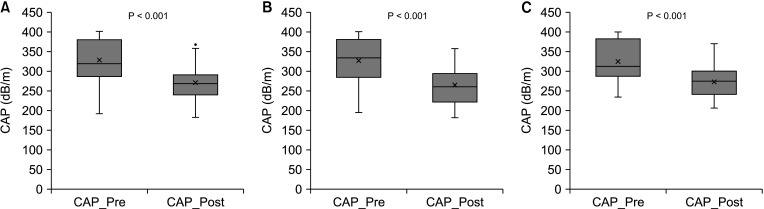
Fig. 1 CAP values preoperatively and 6 months after (A) RYGB + LSG, (B) RYGB, and (C) LSG. CAP, controlled attenuation parameter; RYGB, laparoscopic Roux-en-Y gastric bypass; LSG, laparoscopic sleeve gastrectomy.
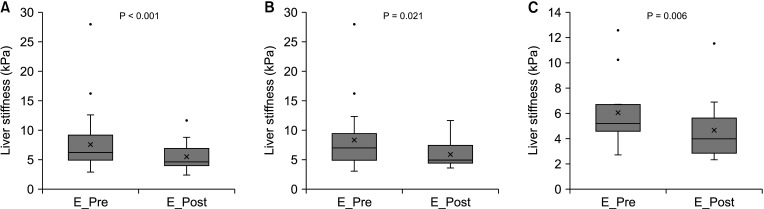
Fig. 2 Liver stiffness (kPa) preoperatively and 6 months after (A) laparoscopic Roux-en-Y gastric bypass (RYGB) + laparoscopic sleeve gastrectomy (LSG), (B) RYGB, and (C) LSG.
Reference
-
1. Vernon G, Baranova A, Younossi ZM. Systematic review: the epidemiology and natural history of non-alcoholic fatty liver disease and non-alcoholic steatohepatitis in adults. Aliment Pharmacol Ther. 2011; 34:274–285. PMID: 21623852.
Article2. Browning JD, Szczepaniak LS, Dobbins R, Nuremberg P, Horton JD, Cohen JC, et al. Prevalence of hepatic steatosis in an urban population in the United States: impact of ethnicity. Hepatology. 2004; 40:1387–1395. PMID: 15565570.
Article3. Kim HC, Choi KS, Jang YH, Shin HW, Kim DJ. Normal serum aminotransferase levels and the metabolic syndrome: Korean National Health and Nutrition Examination Surveys. Yonsei Med J. 2006; 47:542–550. PMID: 16941745.
Article4. Kojima S, Watanabe N, Numata M, Ogawa T, Matsuzaki S. Increase in the prevalence of fatty liver in Japan over the past 12 years: analysis of clinical background. J Gastroenterol. 2003; 38:954–961. PMID: 14614602.
Article5. Park SH, Jeon WK, Kim SH, Kim HJ, Park DI, Cho YK, et al. Prevalence and risk factors of non-alcoholic fatty liver disease among Korean adults. J Gastroenterol Hepatol. 2006; 21(1 Pt 1):138–143. PMID: 16706825.
Article6. Jeong EH, Jun DW, Cho YK, Choe YG, Ryu S, Lee SM, et al. Regional prevalence of non-alcoholic fatty liver disease in Seoul and Gyeonggi-do, Korea. Clin Mol Hepatol. 2013; 19:266–272. PMID: 24133664.
Article7. Younossi Z, Tacke F, Arrese M, Chander Sharma B, Mostafa I, Bugianesi E, et al. Global perspectives on nonalcoholic fatty liver disease and nonalcoholic steatohepatitis. Hepatology. 2019; 69:2672–2682. PMID: 30179269.
Article8. Younossi ZM. Non-alcoholic fatty liver disease: a global public health perspective. J Hepatol. 2019; 70:531–544. PMID: 30414863.9. Palmer M, Schaffner F. Effect of weight reduction on hepatic abnormalities in overweight patients. Gastroenterology. 1990; 99:1408–1413. PMID: 2210247.
Article10. Park HS, Kim MW, Shin ES. Effect of weight control on hepatic abnormalities in obese patients with fatty liver. J Korean Med Sci. 1995; 10:414–421. PMID: 8924225.
Article11. Nickel F, Schmidt L, Bruckner T, Billeter AT, Kenngott HG, Müller-Stich BP, et al. Gastrointestinal quality of life improves significantly after sleeve gastrectomy and Roux-en-Y gastric bypass: a prospective cross-sectional study within a 2-year follow-up. Obes Surg. 2017; 27:1292–1297. PMID: 27878423.
Article12. Nickel F, Schmidt L, Bruckner T, Büchler MW, Müller-Stich BP, Fischer L. Influence of bariatric surgery on quality of life, body image, and general self-efficacy within 6 and 24 months: a prospective cohort study. Surg Obes Relat Dis. 2017; 13:313–319. PMID: 28029597.
Article13. Chon YE, Jung KS, Kim SU, Park JY, Park YN, Kim DY, et al. Controlled attenuation parameter (CAP) for detection of hepatic steatosis in patients with chronic liver diseases: a prospective study of a native Korean population. Liver Int. 2014; 34:102–109. PMID: 24028214.
Article14. Chon YE, Jung KS, Kim KJ, Joo DJ, Kim BK, Park JY, et al. Normal controlled attenuation parameter values: a prospective study of healthy subjects undergoing health checkups and liver donors in Korea. Dig Dis Sci. 2015; 60:234–242. PMID: 25118979.
Article15. Lee JH, Kim D, Kim HJ, Lee CH, Yang JI, Kim W, et al. Hepatic steatosis index: a simple screening tool ref lecting nonalcoholic fatty liver disease. Dig Liver Dis. 2010; 42:503–508. PMID: 19766548.
Article16. Chang JW, Lee HW, Kim BK, Park JY, Kim DY, Ahn SH, et al. Hepatic steatosis index in the detection of fatty liver in patients with chronic hepatitis b receiving antiviral therapy. Gut Liver. 2021; 15:117–127. PMID: 32066210.
Article17. Botros M, Sikaris KA. The de ritis ratio: the test of time. Clin Biochem Rev. 2013; 34:117–130. PMID: 24353357.18. Wai CT, Greenson JK, Fontana RJ, Kalbfleisch JD, Marrero JA, Conjeevaram HS, et al. A simple noninvasive index can predict both significant fibrosis and cirrhosis in patients with chronic hepatitis C. Hepatology. 2003; 38:518–526. PMID: 12883497.
Article19. Hall P, Cash J. What is the real function of the liver ‘function’ tests? Ulster Med J. 2012; 81:30–36. PMID: 23536736.20. Loaeza-del-Castillo A, Paz-Pineda F, Oviedo-Cárdenas E, Sánchez-Avila F, Vargas-Vorácková F. AST to platelet ratio index (APRI) for the noninvasive evaluation of liver fibrosis. Ann Hepatol. 2008; 7:350–357. PMID: 19034235.
Article21. Gordon SC, Kachru N, Parker E, Korrer S, Ozbay AB, Wong RJ. Health care use and costs among patients with nonalcoholic steatohepatitis with advanced fibrosis using the fibrosis-4 score. Hepatol Commun. 2020; 4:998–1011. PMID: 32626832.
Article22. Kang SH, Lee HW, Yoo JJ, Cho Y, Kim SU, Lee TH, et al. KASL clinical practice guidelines: Management of nonalcoholic fatty liver disease. Clin Mol Hepatol. 2021; 27:363–401. PMID: 34154309.
Article23. Nascimento TM, Alves-Júnior A, Nunes MA, de Freitas TR, da Silva MA, Alves MR. Comparison of hepatic profile in pre and postoperative of bariatric surgery: private vs public network. Arq Bras Cir Dig. 2015; 28:274–277. PMID: 26734800.
Article24. Vallet-Pichard A, Mallet V, Nalpas B, Verkarre V, Nalpas A, Dhalluin-Venier V, et al. FIB-4: an inexpensive and accurate marker of fibrosis in HCV infection. comparison with liver biopsy and fibrotest. Hepatology. 2007; 46:32–36. PMID: 17567829.
Article25. Jun DW, Kim SG, Park SH, Jin SY, Lee JS, Lee JW, et al. External validation of the non-alcoholic fatty liver disease fibrosis score for assessing advanced fibrosis in Korean patients. J Gastroenterol Hepatol. 2017; 32:1094–1099. PMID: 27859583.
Article26. Hafeez S, Ahmed MH. Bariatric surgery as potential treatment for nonalcoholic fatty liver disease: a future treatment by choice or by chance? J Obes. 2013; 2013:839275. PMID: 23431426.
Article27. Mummadi RR, Kasturi KS, Chennareddygari S, Sood GK. Effect of bariatric surgery on nonalcoholic fatty liver disease: systematic review and meta-analysis. Clin Gastroenterol Hepatol. 2008; 6:1396–1402. PMID: 18986848.
Article28. Lee Y, Doumouras AG, Yu J, Brar K, Banfield L, Gmora S, et al. Complete resolution of nonalcoholic fatty liver disease after bariatric surgery: a systematic review and meta-analysis. Clin Gastroenterol Hepatol. 2019; 17:1040–1060. PMID: 30326299.
Article29. Naveau S, Lamouri K, Pourcher G, Njiké-Nakseu M, Ferretti S, Courie R, et al. The diagnostic accuracy of transient elastography for the diagnosis of liver fibrosis in bariatric surgery candidates with suspected NAFLD. Obes Surg. 2014; 24:1693–1701. PMID: 24841950.
Article30. Chalasani N, Younossi Z, Lavine JE, Diehl AM, Brunt EM, Cusi K, et al. The diagnosis and management of non-alcoholic fatty liver disease: practice guideline by the American Association for the Study of Liver Diseases, American College of Gastroenterology, and the American Gastroenterological Association. Hepatology. 2012; 55:2005–2023. PMID: 22488764.
Article
- Full Text Links
-
- Actions
-
Cited
- CITED
-
- Close
- Share
-
- Similar articles
-
- Bariatric surgery for non-alcoholic fatty liver disease: Indications and post-operative management
- Noninvasive serum biomarkers for liver steatosis in nonalcoholic fatty liver disease: Current and future developments
- Nonalcoholic fatty liver disease: pathogenesis and treatment
- Elevated serum bilirubin levels are inversely associated with nonalcoholic fatty liver disease
- Nonalcoholic Fatty Liver Disease as a Systemic Disease and the Need for Multidisciplinary Care


