
J Korean Acad Oral Health.
2021 Dec;45(4):227-232. 10.11149/jkaoh.2021.45.4.227.
Evaluation of VGG-16 deep learning algorithm for dental caries classification

- Affiliations
-
- 1Department of Preventive & Community Dentistry, School of Dentistry, Pusan National University, Yangsan, Korea
- 2Department of Dental Hygiene, Jeonju Kijeon College, Jeonju, Korea
- 3Department of Oral and Maxillofacial Radiology, School of Dentistry, Pusan National University, Yangsan, Korea
- KMID: 2524200
- DOI: http://doi.org/10.11149/jkaoh.2021.45.4.227
Abstract
Objectives
Diagnosis of dental caries is based on the dentist’s observation and subjective judgment; therefore, a reliable and objective approach for diagnosing caries is required. Intraoral camera images combined with deep learning technology can be a useful tool to diagnose caries. This study aimed to evaluate the accuracy of the VGG-16 convolutional neural network (CNN) model in detecting dental caries in intraoral camera images.
Methods
Images were obtained from the Internet and websites using keywords linked to teeth and dental caries. The 670 images that were obtained were categorized by an investigator as either sound (404 sound teeth) or dental caries (266 dental caries), and used in this study. The training and test datasets were divided in the ratio of 7:3 and a four-fold cross validation was performed. The Tensorflow-based Python package Keras was used to train and validate the CNN model. Accuracy, Kappa value, sensitivity, specificity, positive predictive value, negative predictive value, ROC (receiver operating characteristic) curve and AUC (area under curve) values were calculated for the test datasets.
Results
The accuracy of the VGG-16 deep learning model for the four datasets, through random sampling, was between 0.77 and 0.81, with 0.81 being the highest. The Kappa value was 0.51-0.60, indicating moderate agreement. The resulting positive predictive values were 0.77-0.82 and negative predictive values were 0.80-0.85. Sensitivity, specificity, and AUC values were 0.66-0.74, 0.81-0.88, and 0.88-0.91, respectively.
Conclusions
The VGG-16 CNN model showed good discriminatory performance in detecting dental caries in intraoral camera images. The deep learning model can be beneficial in monitoring dental caries in the population.
Figure
-

Fig. 1 VGG-16 network architecture.
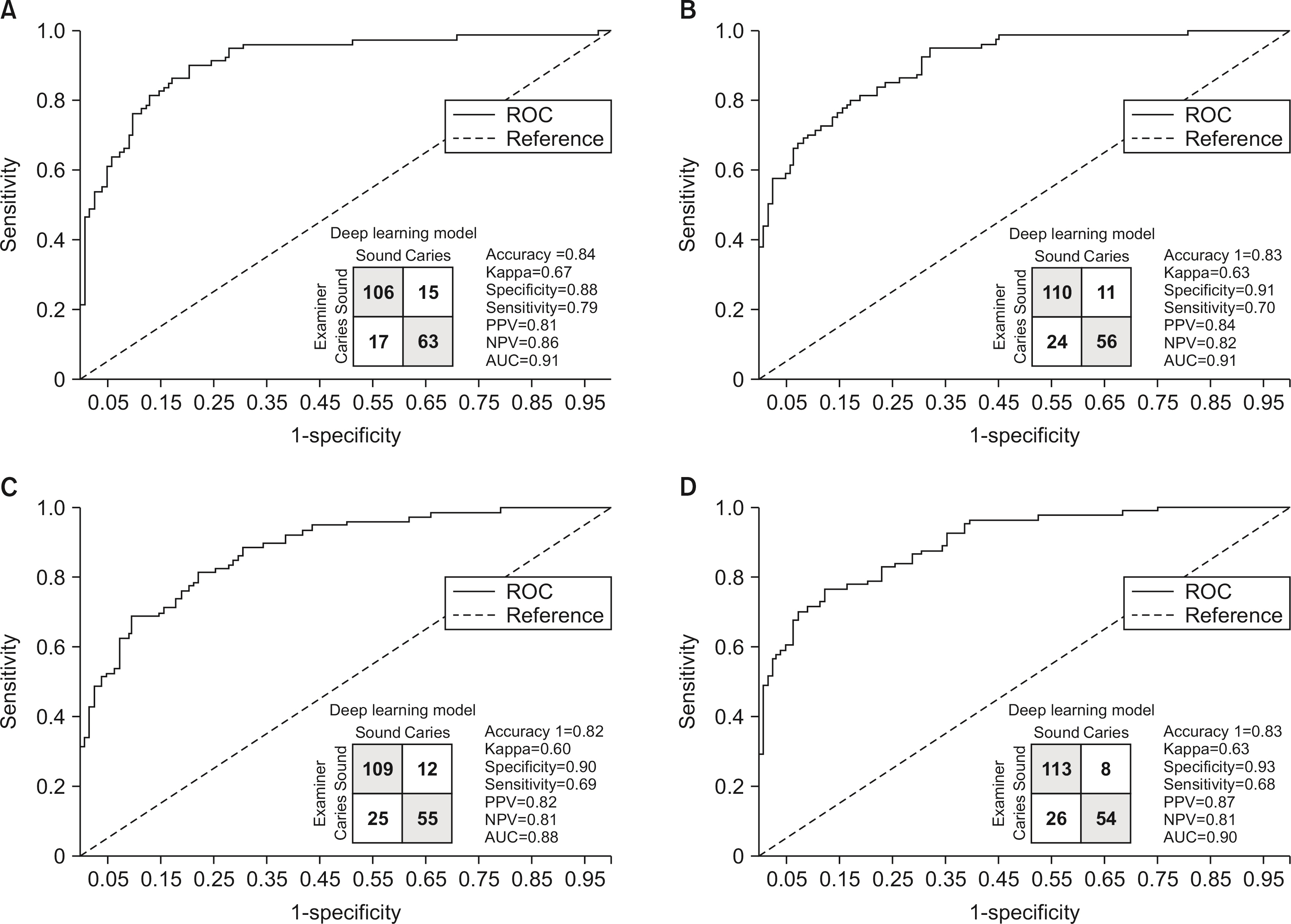
Fig. 2 Receiver operating characteristic (ROC) curves for highest performance deep learning model in each dataset. (A) CV (cross-validation dataset) 1. (B) CV 2. (C) CV 3. (D) CV 4.
Reference
-
References
1. Pitts NB. 2001; Clinical diagnosis of dental caries: a European perspective. J Dent Educ. 65(10):972–978. DOI: 10.1002/j.0022-0337.2001.65.10.tb03472.x. PMID: 11699999.
Article2. National Institutes of Health. 2001; Diagnosis and management of dental caries throughout life. NIH consensus statement. 18(1):1–23. DOI: 10.14219/jada.archive.2001.0343. PMID: 11575024.3. Pretty IA. 2006; Caries detection and diagnosis: novel technologies. J Dent. 34(10):727–739. DOI: 10.1016/j.jdent.2006.06.001. PMID: 16901606.
Article4. Boye U, Willasey A, Walsh T, Tickle M, Pretty IA. 2013; Comparison of an intra-oral photographic caries assessment with an established visual caries assessment method for use in dental epidemiological studies of children. Community Dentist Oral Epidemiol. 41:526–533. DOI: 10.1111/cdoe.12049. PMID: 23566100.
Article5. Fejerskov O, Nyvad B, Kidd EAM. 2015. Chaper 10. The foundations of good diagnostic practice. Dental Caries: the Disease and Its Clinical Management. 3th ed. Wiley Blackwell;Oxford: p. 173–190.6. Alassaad SS. 2011; Incomplete cusp fractures: Early diagnosis and communication with patients using fiber-optic transillumination and intraoral photography. Gen Dent. 59:132–135. PMID: 21903523.7. Obrochta JC. Efficient & Effective Use of the Intraoral Camera. Available from: media. dental care.com/media/en-US/education/ce367/ce367.pdf. Accessed 2012 Dec 19.8. Gimenez T, Piovesan C, Braga MM, Raggio DP, Deery C, Ricketts DN, et al. 2015; Visual inspection for caries detection: a systematic review and meta-analysis. J Dent Res. 94:895–904. DOI: 10.1177/0022034515586763. PMID: 25994176.9. Kim BM. 2018; Trend of image classification technology based on deep learning. The Journal of The Korean Institute of Communication Sciences. 35(12):8–14.10. Gook KH. 2019; Artificial intelligence technology and examples of industrial application. Weekly technology trend. 20:5–27.11. Song KD, Kim M, Do S. 2019; The latest trends in the use of deep learning in radiology illustrated through the stages of deep learning algorithm development. J Korean Soc Radiol. 80(2):202–212. DOI: 10.3348/jksr.2019.80.2.202.
Article12. Choe Gh. 2018; Latest Research Trends in Convolutional Neural Networks. Communications of the Korean Institute of Information Scientists and Engineers. 36(2):25–31.13. Simonyan K, Zisserman A. 2015; Very deep convolutional networks for large-scale image recognition. arXiv 2015;1409.1556.14. Hwang JJ, Jung YH, Cho BH, Heo MS. 2019; An overview of deep learning in the field of dentistry. Imaging Sci Dent. 49(1):1–7. DOI: 10.5624/isd.2019.49.1.1. PMID: 30941282. PMCID: PMC6444007.
Article15. Khanagar SB, Al-Ehaideb A, Maganur PC, Vishwanathaiah S, Patil S, Baeshen HA, et al. 2021; Developments, application, and performance of artificial intelligence in dentistry-a systematic review. J Dent Sci. 16(1):508–522. DOI: 10.1016/j.jds.2020.06.019. PMID: 33384840. PMCID: PMC7770297.16. Babu A, Onesimu JA, Sagayam KM. Artificial Intelligence in dentistry: Concepts, Applications and Research Challenges. DOI: 10.1051/e3sconf/202129701074.
Article17. Ministry of Health & Welfare. 2019. 2018 Korean National Oral Health Survey. :Ministry of Health & Welfare;Seoul: p. 382.18. Deng J, Dong W, Socher R, Li LJ, Li FF. 2009. 06. ImageNet: A large-scale hierarchical image database. In : 2009 IEEE conference on computer Vision and Pattern Recognition; DOI: 10.1109/CVPR.2009.5206848.
Article19. Lee KS, Jung SK, Ryu JJ, Shin SW, Choi J. 2020; Evaluation of transfer learning with deep convolutional neural networks for screening osteoporosis in dental panoramic radiographs. J Clin Medi. 9(2):392. DOI: 10.3390/jcm9020392. PMID: 32024114. PMCID: PMC7074309.
Article20. Kang MJ. 2020; Comparison of Gradient Descent for Deep Learning. Journal of the Korea Academia-Industrial cooperation Society. 21(2):189–94.21. Fejerskov O, Nyvad B, Kidd EAM. Chaper 2. Dental Caries: what is it? Dental Caries: the Disease and Its Clinical Management. 3th ed. Wiley Blackwell;Oxford: p. 7–10.22. Petersen PE, Baez RJ. World Health Organization. Oral health surveys: basic methods. 5th ed. World Health Organization .23. Fejerskov O, Nyvad B, Kidd EAM. Chaper 3. Clinical feature of caries lesions. Dental Caries: the Disease and Its Clinical Management. 3th ed. Wiley Blackwell;Oxford: p. 11–20.24. Ismail AI, Sohn W, Tellez M, Amaya A, Sen A, Hasson H, et al. 2007; The International Caries Detection and Assessment System (ICDAS): an integrated system for measuring dental caries. Community Dent Oral Epidemiol. 35(3):170–178. DOI: 10.1111/j.1600-0528.2007.00347.x. PMID: 17518963.
Article25. Gimenez T, Piovesan C, Braga MM, Raggio DP, Deery C, Ricketts DN, et al. 2015; Visual inspection for caries detection: a systematic review and meta-analysis. J Dent Res. 94:895–904. DOI: 10.1177/0022034515586763. PMID: 25994176.26. Hong JY, Park SH, Jung YJ. 2020; Artificial intelligence based medical imaging: An Overview. Journal of Radiological Science and Technology. 43(3):195–208. DOI: 10.17946/JRST.2020.43.3.195.27. Krizhevsky A, Sutskeve I, Hinton GE. 2012; Imagenet classification with deep convolutional neural networks. NIPS. 25:1097–1105.
Article28. Szegedy C, Liu W, Jia Y, Sermanet P, Reed S, Anguelov D, et al. 2015; Going deeper with convolutions. In:. Proceedings of the IEEE Conference on Computer Vision and Pattern Recognition. 1–9. DOI: 10.1109/CVPR.2015.7298594.29. Prajapati SA, Nagaraj R, Mitra S. 2017; Classification of dental diseases using CNN and transfer learning. In: 2017 5th International Symposium on Computational and Business Intelligence (ISCBI). IEEE. 70–74. DOI: 10.1109/ISCBI.2017.8053547.30. Devito KL, De Souza Barbosa F, Felippe Filho WN. 2008; An artificial multilayer perceptron neural network for diagnosis of proximal dental caries. Oral Surg Oral Med Oral Pathol Oral Radiol Endod. 106:879e84. DOI: 10.1016/j.tripleo.2008.03.002. PMID: 18718785.
Article31. Lee JH, Kim DH, Jeong SN, Choi SH. 2018; (2018). Detection and diagnosis of dental caries using a deep learning-based convolutional neural network algorithm. J Dent. 77:106–111. DOI: 10.1016/j.jdent.2018.07.015. PMID: 30056118.32. Schwendicke F, Elhennawy K, Paris S. 2020; Friebertshäuser P, Krois J. Deep learning for caries lesion detection in near-infrared light transillumination images: A pilot study. J Dent. 92:103260. DOI: 10.1016/j.jdent.2019.103260. PMID: 31821853.33. Kim SJ. 2019. Reliability evaluation of dental caries detection using deep learning [master's thesis]. Seoul National University;Seoul: [Korean].34. Bader JD, Shugars DA, Bonito AJ. 2021; Systematic reviews of selected dental caries diagnostic and management methods. J Dent Educ. 65(10):960–968. DOI: 10.1002/j.0022-0337.2001.65.10.tb03470.x. PMID: 11699997.
Article
- Full Text Links
-
- Actions
-
Cited
- CITED
-
- Close
- Share
-
- Similar articles
-
- Deep Learning in Dental Radiographic Imaging
- Deep learning convolutional neural network algorithms for the early detection and diagnosis of dental caries on periapical radiographs: A systematic review
- The Latest Trends in the Use of Deep Learning in Radiology Illustrated Through the Stages of Deep Learning Algorithm Development
- Detection of Proximal Caries Lesions with Deep Learning Algorithm
- Studies of Automatic Dental Cavity Detection System as an Auxiliary Tool for Diagnosis of Dental Caries in Digital X-ray Image


