
Vitamin C restores ovarian follicular reservation in a mouse model of aging
- Affiliations
-
- 1Department of Biology and Anatomical Sciences, School of Medicine, Shahid Beheshti University of Medical Sciences, Tehran, Iran.
- 2Abnormal Uterine Bleeding Research Center, Semnan University of Medical Sciences, Semnan, Iran.
- 3School of Nursing and Midwifery, Lorestan University of Medical Sciences, Tehran, Iran.
- 4Department of Anatomical Sciences & Cognitive Neuroscience, Faculty of Medicine, Tehran Medical Sciences, Islamic Azad University, Tehran, Iran. sh.abdi@iautmu.ac.ir
- KMID: 2451224
- DOI: http://doi.org/10.5115/acb.2019.52.2.196
Abstract
- Ovarian aging is related to the reduction of oocyte quality and ovarian follicles reservation leading to infertility. Vitamin C is a natural antioxidant which may counteract with adverse effects of aging in the ovary. The aim of this study was to evaluate the possible effect of vitamin C on NMRI mice ovarian aging according to the stereological study. In this experimental study, 36 adult female mice (25-30 g) were divided into two groups: control and vitamin C. Vitamin C (150 mg/kg/day) were administered by oral gavage for 33 weeks. Six animals of each group were sacrificed on week 8, 12, and 33, and right ovary samples were extracted for stereology analysis. Our data showed that the total volume of ovary, cortex, medulla and corpus luteum were significantly increased in vitamin C group in comparison to the control groups (P≤0.05). In addition, the total number of primordial, primary, secondary, and antral follicles as well as granulosa cells were improved in vitamin C group in compared to the control groups (P≤0.05). No significant difference was observed in total volume of oocytes in antral follicles between control and vitamin C groups. Our data showed that vitamin C could notably compensate undesirable effects of ovarian aging in a mouse model.
Keyword
MeSH Terms
Figure
-

Fig. 1 Estimating the volume of ovary using the Cavalieri method. The point counting method, randomly superimposed probe on the images (H&E staining).

Fig. 2 Estimating the number of follicles using the optical dissector method. An unbiased counting frame superimposed on the selected field was used to sample the nucleoli profiles of the oocytes (H&E staining).

Fig. 3 Estimating the mean volumes of oocytes by using the nucleator method. For each sampled oocyte, the distance (intercept, ln) in both directions from the point to the boundary of the nucleus and the oocyte borders is recorded and used for volume estimation (H&E staining).
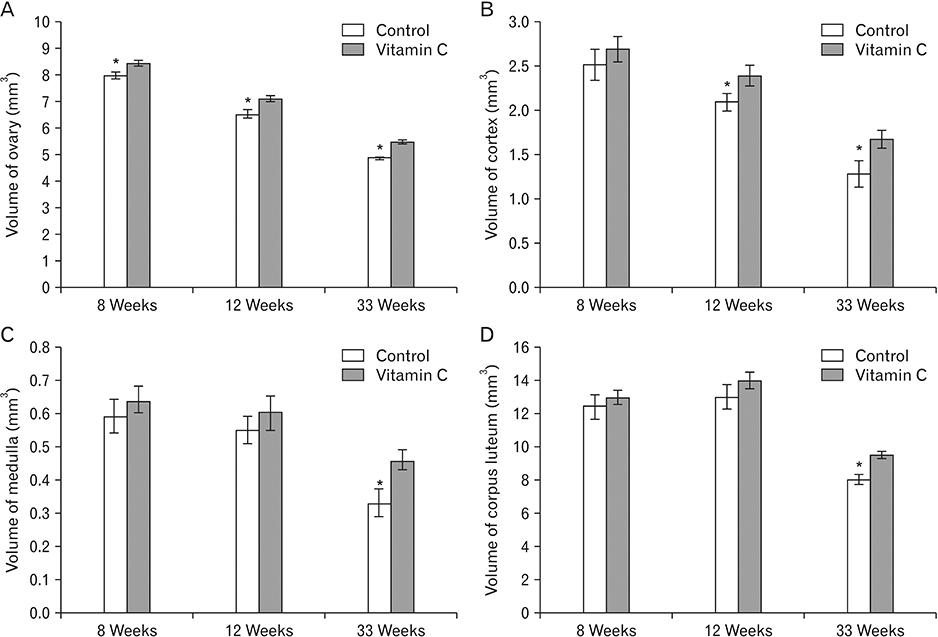
Fig. 4 The total volume of ovary, ovary (A), cortex (B), medulla (C), and corpus luteum (D) in the control and vitamin C groups. *Statistically significant difference (P≤0.05) between groups. Data are shown as mean±SD.
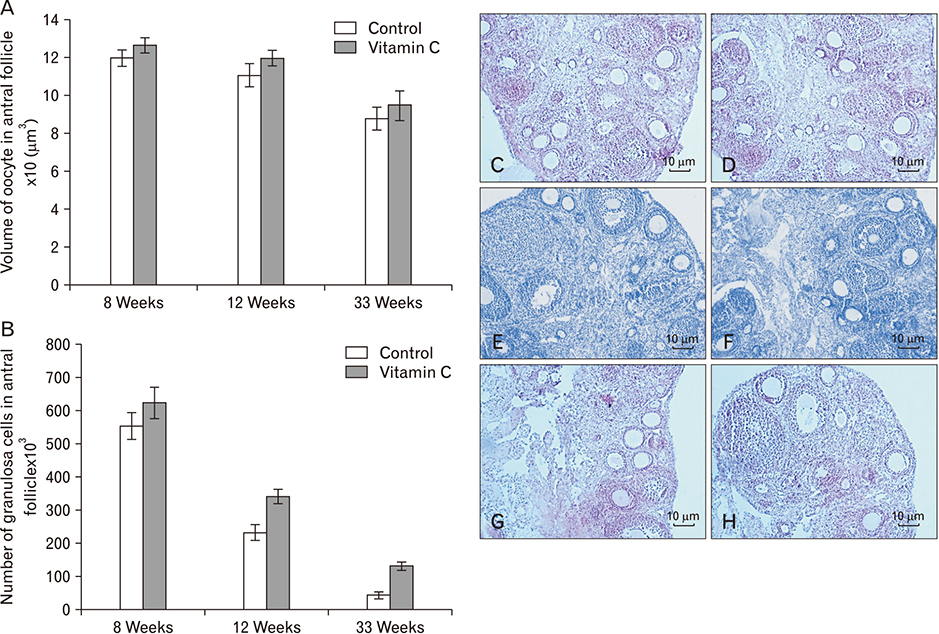
Fig. 5 Comparisons of the mean volume of oocyte (A) and the total number of granulosa cells between groups (B). Data are shown as mean±SD. (C–H) Photomicrograph of the ovaries stained with H&E (×10). (C, D) Control group and vitamin C group (8 weeks). (E, F) Control group and vitamin C group (12 weeks). (G, H) Control group and vitamin C group (33 weeks).
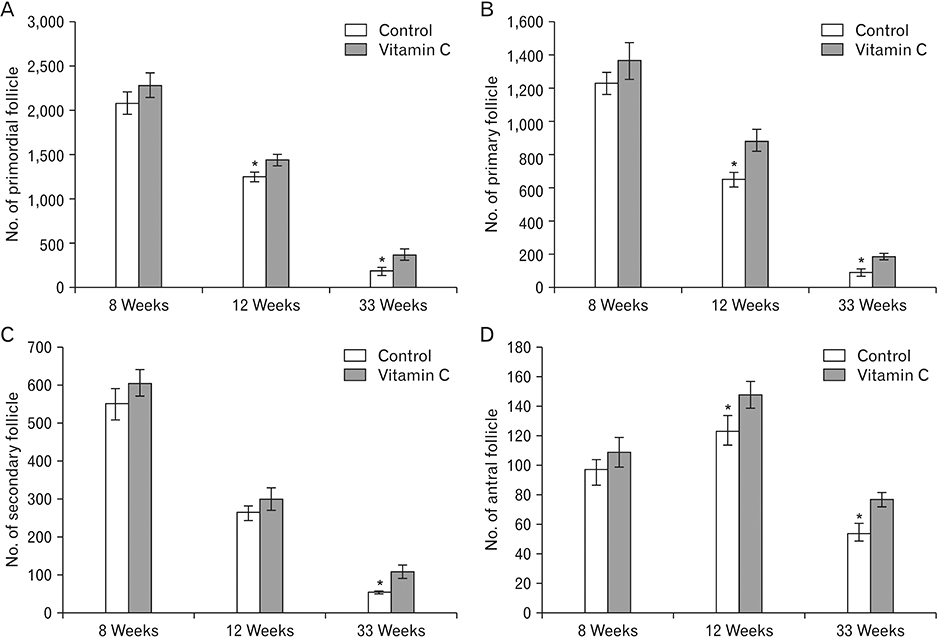
Fig. 6 Comparisons of the total number of primordial (A), primary (B), secondary (C), and antral follicles (D) in the control and vitamin C groups. *Statistically significant difference (P≤0.05) between groups. Data are shown as mean±SD.
Cited by 3 articles
-
Grape seed extract inhibits nucleus pulposus cell apoptosis and attenuates annular puncture induced intervertebral disc degeneration in rabbit model
Ogunlade B., Fidelis O. P., Adelakun S. A., Adedotun O. A.
Anat Cell Biol. 2020;53(3):313-324. doi: 10.5115/acb.20.047.Alterations of Kiss 1 receptor, GnRH receptor and nuclear receptors of the hypothalamo-pituitary-ovarian axis following low dose bisphenol-A exposure in Wistar rats
Eniola Risikat Kadir, Aminu Imam, Olayemi Joseph Olajide, Moyosore Saliu Ajao
Anat Cell Biol. 2021;54(2):212-224. doi: 10.5115/acb.20.215.Mapping of folic acid in the children brainstem
Ewing Duque-Díaz, Rafael Coveñas
Anat Cell Biol. 2021;54(3):340-349. doi: 10.5115/acb.21.016.
Reference
-
1. Bowen RL, Atwood CS. Living and dying for sex: a theory of aging based on the modulation of cell cycle signaling by reproductive hormones. Gerontology. 2004; 50:265–290.2. Dillin A, Gottschling DE, Nyström T. The good and the bad of being connected: the integrons of aging. Curr Opin Cell Biol. 2014; 26:107–112.
Article3. Broekmans FJ, Soules MR, Fauser BC. Ovarian aging: mechanisms and clinical consequences. Endocr Rev. 2009; 30:465–493.
Article4. Balasch J, Gratacós E. Delayed childbearing: effects on fertility and the outcome of pregnancy. Fetal Diagn Ther. 2011; 29:263–273.
Article5. Aboulfoutouh I, Youssef M, Khattab S. Can antioxidants supplementation improve ICSI/IVF outcomes in women undergoing IVF/ICSI treatment cycles? Randomised controlled study. Fertil Steril. 2011; 96:3 Suppl. S242.
Article6. Wang T, Zhang M, Jiang Z, Seli E. Mitochondrial dysfunction and ovarian aging. Am J Reprod Immunol. 2017; 77:e12651.
Article7. Liu J, Wu DC, Qu LH, Liao HQ, Li MX. The role of mTOR in ovarian neoplasms, polycystic ovary syndrome, and ovarian aging. Clin Anat. 2018; 31:891–898.
Article8. Scheffer GJ, Broekmans FJ, Dorland M, Habbema JD, Looman CW, te Velde ER. Antral follicle counts by transvaginal ultrasonography are related to age in women with proven natural fertility. Fertil Steril. 1999; 72:845–851.
Article9. Ng EH, Tang OS, Ho PC. The significance of the number of antral follicles prior to stimulation in predicting ovarian responses in an IVF programme. Hum Reprod. 2000; 15:1937–1942.
Article10. Hunt PA, Hassold TJ. Human female meiosis: what makes a good egg go bad? Trends Genet. 2008; 24:86–93.
Article11. van Rooij IA, Tonkelaar I, Broekmans FJ, Looman CW, Scheffer GJ, de Jong FH, Themmen AP, te Velde ER. Anti-mullerian hormone is a promising predictor for the occurrence of the menopausal transition. Menopause. 2004; 11(6 Pt 1):601–606.12. Sowers MR, Eyvazzadeh AD, McConnell D, Yosef M, Jannausch ML, Zhang D, Harlow S, Randolph JF Jr. Anti-mullerian hormone and inhibin B in the definition of ovarian aging and the menopause transition. J Clin Endocrinol Metab. 2008; 93:3478–3483.
Article13. Sukur YE, Kivancli IB, Ozmen B. Ovarian aging and premature ovarian failure. J Turk Ger Gynecol Assoc. 2014; 15:190–196.
Article14. Ito M, Muraki M, Takahashi Y, Imai M, Tsukui T, Yamakawa N, Nakagawa K, Ohgi S, Horikawa T, Iwasaki W, Iida A, Nishi Y, Yanase T, Nawata H, Miyado K, Kono T, Hosoi Y, Saito H. Glutathione S-transferase theta 1 expressed in granulosa cells as a biomarker for oocyte quality in age-related infertility. Fertil Steril. 2008; 90:1026–1035.
Article15. Lim J, Luderer U. Oxidative damage increases and antioxidant gene expression decreases with aging in the mouse ovary. Biol Reprod. 2011; 84:775–782.
Article16. Tatone C, Amicarelli F. The aging ovary: the poor granulosa cells. Fertil Steril. 2013; 99:12–17.17. Gundersen HJ, Bendtsen TF, Korbo L, Marcussen N, Moller A, Nielsen K, Nyengaard JR, Pakkenberg B, Sorensen FB, Vesterby A, West MJ. Some new, simple and efficient stereological methods and their use in pathological research and diagnosis. APMIS. 1988; 96:379–394.
Article18. Soleimani Mehranjani M, Mansoori T. Stereological study on the effect of vitamin C in preventing the adverse effects of bisphenol A on rat ovary. Int J Reprod Biomed (Yazd). 2016; 14:403–410.
Article19. Panti AA, Shehu CE, Saidu Y, Tunau KA, Nwobodo EI, Jimoh A, Bilbis LS, Umar AB, Hassan M. Oxidative stress and outcome of antioxidant supplementation in patients with polycystic ovarian syndrome (PCOS). Int J Reprod Contracept Obstet Gynecol. 2018; 7:1667–1672.
Article20. Arab SA, Nikravesh MR, Jalali M, Fazel A. Evaluation of oxidative stress indices after exposure to malathion and protective effects of ascorbic acid in ovarian tissue of adult female rats. Electron Physician. 2018; 10:6789–6795.
Article21. Yang M, Teng S, Ma C, Yu Y, Wang P, Yi C. Ascorbic acid inhibits senescence in mesenchymal stem cells through ROS and AKT/mTOR signaling. Cytotechnology. 2018; 70:1301–1313.
Article22. Oudemans-van Straaten HM, Spoelstra-de Man AM, de Waard MC. Vitamin C revisited. Crit Care. 2014; 18:460.
Article23. Fujisawa K, Hara K, Takami T, Okada S, Matsumoto T, Yamamoto N, Sakaida I. Evaluation of the effects of ascorbic acid on metabolism of human mesenchymal stem cells. Stem Cell Res Ther. 2018; 9:93.
Article24. Park S, Ahn S, Shin Y, Yang Y, Yeom CH. Vitamin C in cancer: a metabolomics perspective. Front Physiol. 2018; 9:762.
Article25. Showell MG, Mackenzie-Proctor R, Jordan V, Hart RJ. Antioxidants for female subfertility. Cochrane Database Syst Rev. 2017; 7:CD007807.
Article26. Gundersen HJ, Bagger P, Bendtsen TF, Evans SM, Korbo L, Marcussen N, Moller A, Nielsen K, Nyengaard JR, Pakkenberg B, Sorensen FB, Vesterby A, West MJ. The new stereological tools: disector, fractionator, nucleator and point sampled intercepts and their use in pathological research and diagnosis. APMIS. 1988; 96:857–881.
Article27. Harman D. Free radical theory of aging: an update: increasing the functional life span. Ann N Y Acad Sci. 2006; 1067:10–21.
Article28. Sharov AA, Falco G, Piao Y, Poosala S, Becker KG, Zonderman AB, Longo DL, Schlessinger D, Ko M. Effects of aging and calorie restriction on the global gene expression profiles of mouse testis and ovary. BMC Biol. 2008; 6:24.
Article29. Agarwal A, Gupta S, Sharma RK. Role of oxidative stress in female reproduction. Reprod Biol Endocrinol. 2005; 3:28.30. Finkel T, Holbrook NJ. Oxidants, oxidative stress and the biology of ageing. Nature. 2000; 408:239–247.
Article31. Arteaga E, Villaseca P, Rojas A, Arteaga A, Bianchi M. Comparison of the antioxidant effect of estriol and estradiol on low density lipoproteins in post-menopausal women. Rev Med Chil. 1998; 126:481–487.32. Aten RF, Duarte KM, Behrman HR. Regulation of ovarian antioxidant vitamins, reduced glutathione, and lipid peroxidation by luteinizing hormone and prostaglandin F2 alpha. Biol Reprod. 1992; 46:401–407.33. Luderer U, Kavanagh TJ, White CC, Faustman EM. Gonadotropin regulation of glutathione synthesis in the rat ovary. Reprod Toxicol. 2001; 15:495–504.34. Gardiner CS, Salmen JJ, Brandt CJ, Stover SK. Glutathione is present in reproductive tract secretions and improves development of mouse embryos after chemically induced glutathione depletion. Biol Reprod. 1998; 59:431–436.35. Sato EF, Kobuchi H, Edashige K, Takahashi M, Yoshioka T, Utsumi K, Inoue M. Dynamic aspects of ovarian superoxide dismutase isozymes during the ovulatory process in the rat. FEBS Lett. 1992; 303:121–125.36. Tatone C, Carbone MC, Falone S, Aimola P, Giardinelli A, Caserta D, Marci R, Pandolfi A, Ragnelli AM, Amicarelli F. Age-dependent changes in the expression of superoxide dismutases and catalase are associated with ultrastructural modifications in human granulosa cells. Mol Hum Reprod. 2006; 12:655–660.
Article37. Okatani Y, Morioka N, Wakatsuki A, Nakano Y, Sagara Y. Role of the free radical-scavenger system in aromatase activity of the human ovary. Horm Res. 1993; 39:Suppl 1. 22–27.
Article38. Matos L, Stevenson D, Gomes F, Silva-Carvalho JL, Almeida H. Superoxide dismutase expression in human cumulus oophorus cells. Mol Hum Reprod. 2009; 15:411–419.
Article39. Leridon H. Can assisted reproduction technology compensate for the natural decline in fertility with age? A model assessment. Hum Reprod. 2004; 19:1548–1553.
Article40. Gomes RG, Lisboa LA, Silva CB, Max MC, Marino PC, Oliveira RL, Gonzalez SM, Barreiros TR, Marinho LS, Seneda MM. Improvement of development of equine preantral follicles after 6 days of in vitro culture with ascorbic acid supplementation. Theriogenology. 2015; 84:750–755.41. Tarin JJ. Potential effects of age-associated oxidative stress on mammalian oocytes/embryos. Mol Hum Reprod. 1996; 2:717–724.
Article42. Wu J, Zhang L, Wang X. Maturation and apoptosis of human oocytes in vitro are age-related. Fertil Steril. 2000; 74:1137–1141.43. Tarín JJ, Pérez-Albalá S, Cano A. Oral antioxidants counteract the negative effects of female aging on oocyte quantity and quality in the mouse. Mol Reprod Dev. 2002; 61:385–397.
Article44. Camarena V, Wang G. The epigenetic role of vitamin C in health and disease. Cell Mol Life Sci. 2016; 73:1645–1658.
Article45. Andrade ER, van den Hurk R, Lisboa LA, Hertel MF, Melo-Sterza FA, Moreno K, Bracarense AP, Landim-Alvarenga FC, Seneda MM, Alfieri AA. Effects of ascorbic acid on in vitro culture of bovine preantral follicles. Zygote. 2012; 20:379–388.46. Rumbold A, Ota E, Nagata C, Shahrook S, Crowther CA. Vitamin C supplementation in pregnancy. Cochrane Database Syst Rev. 2015; (9):CD004072.
Article
- Full Text Links
-
- Actions
-
Cited
- CITED
-
- Close
- Share
-
- Similar articles
-
- Impact of vitamin D3 supplementation on the in vitro growth of mouse preantral follicles
- Expression of SDF-1alpha and leptin, and their effect on expression of angiogenic factors in mouse ovaries
- Effects of Ketamine and Pentobarbitone on Degeneration of Oocyte and of Granulosa Cells in Mouse Ovary
- The Effect of Polycystic Ovarian Follicular Fluid on Sperm Motility in Human in vitro Fertilization
- Assessment of Follicular Maturation by Plasma Estradiol Levels and Ultrasound During Normal Periovulatory Period


