Anesth Pain Med.
2018 Oct;13(4):405-408. 10.17085/apm.2018.13.4.405.
Real-time ultrasound-guided spinal anesthesia for cesarean section in patient with severe kyphoscoliosis and Duchenne's muscular dystrophy: A case report

- Affiliations
-
- 1Department of Anesthesiology and Pain Medicine, Asan Medical Center, University of Ulsan College of Medicine, Seoul, Korea. ingwei2475@naver.com
- 2Department of Anesthesiology and Pain Medicine, Presbyterian Medical Center, Jeonju, Korea.
- KMID: 2435999
- DOI: http://doi.org/10.17085/apm.2018.13.4.405
Abstract
- Most elective cesarean sections are conducted under spinal anesthesia. Regional anesthesia has become the preferred technique, because general anesthesia is associated with a greater risk of maternal morbidity and mortality. In patients without absolute contraindication, spinal anesthesia is avoided, when procedural difficulty is increased by severe spinal deformity. A 41-year-old female patient was 33 weeks into pregnancy. Her height and weight were 145 cm and 45 kg. The patient was planned for emergency cesarean section, due to cephalopelvic disproportion. Spinal anesthesia was planned since she was suffering from Duchenne's muscular dystrophy, and had risks of respiratory failure and prolonged mechanical ventilation after general anesthesia. However, the patient also had severe kyphoscoliosis, maybe due to Duchenne's muscular dystrophy. We are reporting a successful spinal anesthesia using real-time ultrasound guidance, for cesarean section in this obstetric patient with severe kyphoscoliosis.
MeSH Terms
Figure
-
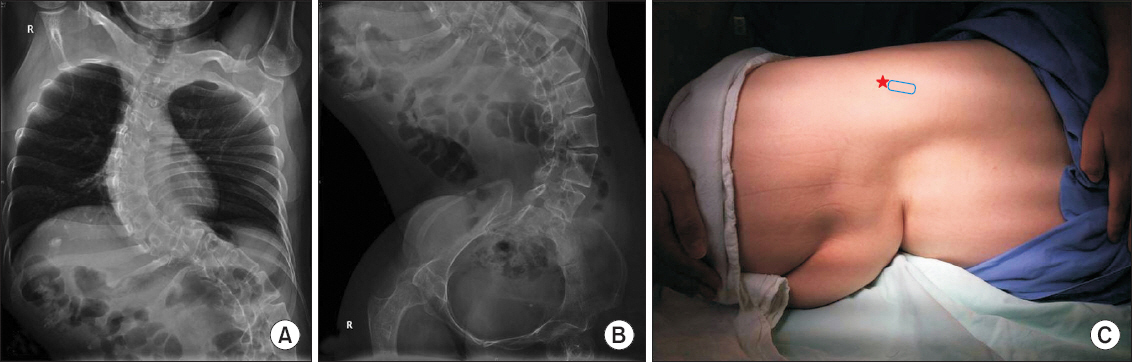
Fig. 1 Chest X-ray (A) and abdomen (B) images before pregnancy. Marked kyphoscoliosis is seen. The patient’s surface anatomy and position for real-time ultrasound-guided spinal anesthesia (C). ☆: insertion site of the needle, Square: ultrasound probe.
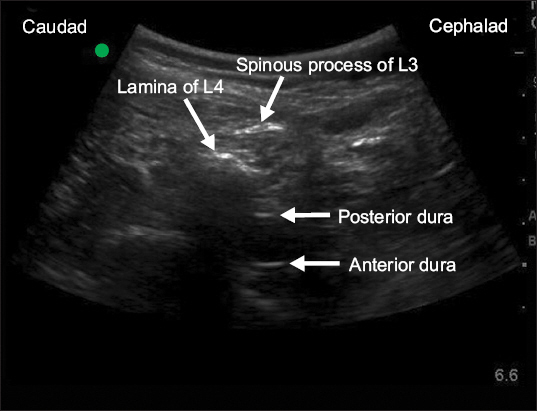
Fig. 2 Ultrasound image immediately real-time ultrasound-guided spinal anesthesia.
Reference
-
REFERENCE
1. Hawkins JL, Koonin LM, Palmer SK, Gibbs CP. Anesthesia-related deaths during obstetric delivery in the United States, 1979-1990. Anesthesiology. 1997; 86:277–84. DOI: 10.1097/00000542-199702000-00002. PMID: 9054245.2. Carvalho JC. Ultrasound-facilitated epidurals and spinals in obstetrics. Anesthesiol Clin. 2008; 26:145–58. DOI: 10.1016/j.anclin.2007.11.007. PMID: 18319185.3. Costello JF, Balki M. Cesarean delivery under ultrasound-guided spinal anesthesia [corrected] in a parturient with poliomyelitis and Harrington instrumentation. Can J Anaesth. 2008; 55:606–11. DOI: 10.1007/BF03021434.4. Prasad GA, Tumber PS, Lupu CM. Ultrasound guided spinal anesthesia. Can J Anaesth. 2008; 55:716–7. DOI: 10.1007/BF03017749. PMID: 18835971.5. Yamaguchi M, Honma E, Mimura M, Yamamoto H, Takahashi E, Namiki A. Identification of the lumbar intervertebral level using ultrasound imaging in a post-laminectomy patient. J Anesth. 2006; 20:231–3. DOI: 10.1007/s00540-006-0406-9. PMID: 16897246.6. Grau T, Leipold RW, Conradi R, Martin E. Ultrasound control for presumed difficult epidural puncture. Acta Anaesthesiol Scand. 2001; 45:766–71. DOI: 10.1034/j.1399-6576.2001.045006766.x. PMID: 11421838.7. Hawkins JL, Gibbs CP, Orleans M, Martin-Salvaj G, Beaty B. Obstetric anesthesia work force survey, 1981 versus 1992. Anesthesiology. 1997; 87:135–43. DOI: 10.1097/00000542-199707000-00018. PMID: 9232144.8. Hayes J, Veyckemans F, Bissonnette B. Duchenne muscular dystrophy:an old anesthesia problem revisited. Paediatr Anaesth. 2008; 18:100–6. PMID: 18184239.9. Perlas A. Evidence for the use of ultrasound in neuraxial blocks. Reg Anesth Pain Med. 2010; 35:S43–6. DOI: 10.1097/AAP.0b013e3181d2462e. PMID: 20216024.10. Elgueta MF, Duong S, Finlayson RJ, Tran DQ. Ultrasonography for neuraxial blocks:a review of the evidence. Minerva Anestesiol. 2017; 83:512–23. PMID: 27827521.11. Perlas A, Chaparro LE, Chin KJ. Lumbar neuraxial ultrasound for spinal and epidural anesthesia:a systematic review and meta-analysis. Reg Anesth Pain Med. 2016; 41:251–60. DOI: 10.1097/AAP.0000000000000184. PMID: 25493689.12. McLeod A, Roche A, Fennelly M. Case series:ultrasonography may assist epidural insertion in scoliosis patients. Can J Anaesth. 2005; 52:717–20. DOI: 10.1007/BF03016559. PMID: 16103384.13. Chin KJ, Chan VW, Ramlogan R, Perlas A. Real-time ultrasound-guided spinal anesthesia in patients with a challenging spinal anatomy:two case reports. Acta Anaesthesiol Scand. 2010; 54:252–5. DOI: 10.1111/j.1399-6576.2009.02112.x. PMID: 19839951.
- Full Text Links
-
- Actions
-
Cited
- CITED
-
- Close
- Share
-
- Similar articles
-
- Ultrasound Findings in Duchenne Muscular Dystrophy Disease
- Duchenne Type Muscular Dystrophy: Report of 8 Cases
- A clinical study on Duchenne muscular dystrophy
- Duchenne Muscular Dystrophy Complicated With Dilated Cardiomyopathy and Cerebral Infarction
- Acute Gastric Dilatation and Calculous Cholecystitis in Duchenne's Muscular Dystrophy